6 Apology Email for Customer Templates (UK 2026)
Mistakes happen in ecommerce. A shipment is delayed, an item arrives damaged, or a billing error causes confusion. How you respond in these moments defines your brand's relationship with its customers. A well-crafted apology email for customer issues can do more than just fix a problem; it can rebuild trust, foster loyalty, and even prevent negative reviews. Ignoring or poorly handling these situations, however, can quickly turn a minor hiccup into a lost customer.
This guide moves beyond generic templates. We will break down six distinct types of apology emails, each designed for specific and challenging customer service scenarios. You will find detailed examples and strategic analysis, offering a clear roadmap for turning a negative experience into a positive resolution. From acknowledging the error and outlining an action plan to showing genuine empathy and offering fair compensation, these frameworks are designed to be practical and effective.
While this article focuses on direct customer communication, the core principles of a sincere apology are universal. The strategies for accountability and clear communication are just as critical when addressing a wider audience. For those managing larger-scale issues, understanding [how to write an apology press release](https://pressreleasezen.com/how-to-write-an-apology-press-release-examples-templates-strategies/) provides a complementary perspective on public-facing damage control. Below, we'll explore the specific tactics for one-to-one customer interactions, providing you with the tools needed to manage any support challenge with confidence.
1. The Acknowledgment + Action Plan Apology Email
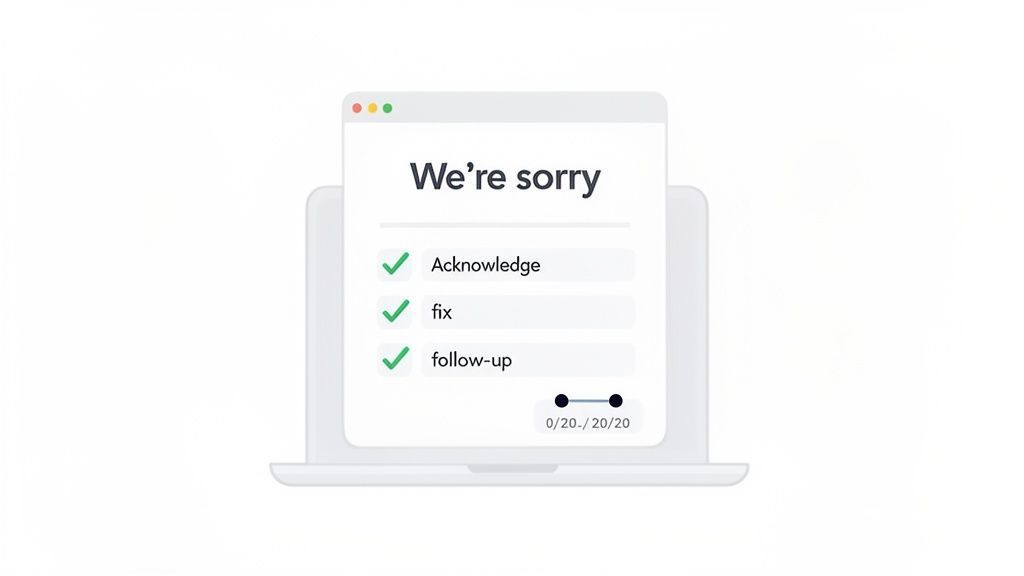
The most effective apology email for a customer goes beyond a simple "we're sorry". The Acknowledgment + Action Plan method is a two-part approach that first validates the customer's feelings and then outlines clear, concrete steps for resolution. This strategy shifts the dynamic from a passive apology to an active demonstration of accountability and commitment, rebuilding trust by showing, not just telling, the customer that you are fixing the problem.
Why this approach works
This method is powerful because it directly addresses the two primary needs of an upset customer: emotional validation and practical resolution. Acknowledging their frustration without making excuses shows empathy and respect. Following up with a specific action plan gives them a clear sense of control and a timeline for when they can expect a solution, which significantly reduces their anxiety and stops them from needing to follow up again.
Strategic Insight: A customer who receives a vague apology is likely to remain frustrated and may escalate their complaint. An action plan with defined steps and timelines turns a negative experience into a structured, manageable process, restoring their confidence in your brand’s competence.
Example in Action: Managing a Shipping Delay
Imagine a customer, Sarah, emails you, frustrated that her order (Order #12345) hasn't arrived by the promised date. Here’s how you would apply this technique.
- Acknowledgement: "Dear Sarah, Thank you for getting in touch. I am so sorry to hear that your order #12345 has not yet arrived and I completely understand your frustration. It is unacceptable that you've had to wait longer than promised, and I sincerely apologise for the delay and the inconvenience this has caused."
- Action Plan: "I have just looked into this and found that your parcel was delayed at the local depot. We have already organised for it to be dispatched with priority overnight shipping at our expense. You can expect it to be delivered by tomorrow, 15th October. We are also reviewing our processes with this courier to prevent this from happening again."
This response validates Sarah's feelings, identifies the problem, provides a specific new delivery date, and mentions preventative measures.
Actionable Tips for Implementation
- Be Specific and Personal: Always include personal details like the customer's name and order number. This shows you've taken the time to investigate their specific issue.
- Set Clear Timelines: Avoid vague promises like "as soon as possible". Provide a concrete date or timeframe for resolution to manage expectations effectively.
- Automate Initial Data Logging: Use a tool like Marvyn AI to automatically log customer complaints and associated order details. This speeds up your agent's ability to find information and craft a precise action plan.
- Refine Your Scripts: Having pre-written but customisable templates for common issues is crucial for providing a consistent and efficient response. For deeper insights into creating these, you can explore various [customer service scripts](https://www.marvyn.co/blog/customer-service-scripts) that can be adapted to fit this model.
- Offer a Gesture (When Appropriate): For significant failures, a small gesture like a 10% discount code on a future purchase can be a nice touch, but the core focus should always be on resolving the immediate problem.
2. The Empathy-First + Solution Hybrid Apology Email
When an issue deeply affects a customer's experience, a standard apology might not be enough. The Empathy-First + Solution Hybrid method prioritises connecting with the customer on an emotional level before presenting a fix. This approach is perfect for situations where the relationship is as important as the resolution, acknowledging the personal impact of the failure to make the customer feel genuinely heard and valued.

Why this approach works
This strategy is effective because it addresses the human element of a transaction first. Before people care about what you will do to fix a problem, they need to know that you understand how it has affected them. Leading with empathy diffuses anger and defensiveness, making the customer more receptive to the solution you propose. It shows that you see them as a person, not just an order number.
Strategic Insight: A purely solution-focused apology can feel cold and transactional, especially for high-value customers or when the mistake has significant personal consequences. By starting with empathy, you reinforce the relationship and demonstrate that your brand's values go beyond just fixing errors; you care about the customer's feelings.
Example in Action: A Damaged Product Meant as a Gift
Imagine a customer, David, ordered a custom-engraved watch for a 10th wedding anniversary, but it arrived with a noticeable scratch on the face. He is understandably upset as the event is just days away.
- Empathy-First: "Dear David, I am so incredibly sorry to see the photo of the watch you received. We know this was intended for your 10th wedding anniversary, and it's completely unacceptable that our mistake has added stress to what should be a special occasion. I can only imagine how disappointing and frustrating this must be for you."
- Solution Hybrid: "To make this right, we want to offer you two options. We can immediately send a replacement via overnight courier to arrive before your anniversary. Alternatively, we can issue a full refund and offer you a 50% discount on a future purchase. Please let us know which you'd prefer, and we will get it sorted straight away. A founder's signature on an apology for a loyal customer can have a powerful impact."
This response directly acknowledges the ruined event, validating David's anger before offering him a choice in the resolution, which gives him a sense of control.
Actionable Tips for Implementation
- Mention the Specific Impact: Use phrases like, "We realise this ruined your event" or "We understand how frustrating this must be when you needed it for your trip". This shows you've read and understood their specific situation.
- Provide a Choice of Solutions: Instead of a one-size-fits-all fix, offering two or three options (e.g., replacement, refund, store credit) empowers the customer and increases the chance they will be satisfied with the outcome.
- Sign Off with a Real Name: For small teams or significant issues, having a founder or a manager personally sign the email adds a powerful, authentic touch. Avoid generic sign-offs like "The Customer Service Team".
- Use Customer Data for Context: With a tool like Marvyn AI, you can quickly see a customer's history. Referring to their loyalty (e.g., "As a loyal customer since 2021...") can make your apology feel more personal and sincere.
- Explain, But Don't Excuse: A brief, authentic explanation can build trust (e.g., "Our fulfilment centre is experiencing unexpected delays"). Keep it short and focused on accountability, not excuses. To learn more about navigating these delicate conversations, explore our detailed guide on how to handle a disgruntled customer.
3. The Multi-Language Apology Email (for Global DTC Brands)
For global direct-to-consumer (DTC) brands, a one-size-fits-all apology email for customers simply won't work. The Multi-Language Apology is an approach that goes beyond direct translation, focusing on crafting messages that are linguistically accurate and culturally resonant. This strategy acknowledges that a sincere apology in one culture might seem insincere or confusing in another, requiring nuance to effectively mend customer relationships across different markets.
Why this approach works
This method is crucial because customer service expectations are deeply rooted in local culture. A simple translated apology can miss critical nuances, leading to further miscommunication and brand damage. By localising the apology, you show a deeper level of respect and understanding for your international customer base. This validates their specific experience and demonstrates that your brand is a global entity with a local touch, which is key for building long-term loyalty.
Strategic Insight: Directly translating an apology from English can inadvertently create a cold or even offensive message. For example, some cultures expect a more formal and detailed explanation of failure, while others prioritise a quick, direct solution. A culturally adapted apology email for a customer addresses their emotional needs according to their own cultural context, making the resolution feel more authentic and satisfactory.
Example in Action: Handling a Quality Issue Across Regions
Imagine a global fashion brand like ASOS discovers a quality issue with a popular line of knitwear. How they apologise to a customer in the UK will differ from how they address a customer in Japan.
- UK Apology (Direct & Solution-Focused): "Dear Chloe, We are so sorry to hear that the jumper you ordered didn't meet our quality standards. This is not the experience we want for our customers. We have already dispatched a replacement for you with express shipping, and a £10 voucher is in your account for the trouble. Please keep or donate the original item."
- Japan Apology (Formal & Detail-Oriented): "Dear Ms. Tanaka, We extend our sincerest apologies for the quality issue with your recent knitwear purchase. We are deeply sorry for the disappointment this has caused. A thorough investigation revealed a fault in a specific batch from our supplier. We have organised a replacement to be sent immediately and are implementing stricter quality checks. We humbly ask for your forgiveness for this oversight."
The UK version is casual and prioritises an immediate fix and compensation. The Japanese version is more formal, provides a deeper explanation, and uses language that conveys humility and a serious commitment to preventing future errors.
Actionable Tips for Implementation
- Research Local Expectations: Understand cultural norms around apologies. For instance, German customers often value directness and efficiency, while many Asian cultures may appreciate a more deferential and detailed explanation of what went wrong and why.
- Go Beyond Machine Translation: Use native speakers to review and refine apology templates. They can catch subtle nuances in tone and phrasing that automated tools might miss, ensuring authenticity.
- Use Regional-Specific Details: Always reference local currency, regional shipping carriers, and relevant public holidays that might have impacted an order. This shows the customer you are seeing them in their local context.
- Leverage Multilingual Tools: For efficiency, use a tool like Marvyn AI, which supports over 80 languages. It can generate a first draft of an apology in the customer's native language, which your team can then refine for cultural nuance.
- Localise Your Entire Support Journey: A multi-language apology is most effective when part of a broader strategy. You can discover more about building a globally-minded support system by learning [how to improve the ecommerce customer experience](https://www.marvyn.co/blog/how-to-improve-ecommerce-customer-experience) from end to end.
4. The Transparency + Data-Driven Apology Email
For widespread issues that affect many customers, such as a website outage or a systemic product bug, a generic apology can feel insufficient. The Transparency + Data-Driven approach uses specific data and transparent communication to explain what went wrong on a larger scale. This method demonstrates operational maturity and a deep commitment to accountability, which is essential for rebuilding trust after a significant failure.
Instead of a simple "we're sorry," you provide a clear, factual account of the incident, the impact, and the quantifiable steps you're taking to fix it. This is the apology email for customer issues that shows you respect their intelligence and are serious about long-term solutions.
Why this approach works
This method is highly effective because it treats customers like partners rather than just consumers. Sharing data and behind-the-scenes details demystifies the problem and shows that you have a firm grasp on the situation. It replaces uncertainty with facts, building confidence that you are not just patching a single issue but improving the entire system. This level of honesty can turn a potentially brand-damaging event into a moment of trust-building.
Strategic Insight: In the face of a large-scale failure, customers fear the problem is a sign of incompetence. A data-driven apology with a clear incident report counters this fear by showcasing your ability to diagnose, measure, and resolve complex issues methodically.
Example in Action: Addressing a Website Outage
Imagine your e-commerce site was down for three hours during a peak shopping period, preventing customers from making purchases. Here's how you would apply the transparency technique in a mass email.
- Acknowledgement & Transparency: "Dear [Customer Name], Earlier today, our website experienced a service disruption from 2:00 PM to 5:00 PM GMT. We know this was frustrating, especially for those of you in the middle of shopping, and we sincerely apologise for the interruption this caused to your day."
- Data-Driven Explanation: "The outage was caused by a sudden failure in one of our main server clusters, which led to a 100% loss of connectivity. Our engineering team was alerted within 90 seconds and began executing our recovery protocol. Full service was restored in 2 hours and 58 minutes. We have already deployed a fix that adds redundant capacity, reducing the risk of a similar failure by 95%."
This response is direct, provides a clear timeline, explains the technical cause in simple terms, and presents a measurable improvement.
Actionable Tips for Implementation
- Identify Systemic Issues: Use a tool like Marvyn AI to track conversation trends and performance data. If you see a spike in complaints about the same issue, it's a sign that a transparent, data-driven response is needed.
- Explain Data Simply: Share relevant metrics but avoid jargon. Translate technical details into customer impact. For example, instead of "CPU utilisation spiked," say "our servers became overloaded, which made the site unavailable."
- Show Improvement: Where possible, compare current performance against past data to demonstrate a positive trajectory. For example, "Our fix has already improved page load times by 30%."
- Master Your Support Systems: A strong foundation in customer service is key to handling these situations effectively. To build this, you can explore [mastering customer support for ecommerce](https://www.marvyn.co/blog/mastering-customer-support-for-ecommerce) for broader strategies.
- Create an Incident Report: For major issues, link to a more detailed (but still easy-to-read) public incident report for those who want more information. This reinforces your commitment to transparency.
5. The Escalation-Ready Apology Email (with Human Handoff)
Some issues are too complex or sensitive for a simple, templated fix. The Escalation-Ready Apology Email acknowledges this reality by combining a sincere initial apology with a clear and direct pathway to a human support agent. This approach is crucial for high-stakes problems where an automated response might feel dismissive, showing the customer that you value their business enough to dedicate real-time, personal attention to their issue.
Why this approach works
This method effectively defuses high-tension situations. By immediately offering a human connection, you prevent the customer from feeling trapped in a frustrating loop of automated responses. It demonstrates transparency and a commitment to resolution, even when the problem requires more than a standard procedure. Giving customers a clear escalation route provides a sense of control and assurance that their unique problem will be heard by someone with the authority to solve it.
Strategic Insight: For complex or high-value customer issues, the offer of a human handoff is as powerful as the handoff itself. It signals that your company is not hiding behind automation and is prepared to invest real resources into making things right, which can salvage a relationship on the brink of failure.
Example in Action: Handling a Merchant Account Issue
Consider a merchant using a platform like Shopify who suddenly has their account flagged for a compliance review, freezing their payouts. This is a critical business issue requiring careful handling.
- Initial Apology & Context: "Dear David, We are writing to inform you that your account is currently under a standard compliance review, and we sincerely apologise for the disruption this has caused to your business operations. We understand this is a critical matter and that the temporary hold on payouts is incredibly stressful."
- Human Handoff: "To get this resolved for you as quickly as possible, your case has been escalated to Sarah from our specialist Merchant Risk team. She has all the details of your account and will be reaching out personally within the next 24 hours to guide you through the next steps. Your ticket reference number is #8675309."
This response validates the severity of the issue, offers a clear path forward, and introduces a named contact, making the process feel managed and personal rather than cold and automated.
Actionable Tips for Implementation
- Set Realistic Timelines: Avoid promising an "immediate" response. Stating a specific timeframe, like "within 24-48 hours," manages expectations and builds trust.
- Pre-qualify Escalations: Use a tool like Marvyn AI to automatically gather all necessary context-order history, previous communications, and issue type-before the ticket reaches a human agent. This ensures the specialist has all the information needed to resolve the issue efficiently on the first contact.
- Provide a Reference Number: Always include a unique ticket or reference number. This makes it easy for both the customer and your team to track the issue, ensuring nothing gets lost in the handoff.
- Name a Real Person: Whenever possible, assign the escalation to a specific person. "You'll be hearing from Tom" is far more reassuring than "a member of our team will contact you."
- Analyse Escalation Data: Use Marvyn's analytics to identify which types of problems are consistently being escalated. This data is invaluable for pinpointing weaknesses in your products, services, or standard support processes that need improvement.
6. The Prevention + Compensation Apology Email
For significant service failures, a standard apology might not be enough to mend the customer relationship. The Prevention + Compensation method is a high-impact strategy that pairs a sincere apology with two powerful elements: meaningful compensation for the trouble caused and a transparent explanation of the preventative measures being implemented. This approach reframes a negative event as a catalyst for improvement, demonstrating a deep commitment to customer satisfaction and operational excellence.

Why this approach works
This method is highly effective because it addresses the customer's immediate loss while also restoring their long-term faith in your brand. The compensation directly remedies their negative experience, while outlining preventative actions shows you are taking the failure seriously at a systemic level. It proves the issue was not just a one-off mistake to be forgotten but a lesson that will lead to a better future experience for all customers.
Strategic Insight: A customer who feels heard and generously compensated is not just retained; they can become a powerful advocate. This apology email for a customer transforms a moment of high friction into a demonstration of your company's values and integrity, often leading to increased loyalty and positive word-of-mouth.
Example in Action: Addressing a Product Quality Issue
Suppose a loyal customer, David, emails to report that the Allbirds shoes he recently purchased have developed a defect. Here’s how you would apply this technique.
- Acknowledgement & Compensation: "Dear David, Thank you for reaching out and sharing your experience with your new shoes. I was genuinely concerned to read about the defect you've found, and I am so sorry for the disappointment this has caused. This is not the standard we hold ourselves to. We have already issued a full refund to your original payment method and sent you a new pair, which will ship today. Please keep or donate the original pair."
- Prevention Plan: "Your feedback is incredibly important. Based on your report, we have flagged a potential weakness in the stitching process for that batch. Our production team is now adding an additional quality assurance checkpoint to specifically inspect this area before shipment to ensure this problem doesn't happen again."
This response gives David an immediate, no-hassle resolution and shows his complaint has led to a tangible improvement in company processes.
Actionable Tips for Implementation
- Tailor Compensation: Use data to adjust your offer. A full refund plus store credit might be appropriate for a high-LTV customer facing a major issue, while a 25% discount could suffice for a minor inconvenience. Marvyn AI's order history data can help you segment customers for this purpose.
- Be Specific About Prevention: Avoid generic phrases like "we will improve our processes". Instead, state the exact change being made, such as "we're now double-checking all order contents at the packing station".
- Make Compensation Meaningful: The offer should feel generous and proportionate to the problem. A token 5% discount for a major shipping disaster will feel insulting. Aim for something that makes the customer feel valued.
- Follow Up on the Fix: For major systemic changes, consider sending a follow-up email weeks or months later to let the customer know the improvement has been successfully implemented. This closes the loop and reinforces accountability.
- Develop Clear Guidelines: Create internal rules for when to deploy this high-value apology. For more ideas on how to craft the right message, explore these templates for [email for customer service](https://www.marvyn.co/blog/email-for-customer-service).
6 Customer Apology Emails Compared
Final Thoughts
We have explored the intricate art of crafting a powerful apology email for customer scenarios, moving far beyond generic templates. The journey from a simple "we're sorry" to a strategic, relationship-building communication is a critical one for any ambitious DTC brand or Shopify store owner. It is the difference between losing a customer for good and creating a fiercely loyal advocate.
Throughout this guide, we have analysed six distinct apology frameworks, from the Acknowledgment + Action Plan model to the Escalation-Ready email with a smooth human handoff. A clear pattern has emerged: the most effective apologies are not merely reactive, but proactive and strategic. They do more than just fix a single problem; they rebuild trust and reinforce your brand's commitment to excellence.
Core Principles for Effective Apology Emails
Let's distill the most important takeaways from our deep dive. A truly effective apology email for a customer is built upon several foundational pillars:
- Sincerity and Ownership: A genuine apology starts with accepting responsibility without excuses. Phrases like "we messed up" or "this was our error" are powerful because they are direct and disarming.
- Empathy and Understanding: You must show the customer you understand their frustration. Reflect their problem back to them to confirm you have heard and understood the real impact of the issue.
- Clear Action and Resolution: Apologising is only half the battle. You must clearly state what you are doing to fix the problem right now and what compensation or solution you are offering. Ambiguity creates more frustration.
- Proactive Prevention: The gold standard is to not only solve the current issue but also to explain what steps you are taking to prevent it from happening again. This shows a commitment to continuous improvement and respects the customer's time and feedback.
These principles are not just about good manners; they are about sound business strategy. Every apology email is a crucial touchpoint that can either erode your brand equity or strengthen it significantly.
From Manual Effort to Strategic Automation
As we have seen, managing these situations at scale, especially for global brands or those with high order volumes, can be a monumental task. The principles remain the same, but the execution needs a more robust system than a single person manually typing out every reply.
This is where the true value of a structured approach, backed by smart automation, becomes clear. By codifying the logic of a great apology email for customer interactions into your support systems, you can deliver consistently high-quality responses 24/7. This frees up your human team to focus on the complex, high-value escalations that require a personal touch, as demonstrated in our escalation-ready email example.
Ultimately, mastering the apology email is about transforming a negative customer experience into a positive one. It’s an opportunity to demonstrate your company’s values, prove your commitment to customer satisfaction, and turn a moment of friction into a moment of connection. By applying the strategies, templates, and insights from this article, you are well-equipped to handle any customer issue with grace, efficiency, and a focus on building lasting relationships.
Ready to automate your apology emails with the same level of sincerity and strategic precision we've discussed? Marvyn AI can implement these complex, multi-step apology workflows, from identifying the issue to offering the right solution, so you can turn customer problems into loyalty-building opportunities at scale. Discover how you can deliver perfect apologies, 24/7, by visiting Marvyn AI.