Ecommerce Growth with Automation in Customer Service
In a crowded ecommerce market, customer satisfaction isn’t just another metric—it’s your most powerful weapon. Too many brands are dropping the ball, creating a massive opportunity for anyone who decides to get it right. And the key to turning frustrated shoppers into loyal fans? Strategic automation in customer service.
Why Customer Satisfaction Is Your New Competitive Edge

Let's be honest: there's a growing chasm between what customers expect and what most brands are actually delivering. For years, the go-to strategy for support was aggressive cost-cutting. This led to painfully slow response times, generic copy-paste answers, and a general feeling of being ignored. That approach has spectacularly backfired, leaving a trail of unhappy customers who won’t hesitate to shop elsewhere.
The Widespread Decline in Customer Experience
The data tells a stark story. In the UK, customer satisfaction has taken a nosedive, falling back to where it was before the pandemic. According to KPMG's 2023 Customer Experience Excellence Report, which surveyed over 13,000 UK consumers, overall satisfaction dropped by 3.8 percent in a single year.
Even more worrying is that 64% of brands saw their scores fall in crucial areas like empathy and personalisation. For Shopify store owners, this should set off alarm bells—and signal a huge market gap. You can dig deeper into these trends in the 2023 KPMG report.
This isn't just a number on a spreadsheet. It represents real friction for your customers:
- Waiting hours (or even days) just to ask, "Where is my order?"
- Scrambling to find basic information on your shipping policy.
- Feeling like just another ticket number in an endless queue.
- Getting a robotic, unhelpful reply that doesn't actually solve their problem.
Every one of these moments chips away at your bottom line, leading to abandoned carts, scathing reviews, and a brand reputation you didn't want.
Reframing Automation as a Strategic Advantage
This is where smart automation flips the script. It’s time to ditch the old-fashioned view of automation as a cold, personality-less replacement for human support. Think of it instead as the tool that restores the personal, efficient service that builds loyalty in the first place.
Modern AI isn't about replacing your team; it's about empowering them. By handling the repetitive, predictable queries that eat up valuable time, automation frees your human experts to focus on what they do best: building relationships and solving complex problems with a human touch.
For direct-to-consumer (DTC) brands, this is a golden opportunity. While larger competitors are often bogged down by clunky, outdated support systems, you can be nimble. By implementing intelligent, AI-powered tools, you can deliver instant, genuinely helpful, and personalised assistance 24/7.
Suddenly, you're not just a store. You're a trusted partner in your customer's shopping journey, giving you a decisive edge that’s hard to beat.
Understanding True Customer Service Automation
Let's get one thing straight: true automation in customer service is so much more than just sticking a basic chatbot on your site and calling it a day. That’s like hiring a receptionist who only knows how to say, “Sorry, I can't help with that.”
Real automation is about building a digital dream team. One that works tirelessly behind the scenes to make your entire support operation smarter, faster, and more profitable.
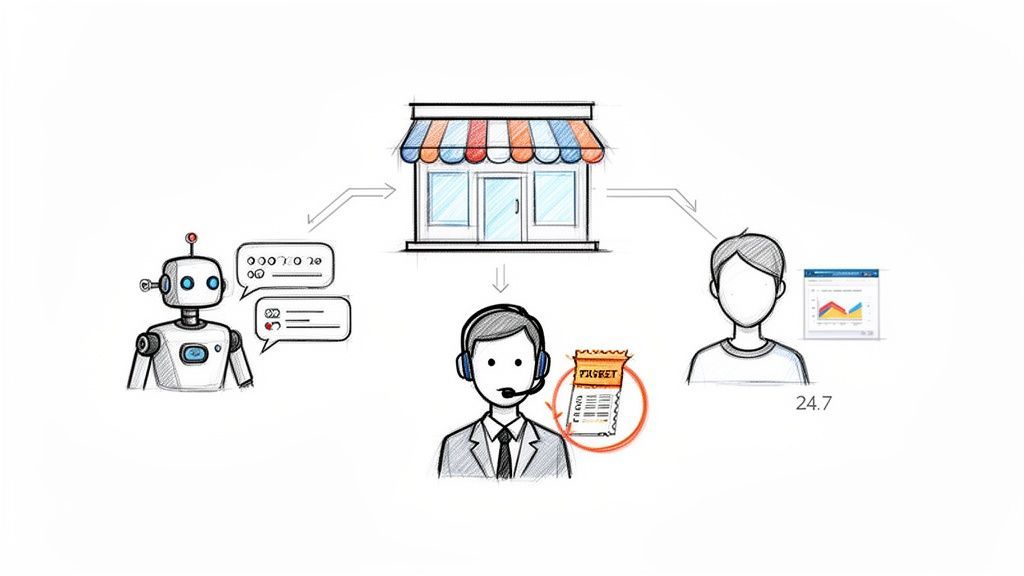
Think of your Shopify store as a busy high-street shop. Without automation, you’ve got one person trying to greet customers, answer questions about every single product, process returns, and check stock levels. It’s a recipe for long queues, frustrated shoppers, and lost sales.
Now, imagine an intelligent, self-operating digital storefront. When a customer has a question, an AI assistant provides the answer instantly. If they need a product recommendation, the assistant asks the right questions to guide them to the perfect item. This isn't about deflecting tickets; it's about creating a responsive and seamless experience that drives sales.
The Spectrum of Automation: From Basic to Brilliant
Customer service automation isn’t a single thing; it’s a spectrum. At one end, you have simple, rule-based systems. At the other, you find advanced artificial intelligence that learns, adapts, and even acts as a personal shopper.
- Rule-Based Bots: These are the most basic form of automation. They follow a rigid script or decision tree, a bit like an automated phone menu (“Press 1 for shipping”). They’re fine for answering very simple, predictable questions but quickly fall apart when a customer has a slightly more complex need.
- AI-Powered Assistants: This is where the magic happens. These systems use natural language processing (NLP) to understand what a customer is actually asking, even if it’s phrased in an unusual way. They can handle a much wider range of queries, learn from past conversations, and provide genuinely helpful answers by connecting to your store’s data.
True automation isn’t about building a wall between you and your customers. It's about intelligently filtering requests so your human experts can focus on the conversations that truly require their empathy and problem-solving skills—the high-value interactions that build lasting loyalty.
Modern AI assistants can do a lot more than just answer "Where is my order?". By integrating directly with your product catalogue, they can act as consultative sales advisors, asking shoppers about their preferences, budget, and needs to recommend the perfect product.
For a deeper look at how these tools work specifically for Shopify, you might want to check out our guide to the best Shopify chatbots available today.
Intelligent Systems Versus Simple Deflection
The crucial difference comes down to the goal. Simple ticket deflection aims only to reduce the number of support requests that land in your inbox. While that sounds good on the surface, it often comes at the cost of customer satisfaction when the tool is unhelpful.
An intelligent automation system, on the other hand, is designed to create a better overall experience. It’s not just about stopping a ticket; it’s about resolving the customer's issue instantly and effectively.
This approach is what drives real growth, turning pre-sale questions into purchases and support queries into positive brand interactions. Understanding this distinction is key to choosing a solution that doesn’t just cut costs but actively builds your business.
The Business Case for Automating Ecommerce Support
Investing in new tech can feel like a big leap, especially when you're already juggling a thousand other tasks. But automation in customer service isn't just another line on your expenses sheet; it's a direct investment in your brand’s growth and profitability. The real question isn't whether you can afford to automate, but whether you can afford not to.
The business case really boils down to three things every ecommerce founder cares about: slashing support costs, boosting sales, and reclaiming your most valuable asset—time. By letting automation handle repetitive queries, you fundamentally shift your operations from reactive firefighting to proactive growth.
Dramatically Reduce Support Ticket Volume
The first and most obvious win from automation is a huge drop in your inbound support tickets. Just think about how many times a day your team answers questions like "Where is my order?", "What's your return policy?", or "Do you ship to Germany?". Each one of these chips away at the time and mental energy that could be spent on bigger issues.
An AI assistant can answer these common questions instantly, 24/7, with zero human input. This immediate resolution deflects a massive chunk of tickets from ever hitting your team's inbox, freeing them from the soul-crushing drudgery of copy-pasting answers.
The goal isn't just to answer questions faster; it's to create operational leverage. When your team isn't buried under a mountain of mundane tickets, they can focus on high-impact activities like nurturing VIP customers, managing complex returns, or developing new retention strategies.
This shift is what makes scaling possible. A recent Slack report on the state of work in the UK found that 83% of workers believe the right tech could streamline mundane tasks and open the door for more impactful work. Yet, with nearly 30% of the average working day lost to low-value activities, there’s a massive productivity gap. Automation directly closes this gap for your support function.
Boost Conversion Rates and Average Order Value
Good customer service automation does more than just solve problems; it actively generates revenue. So many potential sales are lost simply because a shopper has a question and can't find an answer fast enough. They hesitate, get distracted, and abandon their cart.
An AI assistant acts as a tireless, 24/7 sales associate right there on your product pages. It can:
- Answer pre-purchase questions instantly: By providing immediate clarity on sizing, materials, or features, it removes friction from the buying journey.
- Make personalised recommendations: A smart AI can ask about a shopper's needs and budget to suggest the perfect products, acting like a personal shopper.
- Upsell and cross-sell intelligently: When a customer adds an item to their cart, the AI can recommend complementary products, directly increasing the Average Order Value (AOV).
This consultative approach turns your support channel into a powerful sales engine. By engaging customers at that critical moment of decision, you prevent cart abandonment and guide them towards a confident purchase. For a deeper dive on how these strategies play out on Shopify, you can increase your Shopify sales with proven tactics.
Ultimately, automating ecommerce support is a strategic move to build a more resilient, efficient, and profitable business. It transforms your customer service from a cost centre into a growth driver, delivering tangible returns that show up directly on your bottom line.
Your Roadmap to Implementing AI Automation on Shopify
Taking the first step into AI automation can feel like standing at the foot of a mountain. But for Shopify store owners, the path is far simpler than you might imagine. Modern tools are designed for non-technical founders, letting you set up powerful automation in customer service in minutes, not months.
This practical roadmap will guide you from installation to launch. The best part? It all starts with a single click.
Start with a One-Click Installation
Forget about complex coding or hiring developers. Your journey begins in a familiar place: the Shopify App Store. The best AI solutions are built with a “one-click install” philosophy, which means getting started is as easy as adding any other app to your store.
Once installed, the AI doesn’t just sit there waiting for instructions. It gets to work immediately.
The most powerful AI tools for ecommerce are designed for instant value. Upon installation, they automatically sync with your entire Shopify store—your product catalogue, collections, store policies, and existing pages—to start answering customer questions accurately from the very first minute.
This instant knowledge sync is what makes modern AI so effective. It’s like hiring a new team member who has already memorised your entire business operations before their first day.
Customise Your AI to Match Your Brand Voice
Your brand's personality is its most valuable asset, and your AI assistant should feel like a seamless extension of it. A generic, robotic chatbot can feel jarring and off-brand, which is why customisation is such a critical next step.
You can easily adjust the following elements to ensure the AI truly belongs to your store:
- Appearance: Change the colours of the chat widget to match your site's design, upload your logo, and give your AI assistant a unique name and avatar.
- Tone of Voice: Configure the AI’s personality. Whether your brand is playful and witty or professional and straightforward, you can define its communication style to ensure every interaction is on-brand.
- Intelligence and Rules: You can "train" your AI further by uploading existing FAQ documents or creating specific rules for how it should handle certain queries, giving you granular control.
This level of customisation ensures that from the customer’s perspective, they’re interacting with an intelligent part of your brand, not some third-party tool. It creates a cohesive and trustworthy experience. To learn more about building a strong support experience, check out our comprehensive [Shopify customer service guide](https://www.marvyn.co/blog/shopify-customer-service-guide).
Set Up Smart Escalation Paths
Let’s be honest: no AI is perfect. Some customer issues will always require a human touch. That’s why a crucial part of any successful automation strategy is creating a clear, frictionless path for complex queries to reach your support team. This is known as smart escalation.
Instead of trapping customers in a frustrating loop, your AI should be programmed to recognise when it’s out of its depth. When a query is too complex, emotionally charged, or involves a sensitive issue like a damaged product, the AI should seamlessly hand the conversation over to a live agent. This ensures your customers always get the help they need, and your team’s time is reserved for the situations where it matters most.
The growth in accessible AI technology makes this the perfect moment for small businesses to adopt these tools. The proportion of UK companies offering machine learning services grew from 21% in 2022 to 35% in 2023, with micro-businesses making up 82% of all AI activity. This explosion shows that powerful AI is no longer just for large corporations. You can explore more about this trend in the latest UK government report on the AI sector.
This infographic shows how automation directly translates into measurable business growth.
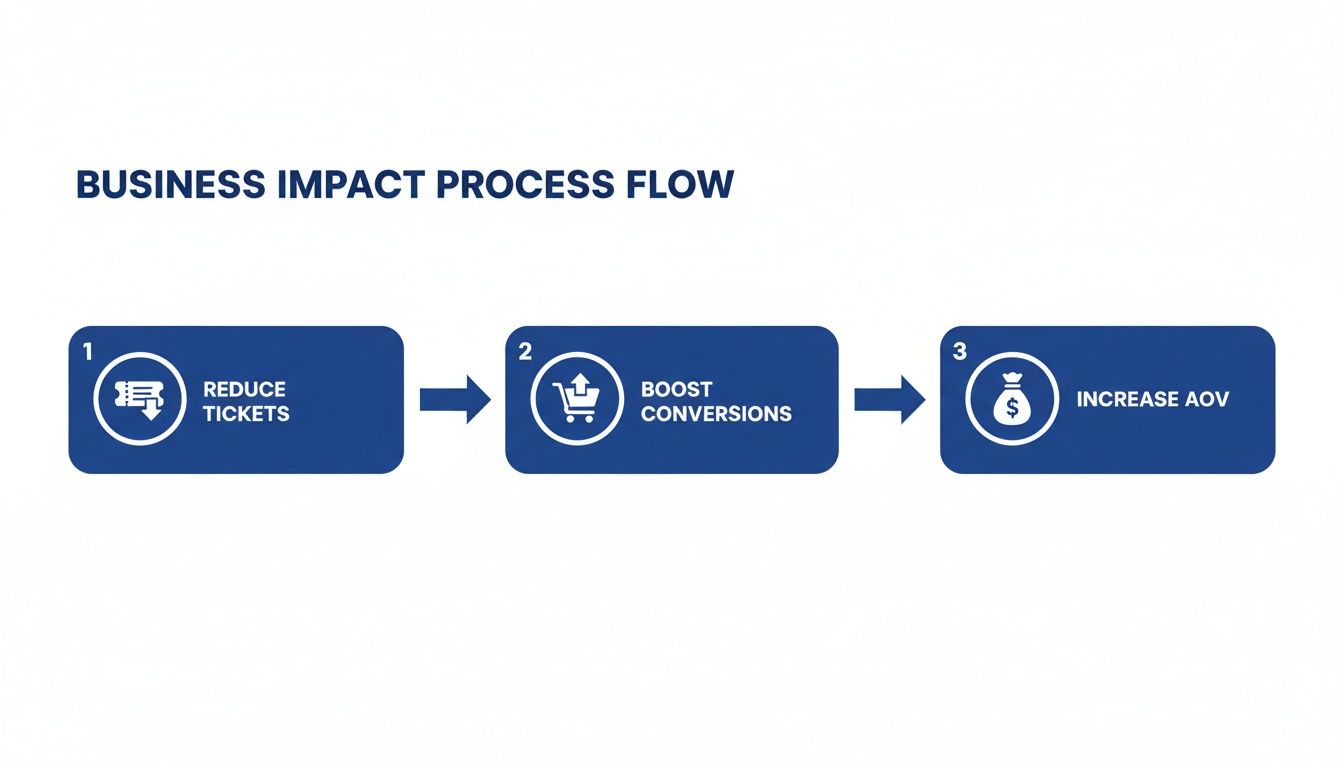
By following this flow, you can see how resolving simple queries automatically frees up time, which in turn leads to higher sales and a healthier bottom line.
Measuring the Success of Your Automation Strategy
Putting automation in customer service is a big step, but how do you actually know if it's paying off? To really prove its worth, you need to look past vanity metrics and get straight to the Key Performance Indicators (KPIs) that make a difference to your bottom line.
Tracking the right data doesn't just show you a return on investment. It gives you a clear map for optimising your strategy, showing you exactly what to tweak for even better results.
Think of your analytics dashboard as your automation's performance review. It's where you see what's firing on all cylinders, what's falling flat, and where your biggest opportunities are hiding. Without this data, you're just guessing.
Key Metrics That Truly Matter for Ecommerce
Let's cut through the noise. Forget abstract numbers and focus on the data that connects directly to your revenue. For an ecommerce brand, the success of your automation strategy boils down to a handful of powerful KPIs. These tell a clear story about efficiency, customer happiness, and sales.
Here are the essentials you should be tracking:
- Ticket Deflection Rate: This is the most direct measure of your automation's muscle. It calculates the percentage of customer questions solved entirely by your AI, without ever needing a human to step in. A high deflection rate is gold—it means your AI is handling all the repetitive stuff, freeing up your team for the tricky problems that need a human touch.
- AI First Contact Resolution (FCR): This metric goes a step further. It measures how often the AI nails the solution on the very first interaction. A high FCR tells you the AI isn't just spitting out answers; it's providing accurate, satisfying solutions. That’s a huge win for the customer experience.
When you focus on these two, you get a crystal-clear picture of how automation is lightening the load on your team and making your whole operation run smoother.
Connecting Automation to Revenue Growth
Efficiency is great, but the real magic of automation is its power to drive sales. Your analytics should draw a straight line from a customer chatting with your AI to them clicking "buy". These are the commercial KPIs you absolutely cannot ignore.
The best automation doesn't just cut costs; it actively creates value. By tracking how AI chats influence buying behaviour, you can prove your customer service tool is a sales engine, not just a support cost.
Keep an eye out for these critical data points in your dashboard:
- Conversion Rate from Chat: This tracks the percentage of shoppers who make a purchase after talking to your AI assistant. If this number is climbing, it's a massive signal that your AI is successfully answering pre-purchase questions and smoothing out the path to checkout.
- Average Order Value (AOV) from Chat: Is your AI a good salesperson? This metric shows you. It compares the AOV of customers who used the AI to those who didn't. An increase here proves your automation is successfully upselling or cross-selling relevant products, persuading customers to add more to their carts.
Using Data to Continuously Optimise
Your performance data isn't just a report card—it's your roadmap for getting better. By regularly diving into your analytics, you can spot common customer sticking points and frequently asked questions that your AI might be struggling with.
For instance, if you notice a flood of questions about a specific product feature your AI can't answer, that's your cue. It's a clear signal to update its knowledge base and make it smarter.
This cycle of monitoring, learning, and optimising is what separates a good automation strategy from a great one. It ensures your AI gets sharper over time, delivering more and more value to both your customers and your business. Making decisions based on this hard data is how you prove a clear, compelling return on your investment.
Common Automation Pitfalls and How to Avoid Them
Implementing automation in customer service is a powerful move, but diving in without a plan can lead to frustration for both you and your shoppers. Success isn’t just about picking a tool; it's about sidestepping the common mistakes that can turn a promising investment into a customer service headache.
By understanding these pitfalls, you can build an automation strategy that genuinely supports your brand’s growth. Let's look at the most frequent errors ecommerce brands make and how you can steer clear of them.
Pitfall 1: Choosing a Generic, One-Size-Fits-All Tool
This is a classic mistake. A brand picks an automation tool that isn't built specifically for ecommerce. A generic chatbot designed for a software company or a bank won’t understand the unique needs of an online shopper. Out of the box, it won’t know how to answer questions about product variants, shipping policies, or order tracking.
The Solution: Always choose an AI solution designed for ecommerce, preferably one that integrates directly with Shopify. These tools are built to sync with your product catalogue, policies, and order data from day one. This ensures they can provide relevant, accurate answers that actually drive sales, not just deflect tickets.
Pitfall 2: Creating a Dead End for Customers
There's nothing more frustrating for a customer than getting stuck in an endless loop with a chatbot that can't help. When there’s no clear way to reach a human, a simple query quickly snowballs into a major complaint. This can seriously damage customer trust and kill a sale.
The Solution: Implement a clear and seamless human escalation path. Your AI should be smart enough to recognise when a query is too complex, sensitive, or emotional for it to handle.
When the AI is out of its depth, it shouldn’t just give up. It should smoothly hand the conversation—along with its entire context—over to a live agent, ensuring the customer doesn’t have to repeat themselves and gets the expert help they need.
Pitfall 3: Forgetting Your Brand’s Personality
Your brand has a unique voice, and a robotic, generic AI can feel completely out of place. This disconnect can make your customer interactions feel impersonal and cheapen your brand’s image. A customer who loves your witty marketing will be completely put off by a bot that sounds like it's reading a legal document.
The Solution: Customise your AI’s personality to match your brand. Take the time to configure its name, avatar, colour scheme, and tone of voice. Modern tools allow you to define whether your AI should be professional, playful, empathetic, or straight-to-the-point, ensuring it feels like a true extension of your team.
Pitfall 4: Setting It and Forgetting It
Finally, many brands treat AI as a one-and-done project. They switch it on and never look at the performance data again. This is a massive missed opportunity, as it stops you from identifying areas for improvement and capitalising on valuable customer insights.
The Solution: Use performance data for continuous optimisation. Regularly review your AI’s analytics to see which questions it answers well and where it struggles. This data is a goldmine. It reveals common customer pain points and gives you a clear roadmap for making your automation even more effective over time.
Have a Few Questions About Automation?
Diving into customer service automation is a big step, and it's completely normal to have a few questions before you commit. We get it. This is a significant move for your brand, and you want to be sure you're getting it right.
To help clear things up, we’ve put together honest answers to the questions we hear most often from Shopify store owners just like you. Let’s tackle them head-on.
Will Automation Replace My Human Customer Service Team?
Not at all. In fact, it does the complete opposite—it makes your human team more valuable. The real goal of automation isn’t to replace people, but to handle the soul-crushing, repetitive questions that eat up your team's day. Think "Where is my order?" or "What are your shipping costs?".
By taking over those simple, high-volume tasks, automation frees up your team to focus exclusively on the complex, high-value stuff. This means they can dedicate their skills to solving tricky problems, nurturing VIP customers, and providing the kind of empathetic support that actually builds loyalty.
Think of it as giving your team a tireless assistant, not a replacement.
Is Setting Up an AI Chatbot Difficult for a Non-Technical Person?
Absolutely not. The days of needing a developer to get AI up and running are long gone. Modern AI tools designed for ecommerce, especially the ones you’ll find on the Shopify App Store, are built for simplicity. Most offer a one-click installation that gets you live almost instantly.
These tools are built to sync with your Shopify store's data right out of the box. They pull in your product catalogue, store policies, and existing pages automatically. This means your AI can start providing accurate, helpful answers from the moment you switch it on, without you needing to write a single line of code.
How Can I Make Sure the AI Sounds Like My Brand?
This is a crucial point, and it's something the best AI tools take very seriously. You're in complete control of the AI's persona, so it never feels generic or robotic.
Leading platforms give you extensive customisation options to keep everything on-brand:
- Visuals: You can easily change the chatbot's name, avatar, and colour scheme to perfectly match your website's look and feel.
- Tone of Voice: You get to define its personality. Should it be witty and fun? Straightforward and professional? Warm and friendly? It's up to you.
- Knowledge: You can "feed" the AI your existing brand guidelines, FAQs, and other key documents. This ensures it communicates in a voice that’s perfectly consistent with how you already talk to your customers.
How Does Automation Help Increase Sales?
This is the part many people miss. Automation is so much more than a support tool; it's a powerful sales engine. It drives revenue by giving shoppers instant answers, 24/7, right when they're making a buying decision. This directly tackles the pre-purchase questions that so often lead to abandoned carts.
An AI assistant can also act like a personal shopper. It can recommend products based on a customer's questions, suggest relevant upsells, and guide hesitant shoppers all the way through to checkout. That kind of direct engagement at critical moments is proven to lift both conversion rates and your Average Order Value (AOV).
Ready to see how a fully autonomous AI can transform your support and drive sales? Try Marvyn AI for free and get live in minutes. Automate over 70% of your customer service and turn browsers into buyers. Get started at https://www.marvyn.co.