Unlocking Growth With AI Sales Agents for Your DTC Brand
Picture this: a superstar salesperson who works 24/7, speaks every customer's language, and never forgets a single detail about your products or policies. In a nutshell, that's an AI sales agent. But these aren't just glorified chatbots. They're sophisticated tools built from the ground up to guide shoppers from browsing to buying.
What Are AI Sales Agents and Why Should You Care?
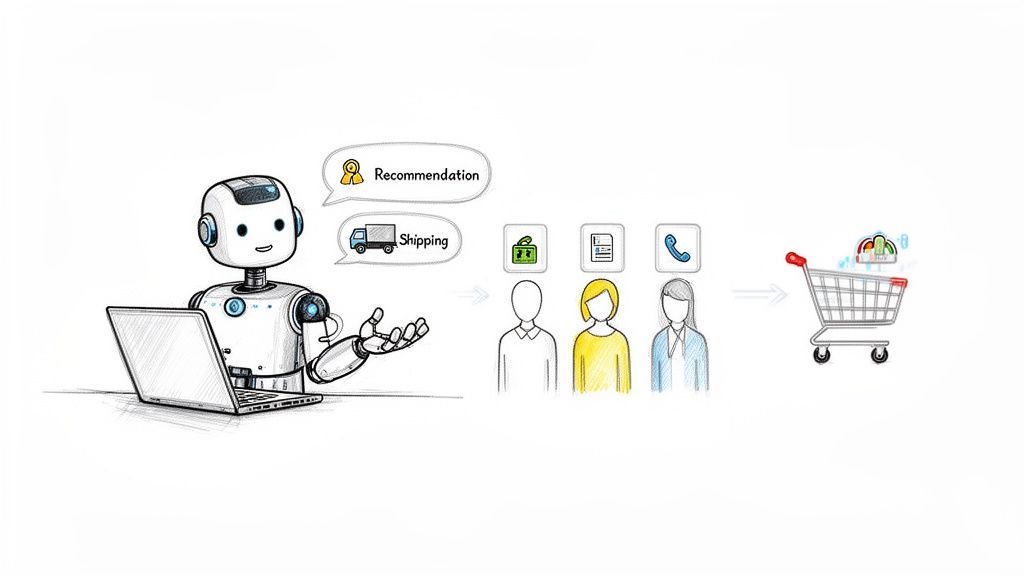
Let's clear up a common misconception. An AI sales agent is fundamentally different from the reactive, rule-based chatbots you've probably encountered. While older bots could only answer pre-programmed questions, a true AI sales agent proactively engages with customers, understands their needs, and acts as a digital personal shopper.
Think of it as upgrading from a static FAQ page to a highly skilled sales assistant. Instead of just pointing a customer toward a return policy link, an AI agent can ask about their style preferences, recommend products that fit their budget, and even cross-sell complementary items to increase their basket size.
The Shift from Luxury to Necessity
For direct-to-consumer (DTC) brands, this technology is no longer a 'nice-to-have'—it's fast becoming a critical tool for growth. The ecommerce market is more crowded than ever, and customers now expect instant, personalised service as standard. AI sales agents meet this demand head-on, providing round-the-clock support that drives real business results.
An AI sales agent is more than a support tool; it's a revenue-generating engine. By automating conversations that lead to sales, it frees up your team to focus on high-level strategy and growth, rather than answering the same questions over and over again.
This shift is creating some explosive market growth. The UK's AI agents market, valued at around £260 million in 2024, is set to skyrocket. Early predictions suggested it could reach £2.2 billion by 2030, but newer research now indicates it could hit an astonishing £7.6 trillion by 2033. This just goes to show how essential this technology is becoming for merchants.
Before we dive deeper, let's put things in perspective. Here’s a quick comparison of how traditional support stacks up against a modern AI sales agent.
Traditional Support Vs AI Sales Agents
As you can see, the difference isn't just about speed; it's a completely different approach to customer interaction. One is about managing problems, the other is about creating opportunities.
Beyond Basic Support
The real power of AI sales agents is their ability to blend sales and service seamlessly. They own the entire pre-sales journey, which is precisely where most online stores lose potential customers. To really get a handle on their impact, it's worth understanding the broader landscape of AI for sales and marketing.
Here’s what truly sets them apart:
- Proactive Engagement: They don’t just sit and wait. They can start a conversation based on a shopper's behaviour, like if they've been lingering on a product page for a while.
- Consultative Selling: Instead of just spitting out facts, they ask smart, qualifying questions to understand a shopper's intent and provide genuinely helpful recommendations, just like a human expert would.
- 24/7 Availability: Your digital salesperson never takes a break. That means no lead is ever missed, no matter what time zone your customer is in.
By taking on these roles, they do more than just answer questions—they actively build customer confidence and drive sales. If you're still relying on older tech, you might find it useful to read our guide on the key differences between modern AI and older chatbots for customer service. This technology isn't just about deflecting support tickets; it’s about creating happier customers and a much healthier bottom line.
How AI Sales Agents Drive Measurable Ecommerce Growth
Knowing what an AI sales agent is only tells you half the story. The real question for any Shopify or DTC brand founder is much simpler: what can it actually do for my bottom line? The answer is found in how these agents directly move the needle on the core metrics that define success in ecommerce.
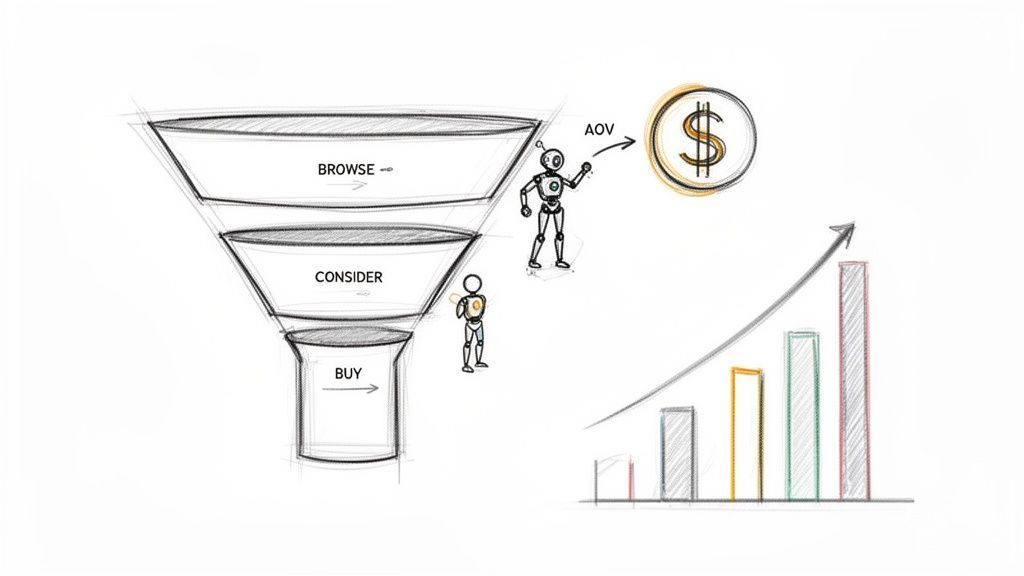
An AI sales agent isn't just a passive support tool; it's a proactive revenue machine. It works around the clock at every single stage of the customer journey, from the first curious click to the final "buy now," measurably lifting your store's performance.
Let's break down the three key pillars of growth these agents are designed to build up.
Pillar 1: Boost Conversion Rates
Cart abandonment is the silent killer of online sales. A customer hesitates. Maybe they have a last-minute question about shipping times, your return policy, or how a product fits. That hesitation is all it takes to lose them. An AI sales agent is your first line of defence.
By being online 24/7 to give instant, accurate answers, the AI smooths out the friction at the most critical moment. For example, a shopper is eyeing a dress and asks, "Can I get this by Friday for a party?" The agent can immediately check your shipping rules, confirm the delivery window, and lock in a sale that was seconds away from being lost.
This isn't just about answering questions. It's about proactive problem-solving that builds trust and confidence, gently nudging uncertain browsers over the line to become happy buyers. It’s like having a top-notch store associate in the corner of every customer's screen, ready to close the deal.
Pillar 2: Increase Average Order Value
A good salesperson doesn't just process a transaction; they make it better. AI sales agents are programmed to do exactly that through smart upselling and cross-selling, which is a direct lever for increasing your Average Order Value (AOV).
Imagine someone adds a high-end camera to their cart. A basic chatbot does nothing. An AI sales agent, however, springs into action.
- Upselling: It might suggest a slightly better model with features that matter. "For just £50 more, the pro version has a longer-lasting battery, which is perfect for travel photography." It's consultative, not pushy.
- Cross-selling: It can recommend the things that complete the purchase. "Most photographers who buy this camera also grab our high-speed memory card and a protective case to keep their new gear safe."
This isn't just random product-pushing. The AI uses your actual product catalogue data to make genuinely helpful, relevant suggestions. This kind of automated consultative selling can seriously lift the value of each order, all without any human lifting a finger.
By intelligently bundling products and making timely, relevant recommendations, AI sales agents can increase a store’s AOV by as much as 30%. This turns every conversation into a potential opportunity for more revenue.
Pillar 3: Slash Customer Support Costs
Every minute your team spends answering the same question for the tenth time is a minute they aren't spending on growing the business. AI sales agents take over the vast majority of common pre-sales queries, leading to a huge drop in support tickets and operational costs.
Think about the usual suspects: "Where is my order?", "What's your return policy?", "Do you ship to Australia?". An AI agent handles these instantly. This frees up your human team to focus on the complex issues that actually require a personal touch, like dealing with a damaged delivery or giving a VIP customer some extra attention.
This efficiency allows even small teams or solo founders to offer world-class support. By automating up to 70% or more of inbound conversations, businesses can scale their operations without needing to scale their support team. It’s a game-changer for the bottom line. Just as AI sales agents boost ecommerce, understanding how to leverage AI for Facebook ads can similarly scale campaigns and maximise return on ad spend. Both technologies use automation to drive efficiency and growth, delivering a powerful return on investment.
Must-Have Features of a Powerful AI Sales Agent
Choosing an AI sales agent can feel a bit overwhelming. A lot of tools are out there, all promising incredible results. But here's the thing: not all of them are created equal. To see a real return, you have to look past the marketing hype and focus on the core features that actually drive sales and make customers happy.
Think of it like buying a car. A flashy paint job is nice, but it’s the engine, safety features, and fuel efficiency that really matter. For an AI sales agent, the 'engine' is its set of core features. These are the non-negotiables that separate a genuinely powerful sales tool from a basic chatbot.
The good news is, it's pretty straightforward to spot these features once you know what to look for. Let’s break down the capabilities your AI needs to deliver real growth for your ecommerce brand.
Real-Time Product Catalogue Syncing
This is, without a doubt, the most critical feature. A powerful AI sales agent absolutely must connect directly to your Shopify store and sync with your product catalogue in real time. Without this, the agent is flying blind.
Imagine a customer asking for a product, only for the AI to recommend something that went out of stock an hour ago. That's an instant trust-breaker. Real-time syncing makes sure your agent always has the most current information on:
- Stock Levels: It knows what’s available and what’s not, preventing customer disappointment.
- Pricing and Sales: It can accurately quote prices, including any discounts or promotions you're running.
- Product Variants: It understands all the different sizes, colours, and styles you offer.
A static, manually-updated AI is a liability. An AI that syncs in real-time is a true sales asset, ensuring every recommendation is accurate, relevant, and, most importantly, shoppable.
Deep Integration with Store Policies and FAQs
Your customers have questions that go way beyond just products. They want to know about shipping times, return policies, and what your brand is all about. A top-tier AI sales agent should be able to absorb and understand all this information instantly.
The best platforms do this by automatically crawling and learning from your store’s existing pages—like your FAQ, About Us, and Shipping Policy pages. This means your agent can confidently answer questions like, "How long does UK delivery take?" or "What is your policy on returning sale items?" without you having to manually program a single response. You can explore a full list of these integrated capabilities to see how they work in a real environment and understand their impact.
Smart Escalation to Human Agents
Let's be realistic: no AI is perfect. Some situations will always need a human touch. That’s why a crucial feature is the ability for the AI to recognise its own limits and seamlessly hand a conversation over to a person on your team. This is known as smart escalation.
For example, if a customer is clearly frustrated about a damaged order or has a super specific, complex query, the AI should be smart enough to stop trying to solve it. Instead, it should politely say something like, "I see this requires a bit more help. Let me connect you with one of our team members who can best assist you," and then route the chat. This hybrid approach gives you efficiency without ever sacrificing the quality of your customer service.
The uptake of these intelligent systems is surging for a reason. In 2026, 46% of UK sellers were already using AI agents. The top performers were 1.7 times more likely to adopt them to slash the time spent on research and content creation, according to recent findings from Salesforce.
Seeing Is Believing: Real-World AI Use Cases
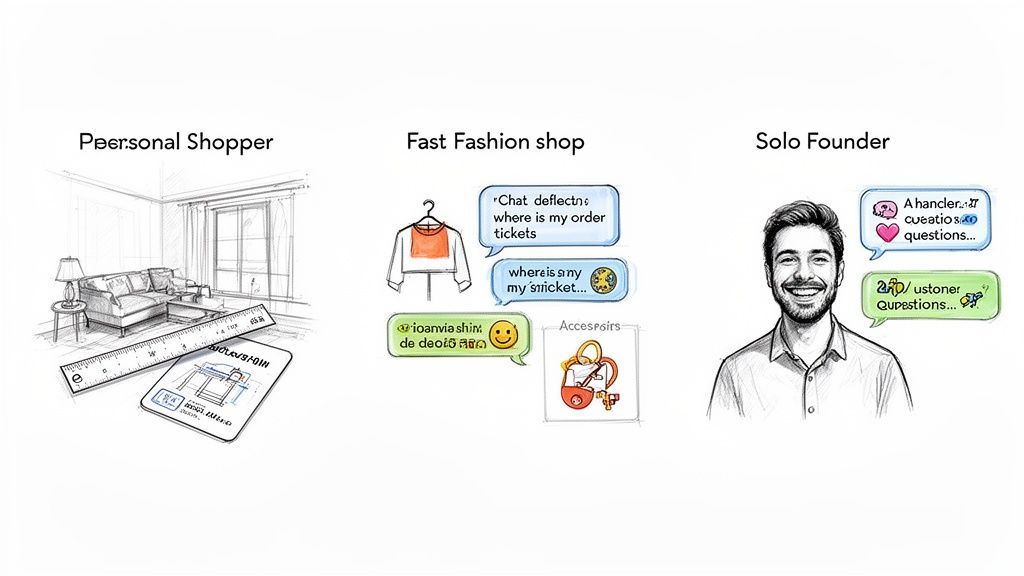
The theory behind AI sales agents is all well and good, but seeing them work in the wild is what really makes their value click. To go from abstract ideas to actual results, let's walk through a few real-world scenarios where these agents become indispensable partners for different kinds of e-commerce brands.
Each story shows how a single, versatile AI can adapt to unique business problems, customer expectations, and brand voices. These aren't futuristic fantasies; they're practical applications happening right now, driving sales and making customers happier for founders just like you.
Scenario 1: The High-Ticket Furniture Store
Imagine a store called ‘The Oak Atelier’ that sells premium, high-ticket furniture. Their customers don't make impulse buys; they need detailed information and a whole lot of confidence before committing to a £2,000 sofa or a £1,500 dining table. This is where an AI sales agent steps in as a sophisticated digital personal shopper.
A customer lands on the site, feeling a bit lost in all the options. The agent immediately opens a conversation: "Hi there! Looking to furnish a room? I can help you find the perfect pieces. What kind of space are you working with?"
From there, the AI guides the conversation with smart, consultative questions:
- "Could you tell me the dimensions of your living room?"
- "What's your preferred style—modern, rustic, or something in between?"
- "Are you looking for a specific colour palette to match your existing decor?"
Based on the answers, the agent instantly filters the product catalogue and presents a handpicked selection of sofas that fit the customer's size needs and style. It can even field specific questions like, "Is the fabric on this model pet-friendly?" by pulling the answer directly from its knowledge base. This guided experience builds the trust needed for a big-ticket purchase, turning a hesitant browser into a confident buyer.
An AI sales agent transforms a static product grid into a dynamic, consultative showroom. For high-ticket items, this guided selling process isn’t a luxury—it’s essential for turning serious interest into actual sales.
Scenario 2: The Fast-Fashion Brand During a Sale
Now, picture ‘Urban Threads’, a trendy fast-fashion brand in the middle of a massive Black Friday sale. Their small support team is completely swamped. Thousands of customers are hammering their inbox and social media with the exact same question: "Where is my order?"
This is a classic scenario where an AI agent becomes a support superhero. It can handle a limitless number of these repetitive questions at the same time, 24/7. When a customer asks about their order, the agent authenticates their identity and, by integrating with the store's backend, gives them a precise, real-time update.
But it doesn't just stop there. After solving the problem, the agent pivots back into a sales role. "Your order is on its way! While you wait, have you seen the new collection of accessories that just dropped? Many customers who bought your jacket also loved this scarf."
By deflecting thousands of routine support tickets, the AI frees up the human team to tackle the genuinely complex issues. More importantly, it flips a support interaction into a revenue opportunity, driving cross-sells and boosting customer lifetime value. For brands in this space, you can learn more about how to increase sales with an AI chatbot and manage high-volume traffic.
Scenario 3: The Solo Founder's Niche Hobby Store
Finally, let's think about ‘The Maker's Corner’, a shop run by a solo founder who sells specialised 3D printing supplies. The founder is an expert, but they can't be online 24/7 to answer technical questions. Their real passion is creating new products, not being chained to a support desk.
Here, the AI sales agent becomes the founder's digital twin. It's been trained on every product spec, material compatibility guide, and troubleshooting document the founder has ever written.
A hobbyist from a different time zone visits the site at 2 AM with a question: "Will this resin work with my specific model of printer?"
The AI agent instantly scans its knowledge and provides a detailed, accurate answer, even recommending a compatible cleaning solution to go with it. This gives customers the expert advice they need, precisely when they need it. The founder gets to wake up to new sales instead of a full inbox, freeing them up to focus on what they do best—innovating and growing their business.
Your Simple AI Implementation Checklist
Getting an AI sales agent up and running might sound like a huge technical project, but it’s far more straightforward than you think. The best platforms are built for busy founders, not developers. This simple checklist will walk you through the whole process, demystifying each step and showing you how to go from zero to a fully functional agent in no time.
Think of it like assembling flat-pack furniture. It looks intimidating in the box, but with a clear set of instructions, you’ll have it built before you know it. Let's break down the five key steps to launching your first AI salesperson.
Step 1: Define Your Primary Goal
Before you touch a single setting, you need to decide what you want your AI to actually do. Having a clear, specific goal will guide every other decision you make down the line. Are you trying to cut down on cart abandonment? Slash support tickets? Or maybe boost your average order value?
A vague goal like "improve sales" is impossible to measure. Get specific.
- Example Goal 1 (Support): Reduce 'Where is my order?' tickets by 50% within the first month.
- Example Goal 2 (Sales): Increase the conversion rate on your top three product pages by 15%.
- Example Goal 3 (AOV): Generate an extra £5 per order through automated cross-selling.
A measurable objective like this turns your AI from a cool new toy into a strategic tool with a clear purpose.
Step 2: Prepare Your Essential Data
For your AI to be effective, it needs good information to work with. The good news? You probably have most of it already. Your job is just to make sure it's organised and easy for the AI to access. Modern platforms like Marvyn AI can automatically sync this data, but a quick review on your end ensures accuracy from day one.
Gather these core assets:
- Key Policies: Make sure your Shipping, Returns, and Privacy Policy pages are up-to-date. Your AI will lean on these heavily to answer common customer questions with confidence.
- Product Information: Double-check that your product descriptions are clear and your inventory levels are accurate. This is what the AI uses to make smart recommendations.
- Frequently Asked Questions (FAQs): If you have an FAQ page, brilliant! If not, just jot down the top 5-10 questions you find yourself answering over and over again. This gives your AI a massive head start.
This prep stage shouldn't take you more than an hour. It's all about giving your AI a solid foundation of knowledge to build upon.
Think of your AI as a new employee on their first day. You wouldn't just leave them in a room with no instructions. Giving them organised policies and product info is like a proper onboarding, setting them up for immediate success.
Step 3: Choose Your Tool and Launch
With your goals defined and data ready, it’s time to pick your tool. For Shopify and DTC brands, you should prioritise platforms that offer a one-click installation straight from the app store. This completely removes any technical hurdles.
Look for a tool with a free plan or trial period, so you can test its capabilities without any financial commitment. Once you install it, the AI should automatically sync with your product catalogue and store pages. This is the "magic" moment where your agent comes to life, ready for you to add your personal touch.
Step 4: Customise the AI's Personality
Your brand has a unique voice, and your AI should absolutely reflect that. This step is all about tweaking the agent’s personality so it feels like a natural part of your team, not some generic robot.
Take a few minutes to adjust its settings:
- Tone of Voice: Is your brand fun and witty, or more professional and formal? Choose a tone that lines up.
- Visuals: Upload your logo and set the chatbot's colours to match your website's design. This makes it look seamless and professional.
- Opening Message: Customise the greeting it uses to welcome visitors. A warm, on-brand opening can make a huge difference in getting people to engage.
Step 5: Monitor and Refine
Your AI is now live on your site, but the job isn’t quite finished. For the first week or so, keep an eye on its conversations. Dive into the chat logs to see what real customers are asking and how the AI is handling their questions.
This final step is all about fine-tuning. If you notice a question that keeps popping up that the AI struggles with, you can simply add the answer to its knowledge base. This continuous feedback loop is what makes your agent smarter over time, turning it into an increasingly valuable asset for your business.
How to Measure Your AI's Success and ROI
An AI sales agent isn't a 'set and forget' gadget. Think of it as a dynamic member of your team that you can train and optimise over time to deliver even better results. But to make it better, you first have to measure its performance.
Tracking the right key performance indicators (KPIs) is the only way to prove its worth and calculate a real return on investment (ROI). Forget vanity metrics like the total number of chats. To really understand your AI’s impact, you need to look at the numbers that directly affect your bottom line.
Key KPIs for Your AI Sales Agent
So, what should you be tracking? To get a clear picture of how your AI is performing, you need to measure its impact on both sales and your support workload. This gives you a balanced view of its contribution as both a salesperson and a support rep.
This table breaks down the most important metrics.
By keeping a close eye on these numbers, you move from hoping the AI is working to knowing exactly how much value it’s adding to your business every single day.
Analysing Conversations for Deeper Insights
Beyond the raw numbers, the actual chat logs are a goldmine. Diving into what your customers are asking gives you a direct line into their thoughts, frustrations, and needs. This is where you can uncover sticking points in the customer journey or find gaps in your product information.
By regularly reviewing conversation analytics, you're not just improving your AI; you're gaining invaluable insights into your customers' needs and pain points. This feedback loop is one of the most powerful, often overlooked, benefits of having an ai sales agent.
For instance, if you see dozens of people asking whether a particular coat is waterproof, that’s your cue to update the product description. Making that small change helps the AI answer the question instantly and helps customers who never even open the chat. It’s a win-win that boosts conversions across the board.
The infographic below shows how these measurement steps fit into a successful AI rollout.
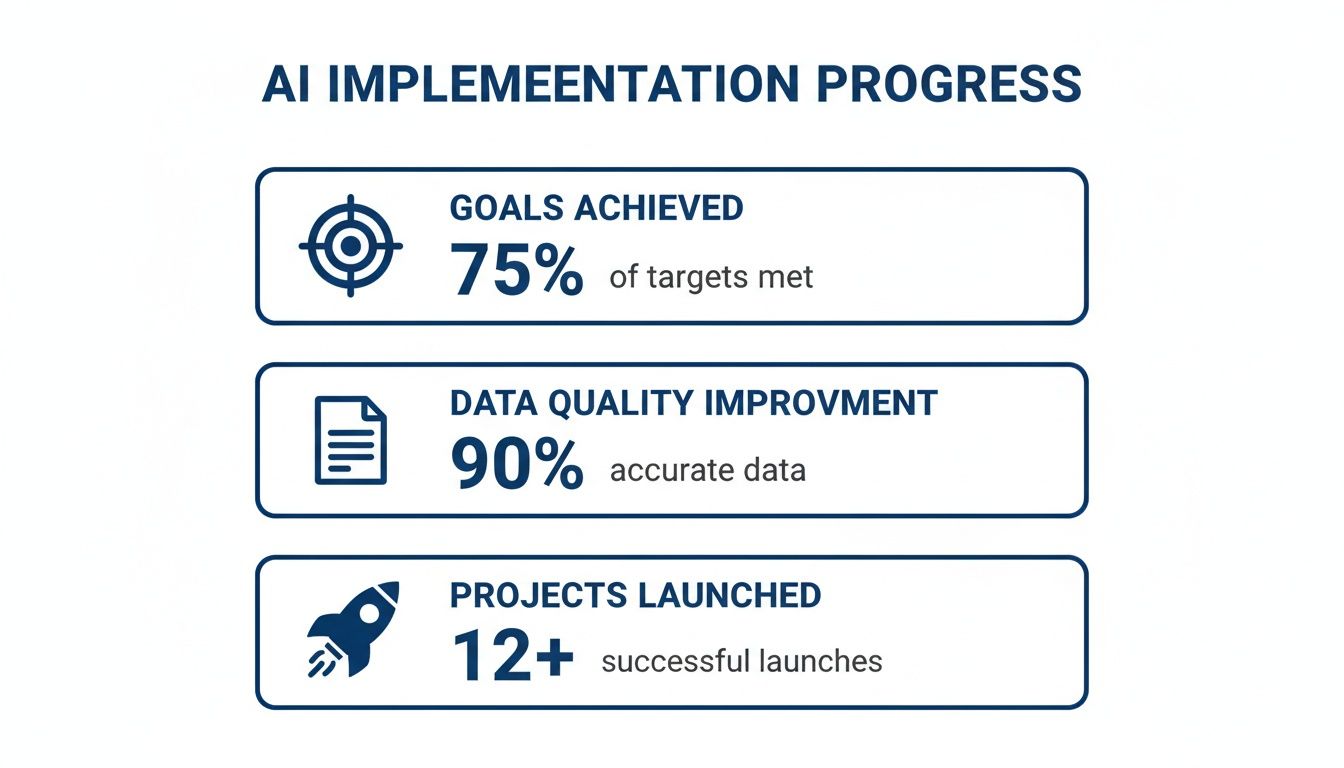
As the graphic shows, a great AI project starts with clear goals and good data. But it's the continuous tracking of KPIs that ensures it keeps delivering real, sustained value long after launch.
Got Questions About AI Sales Agents?
It’s completely normal to have questions before bringing any new tech into your store. Let's tackle some of the most common ones we hear from merchants about AI sales agents, clearing up the myths so you can see the real value.
Will An AI Agent Sound Robotic and Damage My Brand?
Not if it’s done right. The days of clunky, robotic chatbots are long gone. Modern AI sales agents are designed for deep customisation, letting you dial in the exact tone of voice—from witty and playful to formal and professional—that matches your brand.
You train the AI on your own brand documents, past customer chats, and product info. It quickly learns to communicate in a way that feels completely authentic, becoming a natural extension of your brand, not a robotic add-on.
Is Setting Up an AI Sales Agent Difficult and Expensive?
It used to be, but that's changed completely. Today’s top AI agents for Shopify offer one-click installation right from the App Store, and many even have a free plan so you can get started without any risk.
The entire setup is built for non-technical founders. The AI automatically syncs with your product catalogue and store policies, meaning you can be live in minutes without writing a single line of code. It's one of the most accessible and cost-effective pieces of tech you can add to your store.
A common myth is that powerful AI is reserved for huge enterprise companies. The reality is, tools designed specifically for Shopify have made this technology a true plug-and-play solution for brands of all sizes, even one-person operations.
What Happens If the AI Can't Answer a Question?
This is where a well-designed AI really proves its worth. Any good system has a 'smart escalation' pathway built in, ensuring no customer ever gets stuck in a loop. If the AI recognises a question is too complex, sensitive, or just isn't getting it right, it seamlessly hands the conversation over to a live person.
This hybrid approach gives you the best of both worlds: the 24/7 efficiency of AI handling the routine stuff, and the nuanced problem-solving of a human expert jumping in exactly when they're needed most.
Ready to see how an AI sales agent can transform your store's performance? Discover Marvyn AI and launch your free, fully autonomous sales expert in minutes. Get started with Marvyn AI today.
Crafted with [the Outrank tool](https://outrank.so)