A Guide to Chatbots for Customer Service on Shopify
Picture this: a perfect sales assistant. They work 24/7, know every single detail about your products, and never get tired or take a sick day. That's the reality of modern chatbots for customer service. These aren't the clunky bots of the past; they're an essential tool for any serious online business.
Why AI Chatbots Are Now Essential for Shopify Stores
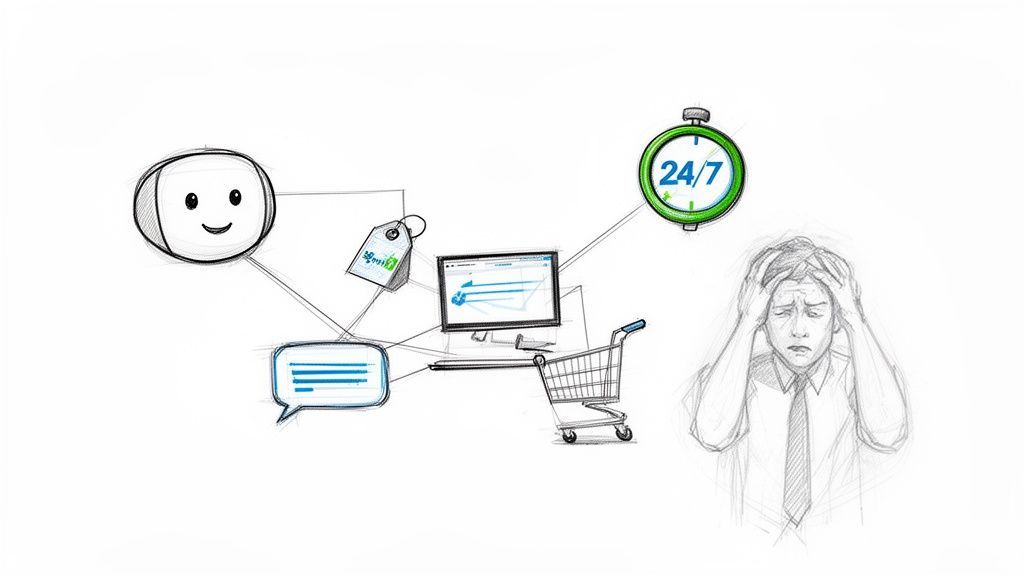
If you're running a Shopify store, especially a direct-to-consumer (DTC) brand or flying solo, your digital storefront is always open. But your support team isn't. This creates a dangerous gap where customer questions go unanswered, and potential sales simply disappear into the ether.
Today's customers want answers now. They don't want to wait until Monday morning to ask about shipping times, product materials, or your return policy. If they can't get a quick response, they don't wait around. They leave. This is where cart abandonment skyrockets and revenue gets torched, especially after your normal business hours.
The Overwhelmed Support Team Dilemma
For a small support team—or often, just the founder—the daily grind of repetitive questions is exhausting. The same queries flood your inbox, pulling you away from the work that actually grows the business. You're stuck choosing between answering "what's your returns policy?" for the tenth time or finally focusing on that new marketing campaign.
A purpose-built AI chatbot acts as your tireless digital employee. It's always on, never gets tired, and its only job is to engage every visitor, providing immediate and accurate support around the clock.
This is about more than just answering questions. It's about proactively turning browsers into buyers. A genuinely effective chatbot can:
- Provide instant product details: Answer questions about materials, sizing, and stock levels in seconds.
- Clarify store policies: Immediately tell customers about shipping costs, delivery times, and how to make a return.
- Guide shoppers to the checkout: Offer smart, personalised recommendations and help them complete their purchase.
To give you a better sense of how this works in practice, here's a quick comparison between the old way and the new way.
Human Support vs. AI Chatbot: A Quick Comparison
This table breaks down the core differences between relying solely on human agents versus integrating an AI chatbot like Marvyn AI. It's a high-level look at how availability, cost, and scale are completely transformed.
As you can see, the AI-assisted model doesn't just make support more efficient—it fundamentally changes what's possible for a small team or solo founder.
The shift towards this technology is undeniable, and the numbers back it up. The UK chatbot market alone was valued at £712.3 million and is projected to explode to £2.64 billion by 2030, with customer service tools leading the charge. For Shopify merchants, this isn't just a trend; it's a signal. Chatbots are now a fundamental part of staying competitive.
By automating your front-line support, a chatbot solves the "always-on" problem and ensures no customer is left waiting. This is the first, most crucial step in building a more efficient and profitable online store, which we cover in-depth in our complete Shopify customer service guide. It sets the stage for turning your support from a simple cost centre into a powerful revenue engine.
The Real Benefits of Integrating a Customer Service Chatbot
Moving past the setup, let's talk about what a chatbot actually does for your business. These aren't just fluffy concepts; they are real, measurable wins that directly boost your Shopify store’s bottom line and ability to grow. Each benefit tells a story of smarter scaling, happier customers, and newfound efficiency.
One of the most immediate and powerful advantages is a huge drop in operational costs. Just think about the maths for a second. Every single customer conversation handled by a live agent, whether on chat or a call, has a real cost attached—salary, training, software, and all the overheads. An AI chatbot, on the other hand, can handle a virtually unlimited number of chats for a small, fixed monthly fee. Your cost-per-interaction plummets to just pennies.
The financial ripple effect is massive. An IBM report found that chatbots can successfully resolve up to 80% of routine customer questions. This can lead to a 30% reduction in total support costs. For any growing Shopify store, that’s a game-changer. It frees up cash that you can pump back into marketing, new products, or other activities that actually grow your brand.
Drive More Sales and Recover Lost Revenue
But this isn’t just about saving money. The right chatbot actively makes you money. Picture this: a shopper is on your site late at night, trying to decide between two sizes. Without instant help, they'll probably just give up and leave. That’s a lost sale.
A proactive chatbot completely flips that script. It can spot that hesitant shopper, jump in with clarifying questions, and offer smart recommendations based on your product data — just like a great sales assistant in a brick-and-mortar shop. This kind of hands-on engagement is a powerful weapon against cart abandonment, guiding people confidently to the checkout. For fashion brands, this is a massive advantage; you can learn how AI chatbots increase sales for fashion stores in our dedicated guide.
Offer True 24/7 Global Availability
Your Shopify store is always open for business, so why shouldn't your customer service be? A chatbot gives you true 24/7 availability, serving customers in different time zones and those who like to shop at odd hours. A question from a customer in Australia at 3 am your time gets the same instant, helpful reply as one from a local shopper at 3 pm.
This around-the-clock presence is no longer a nice-to-have; it’s an expectation. It means you capture sales from a global audience and late-night browsers who would otherwise be lost opportunities, turning your website into a truly international, always-on marketplace.
Improve Customer Satisfaction and Brand Loyalty
In modern e-commerce, instant gratification is everything. When customers get immediate, correct answers to their questions, their satisfaction skyrockets. They feel seen and valued, which builds the kind of trust that turns a one-time buyer into a loyal fan.
And this isn't just a hunch; the data backs it up. Recent studies reveal that customer satisfaction with chatbots for customer service is impressively high, with 87.2% of consumers rating their interactions as neutral or positive. With 60% of purchasing decisions now influenced by chatbot interactions, providing this effortless self-service directly translates into stronger brand loyalty and repeat business.
By flawlessly handling routine queries about shipping, returns, and product details, a chatbot ensures a consistent, high-quality experience every time. This builds a foundation of trust that turns casual shoppers into lifelong advocates for your brand.
Scale Effortlessly During Peak Seasons
Finally, let's talk about the nightmare of scalability. How do you possibly handle the tidal wave of customer questions during Black Friday or after a marketing campaign goes viral? Hiring and training temporary staff is slow, expensive, and a logistical headache.
A customer service chatbot completely solves this problem. It can handle one, one hundred, or ten thousand conversations at the exact same time without a single dip in performance or a penny more in cost. This allows your business to scale predictably and profitably. Even during your most chaotic sales events, every single customer gets instant, world-class support.
How to Choose the Right Chatbot for Your Shopify Store
Picking the right chatbot for your Shopify store can feel like a massive decision, but it really boils down to one simple choice. Do you want a rigid, pre-programmed menu or a dynamic, expert assistant? Getting this right is the first step to finding a tool that actually drives revenue, not just deflects tickets.
You'll generally run into two main kinds of chatbots for customer service. The first type works like an old-school telephone menu—the frustrating kind that makes you "press one for sales, press two for support." This is a rule-based chatbot. It follows a strict script and can only answer questions it’s been explicitly told how to handle. If a customer phrases something even slightly differently, it hits a wall.
The other type is an AI chatbot. Think of this one less like a fixed menu and more like a conversation with your most clued-in employee. It uses artificial intelligence to grasp the intent behind a customer's words, not just the keywords. This lets it handle curveball questions, hold natural conversations, and give genuinely helpful, context-aware answers.
For a Shopify store, where customer questions are all over the map, an AI chatbot is almost always the better choice. It adapts to your customers instead of forcing them into a frustrating, pre-set box.
Distinguishing Rule-Based Bots from AI Bots
At a glance, telling them apart can be tricky. Here’s a quick way to understand the core difference in how they think.
- Rule-Based Bots: These are built on simple "if/then" logic. For example, if a customer types "shipping," then the bot shows your shipping policy. They work for basic, repetitive stuff but fall apart the second a conversation gets more complex.
- AI-Powered Bots: These use natural language processing (NLP) to understand what someone actually means. A customer could ask, "How long until my order gets here?" or "What are your delivery times?" and the AI knows both questions are about the same thing. It can then give a precise answer, sometimes even pulling specific order details for that customer.
Choosing a chatbot isn't just a technical decision; it's a customer experience decision. A rule-based bot says, "Here are your options." An AI bot says, "How can I help you?"
With that distinction clear, you can start looking at potential solutions based on the features that actually matter for an ecommerce business. Just having a chat window isn’t enough; the tool has to be deeply plugged into your Shopify world to deliver real value.
Non-Negotiable Features for a Shopify Chatbot
When you’re comparing options, don't get sidetracked by flashy but useless features. Zero in on the core functions that will directly boost your sales and support efficiency. Your chatbot needs to be more than a simple FAQ tool; it has to be a fully integrated part of your sales process.
Here’s a practical checklist to help you evaluate any chatbot solution. If a tool you’re considering can’t tick these boxes, it’s probably not the right fit for a growing Shopify store.
Feature Checklist for Selecting a Shopify Chatbot
Use this checklist to evaluate and compare different chatbot solutions to ensure you choose the best fit for your ecommerce needs.
Ultimately, the goal is to find a solution that works for you, not one that creates more work. The best chatbots for customer service are those designed specifically for ecommerce, offering a one-click setup, instant knowledge sync, and a clear path to driving both customer satisfaction and revenue from day one.
Right, let's get your AI chatbot set up. The idea of implementing a powerful AI tool might sound a bit daunting, but modern chatbots for customer service are designed to be surprisingly straightforward.
The best solutions, especially those built natively for Shopify, have ditched complex coding for a simple, guided setup. This section is a clear, step-by-step walkthrough of what that process actually looks like. It’s totally achievable, even for the most non-technical founders out there.
Before we dive into the steps, it helps to visualise the decision-making process. This breaks down how to compare different chatbot types and zero in on the features that actually matter for your store.
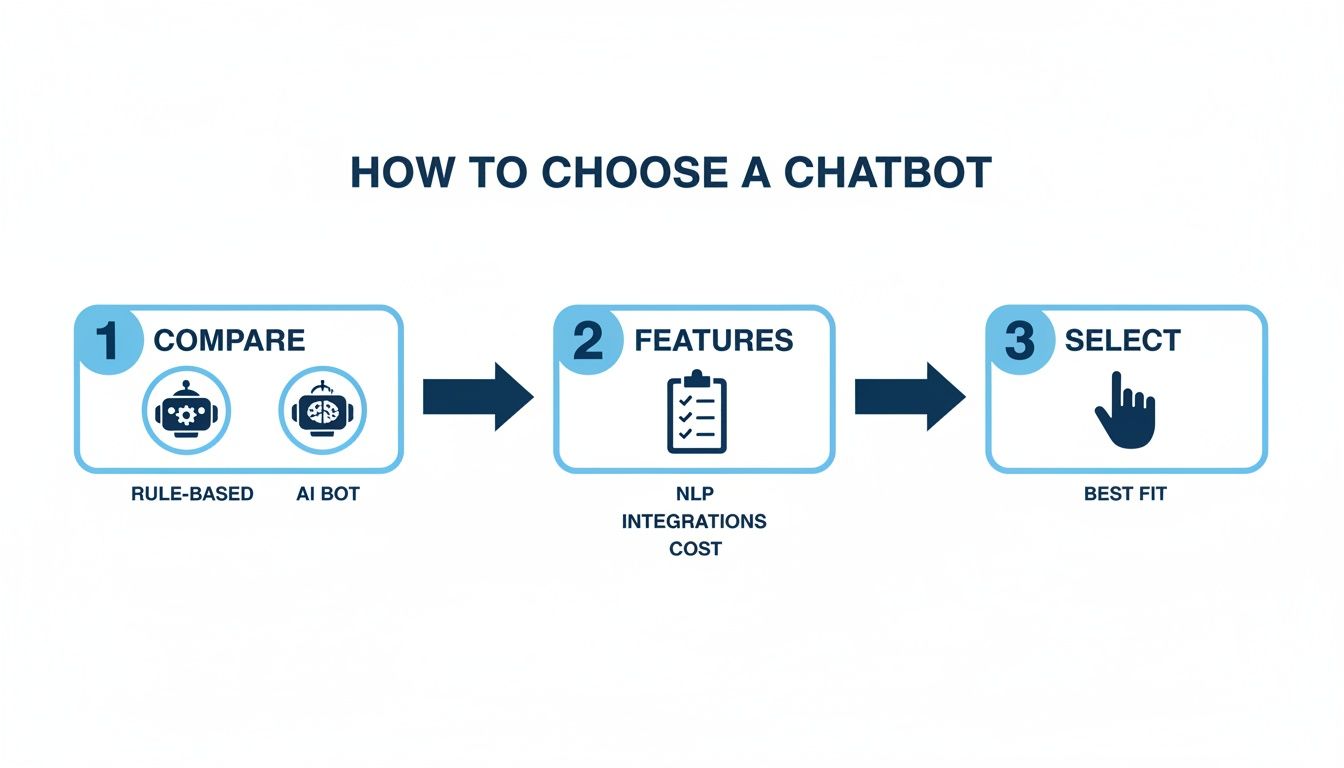
As you can see, the journey starts with understanding the core difference between rigid, rule-based bots and flexible, AI-powered ones. From there, you move on to evaluating features before making your final pick.
Step 1: Install from the Shopify App Store
Your journey begins not with a developer, but with a simple click. Leading chatbot solutions like Marvyn AI are available directly on the Shopify App Store. Think of it like adding any other app to your phone—it’s designed to be fast and intuitive.
You just search for the chatbot, click ‘Add app,’ and grant the necessary permissions. This one-click install is the hallmark of a truly Shopify-native tool. It means the chatbot is built to plug straight into your store's architecture from the get-go, with zero custom code or technical headaches.
Step 2: Witness the Automatic Sync
This is where the magic really happens. Right after you install it, the AI chatbot gets to work, automatically syncing with your entire Shopify store. It’s like a new employee on their first day, instantly absorbing all your company's knowledge.
The bot crawls and learns everything it needs to know to be helpful, including:
- Your Full Product Catalogue: It learns every single product, variant, price, material, and stock level.
- Your Store's Collections: It understands how you've organised your products, so it can make relevant recommendations.
- Your Key Policy Pages: It reads and actually comprehends your Shipping, Returns, and FAQ pages, preparing it to answer common customer questions accurately.
Within minutes, your chatbot is armed with all the foundational knowledge to handle a huge chunk of incoming queries. And you didn't have to do any manual data entry.
This automatic sync is the single most critical time-saver. It means your chatbot doesn't start as an empty shell but as a knowledgeable assistant, ready to provide value from day one.
Step 3: Customise Your Brand's Look and Feel
An effective chatbot should feel like a natural extension of your brand, not some generic add-on. So, the next step is to align its appearance and personality with your store’s identity. This is all about ensuring a consistent and trustworthy customer experience.
Most top-tier solutions give you simple customisation panels where you can:
- Adjust the Colours: Match the chat widget to your brand's specific colour palette.
- Upload Your Logo: Add your logo to the chat header for instant brand recognition.
- Define the Tone of Voice: Choose a personality that fits your brand—whether that’s friendly and casual, formal and professional, or even a bit witty and fun.
This step is crucial for building trust. When the chatbot looks and sounds like it belongs on your site, customers are far more likely to engage with it.
Step 4: Enhance Its Knowledge Base
While the automatic sync provides a solid foundation, you can make your chatbot even smarter. This step is all about uploading additional documents or information that might not be publicly available on your site. This could include internal FAQ documents, detailed product guides, or specific troubleshooting steps.
Think of it as providing advanced training to your new digital employee. By simply uploading a document, you expand its knowledge base, enabling it to answer more niche and complex questions with confidence. This deepens its expertise and further reduces the number of tickets that have to be escalated to your human team.
Step 5: Define Clear Escalation Paths
Finally, let's be realistic: no chatbot can answer everything. A critical part of the setup is deciding what happens when the bot reaches its limits. This is known as defining the escalation path. You absolutely need a clear, seamless process for handing conversations over to a human agent.
This isn’t a sign of failure; it's a feature of a well-designed system. You can set rules for when a handoff should happen, like when a customer expresses frustration, asks to speak to a person, or asks a question the bot can't resolve. A good system will transfer the entire chat history to the human agent, giving them the context needed to jump in and help effectively—without making the customer repeat themselves.
Right, so you’ve launched your chatbot. Job done? Not quite. Getting it live is just the first step. The real magic happens when you start actively managing and refining it, turning a simple tool into a core part of your business strategy.
Think of your chatbot like a new team member. It needs a clear role and personality to be effective. It shouldn't sound like a generic robot; it should sound like your brand. A few key practices will ensure your chatbots for customer service not only meet but smash customer expectations, feeding directly into your bottom line.
Define a Clear Chatbot Personality
Your chatbot is often the very first "hello" a new customer gets, so its tone of voice is incredibly important. Is your brand playful and witty, or more formal and to the point? This personality needs to come through in every single interaction. A consistent tone builds trust and makes the whole automated experience feel more human.
For example, a boutique selling handcrafted jewellery would probably want a chatbot that’s warm, friendly, and descriptive. On the other hand, a store selling tech gadgets would likely do better with a bot that's concise, direct, and hyper-efficient. Getting this right makes the bot a seamless extension of your brand, not just a clunky add-on.
Create a Seamless Escalation Path
Let's be realistic: even the smartest AI will eventually hit a question it can't answer. This is where most stores fall down. Having a flawless escalation path to a human agent isn't just a good idea—it's the single most important best practice. Customers should never, ever feel trapped in a loop, repeating themselves to a machine that just isn't getting it.
Your goal isn't to prevent every human interaction. It's to make sure human time is spent on high-value or complex issues. A smooth handoff is the sign of a well-designed system, not a failure of the bot.
A smart escalation process should do three things well:
- Recognise Frustration: The chatbot should be sharp enough to pick up on signs of frustration—like rephrased questions or short, clipped replies—and proactively offer to connect the customer with a person.
- Provide Context: When the conversation gets handed over, the human agent absolutely must get the full chat history. Making a customer repeat themselves is one of the quickest ways to lose them for good.
- Offer Multiple Channels: Give people choices. Let them switch to live chat, send an email, or request a callback. This puts them back in control and respects their time.
Use Proactive Engagement Strategically
Don't just sit back and wait for customers to come to you with problems. A great chatbot goes on the offensive. Use it to proactively engage visitors at key moments in their journey, turning it from a defensive support tool into a powerful sales driver.
For instance, you could set up your chatbot to automatically pop up on a product page where a visitor has been lingering for over 30 seconds. A simple, "Hi there! I see you're looking at our Winter Collection. Any questions about sizing or materials?" can be incredibly effective. You can also use this to offer help to shoppers who have items sitting in their cart, giving you a chance to tackle last-minute hesitation and reduce cart abandonment.
Leverage Multilingual Capabilities
If you sell internationally—or have any plans to—multilingual support is non-negotiable. Modern chatbots for customer service can chat away fluently in dozens of languages, instantly breaking down communication barriers and opening up entirely new markets.
With a solution like Marvyn AI, you can offer 24/7 support in over 80 languages without the headache and cost of building a global team. This shows a customer in Germany you value their business just as much as one in your home town. It’s how you build a credible, global brand presence that’s ready to scale.
Measuring Success and Proving Your ROI
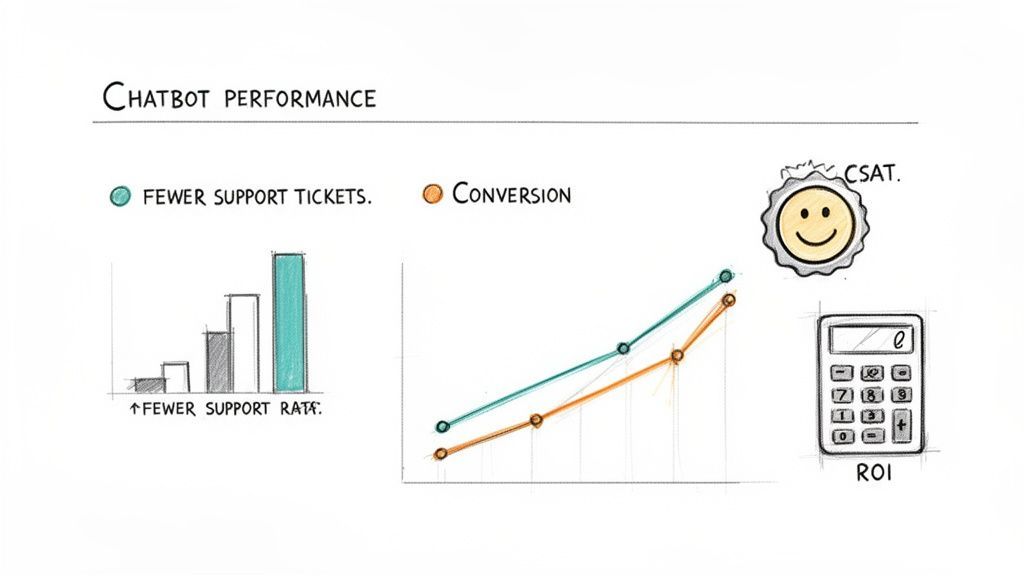
Putting a customer service chatbot on your store is an investment, and like any smart investment, you need to know if it’s paying off. Proving its value isn’t about guesswork; it’s about looking at clear, hard data.
This is how you shift the conversation around your chatbot from a simple support tool to a powerful revenue engine. It all starts with measuring the right things.
The good news? Tracking success isn’t complicated. By focusing on a few key performance indicators (KPIs), you can build a rock-solid business case and see exactly how your chatbot is impacting your bottom line. This data is your secret weapon for justifying the investment and making your bot even better over time.
Key Metrics to Track
To get the full picture, you need to look at a mix of efficiency, satisfaction, and revenue-focused metrics. These numbers tell a story about cost savings, customer happiness, and, most importantly, sales growth.
Here are the essential metrics every Shopify merchant should keep an eye on:
- Reduction in Support Ticket Volume: This is one of the first and most obvious wins. Track the percentage drop in incoming emails and live chat requests. A high deflection rate means the bot is successfully handling all those repetitive queries, freeing up your team.
- First-Contact Resolution (FCR) Rate: This metric tells you how many customer issues are completely solved by the chatbot without ever needing to be passed to a human. A strong FCR rate is a clear sign that your bot is both knowledgeable and effective.
- Customer Satisfaction (CSAT) Score: After an interaction, ask customers to rate their experience. A simple thumbs-up/thumbs-down or a 1-5 scale gives you crucial, direct feedback on the bot's helpfulness and tone.
- Conversion Rate of Chatbot-Assisted Sales: This is where the chatbot really proves its worth as a sales driver. Track how many conversations lead directly to a purchase. This is the metric that connects your bot's activity straight to your revenue.
Calculating Your Return on Investment
Once you have your metrics, figuring out your return on investment (ROI) becomes much clearer. It’s a straightforward comparison of what you save and earn versus what you spend on the tool. Think of it as a simple profit and loss calculation for your automation efforts.
Your chatbot’s ROI isn’t just about cost reduction. It’s about the total value created, combining saved support hours with new, directly attributable revenue.
Here’s a basic framework to calculate it:
- Calculate Your Savings: First, estimate the number of hours your team saves each month thanks to the chatbot. Multiply those hours by your average support staff cost to get your monthly savings. An IBM report found that chatbots can cut support costs by 30%, which is a great benchmark.
- Calculate New Revenue: Next, use your analytics to track the total value of sales where the chatbot assisted. This is new revenue you might have otherwise missed out on.
- Compare Against Cost: Finally, add your savings and new revenue together. Then, subtract the monthly cost of your chatbot tool. The result is your net ROI.
This simple calculation completely transforms the conversation. Your chatbot is no longer just another line item on an expense report; it's a proven asset that saves money and actively generates sales for your Shopify store.
Answering Your Top Questions About Customer Service Chatbots
Even with the huge upside, it’s completely normal to have a few questions before adding a new tool to your Shopify store. Let's tackle some of the most common concerns merchants have about using chatbots for customer service. My goal here is to clear up any lingering doubts you might have.
Will a Chatbot Make My Service Feel Impersonal?
This is probably the number one question I get, and it’s a good one. The short answer is no—not if it’s done right. Modern AI chatbots aren't the clunky, robotic scripts from a few years ago. They’re designed to be customised to your brand's unique voice, whether that’s friendly and casual, strictly professional, or a bit witty.
Think about it this way: by instantly handling all the repetitive, low-value questions ("Where's my order?"), the bot actually frees up your human team. They get to focus their energy on the complex, high-stakes issues that genuinely need a personal, human touch. The result is often a more personal and efficient service overall, because your team’s time is spent where it matters most.
Are Chatbots a Nightmare to Set Up for Non-Technical People?
While some older systems were notoriously complicated, many of today’s chatbots for Shopify are built for people who aren’t developers. The best options, like Marvyn AI, offer a simple one-click installation right from the Shopify App Store.
Once installed, these solutions automatically sync with your product catalogue, store pages, and policies. This means your chatbot is ready to answer customer questions accurately within minutes, with absolutely no coding or technical skills required.
If you're curious about how different solutions stack up on ease-of-use, check out our detailed breakdown of Marvyn vs Tidio to see what really sets them apart.
What Happens When a Chatbot Can’t Answer a Question?
This is where a good chatbot proves its worth. A critical feature of any quality bot is its smart escalation path. When the AI runs into a query it doesn't know, or it senses a customer is getting frustrated, it’s programmed to seamlessly hand the conversation over to a human agent.
The best-in-class solutions have built-in rules for this. They ensure that tricky or sensitive issues are always passed to your support team with the full conversation history attached. This gives your agent all the context they need to jump in and solve the problem effectively, without forcing the customer to repeat themselves—which everyone hates.
Ready to see how an AI-powered chatbot can transform your customer service and drive more sales? Marvyn AI automates over 70% of support queries and provides 24/7 consultative sales for your Shopify store, completely free. Get started with Marvyn AI today.