Conversion optimization best practices for Shopify: Boost Conversions
In the competitive world of Shopify and DTC e-commerce, driving traffic to your store is only half the battle. The real challenge, and the greatest opportunity, lies in converting those visitors into loyal customers. With customer acquisition costs steadily rising, optimising your existing traffic has never been more critical for sustainable growth. This isn’t about guesswork; it's about a systematic process of understanding what your customers want and removing the barriers that stop them from buying.
This guide presents 10 essential conversion optimisation best practices specifically chosen for ambitious direct-to-consumer brands. Each point is a deep dive into an actionable strategy, from using conversational AI for pre-sales support to refining your checkout process. These are not vague theories, but practical steps designed to deliver measurable uplifts in your most important metrics: conversion rate, average order value, and customer lifetime value. To truly grasp the value of conversion optimisation, you can explore strategies for improving website conversion rates with an AI-driven playbook that offers a structured approach.
Forget generic advice. We will cover specific implementation details, metrics to track, and real-world examples you can apply immediately. By focusing on these proven methods, you can turn more browsers into buyers, build a stronger brand, and create a more profitable online store. Let’s get started.
1. Conversational AI for Product Discovery and Support
Moving beyond simple pop-ups, conversational AI transforms your storefront into a consultative experience. Instead of leaving customers to navigate complex product catalogues on their own, AI-driven assistants like Marvyn AI guide them through multi-turn dialogues. This process discovers their specific needs, qualifies their preferences, and offers personalised product recommendations, much like an in-store expert would.
This approach is crucial for conversion optimisation because it removes friction from the buying journey. It gathers valuable zero-party data (like budget, style preferences, or use case) directly from the customer in a natural, conversational way. This data can then be used for immediate personalisation and future marketing efforts. Furthermore, these assistants provide 24/7 support, answering common questions instantly and resolving objections in real time, which prevents cart abandonment.
Why It Works
Conversational AI directly addresses indecision and uncertainty, two major conversion killers. By offering immediate, contextual help, you build trust and confidence. For example, a customer shopping for skincare can be asked about their skin type and concerns, leading to a targeted product suggestion rather than overwhelming them with choices. Sephora's Virtual Artist excels at this by recommending products based on user input and answering specific questions about ingredients or application. This proactive support system is a cornerstone of modern conversion strategies. To gain a deeper understanding of how to effectively convert visitors into buyers, explore these 10 conversion rate optimization best practices for a broader view.
Actionable Tips for Implementation
- Limit Questions: Keep qualification dialogues concise. Focus on 3-5 critical factors to avoid fatiguing the user. Use buttons and quick replies for common answers to reduce typing.
- Establish Clear Handoffs: Define precise rules for when the bot should escalate to a human agent. Use sentiment analysis to detect customer frustration and initiate a handoff early.
- Train with Real Data: Your AI is only as good as its training. Use actual customer support logs and conversation histories to teach the bot your brand voice and common query patterns. For more insights on this, you can learn more about optimising chatbots for customer service.
- Test and Refine: A/B test the order of questions, wording, and response formats to see what drives the highest engagement and conversion rates.
2. Reduce Friction in the Checkout Process
The checkout process is the final hurdle between a customer's intent and a confirmed sale. Reducing friction here involves methodically removing any steps, fields, or decisions that could cause hesitation or abandonment. By simplifying the path from adding a product to the cart to seeing the payment confirmation, you can significantly boost your conversion rate. This means implementing features like one-page checkouts, guest options, pre-filled information, and multiple payment methods.
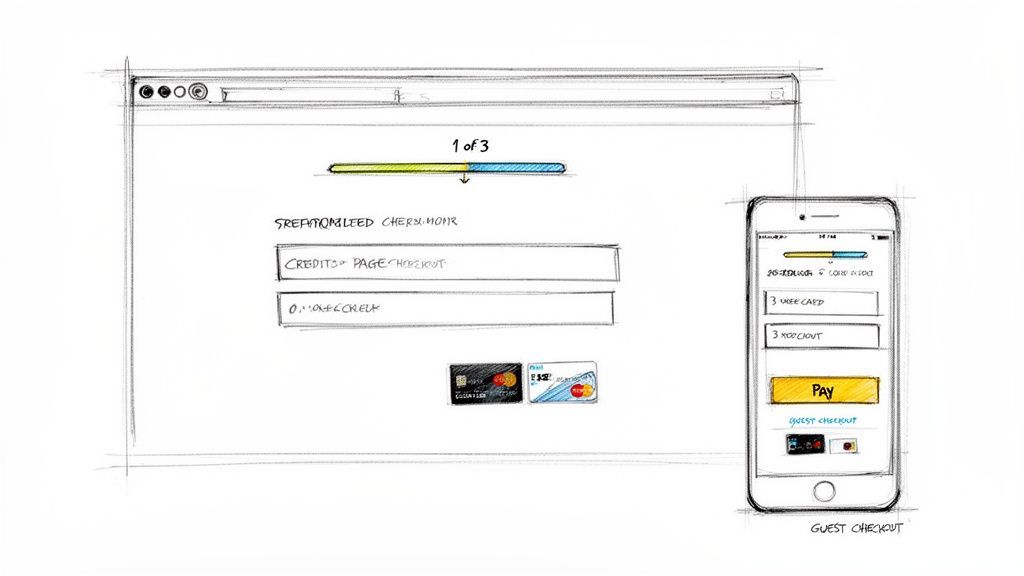
This focus on a seamless checkout is a core component of conversion optimisation because every extra click or required field increases the chance a customer will leave. Surprise costs, a mandatory account creation, or a confusing layout are common culprits for cart abandonment. Streamlining this final step respects the customer's time and momentum, making it as easy as possible to complete their purchase. Brands like Zappos do this well by displaying shipping costs transparently and promoting free returns directly in the checkout, which builds trust at the critical moment of decision.
Why It Works
A frictionless checkout directly counters buyer's remorse and analysis paralysis. By making the process fast and intuitive, you maintain the purchasing momentum built during the product discovery phase. For example, Shopify’s optimised mobile checkout, used by countless DTC brands, remembers customer information for one-click payments, mirroring the convenience popularised by Amazon. This minimises cognitive load and reassures customers that their decision to buy is simple and secure. This practice is one of the most impactful conversion optimization best practices because it addresses the highest-intent visitors on your site.
Actionable Tips for Implementation
- Display All Costs Upfront: Prevent sticker shock by showing taxes and shipping fees early in the process. Use a clear cost summary before the final payment step.
- Offer Guest Checkout: Do not force customers to create an account. This is a major point of friction. Provide the option to create an account after the purchase is complete.
- Enable Autofill and Dynamic Fields: Use autofill for shipping and billing addresses. If a conversational AI tool like Marvyn AI has collected a customer’s details, use that data to pre-populate fields.
- Show Trust Signals: Prominently display security badges (like SSL certificates) and accepted payment logos (Visa, PayPal, etc.) to reassure customers their data is safe.
- Optimise for Mobile: Continuously test your checkout flow on various mobile devices. Ensure buttons are large, forms are easy to fill, and the entire process is thumb-friendly.
3. Leverage Social Proof and Customer Testimonials
Social proof involves displaying authentic reviews, ratings, testimonials, and user-generated content (UGC) to build credibility and reduce purchase anxiety. When potential customers see that others have bought and enjoyed a product, it validates their own consideration and creates a powerful sense of trust. This is especially critical for higher-priced items or brands that are new to the shopper.
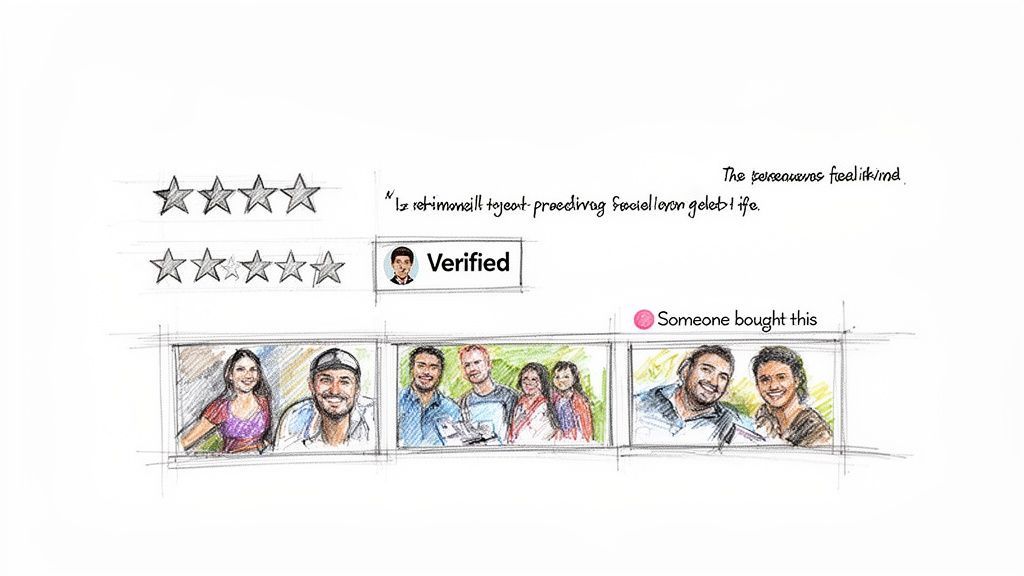
This strategy is fundamental to conversion optimisation because it taps into the basic human tendency to follow the actions of others. By showcasing positive experiences directly on product pages, you counter scepticism and answer unspoken questions in the customer's mind. Displaying a high volume of reviews, like Trustpilot showing 50,000+ for a major brand, or featuring customer photos, as Allbirds does, makes the benefits of your product feel tangible and real, moving shoppers closer to a confident purchase decision.
Why It Works
Social proof directly tackles the risk perception that kills conversions. A shopper might ask themselves, "Will this actually work for me?" or "Is this brand legitimate?". Seeing verified reviews, especially those detailing specific benefits or use cases, provides the necessary reassurance. For example, Peloton masterfully uses customer transformation stories and testimonials to showcase results, not just features. This form of social proof is far more persuasive than any brand-generated marketing copy, making it a key pillar of effective conversion optimization best practices.
Actionable Tips for Implementation
- Time Your Requests: Ask for reviews within a few days of delivery, when the customer's satisfaction is at its peak. Use automated email or SMS follow-ups to make this process seamless.
- Incentivise Honestly: Offer a small discount on a future purchase for leaving a review. Be clear this is a reward for their time, not for a positive rating, to maintain authenticity.
- Prominent Placement: Integrate reviews directly below the product title and price on product pages. Don't hide them on a separate tab or at the bottom of the page.
- Respond to All Feedback: Publicly reply to both positive and negative reviews. Thanking happy customers and offering solutions to unhappy ones shows you are engaged and accountable.
4. Personalize the Shopping Experience with Customer Data
Generic storefronts that treat every visitor the same are a relic of the past. Modern conversion optimisation hinges on using customer data to create a shopping experience that feels unique to each individual. By analysing first-party data, behavioural signals, and interaction history, you can tailor product recommendations, messaging, and offers that resonate deeply with your audience. This improves relevance and engagement, making the path to purchase feel natural and intuitive.
This practice is a cornerstone of effective conversion optimisation because it directly addresses the customer's unspoken question: "Is this for me?" When done transparently and compliantly, personalisation shows you understand their needs and preferences. Amazon’s recommendation engine, which suggests products based on browsing and purchase history, is a classic example. Similarly, DTC brands using platforms like Klaviyo can create email flows that dynamically display products related to a customer's last purchase, significantly increasing the likelihood of a repeat sale.
Why It Works
Personalisation works by reducing choice paralysis and building a stronger connection with the shopper. Instead of forcing them to sift through irrelevant items, you present exactly what they are likely looking for. A powerful example is Spotify’s Discover Weekly playlist, which uses listening habits to curate new music with remarkable accuracy. In e-commerce, a brand can use zero-party data from a conversational quiz about a customer's style preferences to showcase a personalised homepage gallery, immediately capturing their interest and guiding them toward a conversion.
Actionable Tips for Implementation
- Collect Zero-Party Data: Use conversational quizzes, preference centres, and interactive guides to ask customers directly about their needs, style, or goals. This data is willingly provided and highly accurate.
- Segment by Lifecycle Stage: Create distinct audience segments for first-time visitors, repeat customers, and at-risk shoppers. Customise pop-ups, banners, and email offers for each group to reflect their relationship with your brand.
- Create Dynamic Recommendations: Implement dynamic product recommendation blocks on your product pages, such as 'Frequently Bought Together' or 'You Might Also Like', based on real-time browsing behaviour and purchase data.
- Ensure Transparency: Be clear about how you use customer data in your privacy policy. Always provide straightforward opt-out options to build trust and maintain compliance with regulations like GDPR.
5. Address Customer Objections Proactively
Every potential customer has silent questions or hesitations that can stop a sale cold. Proactively addressing these objections means you identify common points of friction like price, shipping costs, product fit, or quality concerns and resolve them directly on the page before they lead to abandonment. This builds trust by showing you understand and have already solved their potential problems.
This strategy is fundamental to conversion optimisation because it systematically dismantles the barriers between interest and purchase. By providing clear guarantees, detailed product data, social proof, and accessible support, you neutralise doubt at the moment it arises. Instead of forcing a shopper to search for answers or, worse, leave to compare with a competitor, you give them the confidence to click "buy now" right away.
Why It Works
Unanswered questions create uncertainty, and uncertainty is a primary driver of cart abandonment. By anticipating and answering these questions, you control the narrative and reinforce your value proposition. For example, Casper's 100-night sleep trial directly counters the objection, "What if I don't like a mattress I bought online?" Similarly, YETI uses detailed comparison charts to justify its premium price against competitors, tackling the price objection with data-driven proof of superior quality. This preemptive approach is a hallmark of strong conversion optimisation best practices, turning potential deal-breakers into reasons to buy.
Actionable Tips for Implementation
- Identify Top Objections: Analyse customer support tickets, live chat logs, and post-purchase surveys to pinpoint the most frequent hesitations. Create an "objection map" that links common concerns to specific product categories.
- Use Data and Guarantees: Embed trust-building information directly into product descriptions. Use phrases like "Over 10,000 five-star reviews," "Ships within 24 hours," or a prominently displayed "Try risk-free for 30 days" guarantee.
- Train Your Support Systems: Programme AI assistants like Marvyn AI to recognise keywords related to common objections (e.g., "shipping," "return," "fit") and provide instant, reassuring answers.
- Create Clear Content: Develop a detailed FAQ page and use content blocks on product pages to address specific concerns. For instance, Allbirds excels by providing in-depth information on its sustainable materials, directly addressing questions about quality and ethics. To see how this fits into a wider support strategy, you can get more ideas from these customer service best practices.
6. Implement Strategic Exit-Intent Offers
Exit-intent technology monitors a user's mouse movements to detect when they are about to leave your site, typically by moving their cursor towards the browser's back button or address bar. Just before they abandon their session, you can present a targeted, last-minute offer. This is not about indiscriminately slashing prices; it is a strategic intervention designed to recover a sale that would otherwise be lost.
This practice is fundamental to conversion optimisation because it gives you one final chance to address a visitor's hesitation. The reason for their departure could be price sensitivity, shipping costs, or simple distraction. A well-timed exit-intent offer, such as a modest discount or free shipping, can directly counter that final objection and persuade them to complete their purchase. It acts as a safety net, capturing a meaningful portion of abandoning visitors without devaluing your brand by training regular customers to wait for discounts.
Why It Works
Exit-intent offers succeed by directly addressing the immediate friction point causing cart or site abandonment. Instead of losing a potential customer forever, you re-engage them with a compelling reason to stay. For example, a customer abandoning a cart worth £150 might be presented with a free shipping offer, neutralising one of the most common reasons for checkout drop-off. Similarly, a pop-up capturing an email address in exchange for a 10% discount on their first purchase, like those used effectively by brands such as Bonobos, turns a lost visitor into a lead for future marketing. These tactics are a core part of modern conversion optimisation best practices because they provide a tangible, last-ditch effort to secure a sale or a lead.
Actionable Tips for Implementation
- Test Diverse Offer Types: Don't just default to discounts. A/B test free shipping, a complimentary gift with purchase, loyalty points, or a simple email capture for a future benefit. This helps you discover what truly motivates your abandoning visitors.
- Time Offers Strategically: Avoid triggering pop-ups on a visitor's first page or within seconds of arrival. Set rules so they appear only after a user has shown genuine engagement (e.g., viewed multiple pages, spent a certain amount of time on-site) and then signals exit intent.
- Personalise the Incentive: Customise offers based on behaviour. For a high-value cart, free shipping might be more profitable than a percentage discount. For a new visitor, an introductory 10% off is a classic way to secure a first-time buyer.
- Ensure Clarity and Simplicity: The offer must be easy to understand and redeem. Use clear, concise copy ("Get 15% Off Your Order Now") and a prominent call-to-action button. Any friction in redeeming the offer defeats its purpose.
7. Optimize Mobile Experience and Page Speed
With more than half of all ecommerce traffic originating from mobile devices, a slow or clunky mobile experience is one of the fastest ways to lose a sale. Optimising for mobile and page speed involves ensuring your storefront loads in under three seconds and provides a flawless, touch-friendly interface. This includes responsive design that adapts to any screen size, simplified navigation, and a checkout process designed specifically for smaller screens.
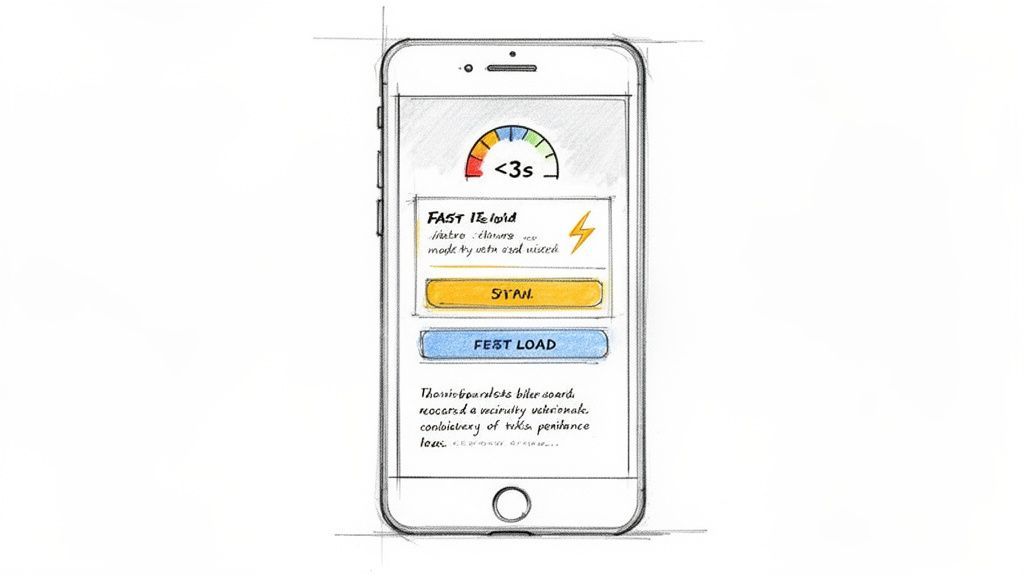
Failing to prioritise mobile performance directly damages your conversion rate. Customers expect instant results, and delays create frustration, leading to high bounce rates and abandoned carts. A fast, intuitive mobile site signals professionalism and respect for the customer's time, building the trust needed to complete a purchase. Google's mobile-first indexing also means that a poor mobile experience can harm your search engine rankings, reducing organic traffic.
Why It Works
A superior mobile experience removes friction at every step of the customer journey. Brands like Glossier build their sites with a mobile-first approach, recognising that their core audience shops on the go. This means large, easy-to-tap buttons, minimal text input, and images that load instantly. Similarly, Amazon targets sub-one-second load times on its mobile app because it knows every millisecond of delay correlates with a drop in revenue. This focus is a key pillar of modern conversion optimisation best practices, as it caters directly to user behaviour and expectations.
Actionable Tips for Implementation
- Compress and Optimise Images: Use tools to compress all product and marketing images, aiming for under 100KB without a noticeable loss in quality. Enable lazy loading for images that appear below the fold.
- Minify Code and Use a CDN: Reduce the file size of your CSS, JavaScript, and HTML. A Content Delivery Network (CDN) will serve assets from a location closer to your customer, drastically reducing load times.
- Prioritise Above-the-Fold Content: Ensure the most critical information and calls-to-action load first. Defer the loading of non-essential scripts until after the main content is visible.
- Test on Real Devices: Do not rely solely on browser emulation. Test your entire user journey, especially the checkout process, on a range of actual mobile phones to identify real-world usability issues.
8. Create Compelling Product Descriptions and Content
Your product page is the final sales pitch before a customer clicks "Add to Basket." Generic, feature-heavy descriptions fail to connect with a buyer's motivations. Compelling content goes beyond technical specifications to tell a story, address pain points, and paint a vivid picture of the benefits, making the product feel indispensable. It answers questions before they are asked, building trust and reducing hesitation.
This approach is fundamental to conversion optimisation because it bridges the gap between a product and a customer's life. By focusing on the "why" behind a purchase, you create an emotional connection that technical data alone cannot. Detailed, benefit-driven copy reduces uncertainty, which in turn lowers return rates, as customers make more informed decisions. Patagonia exemplifies this by detailing its products' sustainability and material sourcing, appealing to the values of its target audience and justifying a premium price.
Why It Works
Effective product copy directly addresses the customer's internal monologue: "What's in it for me?" It transforms a list of features into a set of desirable outcomes. Apple's product pages master this by focusing on experiences like "cinematic mode" rather than just camera specifications. This is a core tenet of conversion optimisation best practices because it shifts the focus from the product itself to the value it delivers. By pre-emptively answering questions and highlighting unique benefits, you build confidence and remove friction from the decision-making process.
Actionable Tips for Implementation
- Follow a Persuasive Structure: Organise your copy logically. Start with a hook, define the problem your customer faces, present your product as the solution, list the benefits, and then detail the features that make those benefits possible.
- Use Sensory and Evocative Language: Help customers imagine using the product. Words like "silky," "crisp," "lightweight," or "luxurious" create a tangible feeling that specifications cannot.
- Focus on Use Cases: Describe specific scenarios where your product shines. If you sell a durable backpack, describe it surviving a rainy commute or a rugged weekend hike, making it relatable to your target customer's lifestyle.
- Incorporate Customer Feedback: Regularly review customer questions, support tickets, and product reviews. If multiple people ask the same question about sizing or material, update your description to answer it proactively.
9. Build and Nurture Email Capture and Remarketing Campaigns
Capturing a visitor's email address is one of the most powerful actions you can take to move them from a one-time visitor to a loyal customer. By using opt-in forms, exit-intent pop-ups, and other capture methods, you build an owned audience that you can communicate with directly. This is crucial for nurturing leads, recovering abandoned carts, and driving repeat business, as email consistently delivers one of the highest returns on investment in marketing.
Email remarketing allows you to re-engage customers at critical points in their journey. Instead of losing a sale when a user leaves, an automated abandoned cart sequence can bring them back. This strategy is a cornerstone of conversion optimisation best practices because it turns lost opportunities into revenue. It also lets you build a relationship through valuable content, personalised offers, and new product announcements, strengthening brand loyalty and increasing customer lifetime value.
Why It Works
Email remarketing directly tackles hesitation and abandonment by providing timely, relevant reminders and incentives. It keeps your brand top-of-mind and gives you a channel to address potential concerns that caused a visitor to leave. For instance, Amazon's abandoned cart emails are legendary for their effectiveness, often recovering a significant percentage of would-be lost sales. Similarly, Glossier's post-purchase campaigns are a masterclass in encouraging repeat orders by showing customers how to use their products and introducing complementary items.
Actionable Tips for Implementation
- Offer Genuine Value: Provide a compelling reason for someone to share their email. A 10-15% discount, exclusive content, or early access to sales is far more effective than just asking them to "subscribe".
- Time Your Sequences: Don't send all your abandoned cart emails at once. A strategic sequence (e.g., 1 hour, 24 hours, and 72 hours after abandonment) gives you multiple chances to recover the sale without being overly aggressive.
- Personalise Your Messaging: Use the customer's name in the subject line and body. Reference the specific items they viewed or added to their cart to make the email feel personal and relevant.
- A/B Test Everything: Continuously test your subject lines, send times, call-to-action buttons, and promotional offers to discover what resonates most with your audience and drives the highest conversion rates.
- Maintain List Health: Clean your email list at least quarterly to remove inactive subscribers. This improves your sender reputation and ensures your messages reach engaged customers.
10. Measure, Test, and Iterate Based on Data
Conversion optimisation is not a one-off project but a continuous cycle of improvement fuelled by data. Relying on intuition or guesswork is a recipe for stagnation. A rigorous measurement and A/B testing framework allows you to validate every change, from a button colour to a pricing model, with real user behaviour. This data-driven approach replaces subjective opinions with objective results, enabling scalable and compounding growth.
This process involves forming a hypothesis, testing it on a segment of your audience, and analysing the results to determine a winner. Giants like Amazon and Netflix run hundreds of experiments annually, constantly refining their user experience based on statistical evidence. This systematic iteration is the engine behind their market dominance and is a fundamental pillar of any serious conversion optimisation best practice. By adopting this mindset, you can make informed decisions that directly boost your conversion and revenue metrics.
Why It Works
A data-first approach removes bias and uncertainty from decision-making. It provides clear, quantifiable evidence of what works and what doesn't for your specific audience. For example, instead of debating whether a new product page layout is "better," you can test it against the original and let the conversion rate decide. Booking.com is famous for its culture of experimentation, running over a thousand tests concurrently to find incremental gains that add up to significant competitive advantages. To build a solid foundation, it's worth exploring a complete guide on conversion rate optimisation for ecommerce to ground your testing strategy.
Actionable Tips for Implementation
- Define Baselines First: Before running any test, establish your current baseline metrics (e.g., add-to-cart rate, conversion rate). This is your control against which you will measure any changes.
- Test One Variable at a Time: To achieve clear attribution, isolate your tests. If you change the headline, the image, and the call-to-action all at once, you will never know which element was responsible for the change in performance.
- Ensure Statistical Significance: Aim for a minimum of 95% statistical confidence before declaring a winner. This ensures your results are not due to random chance. Most A/B testing tools like Optimizely or VWO calculate this for you.
- Run Tests for Full Business Cycles: Let your experiments run long enough to cover different traffic patterns, including weekdays and weekends, to get a complete picture of user behaviour.
- Prioritise and Document: Use a framework like PIE (Potential, Importance, Ease) to prioritise tests based on expected impact and effort. Maintain a centralised log of all experiments, including hypotheses, results, and key learnings.
10-Point Conversion Optimization Comparison
Turn Insights Into Action and Revenue
We have journeyed through a detailed map of conversion optimisation best practices, exploring ten distinct yet interconnected strategies for growing your DTC brand. From the foundational necessity of a speedy, mobile-first design to the advanced implementation of conversational AI for pre-sales support, each point serves a single, unified purpose: to make the path from discovery to purchase as smooth and persuasive as possible for your customers.
The core message weaving through every tactic is that successful conversion optimisation is not a collection of isolated tricks. It is a holistic philosophy built on a continuous cycle of listening to, understanding, and responding to your customers. Implementing strategic exit-intent offers, for instance, becomes far more effective when informed by the personalisation data you have gathered. Likewise, your email remarketing campaigns gain immense power when they address specific objections that your support data and on-site behaviour have revealed.
Synthesising the Strategies for Maximum Impact
Think of these best practices not as a checklist to be completed, but as a toolkit. Your first step isn't to implement all ten at once. Instead, it is to diagnose your most significant opportunity for improvement.
- Is your checkout abandonment rate alarmingly high? Focus your initial efforts on item #2, reducing friction in the checkout process.
- Do analytics show visitors dropping off on product pages? It might be time to prioritise item #8, creating compelling product descriptions, and item #5, proactively addressing customer objections directly on the page.
- Are you struggling with high support ticket volume for repetitive questions? This points directly to item #1, deploying a conversational AI to provide instant answers and guide customers toward a purchase, freeing up your human team for more complex issues.
The true art of CRO lies in identifying which lever to pull first. By using your analytics and customer feedback as a guide, you can select the one or two strategies that will yield the most significant initial return. This creates momentum and provides new data, which in turn informs your next move. This iterative process, this constant cycle of hypothesising, testing, and measuring, is the engine that drives sustainable growth.
The Shift from Catalogue to Conversion Engine
Mastering these concepts fundamentally changes your relationship with your ecommerce site. It stops being a static digital catalogue and becomes a dynamic, intelligent sales environment. Every element, from the social proof on your product page to the personalised recommendations a customer sees, is deliberately placed to build trust, answer questions, and create desire.
This approach acknowledges that modern shoppers expect more than just a transaction; they seek an experience. They want to feel understood and guided. The brands that will thrive are those that meet this expectation by making their customer's journey their central focus. Adopting these conversion optimisation best practices is your commitment to that principle. It's a commitment to moving beyond simply having products for sale and toward building a platform that actively sells, supports, and satisfies. Your journey toward a higher conversion rate begins not with a grand overhaul, but with a single, data-informed test. The time to start is now.
Ready to turn pre-sales questions into instant conversions? Marvyn AI acts as your 24/7 AI sales expert, answering customer questions and guiding them to the right product, directly addressing several of the conversion optimisation best practices discussed. See how DTC brands are increasing their conversion rates by visiting Marvyn AI and starting your journey today.