How to Improve eCommerce Conversion Rate in 2026
If you want to improve your e-commerce conversion rate, you can’t just throw spaghetti at the wall and see what sticks. You have to be methodical. It starts with diagnosing exactly where shoppers are dropping off and then systematically fixing those friction points.
This means digging into your sales funnel, beefing up your product pages with killer copy and images, making your checkout process seamless, and building rock-solid trust.
Diagnosing Your UK Ecommerce Conversion Funnel
Before you can fix the leaks in your sales funnel, you need a map to find them. The first step isn’t about changing buttons or colours; it's about getting into your analytics and understanding the story they tell. This diagnostic process is your playbook for figuring out where your UK store is actually performing, and where it’s falling flat.
Think of your website like a physical shop. Some people walk in and browse (your traffic), but only a fraction make it to the till (your conversions). Your job is to find the confusing aisles, the unappealing product displays, and the till queue that’s just too long. In the digital world, this means dissecting key metrics to find those specific points of friction.
Understanding Your Starting Point
First things first, you need a baseline. What’s your current conversion rate, and how does it stack up against others in your industry? This context is everything for setting realistic goals. The UK e-commerce landscape is incredibly varied, and a "good" conversion rate is a moving target.
Let’s look at the numbers. Recent 2025 data shows the average UK e-commerce conversion rate sits at 3.4%. But that's just an average. High-performing sectors like Grocery can hit an impressive 11.1%, while Fashion retailers often see rates closer to 5.2%. This shows why a fashion brand aiming for grocery-level conversion rates might just be setting itself up for disappointment.
This table provides a quick reference for benchmarking your store against key UK e-commerce sectors based on the latest data.
UK Ecommerce Conversion Rate Benchmarks by Industry (2025 Data)
As you can see, the benchmarks vary significantly. Use these figures not as rigid targets, but as a compass to guide your strategy and understand where you stand in the broader market.
This chart really drives home the conversion rate differences between UK sectors, especially highlighting the massive challenge with mobile.
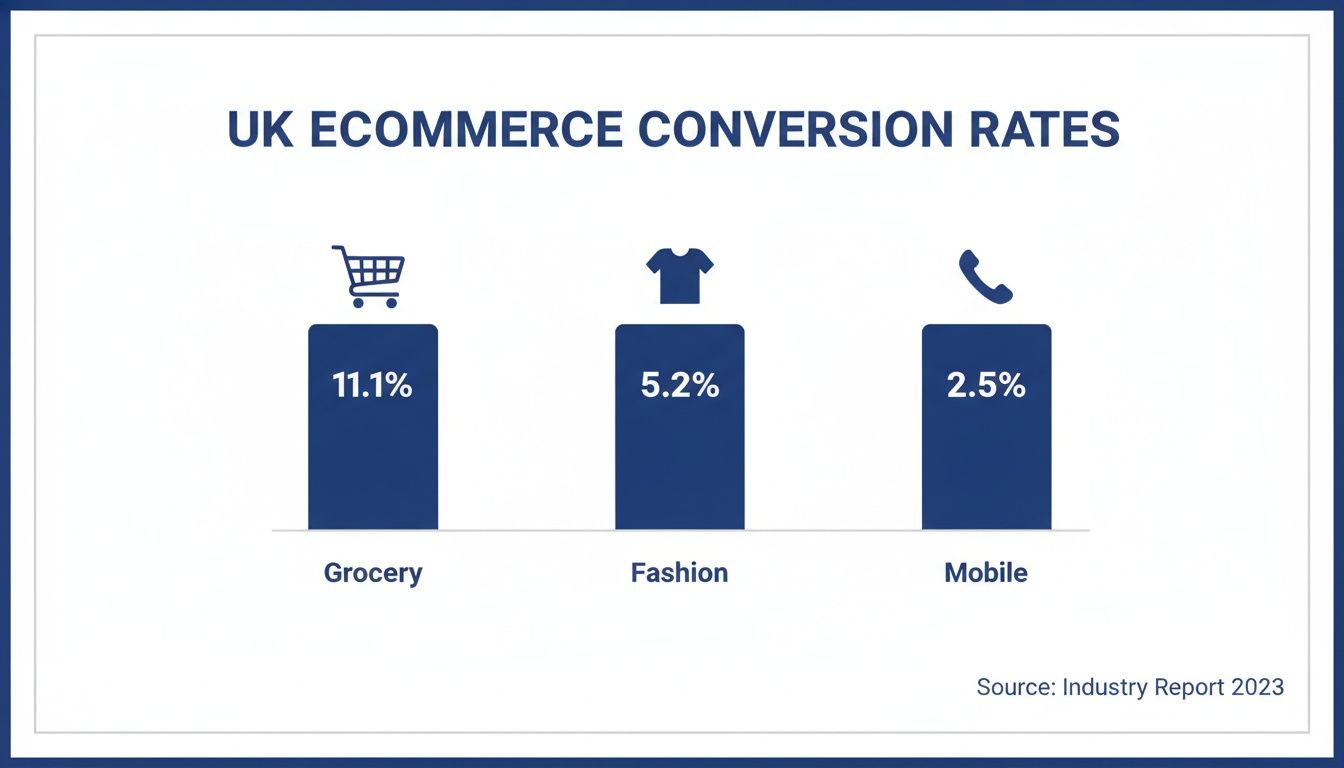
The data is clear: while grocery stores have a relatively straightforward path to conversion, fashion and particularly mobile commerce have a much tougher job turning browsers into buyers.
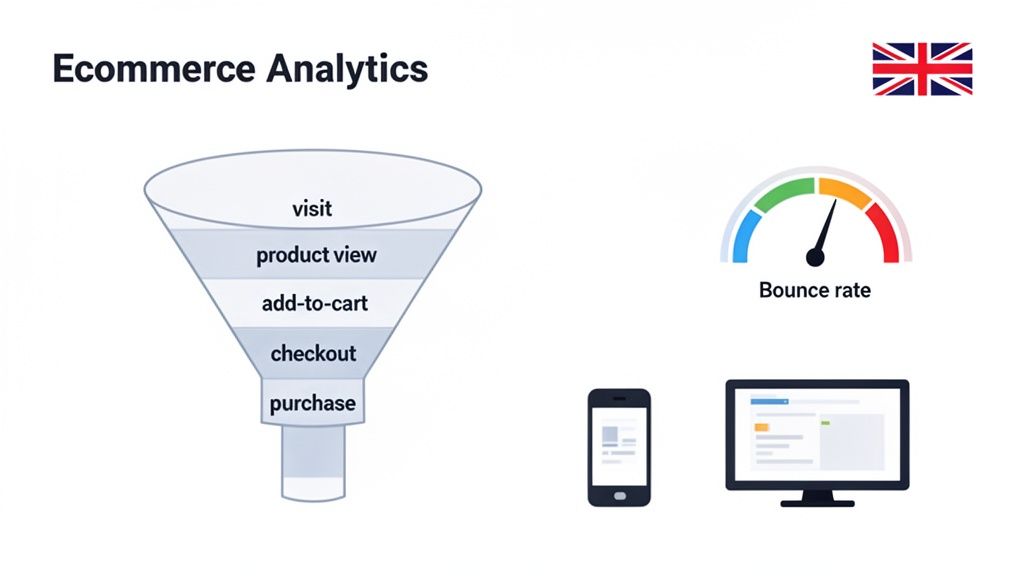
Pinpointing Funnel Drop-Offs
With your benchmarks in mind, it's time to analyse your own funnel. Where are potential customers bailing? A well-organised CRO dashboard in a tool like Google Analytics 4 is your best friend here.
Focus on these key stages:
- Homepage to Product Page: A high bounce rate could mean your value proposition is fuzzy or your navigation is a nightmare. Are visitors finding what they were promised?
- Product Page to Cart: If people are looking but not adding to their basket, the problem might be weak product descriptions, unconvincing images, hidden pricing, or a lack of crucial info like sizing guides.
- Cart to Checkout: A big drop-off here often means people are using the cart as a "wishlist" to save things for later. But it can also signal a weak call-to-action or a wobbly sense of trust.
- Checkout Abandonment: This is the leak that hurts the most. Shoppers who start the checkout process but don't finish are often put off by surprise shipping costs, a ridiculously long form, or not seeing their preferred payment option.
Digging into your data can reveal some powerful insights. For instance, you might find that while your overall conversion rate is a modest 3%, your rate for returning customers who use the search bar is actually 8%. That single piece of information tells you that improving product discovery for new users could be a massive lever for growth.
The Mobile Conversion Gap
The device people use adds another layer of complexity. In the UK, mobile phones drive around 70% of all e-commerce traffic. Yet, their conversion rates are often dismal, hovering between 1.8% and 2.5%, lagging far behind desktop.
This gap is a huge opportunity.
Auditing your mobile user experience isn't optional anymore. Look for slow page speeds, buttons that are impossible to tap, and forms that make you want to throw your phone across the room. A clunky mobile experience is the fastest way to lose a sale in 2025.
By building a diagnostic framework around these checkpoints, you'll have a data-backed roadmap for what to fix first. For a detailed guide on what to tackle, check out our complete [conversion rate optimisation checklist](https://www.marvyn.co/blog/conversion-rate-optimization-checklist).
Attracting Traffic That Actually Converts
Pouring money into ads to drive traffic to an unoptimised site is like trying to fill a leaky bucket. It's frustrating and expensive. But here’s the flip side: even a perfectly optimised website won’t convert traffic that was never going to buy in the first place.
The quality of your visitors is just as important as the quality of your website. Not all traffic is created equal. Some visitors land on your site with their credit card in hand, ready to go. Others are just browsing on their lunch break.
The real key is understanding the intent behind each marketing channel. Someone searching Google for "buy waterproof hiking boots size 9 UK" is worlds away from someone casually scrolling Instagram who happens to see your ad. Getting this distinction right is fundamental to building a marketing strategy that actually turns a profit.
Audit Your Marketing Channels for Conversion Quality
Your first job is to put on your detective hat and get into your analytics. You need to segment every conversion by its source. Which channels are your workhorses, bringing in actual paying customers, and which are just sending you window shoppers that inflate your visitor stats?
Look past the raw traffic numbers and get straight to the conversion rate for each channel. Recent UK ecommerce data shows just how dramatically performance can vary.
Organic search often leads the pack at a 2.1% conversion rate, which makes sense—these are people actively looking for what you sell. Paid search isn't far behind at 1.4%. But social media, especially from platforms like Facebook, can lag significantly with just a 0.9% conversion rate. At the top end, you'll often see email and affiliate marketing hitting anywhere from 2-3%.
You might find that while Instagram drives 40% of your total traffic, it only generates 5% of your sales. That’s not a signal to ditch Instagram. It’s a huge red flag telling you to completely rethink your strategy for that channel.
Refining Your Traffic at the Source
Once you’ve identified your underperforming channels, it's time to start improving the quality of the traffic before it even gets to your site. The aim is to pre-qualify visitors, making sure the audience you pay to acquire is the one most likely to buy.
For your paid search campaigns on Google or Bing, this comes down to tightening up your ad copy and keyword strategy.
- Get Specific in Your Ad Copy: Instead of a vague "Shop Our Shoe Collection," try something like "Handcrafted Leather Loafers | Free UK Shipping." This immediately filters out people looking for cheap trainers.
- Embrace Negative Keywords: Actively block your ads from showing for terms that signal zero buying intent. Add words like "free," "DIY," or "reviews" to your negative keyword list. You'll stop wasting money on clicks from people who were never going to purchase.
- Go Long-Tail: Bidding on a broad term like "handbags" is a lottery. Bidding on "women's vegan leather tote bag" attracts a shopper who knows exactly what they want.
On social media, your content needs to do more than just look pretty. Shift from broad awareness posts to content that pre-qualifies your audience by answering their biggest questions upfront. A video showing your stain-resistant shirt effortlessly repelling a coffee spill does the selling for you. It attracts viewers who value that specific feature, meaning they arrive at your store already half-convinced. If you're looking for more ways to bring in the right kind of visitors, our guide on how to [increase your Shopify sales](https://www.marvyn.co/blog/increase-shopify-sales) is a great place to start.
By focusing your time and budget on channels that attract high-intent shoppers, you stop pouring money into vanity metrics. You start building a sustainable pipeline of visitors who aren't just looking—they're ready to buy.
Turning Product Pages Into Conversion Drivers
Your product page is where the sale is won or lost. It’s the final moment of truth. All the money you spent on ads, all the effort you put into getting a visitor this far, it all comes down to this one page. If it fails to convince, that traffic and ad spend is wasted.
This isn't just about listing product specs. A great product page does the selling for you. It tells a story, solves a problem, and makes the shopper feel confident enough to hit that "Add to Cart" button. It's your last, best chance to make your case.
Crafting Compelling Product Descriptions
Your product description is your 24/7 salesperson. A lazy, feature-dump description is like a bored shop assistant who just points at the item. A great one engages, informs, and sells the outcome, not just the product itself.
Instead of saying, "This jacket is made of GORE-TEX," reframe it as a direct benefit: "Stay bone-dry on your commute, even in a downpour, with our fully waterproof GORE-TEX jacket." See the difference? One is a fact; the other is a solution to a real problem.
To write descriptions that actually sell:
- Focus on Benefits Over Features: For every feature, answer the question "so what?" for the customer. “500-thread count cotton” becomes “Experience hotel-level luxury and a silky-soft feel every single night.”
- Use Storytelling: Connect the product to an experience. Paint a picture of how it feels to use it, where they’ll take it, or the confidence it gives them.
- Incorporate Bullet Points: Shoppers skim. Use short, scannable bullet points for the most important benefits and specs. It makes the critical information impossible to miss.
Leveraging High-Impact Visuals
Online shoppers can't touch, hold, or try on your products. Your photos and videos have to do all of that sensory work for them. People buy with their eyes first—it's that simple. Research consistently shows that high-quality visuals are one of the most significant factors in a purchasing decision.
To really get this right, you have to think beyond a single, static image on a white background. Show your product from every conceivable angle. Use lifestyle shots that put it in a real-world context—a model wearing the dress to a party, a coffee table styled in an actual living room. A 30-second video showing the product in action can answer a dozen unasked questions and build massive confidence. It's critical to learn how to improve your product page conversion rate with visuals that do the selling for you.
Pro Tip: Weave user-generated content (UGC) directly onto your product pages. A feed of customer photos showing real people using your products is one of the most powerful forms of social proof you have. It's instant validation that people just like them are buying and loving what you sell.
Building Instant Trust and Clarity
Even with fantastic copy and beautiful images, a moment of hesitation is all it takes to lose a sale. Your product page has to anticipate and answer any doubts a shopper might have before they have them. This is where trust signals and crystal-clear information make all the difference.
Place these key elements prominently, either "above the fold" or right next to the "Add to Cart" button:
- Customer Reviews and Ratings: Star ratings are an immediate signal of quality. Display a few of the most detailed reviews to help shoppers validate their choice.
- Clear Sizing and Fit Guides: For clothing, a detailed sizing chart with measurements and model specs is non-negotiable. It’s one of the biggest hurdles for online apparel shoppers.
- Shipping and Returns Information: Don't make people hunt for this. A simple, bold line like “Free UK Shipping & 30-Day Returns” can instantly reduce purchase anxiety.
- A Clear Call-to-Action (CTA): Your "Add to Cart" button should be impossible to miss. Use a contrasting colour and clear, direct text.
By pulling these elements together, you create a product page that doesn't just display an item—it confidently guides the customer toward making a purchase. This careful approach is also a fantastic way to boost basket size; for more on that, have a look at our guide on how to increase your average order value.
Solving the Multibillion-Pound Cart Abandonment Crisis
Every abandoned cart is a conversation that ended too soon. A shopper found your store, browsed your products, and liked something enough to add it to their basket. They were moments away from becoming a customer, but then… something stopped them. With the UK ecommerce market projected to smash £286 billion, recovering even a fraction of these near-misses is a massive opportunity.
This is the most fragile stage of the entire customer journey. The smallest moment of hesitation, a flicker of doubt, or a hint of friction can completely derail a sale. The good news? Most of the reasons for abandonment are entirely fixable. It’s rarely about a fundamental flaw in your product; it’s almost always about the small, seemingly insignificant roadblocks you’ve put in their way.
The Great Divide Between ‘Add to Cart’ and ‘Buy’
Before we can fix the leak, we need to understand its size. Recent 2024 data paints a pretty stark picture for UK ecommerce. While a healthy 10.0-10.5% of visitors will add an item to their cart, the final conversion rate nosedives to just 3.4%. That’s a huge chasm. It means over 60% of your most motivated shoppers are dropping off right at the finish line.
The culprits are nearly always friction points that you can systematically identify and remove. This is where you can make some of the biggest and fastest gains in your mission to improve your ecommerce conversion rate.
“The number one killer of conversions at checkout isn’t price—it’s surprise. Unexpected shipping costs, forced account creation, and a clunky payment process are the three horsemen of cart abandonment. Eliminate them, and you’re already ahead of the game.”
Streamlining Your Checkout for Maximum Conversions
Think of your checkout as the final sprint in a marathon. After all that effort, the last thing you want is for your runner to trip over hurdles they never saw coming. A streamlined checkout is all about removing those obstacles and building momentum towards the finish line.
Here’s where to focus your efforts:
- Cull Unnecessary Form Fields: Do you really need their phone number, date of birth, and a separate billing address right now? Every single field is another reason for them to second-guess the purchase. Be ruthless. If it isn't absolutely essential to fulfil the order, get rid of it.
- Embrace Guest Checkout: Forcing a brand-new customer to create an account before they can give you their money is a classic conversion killer. Make guest checkout the most prominent, easiest option. You can always invite them to create an account on the "Thank You" page, after the sale is secured.
- Show All Costs Upfront: Year after year, the top reason people abandon carts is unexpected costs. Display shipping fees, taxes, and any other charges clearly in the cart before they even start the checkout process. No surprises.
Making these changes shifts the experience from an interrogation into a smooth, simple transaction. For a deeper look at this, our guide on how to [reduce cart abandonment](https://www.marvyn.co/blog/reduce-cart-abandonment) has even more actionable strategies.
Proactively Answering Last-Minute Questions with AI
What if a shopper hesitates because they have a last-minute question about your returns policy? Or they aren't sure if you ship to their specific postcode? In a physical shop, a helpful sales assistant would step in. Online, that role is now being filled by smart AI chatbots.
An AI chatbot acts as your 24/7 sales assistant, turning that flicker of hesitation into confident action. In fact, research shows that conversational AI can boost conversions anywhere from 4X to 12.3% by providing instant, accurate answers that remove purchase anxiety. It’s the modern equivalent of having an expert on the shop floor, ready to guide customers and close the sale.
Building Unshakeable Trust Through Personalisation
In a crowded online world, trust is your most valuable currency. A shopper might love your product, but if they feel even a flicker of doubt about your store’s legitimacy, they'll abandon their cart without a second thought. Building this trust isn't a one-off task; it's something you weave into every corner of your website, from the homepage to the checkout.
It all starts with the non-negotiables. These are the foundational elements customers subconsciously look for to feel good about their decision to buy from you. Without them, you’re fighting an uphill battle.
These fundamental trust signals include:
- A Crystal-Clear Returns Policy: Can a customer easily find and understand how to make a return? Hiding this or making it complicated just screams that you don’t stand behind your products. Make it prominent and write it in simple, human language.
- Accessible Customer Service: Shoppers need to know a real person is there if something goes wrong. Offer multiple ways to get in touch—like email, a phone number, or live chat—and make them dead easy to find.
- A Professional ‘About Us’ Story: Your ‘About Us’ page is your chance to connect on a human level. Share your brand’s mission and show the people behind the curtain. This transforms you from a faceless website into a brand they can actually relate to and trust.
These elements are your table stakes. They get you in the game. But to truly win—and seriously improve your e-commerce conversion rate—you need to go a step further. You need to make the entire experience feel personal.
Creating a Bespoke Shopping Experience
Personalisation is the bridge between earning baseline trust and creating genuine customer confidence. It’s about using customer data not just to sell, but to serve. When a shopping experience feels like it was designed specifically for an individual, it makes them feel seen and valued, which is a powerful driver for conversion.
Think of it as the difference between a massive department store and a small, curated boutique. In the boutique, the owner knows your style, remembers what you bought last time, and points you to items they know you’ll love. That’s the feeling you want to replicate online.
Recent studies have found that personalised calls to action can convert 202% better than generic ones. This highlights a simple truth: when you speak directly to a customer's needs, they are far more likely to listen and act.
This level of personalisation relies on intelligently using the data your customers give you through their on-site actions. For example, you can create dynamic offers that adapt in real time. If a shopper has been browsing a specific category, why not show them a banner with a relevant discount for those exact products?
The Power of Consultative Sales with AI
One of the most effective ways to deliver this boutique experience at scale is by using AI tools that offer a consultative sales experience. An AI chatbot, like Marvyn AI, can act as that expert personal shopper, available 24/7.
Instead of just being a reactive tool for support questions, a smart AI assistant can proactively engage with shoppers. It can ask about their needs, preferences, and budget, then guide them to the perfect product—just like a skilled sales associate. If someone is looking for a gift, for instance, the AI can ask about the recipient’s interests and suggest a curated list of options.
This consultative approach does two critical things:
- It removes friction: The AI answers questions instantly, so the shopper never has to leave the page to hunt for information.
- It builds confidence: By guiding the customer to the right product, it validates their choice and makes them feel more certain about their purchase.
This combination of foundational trust signals and smart, AI-driven personalisation creates a powerful flywheel. The more a customer trusts you, the more they interact. The more they interact, the more data you have to personalise their experience, which in turn builds even more trust. For an in-depth look at how this data can be managed, take a look at our guide to using a [CRM in ecommerce](https://www.marvyn.co/blog/crm-in-ecommerce).
Answering Your Top Conversion Rate Questions
Getting into conversion rate optimisation (CRO) always brings up a ton of questions. I get it. To help out, I’ve put together answers to some of the most common queries I hear from UK store owners. Think of this as a quick-start guide to turning more of your visitors into happy, paying customers.
What Is Considered a Good Ecommerce Conversion Rate?
Everyone wants to know the magic number, but a "good" conversion rate is a moving target. For most UK ecommerce stores, a solid benchmark is somewhere between 2% and 4%.
But context is everything. A high-ticket furniture store might be popping champagne for a 1% rate, while a brand selling low-cost beauty products might be aiming for 5% or even higher. Top-tier brands can sometimes hit 8% or more, but don't get hung up on that. They've likely been optimising for years.
Your first job is to benchmark against yourself. If you can lift your rate from 1.5% to 2.5%, that's a massive win. And don't forget to segment by device—mobile traffic often converts at about half the rate of desktop. If 70% of your visitors are on their phones, your overall average will naturally be a bit lower.
How Can Product Pages Improve Ecommerce Conversion Rates?
Your product page is where the sale is won or lost. It's the final pitch before a customer either clicks "Add to Cart" or bounces. This is arguably the most critical touchpoint for your conversion rate.
To make your product pages work harder for you, zero in on these areas:
- World-Class Visuals: You need more than one static photo. Use a mix of high-resolution images from every angle, 360-degree views, and short videos that show the product being used in a real-world setting.
- Crystal-Clear Pricing: No one likes surprises. Show the full cost upfront. If there are shipping fees, make them obvious from the start, not a nasty shock at the final checkout step.
- Real, Honest Customer Reviews: Get those star ratings and detailed testimonials front and centre. Research consistently shows that over 90% of shoppers read reviews before they even think about buying.
- Benefit-Driven Descriptions: Stop just listing features. Tell the customer what your product does for them. How does it make their life easier, solve their problem, or fulfil a desire?
What Are Some Low-Effort Ways to Boost Conversions?
The quickest wins almost always come from reducing friction and building trust. These small tweaks can have an outsized impact on a shopper's confidence and, ultimately, your bank balance.
Here are a few high-impact tactics you can try this week:
- Add Trust Signals Next to Your CTAs: Place reminders like money-back guarantees, free shipping thresholds, and secure payment logos right beside your "Add to Cart" button. It calms last-minute nerves.
- Ruthlessly Simplify Your Checkout: Remember the famous case where Expedia supposedly boosted profits by $12 million just by removing a single, optional form field? Every click counts. Enable guest checkout to get rid of the account creation hurdle.
- Make Your Search Bar Unmissable: A visitor who uses your on-site search bar is telling you exactly what they want. They have high purchase intent. A fast, accurate search function is a direct path to a sale.
A simple, well-placed guarantee like "Free UK Returns & 30-Day Money-Back Guarantee" can do more to ease purchase anxiety than a complete website redesign. It’s a powerful signal that you stand behind your products, making the decision to buy much easier for a hesitant shopper.
How Do Technical Issues Hurt Conversions?
Technical problems are silent conversion killers. A broken link, a slow-loading page, or a clunky mobile menu isn't just an annoyance; it’s a direct reason for a potential customer to leave and never come back.
Think about it like a brick-and-mortar shop. A broken link is a locked door. A slow mobile page is like a cluttered, narrow aisle that's impossible to get down. These aren't minor inconveniences—they are major roadblocks that stop a sale in its tracks.
Google’s data shows that 53% of mobile users will abandon a page if it takes longer than three seconds to load. Before you spend a penny on fancy marketing campaigns, make sure your site's foundations are solid. No amount of clever copywriting can make up for a fundamentally broken user experience.
Ready to turn more browsers into buyers and answer every customer question instantly? Marvyn AI is a free, fully autonomous AI chatbot that installs in one click on your Shopify store. It learns your entire product catalogue and policies to provide 24/7 consultative sales support, reducing cart abandonment and boosting conversions. Get started in minutes at https://www.marvyn.co.