How to Increase Average Order Value in 2026
When it comes to growing your Shopify store, there are really only two ways to increase your average order value (AOV): get customers to buy more things, or get them to buy more expensive things. It sounds simple, but getting it right is what separates fast-growing brands from the rest.
Proven tactics like smart product bundling, offering free shipping once a customer hits a certain spend, and strategic upselling all work towards this goal. They make it almost effortless for shoppers to add a little extra to their carts, boosting your revenue without you needing to spend a penny more on acquiring new traffic.
Why Average Order Value Is Your Most Important Growth Metric

In today's crowded e-commerce market, the cost of acquiring new customers just keeps climbing. It’s a reality that’s forcing savvy Shopify owners to shift their focus away from just chasing more website traffic. Instead, they’re concentrating on maximising the revenue from every single transaction. This focus on AOV is a far more sustainable and capital-efficient way to scale.
Honestly, understanding how to maximise your average order value is a non-negotiable part of any strategy to grow your online business. Getting each customer to spend just a few pounds more can have a massive impact on your profitability and customer lifetime value (LTV).
AOV as a Sustainable Growth Lever
When you really lean into boosting your AOV, you unlock some serious advantages for your brand.
- Increased Profitability: You’ve already paid the cost to acquire the customer. Every additional pound they spend goes straight to your bottom line, directly improving your profit margins.
- Higher Return on Ad Spend (ROAS): When each conversion is worth more, your marketing campaigns suddenly become more profitable. This gives you more cash to reinvest in what’s working.
- Improved Customer Lifetime Value: Customers who have a great experience making a larger, more considered purchase are often more likely to come back. This turns a one-off buyer into a long-term fan.
This focus on basket size is particularly relevant in the current UK e-commerce landscape. Recent data showed that even as consumers shopped less frequently, average order values surged by 7% year-over-year. It’s clear proof that encouraging bigger, more valuable purchases is a winning strategy right now.
For direct-to-consumer (DTC) brands, this proves that strategic personalisation and upselling are proven paths to higher per-order revenue in a maturing market. Focusing on AOV isn't just a tactic; it's a fundamental shift in growth strategy.
This guide will give you a clear roadmap to do just that. We'll walk through the practical strategies you can implement on your Shopify store today, from smart bundling to AI-driven personalisation. The goal is to give you the tools to turn your existing traffic into a powerful revenue engine.
To get started, here’s a quick overview of the core strategies we're going to dive into. Think of this as your cheat sheet for the rest of the guide.
Quick Guide to AOV-Boosting Tactics
Each of these tactics plays a unique role, but they all work toward the same simple goal: making it easy and appealing for your customers to spend a little more. Now, let’s get into the specifics of how to put them into practice.
Crafting Irresistible Product Bundles and Volume Tiers
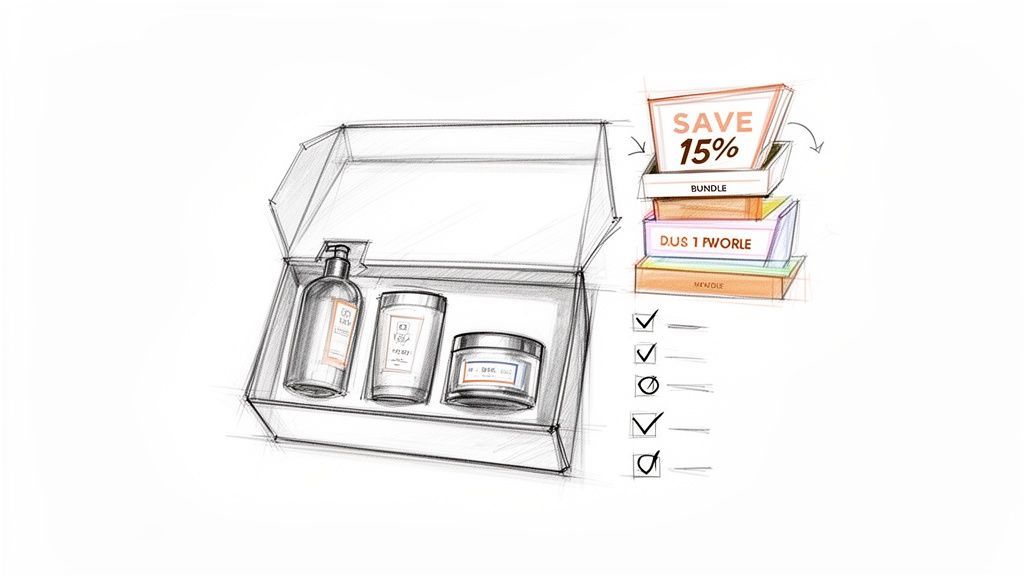
Product bundling is one of the most powerful plays you can make to lift your average order value. Why? Because it completely shifts the customer's mindset from price to value. Instead of just dangling a discount, you’re creating a smart, curated solution that makes their life easier.
The trick is to move beyond generic "buy one, get one" offers and build bundles that feel like an expert recommendation from you, the store owner. By packaging complementary items together—often with a small discount—you make it a no-brainer for shoppers to say yes. This not only boosts their basket size but also introduces them to products they might have missed otherwise. That’s a win-win.
Mine Your Data for Bundle Ideas
The best bundles solve a real customer problem, and the clues are already sitting right there in your Shopify sales data. Dive into your analytics to see which products are frequently purchased together. This is your goldmine for creating data-backed bundles that you already know will resonate.
You’re looking for patterns. A home goods store might notice that customers buying a specific scented candle often come back a week later for the matching room spray. Combining those into a "Home Fragrance Starter Kit" is a natural fit that makes the customer's decision effortless.
For Shopify store owners, finding these patterns is surprisingly straightforward:
- In your Shopify admin, head to Analytics > Reports.
- Run the "Market basket analysis" report. This report specifically shows you which products are most commonly bought in the same order.
- Pinpoint the top pairings and trios. These are your prime candidates for a new product bundle.
Design Bundles That Scream Value
Once you've found your potential pairings, the next step is framing them in a way that highlights the value. Don't just list the products; give the bundle a compelling name that speaks to the solution it provides. This turns a simple transaction into a guided purchase.
Take a skincare brand, for example. Instead of just listing a cleanser, serum, and moisturiser, they could package it as the "Complete Morning Routine Kit." This immediately tells the customer what problem the bundle solves. You're not just selling products; you're selling a clear, simple outcome.
Research shows that when done right, product bundles can lead to a 55% lift in AOV. This is because they simplify decision-making and increase the perceived value of the purchase, making customers feel like they're getting a smart deal.
Implement and Test Different Bundle Types
Shopify’s app ecosystem makes it incredibly easy to experiment with different bundling strategies. You're not just limited to pre-set kits; you can offer more dynamic and personalised options that give customers a sense of control and customisation.
Here are a few popular formats worth testing:
- Fixed Bundles: This is the classic "kit" model, like our skincare routine example. It’s perfect for your best-sellers and for solving common problems your customers face.
- Build Your Own Bundle: Let customers pick 3-5 items from a pre-defined collection to build their own custom package, usually for a set price or a tiered discount. This empowers shoppers and really drives up engagement.
- Volume Tiers: Offer discounts that get better with quantity (e.g., "Buy 2, save 10%; Buy 3, save 20%"). This works brilliantly for consumable products like coffee, supplements, or anything else people use regularly.
Using Shopify apps like **Bundles.app** or **Frequently Bought Together** can get you up and running with these in minutes. My advice? Start with one type, measure its impact on your AOV, and then iterate. The goal is to find what works for your specific customers and your unique product line-up.
Executing Strategic Upsells and Cross-Sells That Convert
While product bundling is about creating value through curation, upselling and cross-selling are where you get surgical. These are two of the most powerful tactics for lifting your average order value, simply by suggesting the right offer at the perfect moment.
But they aren’t interchangeable. An upsell encourages a customer to buy a more premium or larger version of the product they’re already looking at. Think bigger, better, faster. A cross-sell, on the other hand, suggests a complementary item that enhances the original purchase. Think accessories or related essentials.
Knowing when to use each is the secret sauce. For businesses that get it right, cross-selling can drive up to 30% of e-commerce revenue. Upselling often has an even higher conversion rate because the customer is already sold on the product category.
The Art of the Subtle Upsell
An effective upsell should feel less like a sales pitch and more like genuinely helpful advice. The best time to present it is on the product page, right when a customer is showing high purchase intent. Your goal is to show them how a small extra spend can deliver a massive jump in value or longevity.
For instance, say a customer is looking at a standard 250g bag of coffee beans. A perfectly placed upsell might be a 500g bag with a better price-per-gram, or maybe a single-origin "Reserve" version of the same coffee for just a few quid more.
A critical rule of thumb is to keep the upsell price within a reasonable range. If the suggested item costs more than 25% of the original product, you risk sticker shock and could lose the sale entirely. Keep it attainable.
Mastering the Relevant Cross-Sell
Cross-selling is all about anticipating what the customer will need next. You’re essentially saying, “If you’re buying this, you’ll probably want this to get the most out of it.” This works wonders on the cart page or during checkout, once the main purchase decision has been made.
Imagine a customer adds a pair of premium headphones to their cart. As they go to check out, a section titled “Complete Your Setup” appears, suggesting a durable protective case and a headphone stand. These are logical, low-cost additions that make the main purchase better.
This strategy works because it’s genuinely useful. It saves the customer a separate search for accessories and presents a complete solution right away.
Implementing on Shopify
Shopify store owners have a wealth of tools to make this happen without a fuss. Many themes have built-in cross-sell sections you can enable on product and cart pages. For more advanced features, you can turn to the app store:
- Essential Shopify Upsell App: A straightforward option for stores that want upsell and cross-sell offers up and running quickly, without a steep setup process.
- ReConvert Upsell & Cross Sell: Fantastic for post-purchase upsells and customising your thank you page.
- OneClickUpsell: Sharply focused on adding upsells and cross-sells to your pre- and post-purchase funnels.
- Zipify OneClickUpsell: A popular choice for creating sophisticated upsell flows without touching a line of code.
The Magic of Post-Purchase Upsells
One of the most effective, low-friction ways to boost your AOV is the post-purchase upsell. This is an offer that appears after a customer has completed their payment but before they hit the thank you page.
Because the customer has already entered their payment details and committed, adding another item is incredibly easy—often just a single click. This removes all friction without putting the original sale at risk. A post-purchase offer for a travel-size version of a popular product or a heavily discounted accessory can be an irresistible, impulse-driven way to bump up that final order total.
8. Automate Personalised Shopping with AI
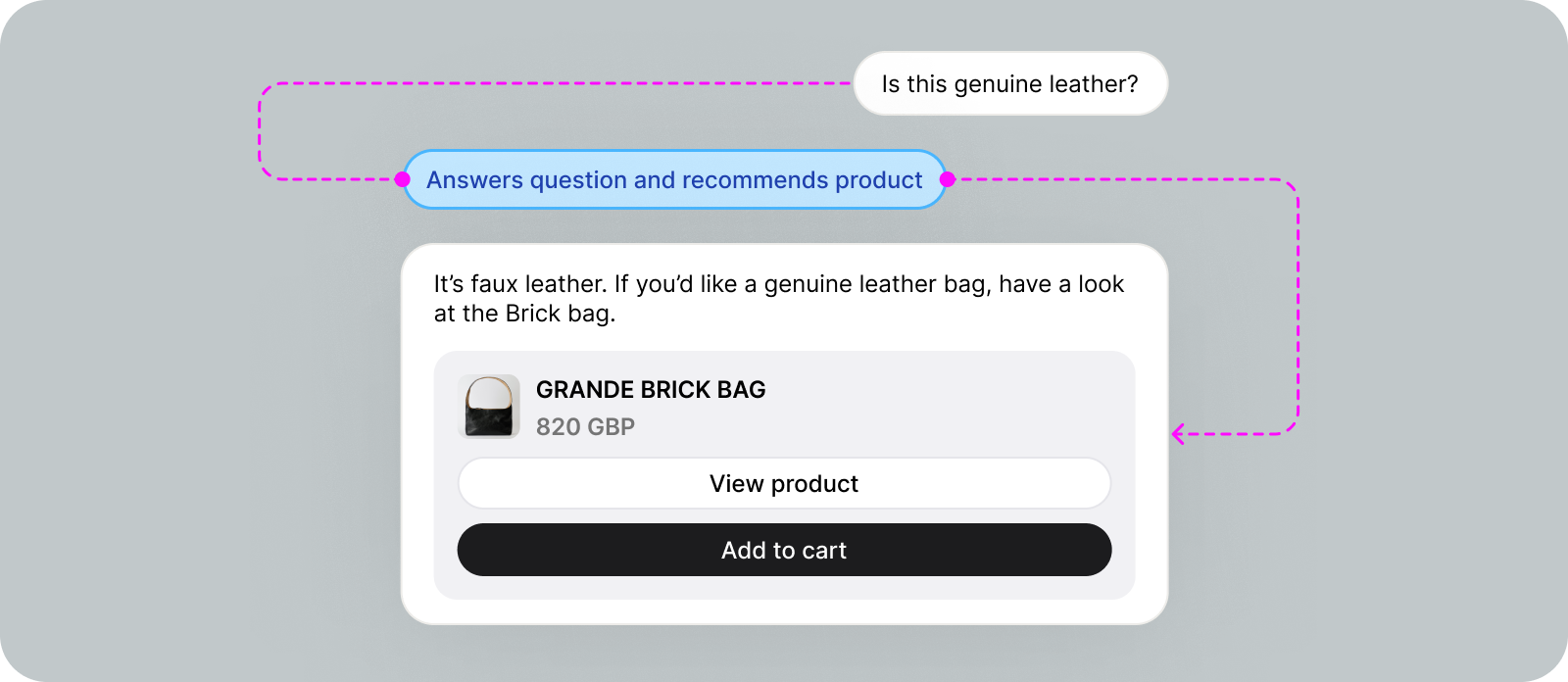
Imagine having a top-tier sales consultant available for every single visitor, 24/7. That’s the real power of AI in modern e-commerce. For Shopify store owners, this technology has become a secret weapon for moving beyond a static product catalogue and creating a guided, consultative shopping journey.
AI is no longer just for enterprise giants. It’s now an accessible way to understand what your customers actually want in real-time and deliver sharp, relevant recommendations. This is a massive leap forward for reducing cart abandonment and making shoppers feel truly understood—which is what drives up average order value.
Moving Beyond Static Recommendations
For years, e-commerce has relied on basic "Customers also bought" widgets. While better than nothing, those static suggestions lack the nuance of a real conversation. AI recommendation engines take this a massive step further by analysing individual behaviour, browsing history, and real-time interactions to predict what a shopper is truly looking for.
Think about it. A customer lands on your site looking for a new running shoe. An AI assistant can immediately engage them, asking about their running style, preferred terrain, and budget. Instead of just showing a grid of best-sellers, it delivers tailored suggestions, explains the benefits of a premium model (an upsell), and even suggests the perfect moisture-wicking socks to go with it (a cross-sell).
This approach transforms shopping from a passive scroll into a helpful dialogue. The result is a larger, more satisfying purchase for the customer and a significant, direct boost to your AOV.
Intelligent, personalised recommendations are now critical for AOV growth. In UK e-commerce, AI-driven tactics have been shown to boost conversion rates by 15-25% and deliver an incredible five to eight times return on marketing spend. As the UK AI e-commerce market is projected to reach $22.60 billion by 2032, it’s clear this is a trend you can't afford to ignore.
Implementing AI Personalisation on Shopify
Getting started with AI on Shopify is far more accessible than you might think. Many modern tools are designed for a simple, one-click installation that requires zero coding. These apps instantly sync with your product catalogue, policies, and existing site content to get up and running in minutes.
The most effective way to do this is with an AI-powered chatbot or sales agent. These tools can:
- Automate Consultative Selling: They act as a personal shopper, guiding users with smart questions about their needs to recommend the perfect products from your catalogue.
- Surface Relevant Upsells: When a user is looking at a product, the AI can suggest a higher-value alternative that offers better features, more durability, or premium materials.
- Offer Smart Cross-Sells: As items are added to the cart, the AI can propose complementary products that complete a set or enhance the original purchase, making the suggestions feel helpful, not pushy.
This proactive engagement keeps shoppers on your site longer and helps them discover more of what you offer. For a deeper look at this technology, check out our guide on how AI sales agents can transform your store.
The Real-World Impact on AOV
Let’s look at a practical scenario. A customer visits your home decor store looking for a sofa. An AI assistant pops up and asks, "Are you decorating a specific room? What’s your style preference—modern, traditional, or eclectic?"
Based on their answers, the AI recommends a few sofas that fit their criteria. Once the customer chooses one, the assistant follows up: "Great choice! Many customers who bought this sofa also loved this matching armchair and rug to complete the living room set. Would you like to see them?"
This simple, automated interaction can easily turn a £1,000 sale into a £1,800 one. The key is that the recommendations feel relevant and genuinely helpful. By understanding and anticipating customer needs, AI makes adding more to the cart a natural decision, directly driving up your average order value.
Setting Smart Thresholds for Free Shipping and Gifts
A "free shipping" offer is one of the most powerful psychological triggers you have. It’s no secret that unexpected shipping costs are a top reason for cart abandonment. In fact, studies show around 58% of shoppers will happily add more items to their cart just to qualify for free delivery.
When used correctly, this simple incentive is a masterclass in boosting your average order value.
The trick is finding the "sweet spot" for your threshold. If you set the bar too high, you’ll just scare customers away and see more abandoned carts. But set it too low, and you're just giving away shipping on orders you would have received anyway, eating directly into your margins.
Calculating Your Perfect Threshold
A reliable starting point is to take your current Average Order Value (AOV) and add about 15-20%. For instance, if your AOV is currently £42, a smart free shipping threshold would be around the £50 mark.
This amount feels attainable. It encourages customers to find one more small item to add to their order instead of just ditching the whole purchase.
Once you’ve set the threshold, make it impossible to miss. You can use Shopify’s announcement bar or a dynamic cart notification to show customers exactly how close they are. A simple message like, "You're only £8 away from free shipping!" creates a mini-challenge that a surprising number of shoppers are happy to take on.
The goal isn’t just to offer free shipping, but to use it as a strategic tool. It should feel like a reward the customer has earned by spending a little more, turning a potential cost centre into a profit driver.
Go Beyond Shipping with Free Gifts
While free shipping is a workhorse, a free gift can be an even stronger motivator. Offering a genuinely desirable product as a reward for hitting a spend threshold often creates a much higher perceived value than simply waiving a £4.99 shipping fee.
Think about a coffee brand with an AOV of £40. They could offer a free bag of a new, exclusive blend on all orders over £50. This tactic not only lifts the immediate order value but also doubles as a product discovery tool, introducing loyal customers to something new they might buy next time.
The offer feels tangible, exciting, and far more generous than a simple discount on delivery.
To really get how this kind of personalised incentive can work, it's worth digging into the technology that makes it possible. For a deeper look at how systems can predict and deliver these tailored experiences, you can learn How NLP Powers Personalization in BI Tools. This is how you turn a simple offer into a smart, data-driven strategy.
Building Loyalty Programmes and Subscription Models
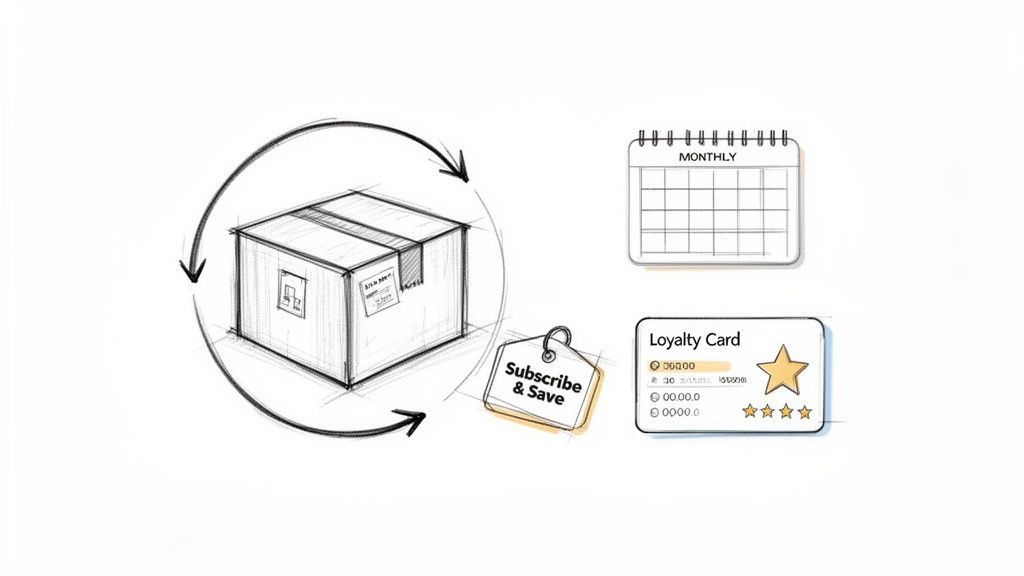
While tactics like bundling and upselling are great for boosting a single transaction, loyalty programmes and subscriptions are where you build real, long-term value. Let's be honest: your highest AOV will almost always come from your most dedicated, repeat customers.
Cultivating that loyalty is a surefire way to not only lift your average order value but also lock in predictable, recurring revenue. These two strategies are absolute powerhouses for making that happen. A smart loyalty programme rewards customers for coming back, while a subscription model secures that repeat business from the very first order.
Structuring a Points-Based Loyalty Programme
The most effective loyalty programmes I've seen feel less like a marketing gimmick and more like a rewarding game. The setup is simple: customers earn points for every pound spent, which they can then cash in for discounts, free products, or exclusive perks. This directly encourages bigger orders.
When a shopper knows that spending just a little more will push them into the next reward tier, they're far more likely to add one more item to their basket. It reframes the purchase from a one-off spend to an investment in future savings.
Here’s a key insight: the best programmes don't just reward spending. They also give out points for non-transactional actions, like writing a review or following your brand on social media. This deepens engagement and makes customers feel like part of a community, not just a number on a spreadsheet.
Implementing this on Shopify is surprisingly straightforward with apps like Smile.io or Yotpo Loyalty & Rewards. These tools let you create tiered programmes where the perks get better as customers spend more, which is a direct incentive for a higher AOV. You can even send automated reminders about point balances to keep your brand top-of-mind. For more tips on engaging your customers, check out our article on using email for customer service.
Launching a “Subscribe and Save” Model
For any store selling consumable products, subscriptions are a complete game-changer. The "subscribe and save" model is simple: offer customers a discount for committing to regular, automated deliveries. This doesn't just guarantee recurring revenue; it often gives your initial order value a significant boost.
Why does this work? Because customers tend to bundle multiple items into their first subscription order to make sure they're "stocked up" for the month ahead. They’re thinking long-term from the get-go, which naturally leads to a larger initial basket. This strategy is proving incredibly effective right now in the UK market.
Subscription models are transforming UK AOV, especially in grocery e-commerce, which is showing a 10.32% CAGR through 2031, largely driven by these "subscribe and save" options. This trend is backed up by data showing Food & Drink AOV rising 8.83% in a single month. For Shopify brands, this is a proven path to locking in revenue and lifting basket sizes right from the first order. You can dive deeper into this trend in the latest e-commerce statistics report.
Micro Case Study: A Pet Food Brand
Let’s look at a real-world example. A Shopify store selling premium, natural pet food had an AOV that hovered around £35, which was usually the price of one large bag of food. To push this number up, they launched a "Monthly Wellness Box" subscription.
- The Offer: Customers could subscribe to a monthly delivery and get a 15% discount.
- The Bundle: The box wasn't just the food. It included their main food product, a bag of healthy treats, and a dental chew.
- The Result: The subscription box was priced at £55. This single change immediately lifted the AOV for subscribing customers by over 55%.
They pulled this off using a Shopify app like Recharge Subscriptions. It was a small change that completely transformed their business, turning one-off buyers into loyal, high-value subscribers and creating a stable revenue stream while simultaneously smashing their AOV goals.
Measuring and Optimising Your AOV Initiatives
Setting up product bundles and free shipping thresholds is a solid first move, but the real money is made in the details. If you just set these strategies and walk away, you're almost certainly leaving profit on the table.
The goal isn't just to launch a tactic; it's to build a continuous feedback loop. You make small, smart changes, measure the results, and let the data tell you what to do next. This is how a good idea becomes a powerful, reliable part of your revenue engine. Without tracking, you’re flying blind.
Key Performance Indicators to Watch
Your main goal is to increase the average order value, but staring at that one number can be seriously misleading. A huge AOV is worthless if it comes at the cost of your conversion rate.
Instead, you need to track a balanced set of KPIs in your Shopify Analytics dashboard. Here are the essentials I always keep an eye on:
- Average Order Value (AOV): The main event, but it needs context. Is it going up because a few people are spending a lot more, or because most people are spending a little more?
- Conversion Rate: This is your reality check. Are your offers actually encouraging sales or just annoying people? A tiny dip might be okay for a massive AOV jump, but you have to find the right balance.
- Items Per Order: This one’s straightforward. It tells you if customers are genuinely adding more products to their carts—a clear sign your bundles or cross-sells are hitting the mark.
- Cart Abandonment Rate: Pay very close attention here, especially when you’re testing shipping thresholds. If you see a sudden spike, it's a huge red flag that your free shipping bar is set too high.
The key is to find that sweet spot where you successfully nudge customers to spend a bit more without creating friction that drives them away. This balance is where you'll find your maximum profit.
A Simple Framework for A/B Testing
Confident experimentation is the cornerstone of optimisation. An A/B test simply lets you pit one idea against another to see which one performs better in the real world. No more guesswork.
For example, you could test two different free shipping thresholds. For one week, set your threshold at £50. The next week, bump it up to £60. Then, compare the AOV, conversion rate, and abandonment rate for both periods to see which one actually generated more overall profit.
You can do the same with product bundles versus a simple discount on a single item. Which one moves more units and drives a higher total cart value? For a more structured approach, our [conversion rate optimisation checklist](https://www.marvyn.co/blog/conversion-rate-optimization-checklist) can give you a great starting point.
Make one change, measure its impact, and let the data guide your next move. It’s a simple process, but it’s how the best stores continuously pull ahead.
Frequently Asked Questions About Increasing AOV
As you start putting these AOV strategies into practice, you're bound to have some practical questions. It's completely normal. Here are quick, straightforward answers to the most common queries we see from Shopify owners.
What Is The Difference Between AOV And LTV?
Average Order Value (AOV) is simple: it’s the average amount a customer spends in a single transaction. It’s a snapshot of a single purchase.
Customer Lifetime Value (LTV) is the long game. It measures the total revenue a single customer brings to your business over their entire relationship with your brand. Think of increasing AOV as one of the most direct ways to boost your LTV.
How Do I Find The Perfect Free Shipping Threshold?
There’s a simple formula that works wonders as a starting point. First, calculate your current AOV. Then, add 15-20% to that number.
For example, if your store's AOV is currently £40, setting a free shipping threshold at £50 is a smart move. It’s a small, achievable jump that encourages customers to add just one more item to their cart, without feeling so high that they just give up.
What Is The First Step For Using AI Personalisation?
The easiest way to get started is with a one-click Shopify app. Forget about wrestling with code or complex setups.
Modern AI sales agents are designed to install in minutes. They instantly connect to your product catalogue and store policies, giving you a fully functional AI assistant that can start guiding customers and offering personalised recommendations right away.
The goal is always to make a larger purchase feel like a natural, helpful, and value-driven decision for the customer—not a forced upsell. A good AI tool makes this happen effortlessly.
Ready to turn more browsers into buyers and boost your AOV automatically? Add Marvyn AI to your Shopify store for free. Our fully autonomous AI sales agent engages customers with consultative selling, driving higher cart values 24/7. Get started in minutes for FREE.
Related Articles
Unlocking Growth With AI Sales Agents for Your DTC Brand
Discover how AI sales agents can transform your Shopify store. Learn to increase conversions, boost AOV, and enhance customer experience with our expert guide.
Conversion Rate Optimization Checklist for Shopify in 2026
Master the conversion rate optimization checklist for Shopify in 2026. Boost sales, reduce cart abandonment, and raise AOV with 10 practical steps.
A Shopify Guide to Reduce Cart Abandonment
Reduce cart abandonment on your Shopify store with this complete guide. Learn to diagnose causes, implement fixes, and use AI chatbots to recover lost sales.
Boost Loyalty with email for customer service - Master Support
Master email for customer service and transform UK ecommerce support with empathetic, efficient messages that build loyalty and drive sales.
7 Top Chat Bot Examples for E-commerce Success in 2026
Discover the best chat bot examples for Shopify stores. See how Marvyn AI and others automate support and drive sales with real-world use cases.
10 Customer Service Best Practices for Shopify Brands in 2026
Discover 10 actionable customer service best practices for DTC brands. Boost sales and satisfaction on Shopify with our 2026 guide to automation and support.