7 Top Chat Bot Examples for E-commerce Success in 2026
In the highly competitive world of e-commerce, generic customer interactions are a liability. Shoppers now demand instant, personalised, and genuinely helpful conversations at any hour. This is precisely where AI-powered chatbots have become essential tools for growth, evolving far beyond simple FAQ bots into round-the-clock sales and support agents.
For Shopify merchants, the right chatbot can mean the difference between a lost sale and a loyal customer. It can slash support ticket volume, recover abandoned carts, and increase average order value (AOV) by providing consultative guidance exactly when it’s needed. But with a crowded market of platforms, identifying the best fit for your specific business goals can be a challenge. To truly thrive, your Shopify store needs more than just a pop-up; it needs tools like powerful AI chatbots for ecommerce that can boost sales by engaging customers proactively and providing instant support.
This article cuts through the noise. We will break down seven of the best chat bot examples available today, analysing their strategic application for DTC brands. For each platform, including Gorgias, Intercom, and Zendesk, you will find a detailed analysis of its core strengths, ideal use cases, and actionable takeaways. We'll provide annotated screenshots and direct links to help you evaluate each option.
We will pay special attention to Marvyn AI, a purpose-built solution designed to turn Shopify stores into high-performing conversion engines. Our goal is to give you a clear, strategic roadmap for selecting and implementing a solution that delivers measurable revenue growth and a superior customer experience.
1. Marvyn AI
Marvyn AI presents a compelling case as a premier chat bot example for Shopify merchants, particularly those aiming for substantial growth without a proportional increase in overheads. It functions as a fully autonomous AI sales agent, designed not just to answer questions, but to actively convert browsers into buyers through guided, consultative conversations. Its core strength lies in its deep, one-click integration with Shopify, which allows it to instantly understand a store’s entire product catalogue, policies, and collections, acting as an expert sales assistant from the moment it’s activated.
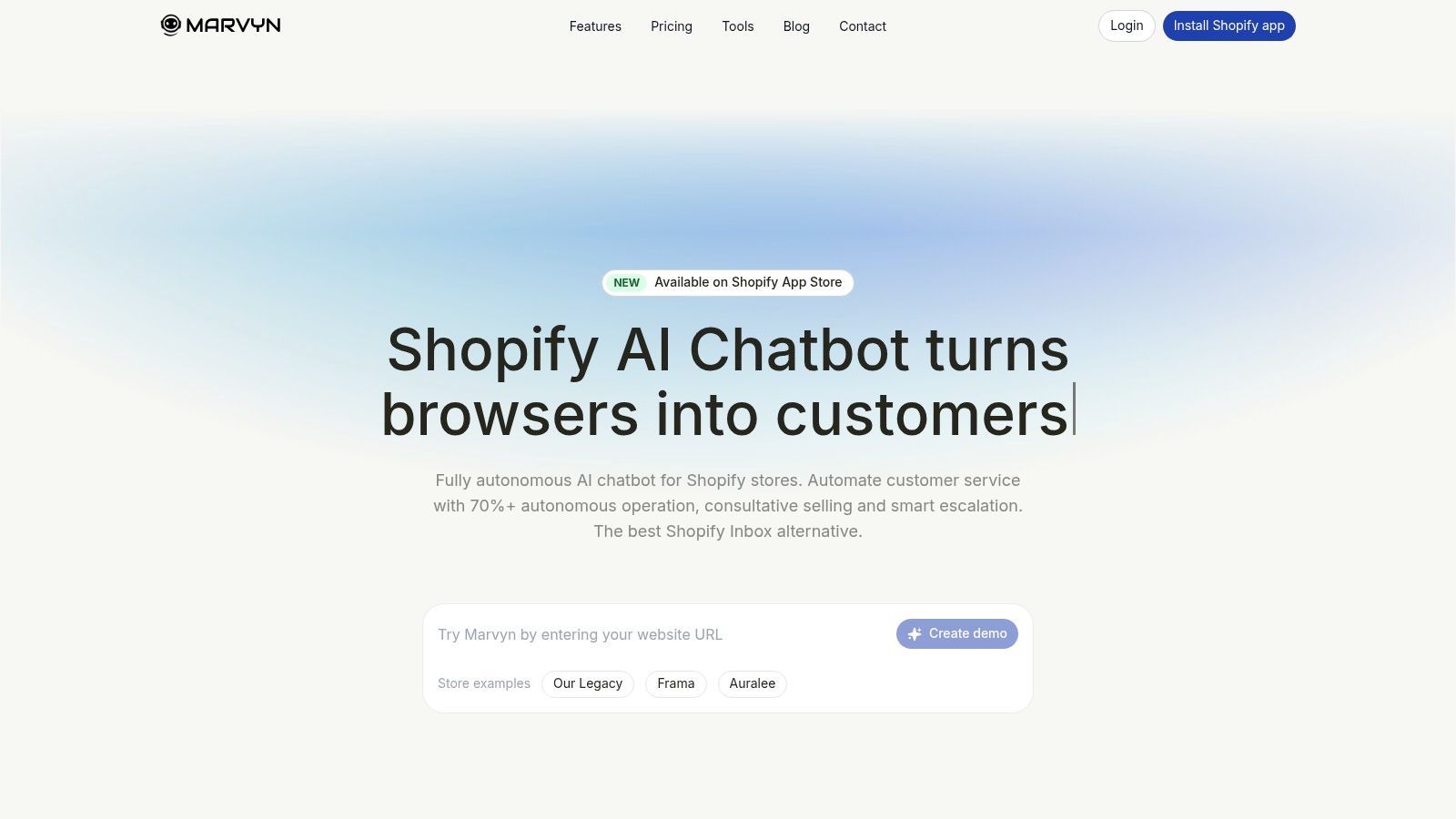
This platform stands out by blending robust support automation with proactive sales functions. While many chatbots focus solely on deflecting tickets, Marvyn is engineered to engage shoppers, ask clarifying questions about their needs and budget, and recommend specific products. This approach directly tackles cart abandonment and helps increase average order value (AOV) by replicating the experience of an in-store expert, available 24/7 in over 80 languages.
Strategic Breakdown and Key Capabilities
Marvyn’s architecture is built for immediate impact and scalability, making it an excellent fit for solo founders and established brands alike.
- Deep Shopify Integration: The one-click installation process is a significant advantage. Marvyn automatically syncs all product data, variants, stock levels, and store policies. This removes the need for manual setup and ensures the bot provides accurate, real-time information on everything from shipping times to return procedures.
- Consultative Selling Engine: Unlike passive Q&A bots, Marvyn initiates dialogue to understand shopper intent. For instance, it might ask, "Are you looking for a gift or something for yourself?" or "What's your budget for a new jacket?" This guided selling method helps shoppers navigate large catalogues and find the perfect item, increasing purchase confidence. For a deeper look at this strategy, you can explore how these AI sales agents are changing e-commerce.
- Cost-Effective Scalability: The platform operates on a model that includes a free tier with unlimited conversations, which is a major differentiator. Businesses are not penalised for growth or high traffic volumes, making it a predictable and low-risk investment. This contrasts sharply with many alternatives that charge per conversation or agent seat.
Actionable Takeaways for Merchants
To get the most out of Marvyn AI, Shopify store owners should focus on a few key areas. First, customise its appearance to match your brand’s colours, logo, and voice, ensuring a consistent user experience. You can adjust its personality from purely functional to more conversational.
Next, use the training feature by uploading your existing FAQ documents or help-centre articles. This enriches its knowledge base beyond the standard product and policy data, allowing it to handle more specific and nuanced customer queries with precision. Finally, regularly review the conversation analytics dashboard. This provides valuable insights into common customer questions, product interests, and potential friction points in the buying journey, offering a direct feedback loop for optimising both your bot and your store.
Website: https://www.marvyn.co
2. Intercom
Intercom presents a customer communications platform that goes beyond simple live chat, offering a complete support stack. Its standout feature is "Fin," a sophisticated AI agent built on large language models, designed to provide instant, human-like answers by drawing directly from a business's existing help centre content, knowledge bases, and conversation history. This makes it one of the most powerful chat bot examples for teams aiming to resolve complex queries automatically without extensive manual setup.
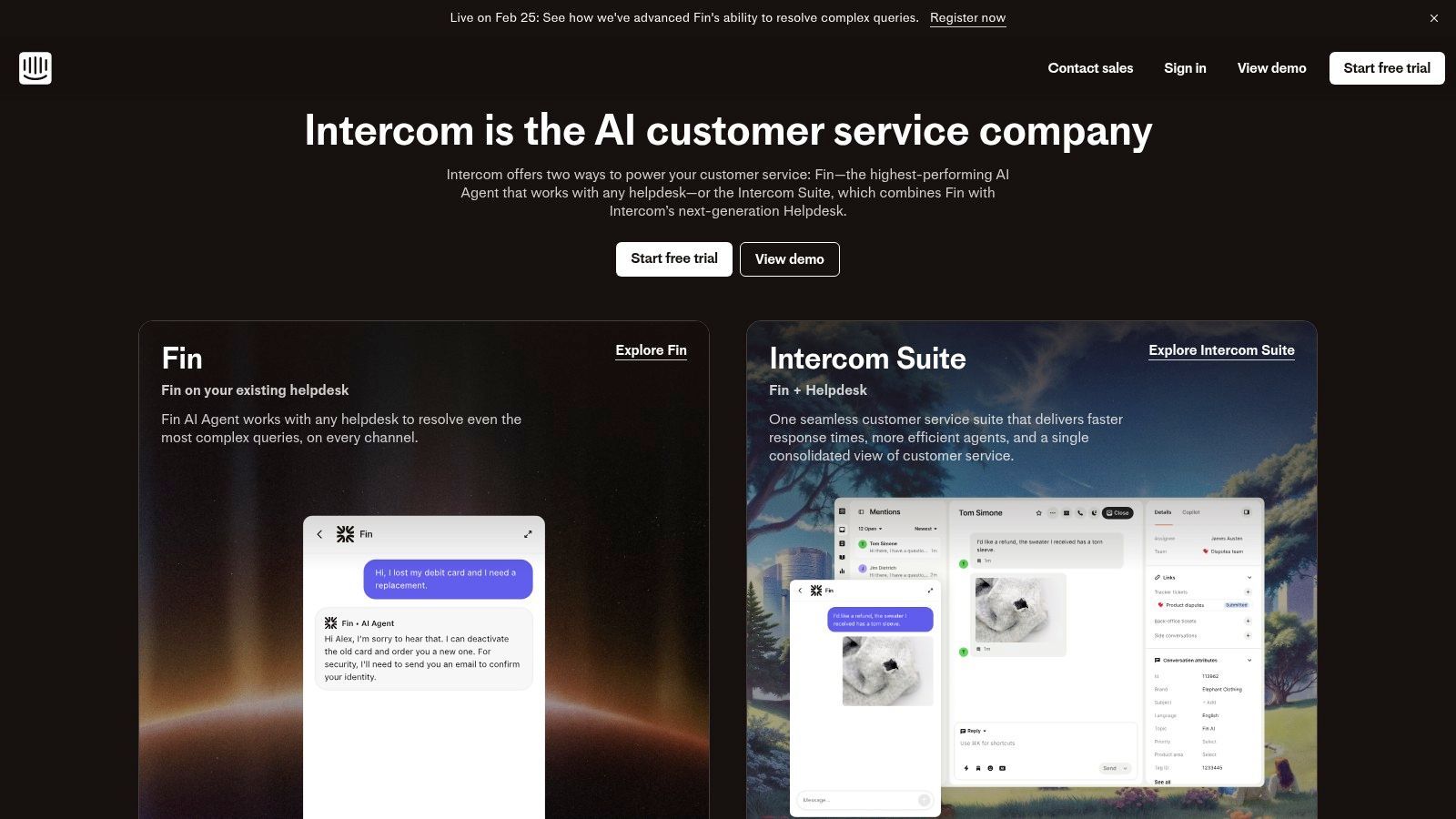
Unlike many bots that rely on rigid, pre-programmed flows, Fin can understand conversational nuances and provide detailed resolutions, significantly reducing the burden on human agents. For Shopify merchants, this means the bot can handle a high volume of pre-sales questions about product specifics, shipping policies, or return procedures 24/7, directly impacting conversion rates by answering purchase-blocking questions on the spot.
Strategic Breakdown & Key Features
Intercom's strength lies in its ecosystem approach. It combines AI automation with proactive messaging tools, allowing brands to engage customers with targeted product tours, surveys, and outbound messages based on their behaviour. The visual workflow builder is another key component, letting managers create automated pathways for routing conversations, gathering customer information, and escalating complex issues to the right human agent. This organised system ensures that while the bot handles the majority of interactions, urgent or high-value conversations are never missed.
Strategic Takeaway: The primary advantage of Intercom is its ability to learn from your existing support content. For a Shopify store with a well-documented FAQ or help centre, deploying Fin can be remarkably fast, providing immediate ROI by deflecting common support tickets from day one.
Pricing and Integration
Intercom's pricing structure is a key consideration. It typically involves a monthly platform fee per agent seat, plus a per-resolution cost for the Fin AI agent. This model can become expensive as a business scales, particularly for teams with many agents or very high support volumes. Add-ons like product tours and surveys also increase the total cost. However, for larger brands that can consolidate their helpdesk, proactive messaging, and AI bot into one platform, the investment often pays off through operational efficiencies and improved customer satisfaction. Integration with Shopify and other e-commerce tools is robust, supported by a large app marketplace.
Website: https://www.intercom.com
3. Drift
Drift pioneered the category of "conversational marketing," focusing on using chatbots to engage website visitors, qualify leads, and directly connect them with sales representatives. Its core function is to accelerate the sales pipeline for B2B companies rather than serve as a post-sale customer support tool. For this reason, it remains a notable chat bot example for high-consideration e-commerce brands where a pre-purchase sales consultation is common.
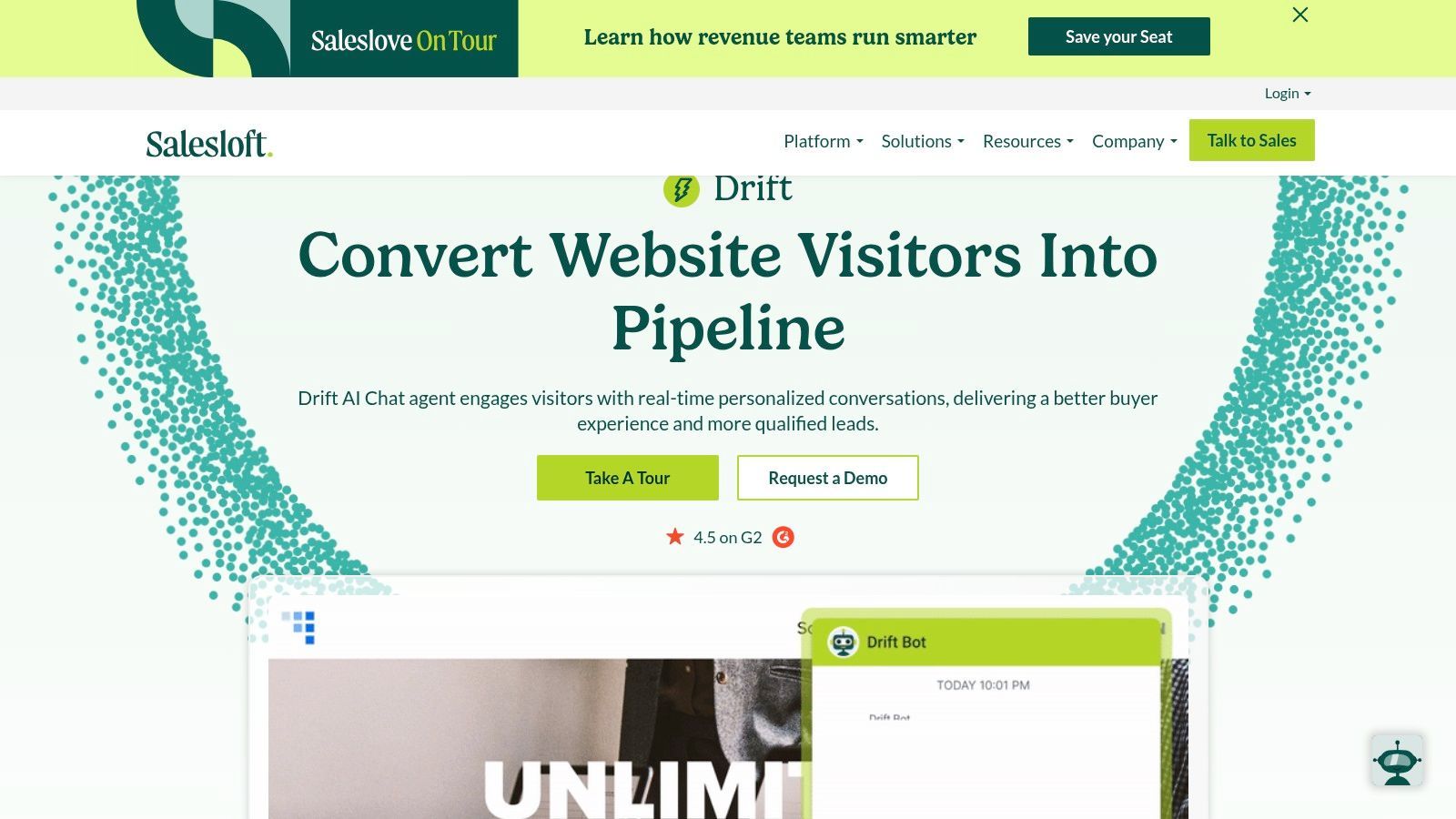
The platform operates using "Playbooks," which are pre-built conversational flows designed to achieve specific goals, such as booking a product demo or qualifying a lead based on company size. For a Shopify merchant selling high-ticket items like custom furniture or enterprise hardware, Drift can identify visitors from target accounts (Account-Based Marketing) and immediately route them to a specialist, bypassing generic support queues. This aggressive, sales-first approach aims to convert anonymous traffic into qualified pipeline opportunities instantly.
Strategic Breakdown & Key Features
Drift's main strength is its deep integration with CRM and marketing automation platforms like Salesforce and Marketo. This allows its playbooks to use rich visitor data to personalise conversations in real-time. For instance, it can greet a returning visitor from a target company by name and reference their previous activity, making the interaction feel highly contextual. Key features include automated meeting booking directly within the chat window and fast-track routing to available sales agents, which is critical in sales-led business models where response speed directly impacts conversion.
Strategic Takeaway: Drift is built for pipeline acceleration, not ticket deflection. For Shopify stores with a dedicated sales team that handles bespoke orders or B2B sales, its ability to identify and fast-route high-value leads to a human is its primary advantage. It turns a passive website into an active lead-generation machine.
Pricing and Integration
Drift's pricing is notoriously opaque and positioned at a premium, often requiring a conversation with their sales team. Reports indicate entry-level plans start at around £2,000 per month, making it a significant investment primarily suited for established B2B-focused businesses. This pricing model reflects its focus on revenue generation over cost-saving support automation. While it integrates with major CRMs, its connection to the Shopify ecosystem is less focused on post-purchase support use cases like order tracking or returns management. For most DTC brands, the cost and B2B feature set make it a less practical choice compared to e-commerce-centric chatbot solutions.
Website: https://www.drift.com
4. Zendesk
Zendesk provides a comprehensive customer service suite that has become a staple for support teams worldwide. Its offering extends far beyond basic ticketing, incorporating advanced messaging and powerful AI agents. These bots are designed to provide automated resolutions by tapping into your knowledge base, making it a strong contender among chat bot examples for established e-commerce brands needing a mature, omnichannel solution. Its Flow Builder tool allows teams to visually design conversational journeys without writing a single line of code.
Unlike solutions focused purely on pre-sales, Zendesk’s strength is its integration into a full-scale helpdesk. For a Shopify merchant, this means the chatbot can handle initial "Where is my order?" queries, then seamlessly hand over complex issues like returns or faulty goods to a human agent within the same platform, with all context preserved. The addition of Copilot, an AI assistant for live agents, further helps by suggesting replies and summarising conversations, improving agent efficiency.
Strategic Breakdown & Key Features
Zendesk's core advantage is its deep integration across multiple support channels. A conversation that starts on a website chat bot can continue over email or social media, creating a unified customer profile. The no-code Flow Builder is a key feature, enabling e-commerce managers to create guided paths for common queries, such as checking order status, processing a return request, or providing product recommendations. These flows can be designed with specific actions, like adding a tag to a customer profile or creating a ticket for follow-up.
Strategic Takeaway: Zendesk is ideal for scaling businesses that need more than just a sales-focused bot. Its ability to manage the entire customer service lifecycle, from automated initial contact to complex human-led resolution, makes it a robust foundation for a growing support operation. For those weighing their options, this Marvyn vs Zendesk analysis offers a detailed comparison.
Pricing and Integration
Zendesk’s pricing model can be complex for newcomers. It typically combines per-agent seat licences for the main suite with an additional cost based on the number of AI-powered "automated resolutions". This means you pay for both your human team's access and the bot's successful interventions. While this structure offers proven value at scale, the combined costs can become substantial for smaller teams or businesses with very high ticket volumes. The platform's administrative depth can also present a steep learning curve. However, its integration capabilities are first-class, with a vast marketplace of apps that connect seamlessly with Shopify and the wider e-commerce tech stack.
Website: https://www.zendesk.co.uk
5. Tidio
Tidio carves out its niche by offering an accessible, all-in-one customer communication tool specifically designed for small-to-mid-sized ecommerce brands. It combines live chat, a ticketing system, and a powerful AI agent named Lyro within a user-friendly platform. Its main appeal lies in its visual "Flows" builder, which allows non-technical Shopify merchants to create sophisticated automations for sales and support without writing a single line of code. This makes it an excellent example of a chat bot that empowers growing brands to compete with larger players.
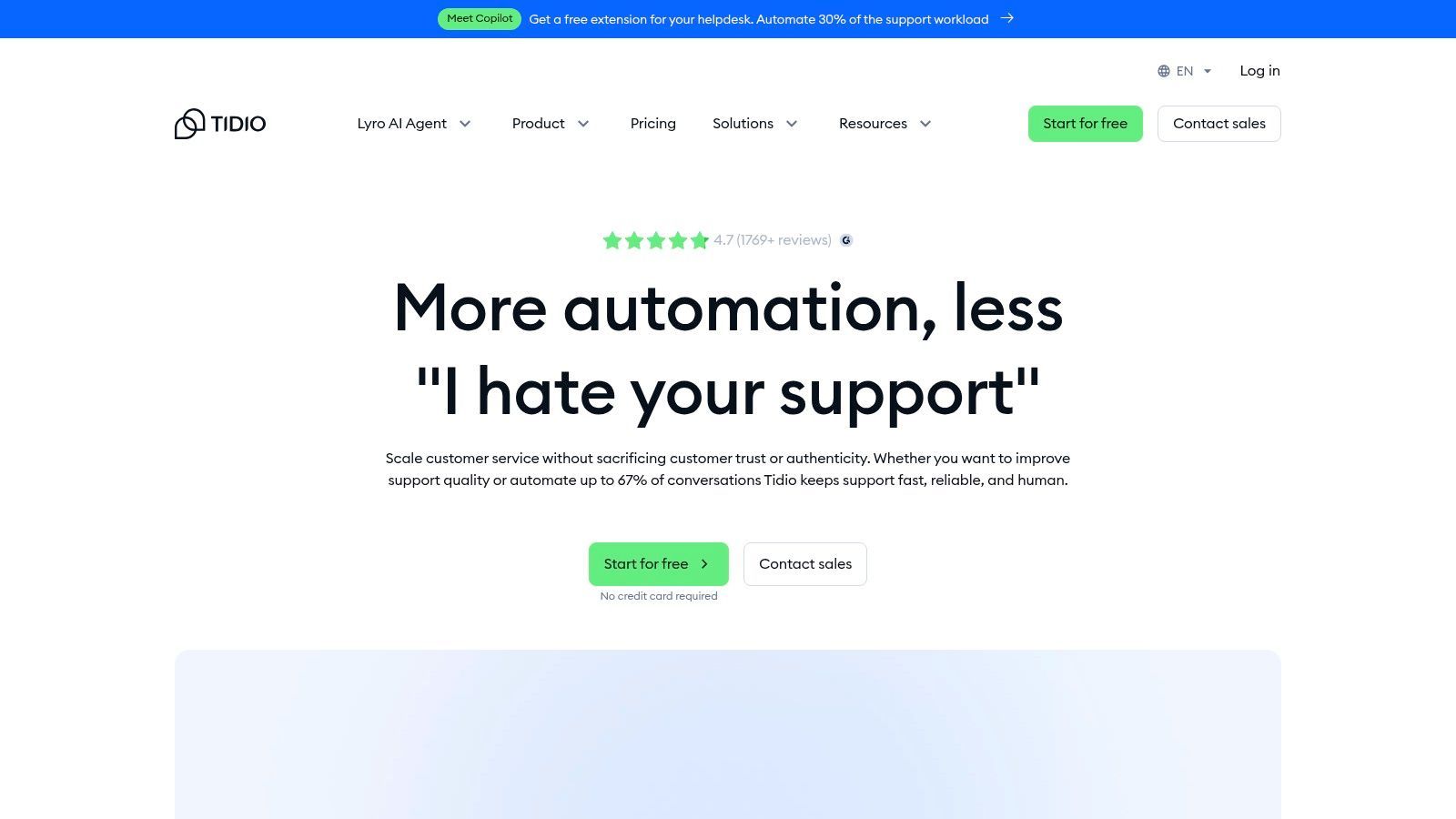
Unlike platforms that require extensive knowledge base preparation, Tidio's Lyro AI can be activated quickly to answer customer questions, drawing from a simple FAQ document. This, combined with pre-built templates for recovering abandoned carts, offering discounts, and capturing leads, means merchants can see a tangible impact on conversions and support workload almost immediately. The seamless integration with Shopify allows it to pull product information and order details directly into the chat, creating a connected and efficient customer experience.
Strategic Breakdown & Key Features
Tidio's core strength is its practicality and speed to value. The visual Flows builder is central to this, providing clear, trigger-based templates for common ecommerce scenarios. A merchant can set up a flow that automatically engages a visitor lingering on a product page, offers a discount code to a first-time visitor, or asks for an email in exchange for a shipping update. Lyro, its AI agent, can function as a standalone support system or work alongside other helpdesks, offering flexibility for businesses as they grow. This dual approach to automation, rule-based flows and AI-powered conversation, allows brands to handle a wide range of customer interactions effectively. For more insights on this blended strategy, you can explore how different chatbots for customer service operate.
Strategic Takeaway: Tidio is ideal for merchants who need to deploy effective automations quickly without a dedicated developer. The library of pre-built templates for guided selling and cart recovery provides a clear roadmap for boosting sales and engagement from day one.
Pricing and Integration
Tidio offers a "freemium" model, which includes a free plan with limited live chat conversations and basic features, making it highly accessible for new businesses. Paid plans introduce higher conversation limits, more advanced features, and access to the Lyro AI agent, which is typically an add-on priced per conversation. This usage-based model for AI can become costly as support volume increases, so businesses should forecast their needs. However, for brands at the start of their journey, the entry-level pricing provides exceptional value. Its native Shopify app ensures a quick and straightforward setup, connecting to your store's data with minimal fuss.
Website: https://www.tidio.com
6. Gorgias
Gorgias establishes itself as a helpdesk platform built from the ground up for e-commerce, with a particular focus on the Shopify ecosystem. Its main differentiator is the deep integration that allows its AI-powered chat to not just answer questions but take action. The AI Agent can resolve common pre- and post-purchase queries, edit orders, manage subscriptions, and process returns directly within the chat window, making it a powerful example of an action-oriented chat bot.
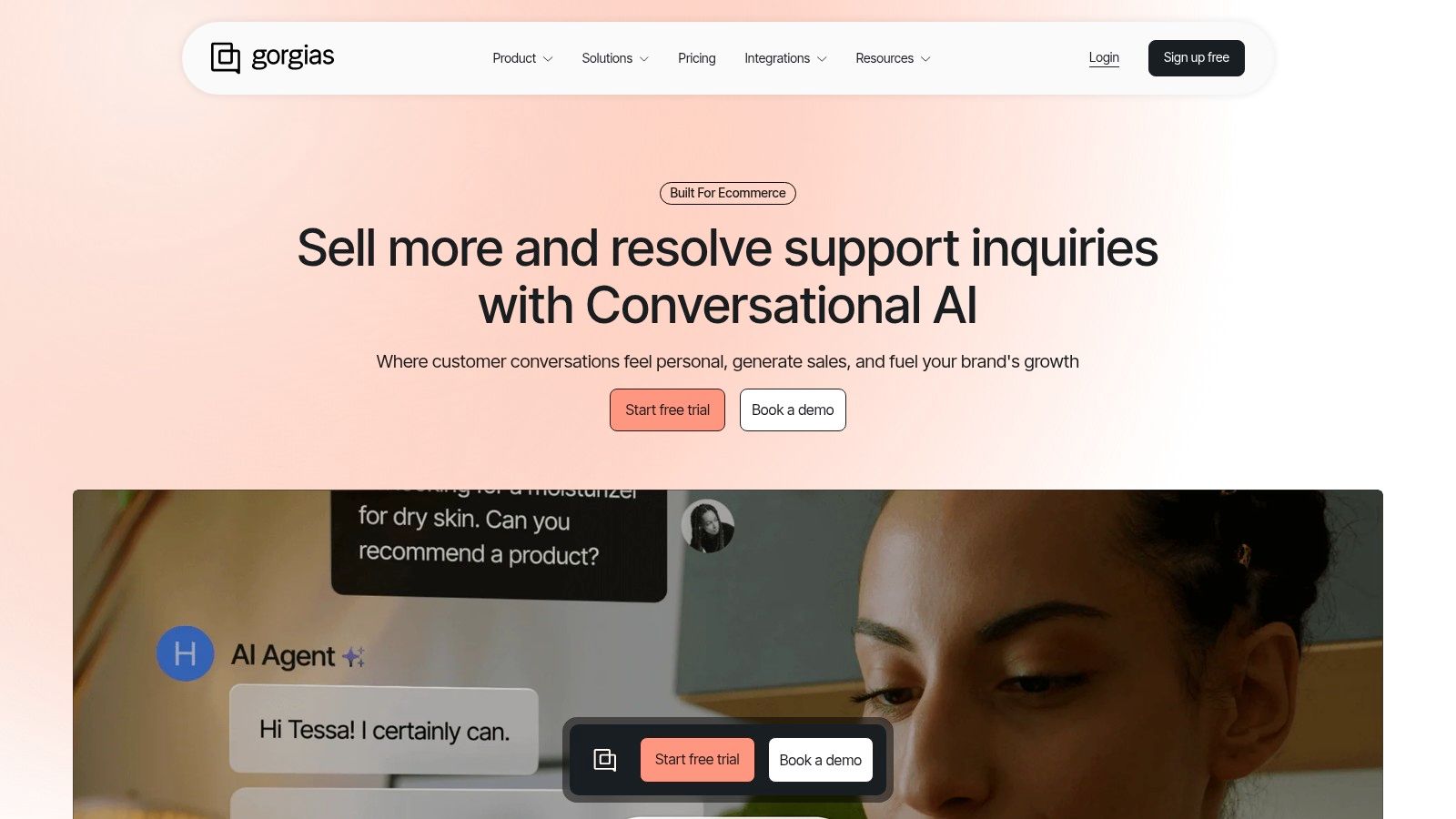
Unlike generic chat tools, Gorgias centralises customer conversations from every channel, including email, social media DMs, SMS, and live chat, into one unified view. For a UK-based DTC brand on Shopify, this means an agent can see a customer's entire order history and conversation log while the AI bot simultaneously handles routine "Where is my order?" requests by pulling live data directly from Shopify and shipping carriers. This fusion of automation and a complete customer profile empowers support teams to be revenue drivers, not just cost centres.
Strategic Breakdown & Key Features
The core strength of Gorgias lies in its e-commerce-centric automation. Its system of macros (pre-made answers) and rules allows merchants to build automated workflows that trigger based on specific customer intents or attributes. For example, a rule can be set to automatically tag and respond to any message containing "shipping" and "UK" with a template that includes live order tracking details. The platform's revenue reporting is another key feature, directly linking support interactions to sales and providing clear data on how chat contributes to the bottom line.
Strategic Takeaway: The key advantage of Gorgias is its ability to perform actions, not just provide answers. For Shopify stores dealing with high volumes of order-related enquiries, the bot's capacity to modify orders or initiate returns without human intervention is a game-changer for operational efficiency.
Pricing and Integration
Gorgias employs a hybrid pricing model that combines a base monthly fee for a set number of tickets with a separate, per-resolution cost for its AI features. The plans are tiered, making it accessible for small businesses to start, but costs can accumulate for high-volume stores as both ticket counts and AI usage grow. While it offers a seamless one-click installation from the Shopify App Store, its deep functionality is best realised on that platform; it is less compelling for businesses operating outside the e-commerce sphere.
Website: https://www.gorgias.com
7. Landbot
Landbot stands out as a visual, no-code chatbot builder celebrated for its user interface-first approach to creating conversational flows. It provides an extensive template library that covers lead generation, customer support, user surveys, and WhatsApp integrations. This makes it an excellent choice for marketers and business owners who want to design highly guided conversational experiences without needing to write a single line of code, offering a gallery of ready-to-edit chat bot examples to get started quickly.
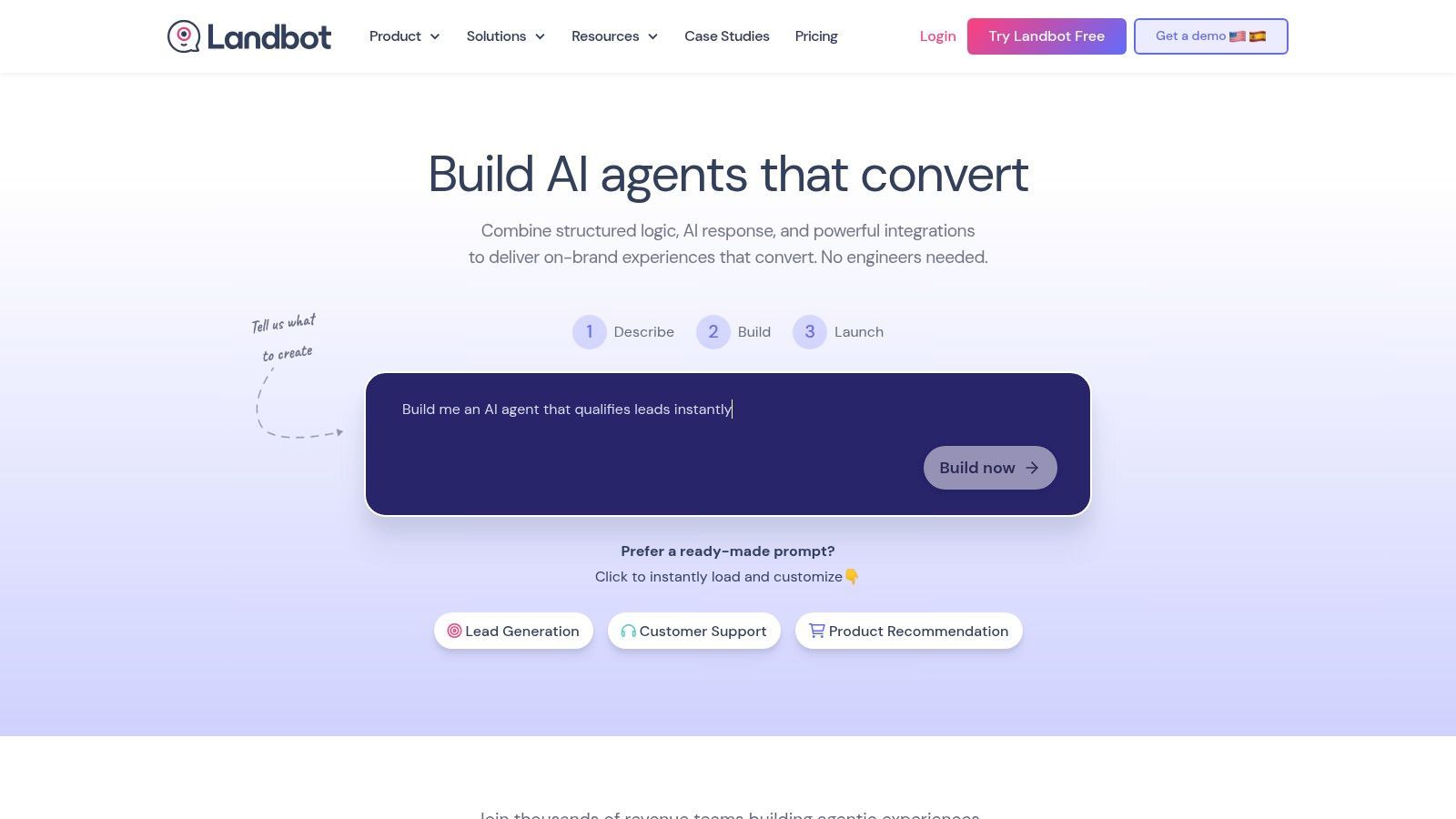
The platform is designed around a drag-and-drop canvas, allowing users to visually map out every step of a conversation. For a Shopify merchant, this could mean building a product recommendation quiz that asks customers about their preferences and guides them to the perfect item. Unlike more open-ended AI agents, Landbot excels at structured interactions, ensuring the user follows a specific path designed to capture information, qualify a lead, or complete a task.
Strategic Breakdown & Key Features
Landbot’s core strength is its accessibility for non-technical users. The visual flow builder, complete with conditional logic, allows for the creation of complex, branching conversations that feel dynamic and personalised. Key features include the ability to A/B test different conversational paths to optimise performance and, on higher tiers, the integration of AI agents for more flexible interactions. Its robust WhatsApp Business capabilities are also a major draw, allowing brands to deploy automated flows directly within the popular messaging app.
Strategic Takeaway: The main advantage of Landbot is its rapid prototyping and deployment capability. For a Shopify store looking to quickly launch a marketing campaign like a lead-capture quiz or a feedback survey, the vast template library provides a massive head start, enabling a polished flow to go live in hours, not weeks.
Pricing and Integration
Landbot operates on a tiered subscription model, starting with a free sandbox plan that allows users to build and test flows. Paid plans increase the quota for chats and, on higher tiers, unlock advanced features like AI agents and WhatsApp messaging. The pricing structure is based on usage limits, which can become a key consideration for high-traffic stores as chat and AI quotas can be reached quickly. While it isn’t a Shopify-native tool, it can be integrated with e-commerce platforms and other marketing software through tools like Zapier or direct webhooks to perform actions like sending lead data to a CRM.
Website: https://landbot.io
Top 7 Chatbot Platforms Comparison
Making the Right Choice: From Examples to Action
Our journey through these diverse chat bot examples has illuminated a critical truth: not all conversational tools are created equal. The right choice is deeply tied to your specific business model, operational capacity, and overarching goals. We've seen how platforms like Drift are precision-engineered for B2B sales cycles, prioritising meeting bookings above all else, while enterprise solutions such as Zendesk and Intercom build powerful, structured systems for managing support tickets at a massive scale.
For Shopify merchants, however, the battlefield is different. The primary objectives are direct-to-consumer sales, customer loyalty, and operational efficiency. This environment demands a tool that doesn't just answer questions but actively guides customers through the buying journey, from product discovery to checkout. It needs to be an extension of your brand, acting as a 24/7 sales associate and a first-line support agent simultaneously.
Finding the Right Fit for E-Commerce
While tools like Gorgias and Tidio offer excellent, e-commerce-centric features, their pricing structures, often based on per-ticket or per-conversation models, can present a challenge. As your store's traffic and customer interactions grow, so do your costs, potentially penalising you for successful engagement. This is a crucial consideration for ambitious DTC brands planning for scale.
This is where the new generation of autonomous AI agents, like Marvyn AI, offers a distinct advantage. By focusing on a flat-rate, unlimited conversation model, the platform aligns its success with yours. It encourages, rather than meters, customer interaction. Its one-click Shopify integration means it understands your product catalogue, inventory, and order details from the moment it's activated, enabling it to provide genuinely helpful, consultative guidance.
Your Actionable Next Steps
To move from analysis to action, begin with a clear-eyed assessment of your store's primary bottleneck. Pinpoint the most significant point of friction in your customer journey:
- Is it pre-sale uncertainty? Do customers frequently ask about sizing, materials, or compatibility, indicating a need for detailed, on-demand product information?
- Is it cart abandonment? Are shoppers adding items to their cart but failing to complete the purchase, suggesting that last-minute questions or a lack of trust are derailing the sale?
- Is it repetitive support queries? Is your team spending hours answering the same "Where is my order?" or "What is your return policy?" questions, diverting resources from more complex issues?
- Is it low average order value (AOV)? Are customers making single-item purchases when there are clear opportunities for upselling and cross-selling complementary products?
Once you have identified your main challenge, you can select a solution purpose-built to solve it. This strategic approach ensures your investment in a chatbot directly contributes to your bottom line. An effective chat bot is one of many powerful Conversion Rate Optimization Tools that can significantly improve your store's performance by turning passive browsing into active buying. By matching the tool's core strength to your store's biggest weakness, you transform conversations into currency and build an automated engine for growth.
Ready to see how an AI-powered sales agent can transform your Shopify store? The chat bot examples in this article show what's possible, and Marvyn AI is built to deliver it. Stop answering repetitive questions and start converting more customers, 24/7, with an autonomous agent designed for e-commerce.