How to Calculate NPS Score for Your Shopify Store
Let's be honest—most customer satisfaction surveys are a waste of time. They’re clunky, customers hate filling them out, and they rarely lead to any real change.
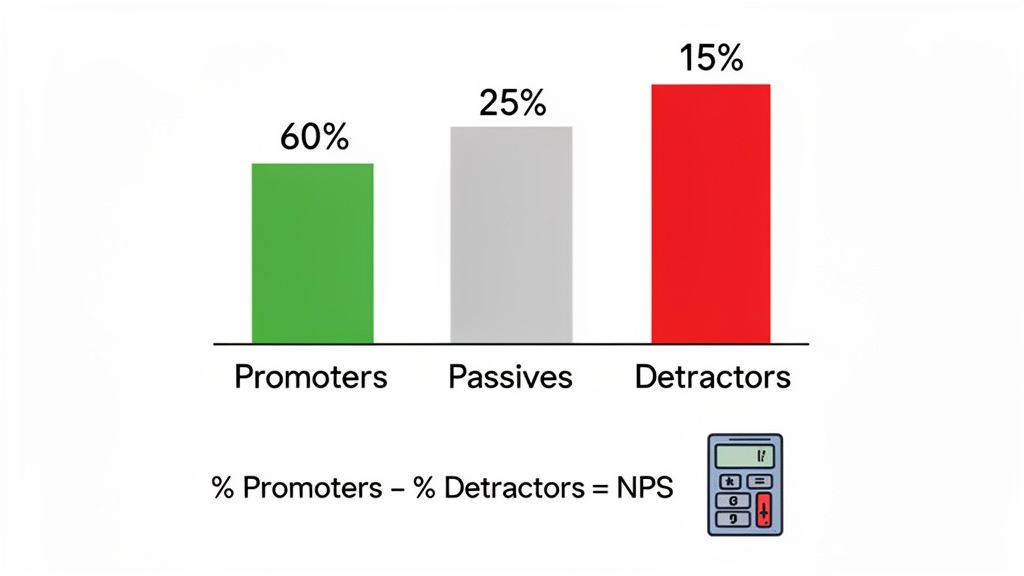
The Net Promoter Score (NPS) cuts through all that noise. It’s built on one simple question that tells you more about your store's future than pages of feedback ever could. To get your score, you just subtract the percentage of Detractors from the percentage of Promoters. Simple as that.
What Is Net Promoter Score (And Why Should You Care)?
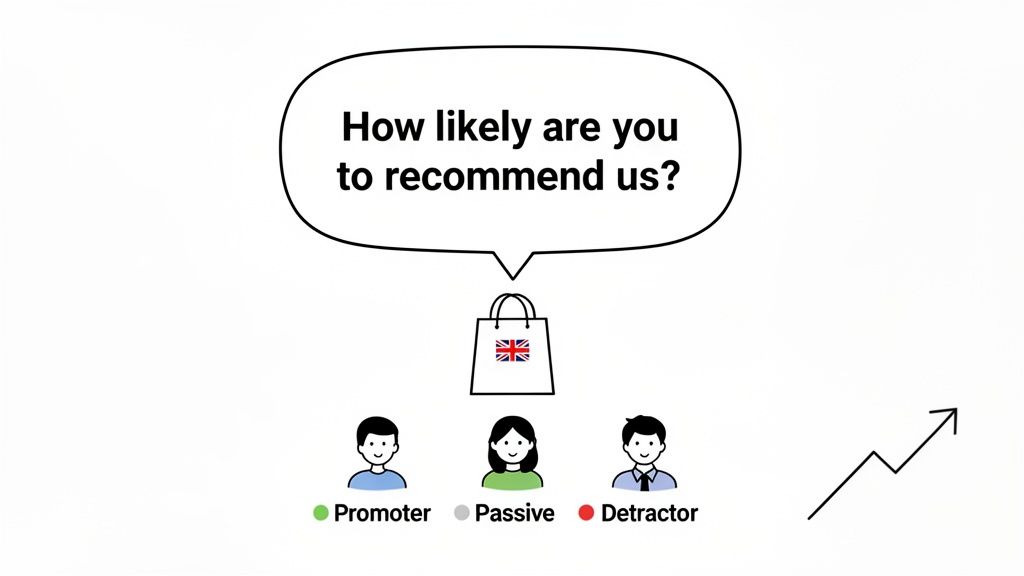
NPS isn't just another vanity metric. It’s a proven indicator of customer loyalty and a solid predictor of future business growth. It gives you a way to turn squishy customer opinions into a real strategic advantage for your Shopify store. If you want a deeper dive, this guide on Net Promoter Score Explained is a great starting point.
The whole methodology exploded back in 2003 when Frederick F. Reichheld published his article, "The One Number You Need to Grow." His research uncovered a direct link between high NPS scores and faster company growth. The reason is simple: loyal customers don't just stick around; they bring new customers with them.
Today, more than half of the Fortune 1000 companies rely on NPS. It’s become a standard for a reason.
Why NPS Is a Big Deal for UK Shopify Stores
For Shopify store owners here in the UK, a good NPS score isn't just about feeling good. It translates directly into pounds and pence. A healthy score is one of the strongest signals you have that your business is heading in the right direction.
When you start thinking about your customer base in terms of Promoters, Passives, and Detractors, it forces you to focus your efforts where they'll have the biggest impact. You stop guessing and start building a clear, actionable plan for growth.
Your NPS isn't just a grade for your customer service. It's a roadmap showing you exactly who your best customers are and what it takes to create more of them.
Here are the core benefits you'll see from tracking your NPS:
- More Repeat Business: Promoters are your loyal fans. They come back again and again, forming the reliable backbone of your revenue.
- Real Word-of-Mouth Marketing: Your biggest fans become your most effective (and free) marketing channel, telling friends and family about your store.
- Lower Customer Acquisition Costs: Keeping a happy customer is always cheaper than finding a new one. Promoter-driven referrals slash your marketing spend.
Ultimately, NPS gets you past surface-level feedback and helps you figure out why your customers behave the way they do. It clarifies what drives loyalty, which is essential if you're trying to understand what customers need. By consistently measuring and acting on this feedback, you can build a much more resilient and profitable ecommerce business.
The Simple Way to Calculate Your NPS Score
You don’t need to be a data scientist to figure out your Net Promoter Score. In fact, the calculation is refreshingly simple and gives you a clear, immediate pulse on customer loyalty.
The whole process starts by sorting your survey responses into three distinct groups. These buckets are defined by the 0-10 score a customer gives when asked how likely they are to recommend your brand.
- Promoters (Scores 9-10): These are your brand champions. They’re the enthusiastic, loyal customers who will actively tell friends and family about your Shopify store.
- Passives (Scores 7-8): This group is satisfied enough, but they aren't exactly shouting from the rooftops. They’re neutral and could easily be swayed by a competitor’s better offer.
- Detractors (Scores 0-6): These are your unhappy customers. Not only are they unlikely to buy from you again, but they might also share their poor experience, actively damaging your brand’s reputation.
The Core NPS Formula
Once you have your responses categorised, you can plug them into the core NPS formula. It’s a straightforward piece of subtraction that deliberately ignores the Passives, focusing instead on the two most vocal ends of your customer base.
The formula is: % of Promoters – % of Detractors = Your NPS Score
The final score is a single number that can range from -100 (everyone is a Detractor) to +100 (everyone is a Promoter). For instance, a Shopify store with 50% Promoters and 20% Detractors would land a score of 30. As you can see from these NPS benchmarks, a score between 30 and 60 is generally considered a sign of strong customer satisfaction.
Putting It Into Practice: A Real-World Example
Let’s run the numbers for a UK-based Shopify store that just surveyed 200 customers. After tallying the results, you find you have:
- 110 Promoters (scores of 9 or 10)
- 60 Passives (scores of 7 or 8)
- 30 Detractors (scores of 0 to 6)
To get to your final score, you'll need to turn those counts into percentages. This table breaks down exactly how to do it.
NPS Score Calculation Example
Don't forget about your Passives! Even though they aren't in the final formula, they account for 30% of your customers in this example. This group represents a massive opportunity—they are sitting on the fence and can often be converted into Promoters with a little extra attention.
With a final score of +40, this Shopify store has a solid, positive Net Promoter Score. It’s a powerful benchmark you can track over time to see if your efforts to improve customer experience are actually working.
If you’d rather skip the manual maths, our free NPS calculation tools can give you an instant result.
So, you’ve calculated your Net Promoter Score and now you’re staring at a number. Is a score of +20 a reason to pop the champagne or a sign you’ve got work to do?
Without context, the number itself is almost meaningless. This is where understanding UK-specific benchmarks becomes absolutely vital for any ambitious Shopify store. A score isn't just "good" or "bad"—it’s a direct reflection of your standing in a very specific, competitive market.
Finding Your Place in the UK Ecommerce Scene
The first thing to do is move past generic labels. Instead of just seeing a number, you need to see where it places you against your direct competitors and the wider UK retail environment.
Let's say you landed on a score of +20. On the surface, that might seem unremarkable.
But what if the average for your niche in the UK is just +5? Suddenly, your +20 looks outstanding. It means you have a real competitive advantage. On the flip side, if your competitors are consistently hitting +50, that same +20 is a clear signal that you’re falling behind and need to take action.
A Net Promoter Score isn't a final grade; it’s a starting point. It tells you where you are on the map, but you still have to decide on the destination and plot the course to get there.
To set realistic goals, you need data. According to 2026 international comparative data, the United Kingdom as a whole clocked an overall NPS of 28. This number came from 45% of UK respondents being Promoters, 38% Passives, and 17% Detractors. You can dig into these global NPS benchmarks on Surveymonkey.com.
For ecommerce brands, knowing that a score hovering around 28 is considered 'good' is the first step in competitive positioning. If your score is sitting below this, you’ve just identified a clear opportunity for growth.
Turning Your Score into a Strategic Asset
Once you have a benchmark, your NPS score becomes a powerful tool. It helps you set tangible goals and measure the real-world impact of your efforts to improve the customer journey. Did your score climb after you switched to a faster delivery service? Did it dip after a change to your returns policy?
Here’s how to start putting that number into context:
- Track it over time: A single score is just a snapshot. Tracking it quarterly or monthly reveals trends and shows you if your initiatives are actually moving the needle.
- Segment your data: Is your NPS higher for first-time buyers than for repeat customers? This kind of insight helps you tailor your retention and acquisition strategies more effectively.
- Focus on the 'why': The real gold is in the follow-up questions. Understanding why Detractors are unhappy and why Promoters love you is the key to making meaningful progress.
By viewing your NPS through this UK-specific lens, you can transform a simple metric into a strategic asset. It gives you the context you need to not just calculate your NPS, but to truly understand it and, most importantly, act on it. These are the kinds of insights that lead to genuine business improvements and can ultimately help you increase your Shopify sales.
If nobody answers your NPS survey, the score is meaningless. It’s as simple as that. You can’t trust the data if only a handful of customers respond, so getting a decent response rate is half the battle. This isn't just about the question you ask—it's about when, where, and how you ask it.
A common mistake is blasting out survey requests at random, completely disconnected from the customer's experience. To get feedback that’s actually useful, you need to ask when the interaction is still fresh in their mind.
Choosing the Perfect Moment
There are two main ways to time your NPS survey, and the best approach depends entirely on what you’re trying to measure.
- Transactional NPS: This is sent right after a specific interaction. Think post-purchase, after a delivery confirmation, or—most powerfully—immediately after a customer support chat has ended. It gives you instant, targeted feedback on a single touchpoint.
- Relational NPS: This survey measures the customer's overall feeling about your brand. It’s better to send this on a regular schedule, maybe quarterly or semi-annually, to keep a finger on the pulse of long-term loyalty and spot trends over time.
For most Shopify stores, a mix of both is the sweet spot. Use transactional surveys to get immediate feedback on your operations and relational surveys for the big-picture view of your brand's health.
Using Automation to Boost Responses
Let’s be realistic—manually sending surveys at the perfect moment is impossible. This is where automation becomes your best friend, especially for busy ecommerce teams. By setting up simple triggers, you can make sure the NPS question pops up at the most impactful time, every time, without you lifting a finger.
For example, a customer has a question about a product. They open up your support chatbot, get an instant answer, and are now ready to buy. Triggering the NPS survey right at that moment is worlds more effective than a random email a week later.
The best way to get feedback is to ask for it when you’ve just delivered value. A customer who has had a problem solved is far more likely to respond than one who receives an out-of-the-blue email.
This is exactly where modern tools for Shopify shine. An AI chatbot like Marvyn, for instance, can be configured to do precisely this.
Here’s a real-world example of how a chatbot can be woven into your Shopify store to engage customers and gather feedback.
The screenshot shows how a conversational AI can blend seamlessly into your storefront, ready to help customers and collect feedback right where they are.
By asking the NPS question directly within the chat conversation after a successful interaction, you make giving feedback completely effortless. This in-the-moment, low-friction approach doesn't just deliver more timely data—it can dramatically increase your survey response rates. That gives you a much more reliable foundation to calculate your NPS score. For more on this, check out our guide on how to improve customer engagement with conversational tools.
Turning Customer Feedback into Real Growth
Collecting your NPS data is just the starting line. Honestly, that’s the easy part. The real work begins when you start using that feedback to close the loop with your customers and drive genuine improvements in your business. This is where a simple metric transforms into a powerful engine for growth.
A crucial part of this is spotting the patterns in what people are telling you. Are Detractors consistently complaining about delivery times? Is there a recurring issue with a specific product's quality? Pinpointing these themes is the first step toward fixing the root cause, not just slapping a plaster on the symptoms.
To really get this right, you have to go beyond the scores and dig into the qualitative feedback. Understanding how to analyze qualitative interview data from open-ended questions is where the gold is. It gives you invaluable context and tells you exactly what to do next.
Responding to Your Detractors
Ignoring unhappy customers is one of the fastest ways to torch your brand’s reputation. A Detractor who feels heard can sometimes be won back, but one who is ignored will almost certainly churn—and probably tell their friends about the bad experience. A prompt, genuine response isn't just nice to have; it's non-negotiable.
This doesn't mean you need to manually email every single person. That’s not scalable. Setting up an automated follow-up workflow is a much more practical solution. For example, a customer who leaves a score between 0-6 could instantly receive an email that:
- Acknowledges their feedback: "Thank you for sharing your thoughts. We're sorry to hear your experience wasn't up to standard."
- Shows you’re taking it seriously: "Your feedback has been passed directly to our team so we can look into what went wrong."
- Offers a resolution: This could be anything from a discount on a future purchase to an offer to connect with a support agent, or even just a sincere apology.
This automated first touch buys you time and, more importantly, shows the customer you’re actually listening. You can get more ideas on setting these up in our guide to automation in customer service.
The diagram below shows a simple, automated process for gathering this feedback in the first place.
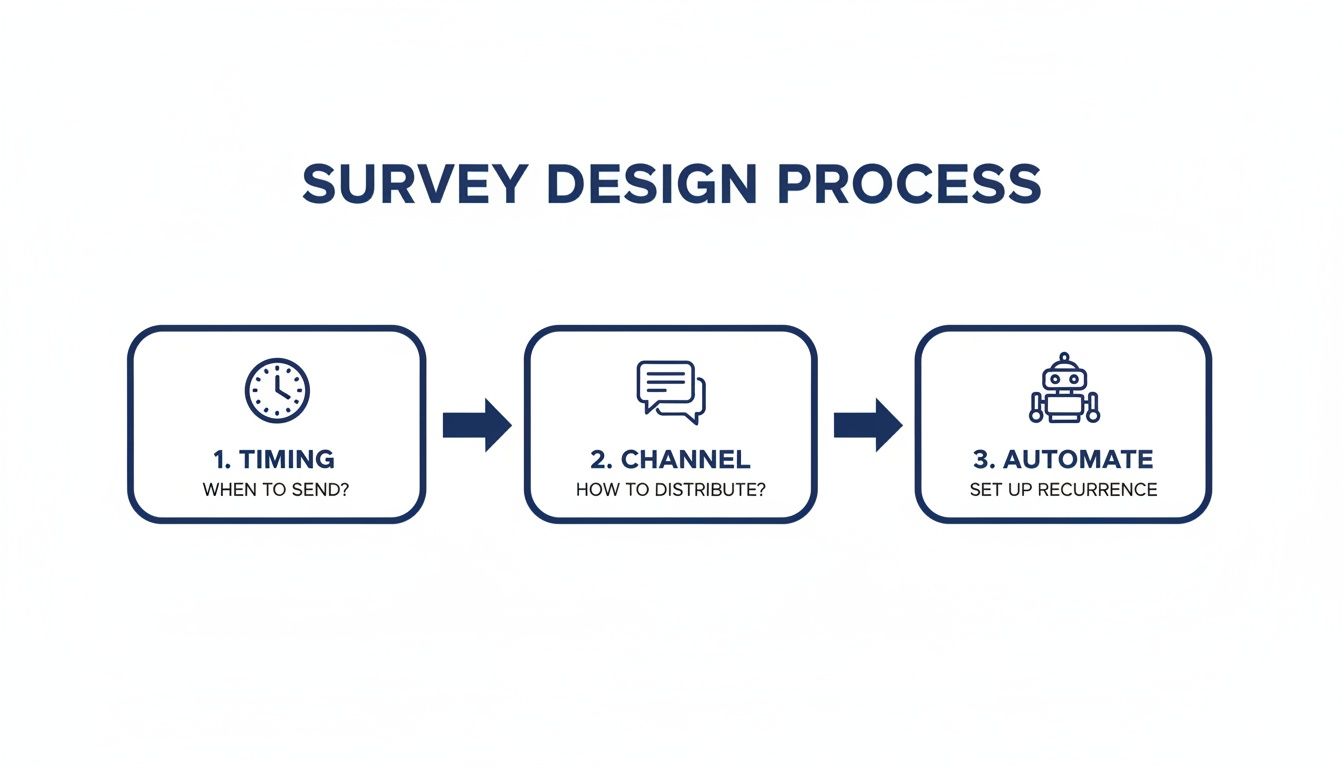
This process really highlights how automating the timing and channel for your surveys leads to more consistent and reliable data collection from the get-go.
Activating Promoters and Engaging Passives
Your work doesn't stop with Detractors. Far from it. Your Promoters and Passives represent massive, often untapped, opportunities for growth.
Your Promoters are your most valuable marketing asset. The glowing feedback they provide is authentic social proof you can use to build trust with new customers.
Think about it: they’ve already told you they love your brand. So, reach out to your Promoters and ask for a public review or a testimonial. Since they’ve already raised their hand, the chances of them following through are incredibly high.
Passives, on the other hand, are your swing voters. They’re satisfied but not exactly loyal. A targeted follow-up asking what it would have taken to earn a "10" can uncover small but crucial improvements that could easily tip them into the Promoter camp.
By systematically closing the loop with all three groups, you create a cycle of continuous improvement that fuels sustainable, long-term growth.
Common Questions About Using NPS for Shopify
Once you decide to use Net Promoter Score for your Shopify store, the practical questions start popping up pretty quickly. Moving from the "what" to the "how" can feel like a big leap, but figuring out the details is what turns raw feedback into real growth.
Let's dig into the most common questions we see from merchants just like you.
How Often Should I Send an NPS Survey?
There's no single magic number here. The right frequency really depends on what you’re trying to learn. It’s less about a rigid schedule and more about matching the survey to a specific goal.
For a big-picture look at brand loyalty, which we call relational NPS, sending a survey out quarterly or even twice a year is a solid rhythm. This gives you a consistent pulse on how customers feel about your brand overall, without bombarding them.
But if you want feedback on a specific interaction, you need a transactional NPS survey. These should go out right after a key moment. Think immediately after their first purchase, once their order is delivered, or a few minutes after a support chat ends. The trick is to be strategic and timely to avoid "survey fatigue."
Can I Calculate NPS with Only a Few Responses?
Technically, yes, you can run the numbers. But you need to be incredibly careful with the conclusions you draw from a tiny sample size. A score based on just ten responses is statistically shaky and can swing wildly with every new piece of feedback.
If you’re just starting out and only have a handful of responses, my advice is to ignore the score for now. Seriously.
Focus on the qualitative feedback instead – the 'why' behind their number.
The comments from your first few Detractors and Promoters will give you far more actionable insight than an unstable score ever could. Use their exact words to guide your first improvements.
Once you’ve collected a decent volume of responses, you can start putting more trust in the stability and accuracy of the score you calculate for your NPS.
What Other Questions Should I Ask?
The beauty of NPS is its simplicity, but the standard "how likely are you to recommend" question is only half the picture. To get insights you can actually do something with, you must ask a follow-up question.
Keep it short and open-ended. Your goal is simply to understand the reason for their score.
- For Detractors (0-6): "What is the main reason for your score?"
- For Promoters (9-10): "What did you particularly love about your experience?"
- For Passives (7-8): "What could we have done to make your experience a 10?"
This one simple addition turns a sterile number into a story you can act on. And the best part? Conversational tools can ask these follow-ups automatically, making the whole thing feel natural for your customer.
Should I Make My NPS Score Public?
It’s tempting, especially when you get a great score you want to shout about from your homepage. But you should approach this with a bit of caution. At least at first, think of NPS as an internal compass for improvement, not a public marketing number.
Sharing a fantastic score can definitely build social proof. The flip side is that it sets a public expectation you have to live up to. If that score dips next quarter, it can create a negative perception you now have to manage.
Our advice? Focus on using the feedback to make your business genuinely better first. Build a solid system for listening, acting, and improving. Once you have a score you're consistently proud of and a process to maintain it, then you can think about sharing it with the world—along with the story of what that number really means for your brand.
Ready to stop guessing and start listening? Marvyn AI can automatically collect NPS feedback from your customers at the perfect moment, turning insights into growth. Install our free Shopify chatbot in one click and see the difference it makes. Find out more at https://www.marvyn.co.