What Are Customers Needs A Guide to Winning Modern Shoppers
So, what are customer needs, really? In simple terms, they are the mix of functional problems, emotional desires, and social aspirations that drive someone to make a purchase. It’s the ‘why’ behind every click of the ‘buy now’ button.
Understanding these needs is the difference between selling a product and offering a genuine solution.
The Three Layers of Customer Needs
Every purchase has layers. Think of it like an onion. On the surface, a customer is buying an item to do a specific job. But if you peel back the layers, you’ll uncover the deeper, more powerful motivations that turn a casual browser into a loyal fan.
Framing your products this way helps you see them not just as inventory, but as answers to your customers’ problems. This model breaks down into three core types of needs.
To make this crystal clear, let's break down these three layers. Each one answers a different, fundamental question the customer is asking themselves, even if they don't consciously realise it.
As you can see, the functional need is just the starting point. The real magic happens when you connect with the emotional and social drivers, which is where brand loyalty is truly built.
Let's look at this in another way.
Imagine someone is shopping for a pair of high-performance running shoes.
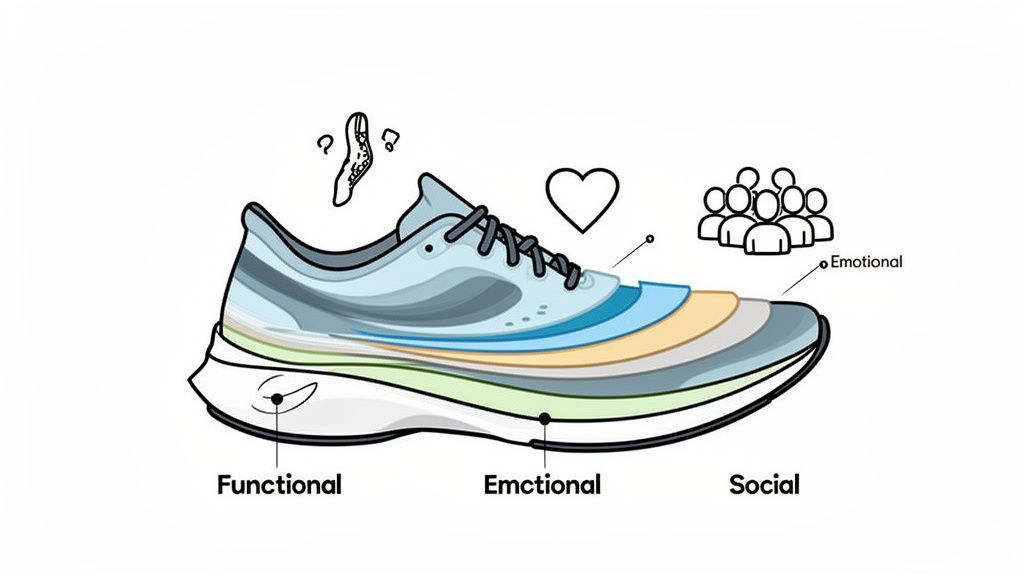
Their functional need is obvious: they need a shoe that supports their feet, absorbs impact, and prevents injury during a run. It’s a practical requirement.
But there's more going on. Their emotional need might be to feel confident, fast, and athletic. They want to feel like they are investing in their health and performance.
And finally, their social need could be to be perceived by their running group or on social media as a dedicated, serious runner who knows their gear. It’s about identity and belonging.
This hierarchy shows how these needs build on one another, from the practical foundation to the aspirational peak.
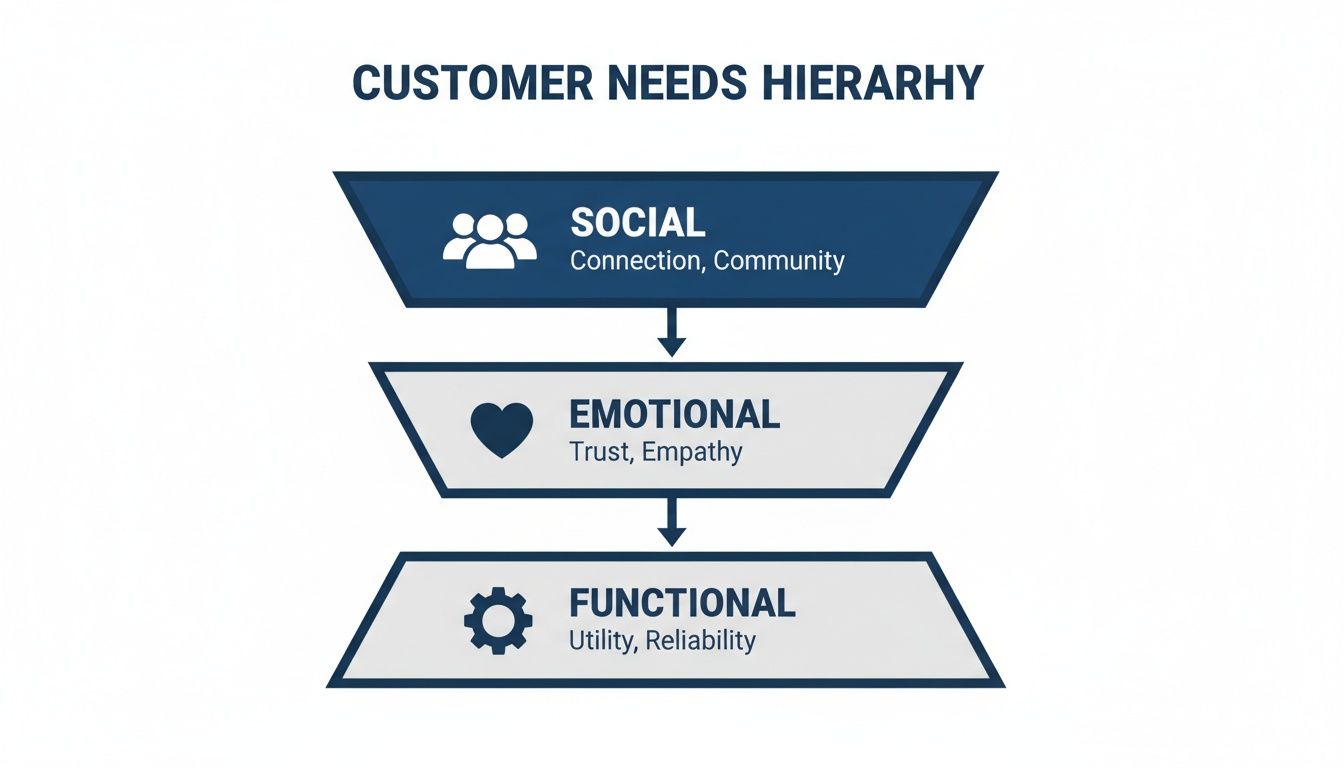
While the functional layer is the price of entry, the most successful brands are masters of the emotional and social layers. They don't just sell a product; they sell a feeling, an identity, and a sense of belonging.
By uncovering these deeper motivations, you can craft marketing messages and product descriptions that resonate on a much more profound level. This is a core part of building strong customer relationships, a concept we dive into in our guide on what is consultative selling.
When your Shopify store successfully addresses all three needs, you stop being just another shop and start becoming a brand people genuinely connect with.
How to Uncover What Your Customers Truly Want
It’s one thing to know that customer needs have different layers. It's another thing entirely to actually find them. Guessing what your customers want is a fast track to wasted effort and a warehouse full of unsold stock.
The good news? You don’t need a massive research budget. The clues are already there, hiding in plain sight. Every single interaction a customer has with your brand is a breadcrumb, and you just need to know where to look.
These methods are the different pieces of the puzzle. Put them together, and you'll build a complete picture of what your audience is really thinking.
Go Through Your Digital Conversations
Your customer service channels are goldmines of unfiltered, honest feedback. Think about it—when you’re frustrated with a purchase, you don’t mince your words. Neither do your customers.
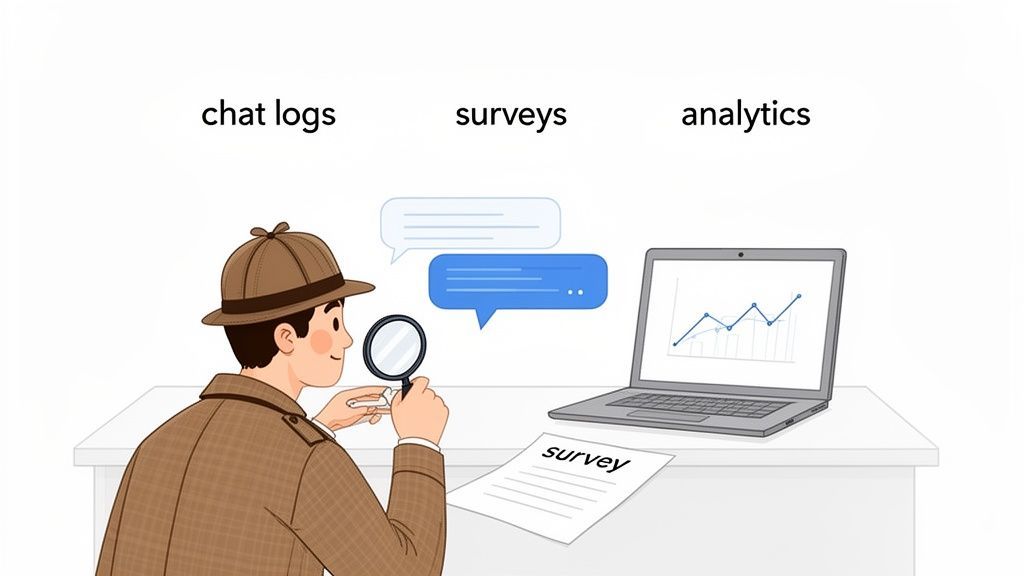
Start by digging into your support tickets, emails, and especially your website chat transcripts. These conversations contain the raw, uncensored voice of your customer. You're looking for recurring questions, common complaints, and moments of confusion.
For example, if you keep seeing the question, "Do your T-shirts shrink?", you've just uncovered a critical functional need for durable, pre-shrunk fabric. You’ve also stumbled upon a powerful selling point to add to your product descriptions. If you're looking for ways to capture more of these insights, our guide on implementing live chat on a website is a great place to start.
Key Takeaway: Unfiltered customer chats and support tickets are your most honest source of feedback. They reveal the immediate pains and unmet needs that are costing you sales right now.
Use Surveys and Listen to Social Media
While direct chats show you the immediate problems, surveys and social media help you see the bigger picture. They let you proactively ask questions and get a real-time pulse on what people are saying about your brand publicly.
Here are two simple strategies you can implement right away:
- Post-Purchase Surveys: After an order is delivered, send a very short survey—just one or two questions. Ask something like, "What was the main reason you chose our product today?" or "Was there anything that almost stopped you from buying?" This captures their motivation while the experience is still fresh.
- Social Media Monitoring: Keep an eye on comments, mentions, and tags related to your brand. Customers often share their excitement (emotional needs) or their frustrations in public, giving you a direct line into how your brand is perceived.
To really get to the bottom of what your customers are saying, a structured approach to Voice of Customer analysis can help you organise all this qualitative feedback into insights you can actually use.
Analyse User Behaviour on Your Website
Sometimes, what customers do tells you more than what they say. Your website analytics can show you exactly where their needs aren't being met by revealing points of friction. A free tool like Google Analytics is all you need to get started.
Look for pages with high exit rates. If a flood of visitors are leaving from a specific product page, it could mean the description is unclear, the photos are bad, or the price is a sticking point.
Likewise, a high cart abandonment rate is a massive red flag for your checkout process. Are there unexpected shipping costs? Not enough payment options? These metrics point directly to unmet functional needs for clarity and convenience.
The Real Cost of Ignoring Customer Needs
Let's be blunt: understanding what customers really need isn't some fluffy, "nice-to-have" part of running a business. It’s the absolute bedrock of your revenue. When a gap opens up between what a shopper wants and what your store delivers, the damage is immediate and easy to measure.
Every single unmet need creates friction. And friction is the silent killer of conversions.
Think about it. A potential customer lands on your product page with one specific question. If they can’t find the answer in a few seconds, they’re gone. They won't wait around. They’ll just click away—likely straight to a competitor who makes their life easier. This isn't just one lost sale; it's a lost customer for good.
The Financial Drain of Poor Service
Slow, unhelpful, or unavailable support is one of the fastest ways to bleed money in e-commerce. Today’s online shoppers have incredibly high standards. They expect their problems solved on the first try, without having to repeat themselves or get bounced between different agents.
When your support doesn't meet this standard, you see the consequences in several painful ways:
- Soaring Cart Abandonment: A shopper has a last-minute question about shipping or sizing right before checkout. If they can’t get an instant answer, that cart is as good as gone.
- Plummeting Customer Loyalty: About half of all customers will jump ship to a competitor after just one bad experience. That number skyrockets to a staggering 80% if they have more than one.
- Damaging Negative Reviews: A frustrated customer is far more likely to leave a scathing review than a happy one. Those reviews scare away new shoppers and tarnish your brand's reputation for a long time.
For an online store, this isn't just about service; it's about survival. Every unanswered question is a potential sale slipping through your fingers, turning your support function into a cost centre instead of a growth engine.
The High Demand for First-Contact Resolution
Modern customers value their time above all else. They demand efficiency. And recent data shows just how critical this is for UK shoppers in particular. While many still appreciate a human touch, their patience wears thin if that interaction isn't effective.
A 2025 UK consumer survey found that the most valued trait in customer service is speed, with 58% of consumers prioritising a quick resolution. But here's the kicker: only 46% report actually getting their issue solved on the first try, and 39% say they usually have to speak with at least two different agents. You can dig into more of these British consumer habits in the full TCN survey findings.
This gap between what customers expect and what they get is precisely where revenue leaks out. To close it, you have to adopt stellar customer service best practices that are built around immediate, accurate answers. When you fail to solve a problem on the first contact, you’re not just wasting the customer’s time—you’re doubling your own support costs and destroying goodwill in the process.
Right, you’ve got spreadsheets full of customer feedback, analytics dashboards, and maybe even a few chat transcripts. Now what?
Knowing what your customers want is one thing. Actually doing something about it, in real-time, is where most businesses get stuck. All those valuable insights end up gathering digital dust, never making it to the one place they matter most: the live shopping experience.
This is where an AI tool like Marvyn AI stops being a buzzword and starts acting like a 24/7 expert on your team. It’s designed to turn all that data into satisfying, one-on-one conversations, translating what you know about your customers into action, at scale.
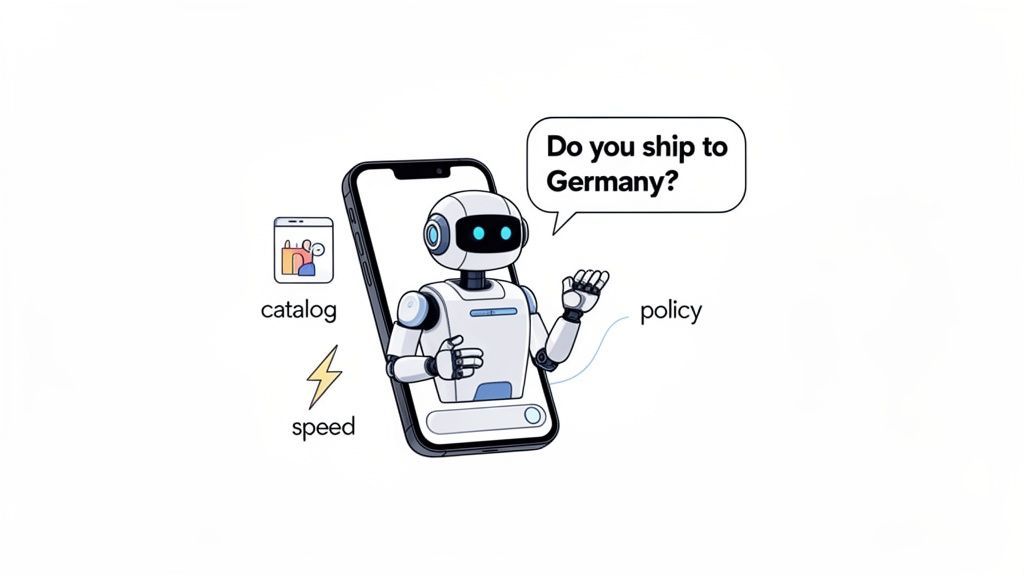
For example, it instantly handles the practical stuff (functional needs) by answering direct questions like, “Do you ship to Germany?” or “Is this jacket waterproof?” because it’s synced with your product catalogue and policies. But it doesn't stop there. It also addresses the emotional needs by offering reassurance—guiding a hesitant shopper to the perfect size or clarifying return policies to ease any pre-purchase anxiety.
Meeting the Modern Demand for Instant Gratification
Today’s shoppers aren't just hoping for fast, accurate, and personal service; they expect it. It’s a non-negotiable that directly shapes whether they’ll buy from you again. The latest UK Customer Satisfaction Index data shows overall satisfaction has hit 78.2 out of 100. The crucial part? This score is being driven up by a record-breaking 83.2% of customer experiences being resolved on the very first try. You can dig into more of these evolving expectations by checking out the full 2025 UK benchmark report.
These numbers tell a clear story: one of the biggest customer needs is getting the right answer, right now. Shoppers hate repeating themselves or waiting for an email that might come tomorrow. They want their problem solved on the spot, and AI is perfectly built to deliver on this promise by providing immediate, consistent answers around the clock.
This is what it looks like in action. Here, an AI sales agent like Marvyn AI isn’t just waiting for questions; it’s asking its own to understand what the customer really needs.
By guiding the conversation, the AI turns a simple question into a proper sales consultation, actively helping the customer find the right product for them.
From Raw Data to Strategic Action
Acting on customer insights is about more than just answering questions in the moment. It’s about structuring that feedback to make smarter decisions for your entire business. To really put these insights to work, advanced techniques like conversation intelligence can turn messy, raw chat logs into clear, actionable data that feeds right back into your strategy.
This is how an AI chatbot becomes more than just a support tool; it becomes a source of genuine business intelligence.
For instance, Marvyn AI can spot trends and give you concrete data to act on:
- Identify product gaps: If dozens of shoppers keep asking for a specific colour or size you don’t stock, that’s not just a handful of questions—that’s a clear signal for your next inventory order.
- Refine marketing messages: See the same pre-sales questions pop up over and over? That’s your cue to update your product descriptions and ads to answer those concerns before they’re even asked.
- Improve website navigation: If customers constantly have to ask where your return policy is, it’s a pretty strong hint that you need to make that link more visible.
When you use technology to automate these interactions, you're not just making customers happier. You’re also freeing up your human team. Instead of spending their day on repetitive questions, they can focus on the high-impact work that actually grows the business. You can read more about how these AI sales agents work to boost revenue and make your whole operation more efficient.
Meeting the Needs of a New Generation of Shoppers
It’s easy to think of your customers as one big group, but the reality is you’re selling to multiple generations at once. What works for a Baby Boomer might completely miss the mark with a Millennial, and navigating this generational divide is one of the biggest challenges for modern brands.
Older shoppers might prefer the familiar comfort of a phone call with a human agent. But younger shoppers—Gen Z and Millennials—grew up with smartphones in their hands. They expect speed, convenience, and the ability to find answers themselves, right now. For them, waiting on hold for a human isn't good service; it's a bug.
This shift in expectations is a massive opportunity. What are customers needs if not the desire for fast, effective solutions? For these younger demographics, an AI chatbot that gives an accurate answer in seconds isn’t just a nice-to-have. It’s their preferred way of getting help.
Bridging the Generational Gap
This doesn't mean you have to pick a side. The smartest brands are building a hybrid model that delivers the best of both worlds—giving modern shoppers the speed they demand without losing the personal touch that other customers value.
Recent UK research backs this up. While only 10% of all consumers wanted more AI in customer service, that figure shoots up to 16% for Gen Z and Millennials. For Baby Boomers, it was just 3%. But here’s the stat that unites everyone: 35% of all consumers said they just want quicker responses. You can dig into the numbers yourself in this analysis of UK consumer behaviour.
A smart system balances these needs perfectly. An AI sales agent like Marvyn AI can field the vast majority of common questions 24/7, delivering the instant support younger customers crave. Questions about shipping policies, order status, or product details get answered in seconds, not hours.
By automating the routine, you free up your human team to focus on what they do best: handling complex, emotionally nuanced issues that require a personal connection. This is the essence of a modern customer-centric strategy.
The Power of Smart Escalation
Of course, this hybrid model only works if the handoff from AI to human is completely seamless. This is where "smart escalation" comes in. It’s the moment an AI recognises it has hit its limit and smoothly passes the conversation to a human agent, complete with the full context.
This one feature prevents the single most frustrating experience in customer service: having to repeat yourself.
The customer gets the best of both worlds—the raw efficiency of AI for simple queries, and the empathy of a human for the tricky ones. This dual approach is key for any brand looking to improve customer engagement across all demographics. It lets you meet every single customer exactly where they are, building the trust that ultimately drives sales.
Answering Your Questions About Customer Needs
Putting theory into practice is where the real questions pop up. As you start digging into what your customers actually need, a few common hurdles are bound to appear.
We've gathered the most frequent questions store owners ask when they start this journey. Here’s some straight-talking advice to help you get this right.
What Is the Most Important Customer Need?
This is the golden question, but the answer isn't a one-size-fits-all secret. While it always depends on your products and who you're selling to, the most crucial, non-negotiable need is always functional.
Does your product actually solve the core problem it promises to?
Think of it this way: a slick website and a killer brand story can’t save a waterproof jacket that leaks. The product has to do its job, full stop.
But once that box is ticked, the emotional and social needs are what really pull you away from the pack.
- Emotional Needs: This is all about how your product makes the customer feel. Confident? Secure? A little more adventurous?
- Social Needs: This connects to how they want others to see them. Are they a savvy shopper? An expert in their hobby? Part of an exclusive club?
Fulfilling the functional need gets you in the game. Fulfilling the emotional and social needs is how you create loyal fans who do your marketing for you.
How Can a Small Store Afford to Analyse Customer Needs?
Good news. You don’t need an enterprise-sized budget or a data science team to get inside your customers' heads. The secret isn’t shelling out for expensive software; it’s about consistent, focused effort.
You can start unearthing powerful insights with free tools and just a little bit of time. The key is to start small and do it every single week. Carve out one hour. That’s it.
The most valuable customer insights often come from the places you already own. Your support inbox, social media comments, and product reviews are unfiltered goldmines of customer pain points and desires.
Here’s a simple, zero-cost plan to get you started:
- Read Your Comms: Spend 30 minutes sifting through support emails and social media DMs. What questions keep coming up? What are the common complaints? That’s your roadmap.
- Check Your Analytics: Jump into Google Analytics for 30 minutes (it’s free). Find your top 5 pages with the highest exit rates—this is literally showing you where customer journeys are hitting a brick wall.
- Analyse Your Reviews: Forget the 5-star and 1-star reviews for a moment. Your 3-star reviews are often the most honest, detailing what a customer liked but also what fell just short of their expectations.
Should I Use AI or a Human Team for Customer Service?
For most modern e-commerce stores, this isn't an "either/or" choice anymore. The smartest approach is a hybrid "both/and" strategy. This setup lets you deliver the best of both worlds, meeting every type of customer need efficiently.
A fully automated AI agent like Marvyn handles the high-volume, repetitive questions instantly. This frees up your human team (or you!) to focus on the complex, high-value conversations that require empathy and genuine problem-solving. This ensures every customer gets the right kind of help, fast.
Thinking about the long-term value of automation versus manual support can help you make an informed decision. Here's a look at the costs and benefits side-by-side.
Marvyn AI vs Manual Support: A Cost-Benefit Analysis
As you can see, the right AI doesn't just cut costs—it provides a level of service that's simply not possible with a purely manual team. It delivers instant, 24/7 support that customers now expect, while letting your human experts focus where they can make the biggest impact.
Ready to turn customer needs into conversions? Marvyn AI is a free, fully autonomous AI sales agent for Shopify that answers over 70% of support questions and guides shoppers to purchase, 24/7. Get started in one click and see your sales grow.