Customer Service Scripts for Shopify: Boost Support and Revenue

Think back to the last time you dealt with a truly awful customer service bot. We've all been there. Rigid, copy-paste customer service scripts are meant to keep things consistent, but they often do more harm than good. They're the pre-written responses that guide support agents (and bots) through common scenarios, from a simple "hello" to complex troubleshooting.
The idea is sound: deliver clear, on-brand answers every time. The reality? Not so much.
Why Generic Scripts Are Hurting Your Brand
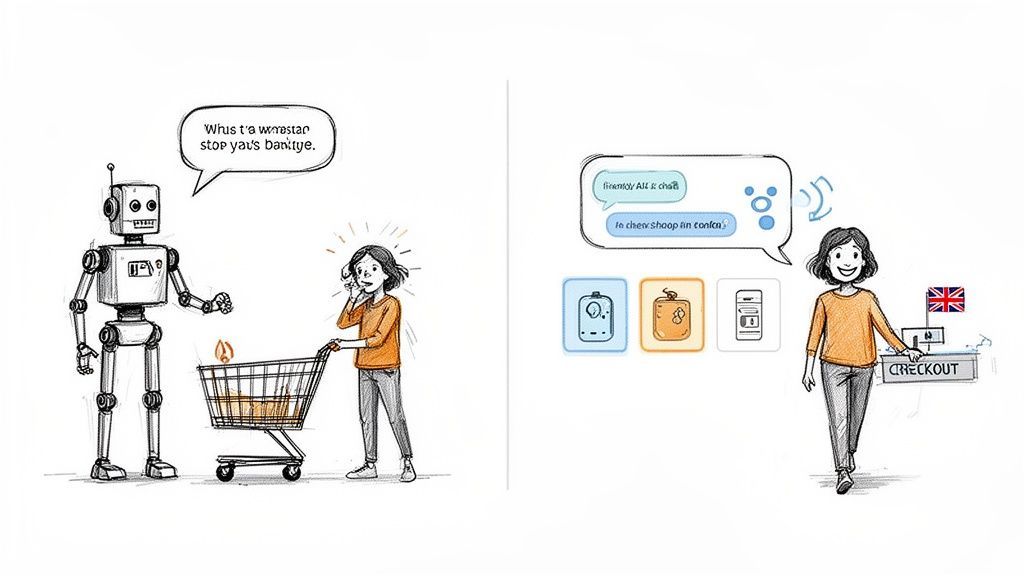
Let's be blunt—those robotic, one-size-fits-all scripts are a relic. In the hyper-competitive world of Shopify and DTC brands, your customers expect instant, personalised help. They don't want a soulless reply that completely misses the point of their question. A generic script makes a customer feel ignored, turning a simple query into a brand-damaging headache.
This friction isn’t just a minor annoyance; it’s a direct hit to your bottom line.
Picture this: a customer asks about the fit of a specific dress and gets a canned response about your general returns policy. They don't feel helped; they feel dismissed. That’s the exact moment they bounce, leaving their cart behind for a competitor who can give them a real answer.
The Real Cost of Outdated Support
The fallout from poor service experiences adds up fast and plays out in public. A recent study found that in 2026, nearly half of UK shoppers—a staggering 48%—reported bad customer service in the past year. What’s worse, it takes an average of just 2.3 poor experiences before a frustrated customer takes their complaints online.
With 89% of UK consumers admitting that reviews heavily influence what they buy, the stakes couldn't be higher. You've poured everything into your product and brand, but an outdated script can tear all that hard work down in a single, frustrating interaction. You can learn more about these UK consumer trends to see just how critical great service has become.
The Shift to Dynamic AI Scripting
The answer isn't to ditch scripts entirely. It's to make them intelligent. For any ambitious Shopify store, the future is dynamic, AI-powered scripting that thinks and adapts in real-time. Imagine a system that doesn't just parrot pre-written lines but actually understands what your customer is trying to achieve.
This is where a tool like Marvyn AI completely changes the game. By syncing directly with your product catalogue, inventory, and store policies, it goes far beyond rigid templates. It delivers consultative, accurate answers that not only solve problems but actively guide customers to the perfect purchase.
The old way of thinking about scripts is what holds so many brands back. A static script feels like a barrier, while a dynamic one feels like a helpful, knowledgeable store assistant.
To see the difference, let’s compare the two approaches directly.
Traditional Scripts vs Dynamic AI Scripts
Instead of a script that flatly states, "We offer free shipping on orders over £50," a dynamic AI can engage the customer intelligently:
"I see you have the 'Midnight Bloom Silk Scarf' in your cart for £45. You're so close! Just add one more item, like our popular 'Leather Card Holder,' and you'll qualify for free shipping!"
This simple shift turns your customer support from a cost centre into a powerful revenue driver. It anticipates needs, solves problems with pinpoint accuracy, and creates the kind of seamless experience that builds loyalty and gets people to actually complete their checkout. This is the new standard for customer service scripts.
Building Your Foundational Script Library
A great script library is the backbone of exceptional customer support. Think of it less as a rigid set of rules and more as a reliable guide for your team. For a busy Shopify store, having a solid foundation of customer service scripts is a game-changer, bringing consistency, accuracy, and speed to every interaction. It gives your team—and your AI chatbot—the confidence to handle common questions, freeing them up for the gnarly, complex stuff.
These foundational scripts aren't static text; they're dynamic blueprints for real conversations. They should cover the most common touchpoints in a customer's journey, from the first hello to the inevitable post-purchase questions. The real goal here is to create a seamless experience that feels genuinely helpful and human, building trust with every message.
Crafting The Perfect Welcome
The first greeting sets the entire tone. It's your first, and sometimes only, chance to make a customer feel seen and valued. A warm, efficient opening can instantly defuse frustration and signal that real help has arrived.
You'll want to have a few different welcomes scripted out for common situations:
- A Simple Hello: For general questions, a friendly and direct approach is all you need. "Hi there! Thanks for getting in touch with [Your Brand Name]. What can I help you with today?"
- Acknowledging a Known Issue: If a customer lands on your site during a big sale or a known technical hiccup, address it upfront. "Welcome to our flash sale! If you have questions about shipping times, just ask. Otherwise, how can I help you?"
- Proactive Engagement: This is where an AI like Marvyn really shines. When a customer is lingering on a specific product page, it can step in. "I see you're looking at the [Product Name]. It's one of our bestsellers! Do you have any questions about the sizing or material?"
This first interaction is critical. It's where you establish your brand's voice and show you’re eager to help. You can explore a variety of expert-level customer support scripts to get more ideas for your own library.
Answering Common Product Questions
Product-related questions are a given, but they’re also a huge opportunity. A quick, accurate answer can be the final nudge a customer needs to hit "Add to Basket." Your scripts should be built to handle the most frequent queries about your catalogue.
Focus on these key areas:
- Sizing and Fit: "Great question! Our [Product Name] has a [e.g., relaxed, athletic] fit. For the best result, I'd recommend checking our size guide here [Link]. Or, if you let me know your measurements, I can give you a personal recommendation."
- Materials and Care: "The [Product Name] is made from [e.g., 100% organic cotton]. To keep it looking its best, we suggest washing it on a cool cycle and hanging it to dry."
- Compatibility/Use Case: "Yes, the [Accessory Name] is fully compatible with the [Main Product Name]. It's designed to work perfectly with it."
An AI chatbot is especially good at this. When it’s synced with your Shopify data, Marvyn can pull up specific details instantly, giving consultative answers that feel like you’re talking to a knowledgeable shop assistant. This is where you can learn more about how chatbots for customer service are transforming online support.
Navigating Shipping and Returns
Let's be honest, questions about shipping and returns are often loaded with a bit of anxiety. Customers want to know where their stuff is and what happens if it's not right. Clear, empathetic, and straightforward scripts are absolutely essential here. Vague answers will send them straight for the exit.
Your goal should be to resolve these common queries on the first contact. High first-contact resolution not only improves satisfaction but also signals that your operations are running smoothly.
The impact of having well-structured responses is massive. Take HMRC's 2025-2026 performance report, for example. It showed a customer satisfaction rate of 79.7%, with their 'Once and Done' metric reaching an impressive 85.5%. This data proves how structured information, the kind you bake into effective scripts, leads directly to happier customers and better efficiency. You can read more about HMRC's performance insights on gov.uk.
Here’s how to structure these crucial scripts:
- Shipping Costs and Times: "We offer free standard shipping on all UK orders over £50, which typically arrives in 3-5 working days. We also have an express option at checkout if you need it sooner!"
- Order Status: "I can definitely check on that for you. Could you please provide your order number?"
- Returns Process: "We have a 30-day return policy. You can start the process easily through our returns portal here [Link]. Just enter your order number and email address to get started."
Building out this foundational script library is the first practical step toward creating a world-class, scalable customer support system for your brand.
Crafting Scripts That Drive Sales And Recover Carts
Once your foundational support scripts are humming along, it’s time to flip the switch from purely reactive to proactive. This is where your customer service scripts stop being just a safety net and start becoming a powerful engine for sales.
Instead of only answering questions, your team—and especially your AI chatbot—can start guiding customers toward better purchases and recovering sales that were about to slip away.
This isn’t about hard-selling. It's about consultative selling. You’re using your product knowledge to help shoppers find exactly what they need, and maybe something extra they’ll absolutely love. A well-crafted script for an upsell feels like genuine, expert advice, not a sales pitch. It builds on the trust you've already earned by being helpful.
Turning Queries into Upsell Opportunities
Every single product question is a golden opportunity to increase your Average Order Value (AOV). The trick is to actually listen to what the customer needs and then make a relevant, valuable suggestion.
Your script should feel like a helpful tip, not a command to buy more. It’s all about enhancing their purchase, not just inflating the total.
Think about these real-world scenarios:
- When a customer asks about a specific product: "That's an excellent choice! A lot of customers who buy the 'Hydrating Face Serum' also grab the 'Vitamin C Eye Cream' to complete their routine. They’re actually designed to work together for the best results."
- When they're close to the free shipping threshold: "You're so close to unlocking free shipping! Your total is at £45 right now. If you add a small item like our 'Silk Scrunchie Set,' your whole order will ship for free."
- When a customer is buying a gift: "If this is a gift, our premium gift-wrapping service is a really popular add-on. We can even pop a personalised note in there for you."
This is exactly where an AI chatbot like Marvyn shines. It instantly knows what’s in the customer's cart and your entire product catalogue, letting it make smart, real-time recommendations that feel personal and genuinely useful.
The best upsell scripts are subtle. They solve a potential problem for the customer before it even pops into their head—like needing the right accessory or wanting a more complete solution. It's this proactive helpfulness that drives sales without feeling pushy.
Winning Back Abandoned Carts with Proactive Scripts
Cart abandonment is a multi-trillion-pound headache for e-commerce brands. But here's the thing: customers often leave not because they dislike the product, but because a last-minute question or hesitation goes unanswered.
A proactive chatbot script can intercept these shoppers right as they show signs of leaving.
The goal is to pinpoint the friction and smooth it over on the spot. Is it the shipping costs? The return policy? A question about the warranty? Your AI chatbot needs to have scripts ready to tackle these common hurdles head-on.
An Example Exit-Intent Script Flow
- The Hook: "Wait! Before you go, did you have any questions about the items in your cart? I can help."
- Tackling Shipping Worries: "Just so you know, we offer free 3-5 day shipping on all orders over £50. We also have an express option at checkout if you need it sooner!"
- Soothing Return Policy Fears: "Shopping online can be tricky! That's why we have a no-fuss 30-day returns policy. If it's not a perfect fit, you can send it back for free."
- Adding a Touch of Urgency (Optional): "Those items in your cart are some of our bestsellers and stock is getting low. Let me know if I can help you complete your order."
This kind of automation turns a passive website into an active selling environment. You can see how leading brands are putting these strategies to work by reading more about AI sales agents and the real impact they have on conversion rates.
By scripting these crucial interventions, you rescue revenue that would have otherwise vanished, turning a moment of doubt into a happy, completed sale.
Weaving Your Brand Voice Into Every Script
A library of perfect customer service scripts is useless if every response sounds like it came from a generic, corporate robot. Customers connect with brands, not templates. That’s why adapting every script to reflect your unique brand voice isn’t just a nice-to-have; it’s essential for building a loyal community.
Your brand's voice is its personality. Are you fun and witty, or professional and reassuring? A script for a trendy streetwear brand will sound completely different from one for a luxury skincare line, even when answering the same question about shipping times.
Injecting Your Brand’s Personality
First, get a solid handle on your brand's core communication style. Is it formal or casual? Do you use emojis and slang, or stick to clear, straightforward language? Once you've defined that, you can start breathing life into your foundational scripts.
It’s amazing how a few small tweaks can completely transform a standard reply:
- Generic: "Your order has been shipped and will arrive in 3-5 business days."
- Fun & Friendly Brand: "Great news! Your order is officially on its way. Get ready for some good stuff to land on your doorstep in 3-5 days! 🎉"
- Luxe & Formal Brand: "We are pleased to inform you that your order has been dispatched. You can expect delivery within three to five working days."
This simple change ensures that even routine interactions reinforce who you are as a brand. When you're crafting these scripts, it’s also really helpful to think about the differences between internal vs customer-facing SOPs, as this changes how your instructions are designed and delivered by your team or AI.
Knowing When AI Should Hand Off to a Human
Automation is a game-changer, but it isn’t a silver bullet. The true art of modern customer service is knowing precisely when an AI chatbot should step aside and let a human take over.
Forcing a customer to battle a bot over a complex or emotional issue is a fast track to losing them forever.
A recent survey from MaxContact really drives this home, finding that a staggering 42% of UK consumers have switched brands because of poor service. While AI is great for speed, customers have very clear ideas about when they want a human. The research shows 70% want a person to explain specific situations, 65% for complex queries, and 61% when making a complaint. Ignoring that is a huge risk.
The smartest systems combine AI efficiency with human empathy. The AI acts as the first line of defence, instantly resolving common queries while recognising the triggers that need a person's touch.
Your escalation rules need to be crystal clear. This ensures a seamless handoff that makes the customer feel supported, not just passed along.
Designing a Seamless Escalation Path
A smooth transition from AI to a human agent is vital. The script used for this handoff can make or break the experience. It needs to be reassuring, transparent, and efficient, showing the customer you value their time.
I’ve put together a quick table of common triggers and the kind of scripts that work well. These are designed to manage expectations and keep the customer on your side.
Escalation Triggers And Scripted Handoffs
By building these intelligent pathways, you create a support system that gets the best of both worlds. You get the speed and scale of automation for the simple stuff, while reserving the critical thinking and empathy of your human team for the moments that truly matter.
Putting Your AI Scripts into Action
Alright, you've got your scripts polished and ready. Now for the fun part: plugging them into an AI that can turn them into a 24/7 sales and support engine.
If you’re thinking this involves a team of developers and weeks of complex coding, think again. With a modern platform like Marvyn AI, you can get started with a simple one-click install from the Shopify App Store.
Once you’re in, you’re not just copy-pasting scripts one by one. Instead, you're training the AI. This means uploading your existing knowledge base – all your FAQs, returns policies, shipping details, and brand documents. The AI digests all of it, learning to answer questions naturally, just like a human team member would.
Fine-Tuning Your AI’s Personality and Smarts
That initial data dump is just the starting point. The real magic happens when you start to fine-tune the AI to match your brand's unique vibe and rules.
Inside a platform like Marvyn, you can easily set your brand’s tone of voice. Do you want it to be witty and fun? Professional and straight to the point? Friendly and empathetic? You decide. This ensures every automated response feels authentic to your brand, not like it’s coming from a generic robot.
You can also dial in the AI’s intelligence. You might want it to be more consultative when it comes to product recommendations but stick strictly to the facts for support queries. This level of customisation is what turns a basic Q&A bot into an intelligent shopping assistant that helps customers and actually drives sales. The goal here is to automate over 70% of common support queries, freeing up your team for the tricky stuff.
This is the core process: taking your base scripts and adapting them for brand voice, location, and knowing when to hand off to a human.
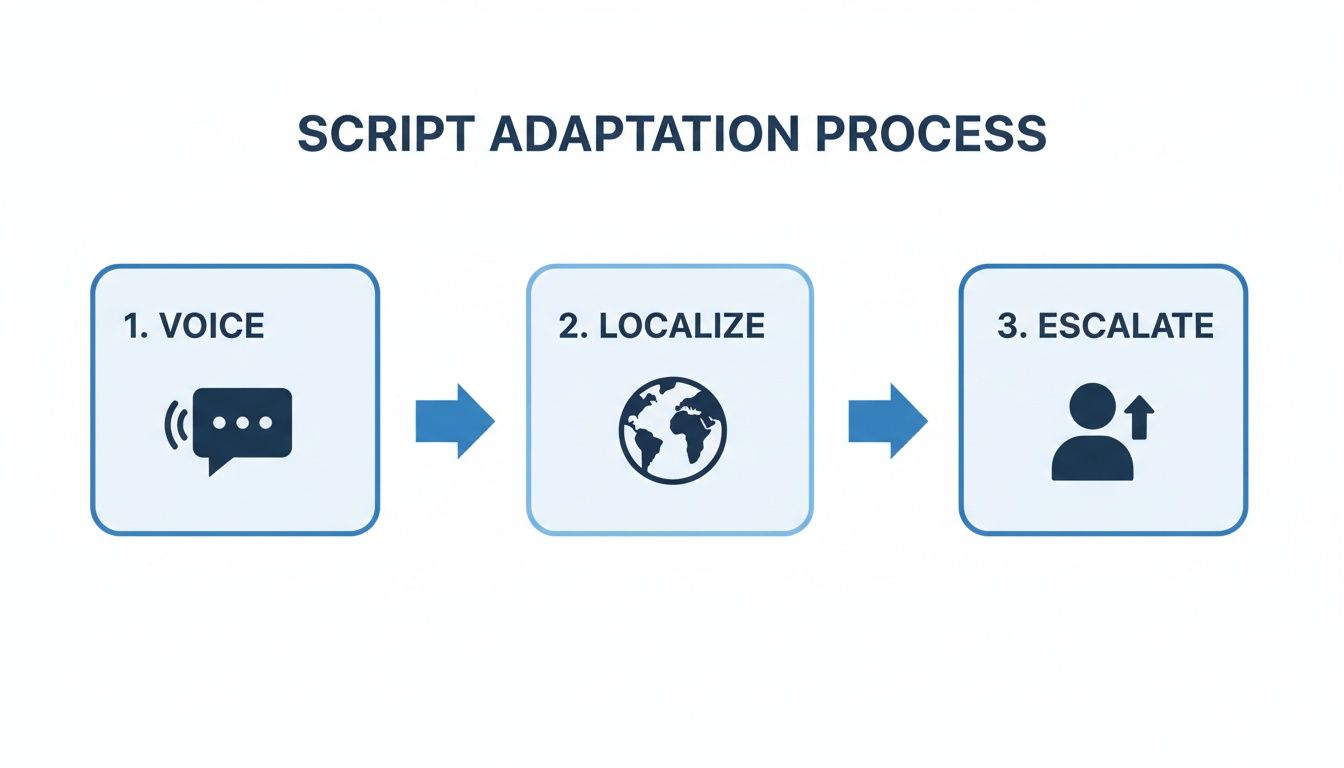
It’s all about creating a system that’s both consistent and flexible enough to feel personal.
From Launch to Learning Loop
Going live is a great milestone, but it’s not the end of the road. The brands that win with AI treat it as a constant process of refinement. This is where your conversation analytics become your new best friend.
By keeping an eye on how your AI is performing, you can uncover some incredibly useful insights:
- Spot the Gaps: See which questions are stumping the AI. This is a goldmine. It shows you exactly where you need to add more information to your knowledge base.
- Track What Matters: Measure the important stuff. How many issues are resolved on the first try? How often does the AI need to escalate to a human? And, most importantly, what’s the conversion rate on conversations handled by the AI?
- Get Smarter Over Time: Use all that data to continuously update your FAQs and training documents. With every interaction, your AI becomes more effective.
This cycle of feedback and improvement is what makes your AI a true asset. For a deeper look, our guide on automation in customer service covers these optimisation strategies in more detail.
The ultimate aim is to create a feedback loop. Customer conversations provide the data, analytics turn that data into insights, and you use those insights to improve the AI's knowledge. This continuous cycle is what separates a basic chatbot from a true AI sales and support channel.
Platforms like Marvyn make this process dead simple, giving you a clear dashboard where you can see conversation history and analytics at a glance.
By pairing your customer service scripts with a smart AI tool and committing to ongoing improvement, you're building more than just a support channel. You're creating a scalable, intelligent system that makes customers happier, cuts down on operational headaches, and actively helps your store grow. It’s about turning every single customer question into an opportunity.
Got Questions? We've Got Answers
When you're diving into customer service scripts, a few common questions always pop up. It's totally normal. Getting these sorted is the first step to building a support system that doesn't just put out fires but actually helps you grow.
Let’s tackle the big ones.
How Long Should a Customer Service Script Be?
Honestly, there’s no magic number. A script should be as long as it needs to be and not a word longer.
For a simple "Where's my order?" query, short and direct is the way to go. Get them the answer, fast. But if someone's asking for a product recommendation, the script can be a bit more conversational to provide genuine help.
The real goal is clarity, not word count. You want to give the customer what they need without making them read a novel. The good news is, with an AI tool, you’re not writing rigid, linear scripts anyway. You're building a knowledge base with your FAQs and policies, and the AI figures out how to construct a perfectly-sized answer on the fly.
Can AI Scripts Actually Sound Like My Brand?
Absolutely. This isn't the clunky, robotic AI of five years ago. Modern AI is built for this exact purpose.
You can customise its tone of voice—whether you want it to sound ‘friendly,’ ‘professional,’ or a bit ‘witty.’ By feeding it your existing brand documents, like your website copy or past support chats, the AI learns to mimic your unique personality.
The result? You get a chatbot that feels less like a machine and more like a helpful, on-brand member of your team. This keeps every single customer interaction consistent, reinforcing that brand experience you’ve worked so hard to create.
The biggest mistake you can make is writing scripts that are too rigid. Customers can spot a robotic, copy-paste response from a mile away. Think of scripts as flexible guidelines, not concrete rules. This is where AI really shines—it gets the intent behind the question and crafts a natural response, instead of just following a pre-written path.
How Do I Know if My Scripts Are Actually Working?
Success is about more than just a thumbs-up emoji on a satisfaction survey. To get the full picture, you need to look at a few key metrics.
Here’s what I always recommend tracking:
- First Contact Resolution (FCR): What percentage of problems get solved in the very first interaction? A high FCR is gold. It means your scripts are clear, your customers are happy, and your team isn't getting bogged down in back-and-forth emails.
- Escalation Rate: How often does a chat need to be handed over to a human? If your escalation rate for common questions is low, it’s a great sign that your AI and scripts are handling the routine stuff perfectly.
- Sales Impact: This is the big one for any e-commerce brand. Are the conversations handled by your chatbot actually leading to sales? Track things like conversion rates and Average Order Value (AOV) from those chats to see the direct impact on your revenue.
Most AI platforms come with detailed analytics dashboards to monitor all of this, giving you a clear view of what’s working and what needs a bit of a tune-up.
Ready to turn your support from a cost centre into a revenue machine? Marvyn AI is a FREE, fully autonomous Shopify chatbot that automates over 70% of customer service while driving consultative sales. Install Marvyn AI with one click and start delivering exceptional support 24/7.