A Guide to Customer Service Software for UK E-commerce

Imagine a digital concierge for your online shop, always on, ready to answer questions, guide shoppers, and solve problems in an instant. That’s the core idea behind modern customer service software. It’s a system designed to pull all your customer conversations—from email and social DMs to live chat—into a single, organised hub.
Why Customer Service Software Is Not a Luxury

Not too long ago, customer support was seen as a cost centre—a necessary evil you managed with a messy email inbox and a phone that never stopped ringing. That thinking is dangerously outdated. For any e-commerce brand today, especially in the crowded UK market, this software is the engine for growth.
Think of it as the digital version of a brilliant assistant in a physical shop. A great retail assistant doesn't just stand behind the till; they greet people, offer help, suggest products, and make the whole experience feel effortless. This software does exactly that for your online store, but at a scale no human team could ever manage alone.
Tackling E-commerce Pain Points
Let's be honest, running a UK direct-to-consumer (DTC) store has its challenges. You're fighting high cart abandonment rates, the ever-rising cost of manual support, and customers who (rightfully) expect answers immediately, day or night.
This is precisely where these platforms prove their worth. Instead of a potential customer bouncing from your site because they can't find your return policy, an AI-powered chatbot can give them the answer in seconds. It turns a moment of frustration into a smooth conversion.
To put it in perspective, here's a look at how this software directly addresses common issues for UK online retailers.
How Customer Service Software Solves Key UK E-commerce Challenges
As the data shows, the benefits are tangible and directly tied to your bottom line. It's about turning a reactive cost centre into a proactive growth driver.
By automating repetitive queries, this software frees your team to focus on high-value tasks like strategy and business growth, rather than spending hours answering "Where is my order?". It transforms your support function from a reactive cost to a proactive revenue driver.
The Shift from Reactive to Proactive Support
The biggest change this software brings is moving from a reactive to a proactive model. Old-school support waits for a customer to complain. A modern system anticipates their needs and steps in before a problem even starts.
Here’s how that plays out in the real world:
- Instant Answers: A customer is looking at a product and has a question about the material. The chatbot gives them an answer on the spot, keeping them on the page and moving toward a purchase.
- Abandoned Cart Recovery: A shopper gets distracted and leaves items in their cart. The system can ping them with a helpful reminder, answer a lingering question, or even offer a small discount to seal the deal.
- 24/7 Availability: It's 3 AM and someone from a different time zone is on your site. They have a question. The software is there to help, meaning you never miss an opportunity just because your team is asleep.
This constant, helpful presence builds immense trust. To dig deeper into getting this right, our guide on customer support for e-commerce breaks down the fundamentals.
In a marketplace where you're competing with thousands of other brands, this level of service is what makes you stand out. It’s no longer just about fixing problems—it’s about creating genuinely happy customers who come back time and time again.
So, What’s Actually Inside a Modern Support Platform?
To really get what makes modern customer service software tick, we need to look under the bonnet. Forget a dry feature list; let's connect each piece to a real-world job it does for your Shopify store. These aren't separate tools, but interconnected parts of a machine built to serve your customers and grow your business.
At the very heart of it all is the shared inbox. Think of it as your digital command centre for customer service. Instead of your team tripping over each other in a single, chaotic Gmail account, every email, live chat, and social media message lands in one organised space. This immediately stops the confusion, prevents multiple people from replying to the same customer, and makes sure every single query gets assigned to someone who owns it.
Working hand-in-hand with this central hub are AI chatbots. These are your tireless, front-line assistants, ready to go 24/7. They act as the first point of contact, instantly answering all the common questions like "Where is my order?" or "What's your return policy?". This frees up your human team to handle the more complex, high-value problems that need a personal touch. We dive deeper into how this works in our guide to customer care automation.
Taming Complexity with Help Desks and Knowledge Bases
While chatbots manage the sheer volume, a help desk brings structure to the more complicated stuff. A help desk is basically a smart ticketing and case management system. When a query is too tricky for a chatbot—say, a damaged item or a bespoke order request—the system creates a 'ticket'.
This ticket can then be tracked, prioritised, and passed between team members, making sure no complex issue ever falls through the cracks. It gives you a complete history of the entire conversation, which is gold for quality control and training your team.
Working alongside these active support channels is your knowledge base. This is your store's own self-service library. It’s a searchable, public collection of articles, FAQs, and video guides that helps customers find their own answers, fast. A great knowledge base doesn't just cut down on support tickets; it also builds customer confidence by giving them the info they need, right when they need it.
A strong knowledge base is like having your best salesperson and support agent available to every customer, on every page, at any time of day. It answers questions proactively, removes friction from the buying process, and lets your human team focus on what they do best.
The Real Power Is in Integration and Automation
These parts don't just exist in a vacuum. The real magic happens when they're all deeply connected and automated. Understanding how different components, like integrated CRM and automation development services, work together is the key to building a support system that actually works.
For example, a chatbot can pull order details straight from your Shopify store, find a relevant article from your knowledge base, and then seamlessly hand the conversation over to a human agent in the shared inbox if needed. The best part? The customer never has to repeat themselves.
This level of integration is a complete game-changer, especially as UK e-commerce brands face enormous pressure from rising customer expectations. Poor service is costing the sector billions in lost sales every year. In this climate, customer service software has become essential, with AI chatbots now able to resolve a huge chunk of cases all on their own.
For Shopify owners, this means tools like Marvyn AI can automate a massive portion of customer interactions. The result is dramatically faster response times and happier customers, a finding backed by countless CRM leaders who have made the switch to AI. You can find more detail in the latest customer service statistics and research.
Choosing the right setup for your customer support is one of those big decisions every e-commerce brand has to make. This isn't just about picking a tool; it's about defining the very personality of your brand's service. The choice really comes down to three paths: relying entirely on human agents, deploying AI chatbots, or blending the two in a hybrid approach.
Think about it like this. Sometimes you need a master watchmaker to handle a delicate, complex repair that requires years of experience and intuition. Other times, you just need a quick, accurate answer to, "What time is it?" The best solution often involves knowing which one to use and when.
This decision tree gives you a simplified peek at how a smart customer service software system routes questions.
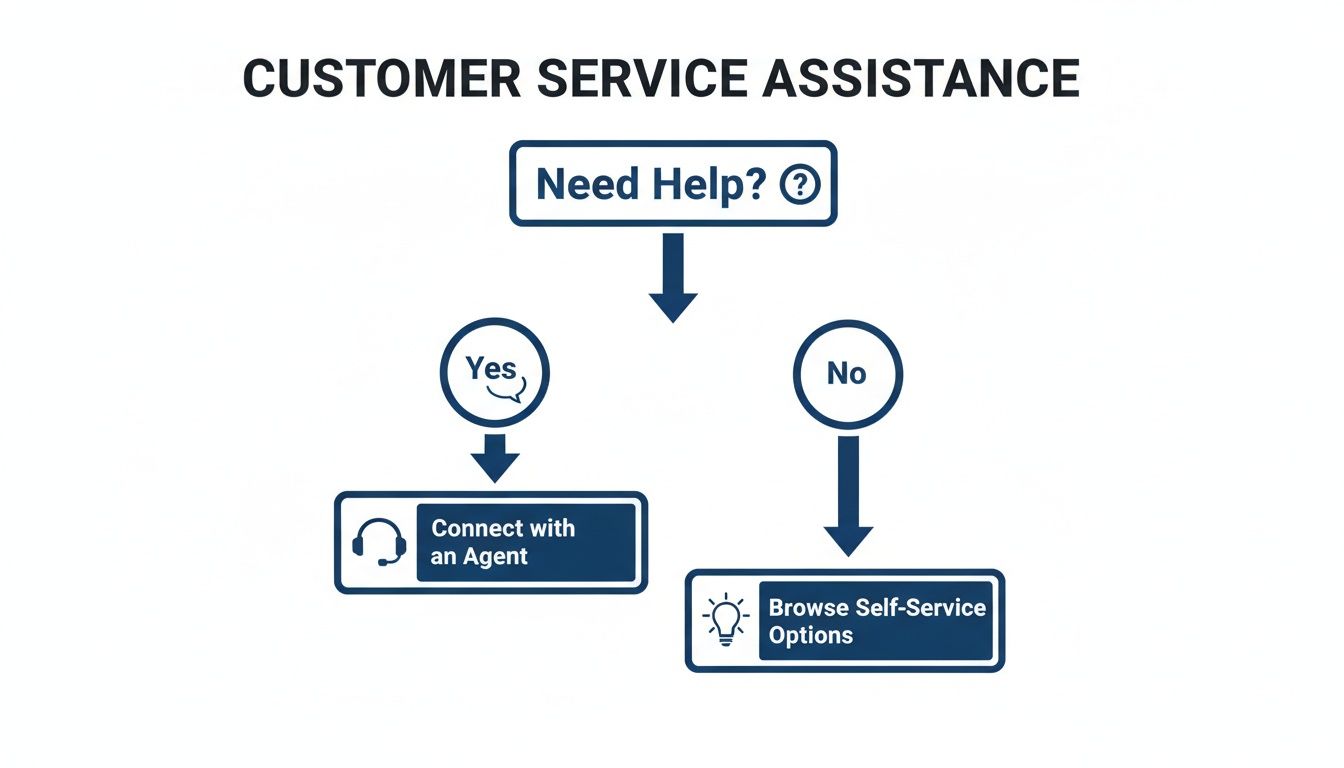
At its core, the system is just a sophisticated sorter, figuring out whether a problem needs a human touch or if an automated answer will do the job faster.
Before we dive into the details, let's break down these three models. The table below gives a quick overview to help you see how they stack up against each other, especially for a busy Shopify store.
Comparing Customer Support Models for Shopify Stores
This table gives you the 30,000-foot view. Now, let’s get into the nitty-gritty of what each model really means for your business day-to-day.
The All-Human, Live Agent Model
Going all-in on live agents means every single customer question—no matter how simple—is handled by a real person. This approach delivers an incredible level of personalisation and empathy. It’s absolutely vital for high-value sales, complex technical problems, or emotionally charged complaints.
If a customer's £2,000 order has gone missing or they need detailed advice before a major purchase, a human conversation is non-negotiable. That’s where you build real trust.
But here’s the catch: this model is eye-wateringly expensive. It’s difficult to scale, and running it 24/7 requires a large, globally distributed team. For a growing Shopify store, relying only on agents is a fast track to slow response times and spiralling operational costs.
The AI Chatbot-Only Approach
At the other end of the spectrum, you have a fully automated model driven entirely by AI chatbots. This is the ultimate answer to scalability and round-the-clock service. A single chatbot can juggle thousands of conversations at once, giving instant answers to common questions like "Where is my order?" or "Do you ship to Germany?"
This instant, 24/7 support is a massive win for customer satisfaction, especially for the routine questions that make up over 70% of support volume for most e-commerce brands. The main drawback? Even the smartest AI can get stuck on a completely new, multi-layered, or highly nuanced problem it hasn't been trained to solve.
If you want to go deeper on this, our guide on the best AI chatbots for business is a great place to start.
The Hybrid Model: The Best of Both Worlds
For the vast majority of growing e-commerce businesses, the hybrid model hits the sweet spot between efficiency and quality. This approach uses AI as the first line of defence, instantly knocking out the high volume of simple, repetitive queries.
In a hybrid system, the AI chatbot acts as an intelligent filter. It resolves what it can on its own and gathers key information before seamlessly escalating the conversation—along with its full context—to a human agent.
This setup ensures customers get immediate help for simple issues. More importantly, it frees up your human agents to focus their expertise on the complex problems where they actually make a difference.
A hybrid model in action looks something like this:
- A customer lands on your site and asks the chatbot for their order status. The AI instantly pulls the data from Shopify and provides a real-time update.
- That same customer then asks a complicated question about a custom product bundle they're trying to build.
- The chatbot recognises it can't give a perfect answer, so it automatically transfers the conversation to a live agent.
- The agent sees the entire chat history. The customer never has to repeat themselves, creating a smooth and frustration-free experience.
This intelligent tag-team lets you offer the speed of AI with the empathy and problem-solving smarts of a human expert. It's the most effective way to scale your support, keep costs in check, and deliver the kind of exceptional service that turns shoppers into loyal customers.
How to Evaluate Customer Service Software for Your Store
Choosing the right customer service software is one of those decisions that will quietly define your brand’s relationship with its customers. Faced with a sea of options, it’s easy to get lost in feature lists and clever marketing. The trick is to look past the sales pitch and start asking the right questions — questions that get to the heart of what your e-commerce store actually needs.
Think of it like hiring a key team member. You wouldn't just glance at a CV; you’d run interviews, ask tough questions, and make sure they’re a perfect fit for your culture and the way you work. This checklist is designed to help you do exactly that for your software, so you can make a smart decision and avoid the common pitfalls.
How Deep Is the Shopify Integration?
For any Shopify merchant, this is the first and most important question. A "Shopify integration" can mean anything from a glorified contact sync to a system that's deeply woven into your store's backend. You need to know exactly what the software can see and do inside your Shopify admin.
A superficial integration might just pull in customer names and emails. A genuinely powerful one goes much, much further.
- Order Management: Can your team view a customer's entire order history, check a delivery status, or process a refund and exchange right from the support chat? They shouldn't be juggling two browser tabs to solve one customer problem.
- Product Catalogue Sync: Does the software automatically pull in your entire product catalogue, complete with images, pricing, and live inventory levels? An AI chatbot is pretty useless if it can't answer "Do you have this t-shirt in blue?"
- Customer Data Access: Can it see customer data like shipping addresses or lifetime value to give your team the context they need for personalised support?
The goal here is a single pane of glass. Your support team needs one place where they have all the information required to solve issues fast. A shallow integration creates more work; a deep one eliminates it.
What Are Its Real Automation Capabilities?
Every platform on the market now claims to have "AI automation," but the term has become so vague it's almost lost all meaning. You need to dig in and find out what the automation actually does. Is it just a glorified FAQ page, or will it genuinely take work off your plate?
Don't get distracted by buzzwords. Ask for specific examples. A vendor should be able to show you, step-by-step, how their system automates the top three to five questions your store gets every day, like "Where is my order?".
True automation handles entire conversations, from start to finish, without a human needing to step in. For an e-commerce brand, that means things like:
- Proactive Engagement: Can it reach out to a customer who’s been stuck on a product page for a few minutes and offer help?
- Complex Query Handling: Can it guide a customer through your entire multi-step returns process all by itself?
- Smart Escalation: And when it hits a problem it can't solve, does it intelligently gather the important information before seamlessly passing the conversation to a human? Recent data shows that platforms with advanced AI can cut ticket volume by up to 40%.
Will It Scale Without Hidden Costs?
Growth is the goal, but your software shouldn't punish you for achieving it. A lot of pricing models look great when you're small but hide nasty surprises that penalise you as you scale. Be very wary of any platform that charges per-conversation or has tight ticket limits.
Your support volume is going to fluctuate, especially during peak sales seasons like Black Friday. A scalable pricing model should be able to handle these spikes without your monthly bill going through the roof. Look for plans that offer unlimited conversations and are priced on the value they provide, not the volume they handle.
Can It Be Customised to Match My Brand?
Your customer service is a direct extension of your brand. The software you choose has to be able to reflect your unique voice, tone, and visual style. A generic, robotic-sounding chatbot can do more harm than good, chipping away at the brand trust you've worked so hard to build.
Ask these specific questions about customisation:
- Brand Voice: Can I train the AI on my own brand guidelines, policies, and past support chats to make sure it sounds like us?
- Visual Identity: Can I change the colours, add my logo, and make the chat widget look like a natural part of my website's design?
- Language Support: Does it support multiple languages to help us serve a global customer base?
Picking the right customer service software is an investment in your brand's future. By asking these tough, practical questions, you can make sure you're choosing a partner that will help you grow, not hold you back.
A Step-by-Step Implementation Roadmap
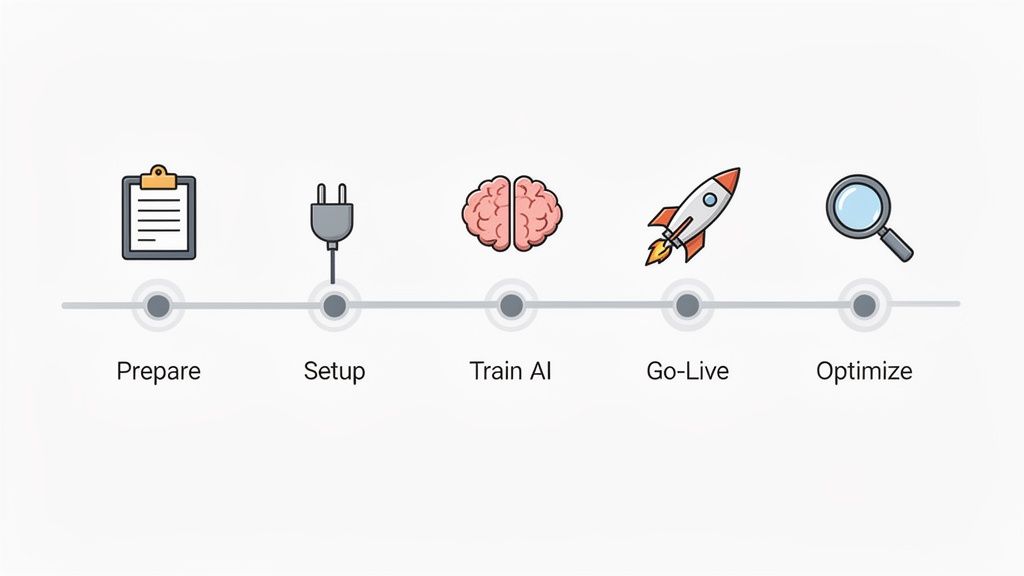
Thinking about bringing in new tech can feel overwhelming. The good news is that with modern customer service software, especially tools built for Shopify, you can go from sign-up to a fully working system faster than you might think. Forget about those month-long projects that need a team of developers.
Today, you can get set up in a matter of hours. This roadmap breaks the whole thing down into five simple stages, designed to get your new support system live and driving sales as quickly as possible.
Phase 1: Preparation and Goal Setting
Before you click "install" on anything, you need a plan. This first phase is all about defining what a "win" looks like for your store and gathering the information your new software needs to actually be useful. A little prep work here will save you a ton of headaches later.
Here are your main tasks:
- Define Your Goals: What's the number one problem you're trying to fix? Is it slashing response times, deflecting repetitive questions, or boosting your conversion rate? Set one clear, primary objective.
- Gather Your Knowledge: Pull together your FAQs, returns policy, shipping info, and any other standard customer documents. Having these ready makes the AI training process dead simple.
- Map Key Interactions: You can't improve your customer service if you don't understand where it's currently breaking. Learning to create a customer journey map is a brilliant exercise. It helps you pinpoint exactly where customers get stuck and where an AI tool can help the most.
Phase 2: Setup and Integration
This is the "technical" bit, but for tools built for Shopify, it's often as easy as installing an app. The software does all the heavy lifting, creating a direct link between your support tool and your shop without you writing a single line of code.
Here’s what typically happens during this stage:
- Install the App: Usually a one-click process from the Shopify App Store.
- Sync Your Store Data: The software automatically connects to your Shopify admin and starts syncing your entire product catalogue, collections, and key pages. This gives it real-time information on your products, prices, and stock levels.
Think of this as the software taking a full inventory of your business. It learns what you sell, how you operate, and where all your key information lives. This creates the foundation it needs to start helping customers.
Phase 3: Training Your Digital Assistant
With the technical side sorted, it's time to give your AI its brain and personality. This is where you turn a generic tool into a branded assistant that sounds like it genuinely works for your company.
You'll focus on a couple of key things:
- Uploading Policies: Feed the system all those documents you gathered in Phase 1, like your returns policy and FAQs. The AI will digest this information instantly.
- Refining the Brand Voice: Most modern tools let you tweak the tone. Do you want to sound formal and professional, or more fun and casual? You can set the personality to perfectly match your brand's vibe.
Phase 4: Go-Live and Monitoring
Once the AI is trained and the system is integrated, you're ready for launch. This phase is all about flipping the switch and then watching closely to see how it performs in the wild. Modern platforms make this a low-risk step, as you can see every single conversation in real time.
Your key activities will be:
- Activating the Tool: With a simple toggle, your new AI assistant goes live on your website, ready to greet customers.
- Tracking Initial Conversations: Your dashboard will show you every interaction as it happens. You can see the questions people are asking and how the AI is responding.
- Monitoring Key Metrics: Keep a close eye on your automation rate (how many queries are solved without needing a human), conversation volume, and any initial customer feedback. For more guidance on building out your self-service options, check out our article on creating a Shopify help centre.
Phase 5: Ongoing Optimisation
The final phase never really ends. Your customer service software isn't a "set and forget" tool; it's a dynamic system that gets smarter with your input. By analysing its performance, you can spot opportunities to make it even more effective.
Look for ways to:
- Analyse Conversation Logs: Dive into the chats where the AI struggled or had to escalate to a human. This is your goldmine for finding gaps in its knowledge.
- Update and Refine: Use those insights to create new FAQ articles, tweak your policies, or refine the AI's training. Every small adjustment makes the system smarter and more capable. This continuous feedback loop is what turns a good support tool into a great one.
Measuring Success and Calculating Your ROI
So, you’ve decided to invest in new customer service software. That's a big move. But how do you actually prove it’s working and not just another subscription on the books? The temptation is to look at simple things like the number of chats handled, but those are just vanity metrics. The real test is seeing a tangible impact on your bottom line—both in costs saved and new revenue earned.
If you want to justify the investment, you have to learn to speak the language of pounds and pence. This means tracking metrics that tie your support activities directly to business outcomes. It’s all about shifting your support from being seen as a cost centre to proving it’s a powerful engine for growth.
Focusing on Cost Savings
The quickest and most obvious return on your investment often comes from cutting down operational costs. When you automate all those repetitive, time-sucking questions, you free up your team to handle more complex issues. You can get more done with the same team, or even a smaller one.
The maths is actually quite simple. Let's say your new software automatically handles 500 tickets a month. If each of those tickets would have taken a human agent six minutes to resolve, you’ve just saved 3,000 minutes. That’s 50 full hours of labour.
At a blended rate of £15 per hour, those 50 saved hours translate directly into £750 of labour cost savings every single month. Over a year, that's a cool £9,000 back in your pocket, just from automating the easy stuff.
This is a powerful, undeniable metric. The UK customer service software market has exploded precisely because of these clear-cut benefits. A 2023 report found that 64% of UK retailers using these tools saw a 25% reduction in support tickets within the first year, with SaaS solutions leading the charge. If you want to dig deeper, you can explore detailed market analysis on customer service software.
Tracking Revenue Gains
While saving money is great, generating more of it is where your software truly proves its worth as a growth tool. Better, faster support has a direct line to a customer's decision to buy, how much they spend, and whether they’ll ever shop with you again.
Here are the key revenue metrics you should be watching like a hawk:
- Conversion Rate: Keep an eye on how often a chatbot interaction on a product page actually ends in a sale.
- Average Order Value (AOV): Are customers who chat with support spending more? This is a clear sign of effective cross-selling or upselling recommendations. A 2024 Federation of Small Businesses survey found that mid-sized UK e-commerce firms saw their AOV jump by 18% after implementing omnichannel software.
- Reduced Cart Abandonment: Pay close attention to how many shoppers are "rescued" at the checkout by a proactive chat pop-up or a quick answer to a last-minute question.
Measuring Customer Satisfaction
Finally, and this might be the most important part, you have to track how happy your customers are. Because happy customers come back. They tell their friends. They become your best marketing channel.
These key performance indicators (KPIs) are non-negotiable for any serious brand:
- Customer Satisfaction (CSAT): This is your bread-and-butter, post-interaction survey asking customers to rate their experience. A high score is a direct signal of quality service.
- Net Promoter Score (NPS): This one goes beyond a single interaction to measure overall brand loyalty. It asks the ultimate question: "How likely are you to recommend us?" If you want to get this right, we have a helpful guide on how to calculate your NPS score.
- First Response Time (FRT): This tracks the raw speed of your support. In a world of instant gratification, making customers wait is a death sentence for satisfaction.
When you bring these three pillars together—cost savings, revenue gains, and customer happiness—you build an undeniable business case. You'll have a clear, data-driven picture of the immense value your customer service software delivers, making it one of the best investments you can make for your brand.
Frequently Asked Questions
Thinking about AI support brings up some big questions. It’s a smart move to be cautious. Let's tackle the most common (and completely valid) hesitations we hear from UK Shopify merchants.
Will an AI Chatbot Sound Robotic and Hurt My Brand?
This is a fair question. The last thing you want is a clunky, robotic chatbot frustrating your customers and damaging the brand you’ve worked so hard to build. And frankly, the early chatbots earned that reputation.
But the AI of 2026 is a different beast entirely. You're not just picking a colour scheme; you're shaping a personality. Modern customer service software lets you train the AI on your brand’s actual voice—using your past support chats, your policy pages, and your site content. The result is an assistant that sounds less like a machine and more like your best, most helpful employee.
The goal isn't to fool customers. It's to give them what they want—an instant, accurate, on-brand answer—at 3 AM on a Sunday, without making them wait.
What Happens if the AI Cannot Answer a Question?
This is where a good system proves its worth. The AI's job isn't just to answer questions; it's also to know when it can't. When it gets stuck, detects a customer is getting frustrated, or sees a direct request for a human, it doesn’t just give up.
Instead, the best platforms use what’s called a "smart escalation" to seamlessly hand the conversation over to a person.
The real magic is that the human agent gets the full chat history. The customer never has to repeat themselves. This hybrid approach gives you the speed of automation when you need it and the empathetic touch of a real person when it matters most.
How Much Technical Skill Do I Need to Set Up This Software?
If you can install a Shopify app, you have all the technical skill you need. Seriously. For platforms built specifically for Shopify, the setup is often a one-click install from the App Store. The system then automatically hooks into your product catalogue, pages, and policies.
The backend isn't built for developers; it's built for merchants. You’ll find that you can:
- Customise the bot’s personality with simple toggles and text boxes.
- Keep an eye on conversations through a clean, intuitive dashboard.
- Update the AI's knowledge by just uploading a new FAQ document.
Forget the days of needing a dev team to get support automation running. The tools today are built for you.
Ready to see how an AI assistant can transform your Shopify store? Marvyn AI automates over 70% of customer interactions, provides 24/7 support in 80+ languages, and drives sales, completely free. Get started in minutes at https://www.marvyn.co.