Customer care automation: Boost Shopify Support & Conversions
Imagine hiring a team of sales experts who never sleep, speak over 80 languages, and know your entire product catalogue inside out. This isn't some far-off dream; it's what customer care automation delivers, and it's quickly becoming a core revenue strategy for modern Shopify stores.
The New Reality of Ecommerce Customer Experience

The conversation around customer care automation has changed. It’s no longer just about cutting costs by deflecting support tickets. Today, it’s about creating a better, scalable customer journey that turns casual browsers into loyal buyers. The new reality is built on a deeper understanding of customer experience, which modern automation is designed to elevate, not just replace.
Think of it less like a basic, scripted chatbot and more like an intelligent sales assistant for your online shop. This is a huge shift. We’re moving beyond just answering "Where is my order?" to proactively guiding shoppers, almost like a product expert in a physical retail store.
To see what this really means for an ecommerce brand, let's compare the old way with the new.
Manual Support vs Automated Customer Care
The difference is stark. One model is built on managing problems, while the other is built on creating opportunities.
From Cost Centre to Revenue Driver
For any growing Shopify brand, this is the biggest win: turning customer support from a reactive cost centre into a proactive revenue engine. Instead of just putting out fires, automation actively drives sales and makes the entire shopping journey smoother.
It does this by:
- Providing consultative sales: The AI can ask shoppers about their needs, style, and budget, then recommend the perfect products from your catalogue.
- Resolving queries instantly: A well-designed system can resolve over 70% of routine questions without any human help, freeing up your team for more important work.
- Empowering your human agents: With all the repetitive tasks handled, your team can focus on the high-value conversations that build relationships and solve complex problems.
This is all about augmenting your team, not replacing it. Automation handles the high-volume, low-complexity stuff with speed and precision, while your people provide the high-value, strategic expertise that builds real brand loyalty.
The growth here is undeniable. In the UK, AI-powered chatbots now handle an estimated 65% of customer service interactions in businesses that use them. With 31% of UK businesses having fully automated at least one function, some are reporting returns as high as 250% in the first year. It’s a proven strategy that works.
Ultimately, customer care automation is about building a more resilient, efficient, and profitable business. It lets you offer exceptional, consistent service at scale, ensuring every visitor gets the attention they need to make a confident purchase. If you're looking for more ways to level up your online store, you might also find our guide on how to improve the ecommerce customer experience useful.
How Automation Directly Boosts Your Bottom Line
While smarter support sounds nice, the only question that matters for a Shopify merchant is this: what’s the return on investment? Customer care automation isn't just another app to install; it’s a strategy that hits your profit and loss statement directly. The ROI is real, immediate, and comes from several directions at once, changing your support from a cost centre into a growth engine.
Just think about the time you and your team spend typing out the same answers day after day. "Where is my order?", "What's your return policy?", "Do you ship to Germany?". Every one of those tickets pulls you away from work that actually grows the business, like marketing, product sourcing, or brand building.
This is where automation gives you your first, most obvious win. By handling a huge volume of these repetitive questions instantly, you get countless hours back. Your team is freed from the daily grind and can focus on proactive work that actually moves the needle.
Slash Support Costs and Scale Effortlessly
For a growing business, one of the biggest operational costs is hiring, training, and managing a customer support team. As your store starts selling internationally, that cost explodes. Suddenly, you need staff across different time zones who speak multiple languages, which can get incredibly expensive.
Customer care automation offers a much more efficient way forward. A tool like Marvyn AI runs 24/7 in over 80 languages, giving you global coverage without the overhead of a global team. It means you can sell confidently into new markets, knowing every customer gets instant, accurate support, whether it's day or night. This model lets you scale effortlessly, handling huge traffic spikes like Black Friday just as easily as a quiet Tuesday morning.
Crush Cart Abandonment and Boost Conversions
Most abandoned carts happen in a moment of doubt. A shopper has a last-minute question about sizing, materials, or shipping costs. If they can’t get an answer right away, they’re gone—and they probably won't be back.
Automation closes this critical gap. By putting instant, accurate answers right on the product page, an AI agent acts like a sharp sales assistant, removing friction and giving shoppers the confidence to buy.
This is about more than just a fancy FAQ. It’s about being there with the right information at the exact moment a customer needs it to click "buy". This kind of proactive help is a powerful way to cut down on abandoned carts and directly lift your store's conversion rate.
Increase Average Order Value with Smart Selling
Good automation doesn't just answer questions; it sells. Think about a great in-store assistant who doesn't just grab your size but also suggests a matching accessory to complete the look. That's exactly what a consultative AI can do for your online store.
For example, when a shopper adds a dress to their cart, the AI can pop up and recommend the perfect pair of shoes or a complementary handbag. This type of smart upselling and cross-selling feels helpful, not pushy, and is a proven way to increase your Average Order Value (AOV). You grow revenue from every single transaction without spending a penny more on marketing.
This approach is already making a big impact across the UK. Recent data showed UK customer satisfaction climbed to 78.2 out of 100 in early 2026, a jump largely driven by smarter tech in customer care. With 39% of business leaders reporting faster resolutions and 30% seeing better outcomes with AI, it’s clear that automation is becoming a key piece of building a more profitable brand. You can dig into more of these findings on the latest UK customer satisfaction index from Answer-4u.com.
These benefits all build on each other over time, making a solid case for making [automation in customer service](https://www.marvyn.co/blog/automation-in-customer-service) a core part of how you run your business.
To really get what customer care automation can do, you need to lift the bonnet and see how the engine works. Don't worry, you don't need a degree in computer science. Just think of it as setting up a perfectly efficient, self-running retail store.
Modern automation isn’t a single piece of tech. It’s a few key components bundled into one intelligent system. Each part has a specific job, and they all work together to create a customer experience that feels both smart and responsive.
The AI Chatbot as Your Digital Storefront Staff
The most obvious part of the whole setup is the AI Chatbot. This is your tireless, friendly, and incredibly knowledgeable staff member, always on the digital shop floor. It’s the first face your customers see, ready to greet them, answer their questions, and point them in the right direction.
But these aren't the clunky, script-following chatbots of the past. Today’s AI agents can hold natural, human-like conversations. They understand context, ask follow-up questions, and offer personalised recommendations—just like an expert sales assistant in a high-end boutique.
The Knowledge Base as Your Operational Manual
For that chatbot to be any good, it needs a brain. That brain is the Knowledge Base. And this isn't just some dusty, forgotten FAQ page. It’s a living, breathing library that instantly syncs with every single piece of information about your business.
This includes everything from:
- Product Details: All your specifications, materials, sizing charts, and stock levels for every single item.
- Store Policies: Your complete shipping rules, returns policy, and terms of service.
- Uploaded Documents: Any extra brand guidelines or specific FAQs you want to add.
With a tool like Marvyn AI, this is completely automatic. The moment you install it, the AI syncs with your Shopify store and learns your entire business in minutes. This ensures the information it gives out is always up-to-date and spot-on.
A powerful knowledge base is the absolute foundation of great automation. It’s what guarantees the answers your AI provides are not just fast, but consistently accurate, building trust with every single customer interaction.
Natural Language Processing The Art of Understanding
So, how does the AI figure out what a customer actually means? That’s the magic of Natural Language Processing (NLP). NLP is the sophisticated tech that lets a machine understand human language in all its messy, brilliant, and sometimes misspelled glory.
Whether a customer types "where's my stuff?", "track my parcel," or "status of order #12345," NLP gets the real intent behind the words. This ability to decipher slang, typos, and different ways of phrasing the same question is what separates a helpful AI from a frustrating one. It makes the conversation feel smooth and ensures the customer gets what they need without having to ask twice.
Smart Escalation Your Line to Human Expertise
Finally, even the smartest AI knows its own limits. Smart Escalation Pathways are the safety net that makes sure no customer ever gets stuck. These are just predefined rules that automatically pass a conversation over to a human agent when a question gets too complex, emotionally charged, or simply needs a decision only a person can make.
This creates the perfect hybrid model where tech and people work together. The AI handles the huge volume of day-to-day questions, which frees up your team to focus on providing high-touch support where it really counts. It's the ideal balance of efficiency and empathy.
Together, these parts create a powerful engine for growth, turning your customer support from a time-consuming chore into a real strategic advantage. You can see how these components work together in proactive selling by reading our post on AI sales agents.
Practical Automation Workflows You Can Use Today
Alright, theory is one thing, but seeing how automation actually solves the day-to-day headaches of running a Shopify store is another. Let’s get practical. Here are three real-world automation workflows you can set up right now to cut down your support tickets, lift your sales, and give your customers a much smoother experience.
These aren't just separate tricks; they show how a smart, connected automation system really works.
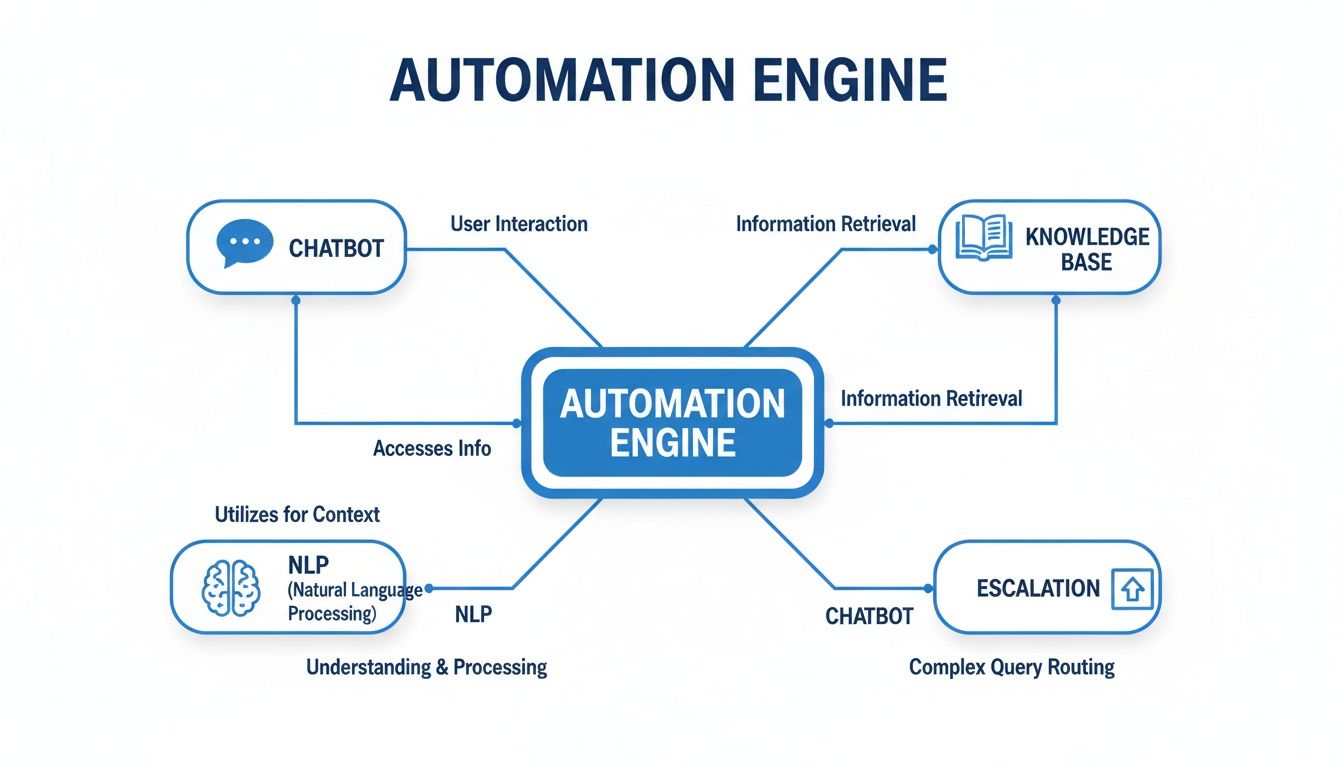
Think of it like this: the chatbot, knowledge base, and escalation rules aren't separate tools you're juggling. They're all parts of a single, intelligent engine. The real magic happens when they work together seamlessly, letting the system handle a huge range of tasks all by itself.
Workflow 1: Proactive Pre-Sales Guidance
You know the scene: a potential customer is on a product page, clearly interested but stuck on a question. Maybe it's about sizing, materials, or if the product is right for them. Without a quick answer, that hesitation almost always leads to a lost sale. They just click away.
Instead of waiting for them to get frustrated and leave, an AI can step in proactively. After a few seconds on the page, the chat widget can pop up with something helpful and not at all pushy, like: "Finding the perfect fit can be tricky. Can I help you with our sizing guide or material details?"
Instantly, you've turned a passive browser into an engaged shopper. The AI, armed with your entire product catalogue, can act like an expert sales assistant. It can answer specific questions, compare products side-by-side, and even offer personalised recommendations. For a tool like Marvyn AI, this is a core function — it’s like having a tireless expert on every single product page, 24/7.
Workflow 2: Instant Post-Purchase Support
Here's the big one. A customer has just placed an order and, inevitably, the "Where Is My Order?" (WISMO) question lands in your inbox. This is, without a doubt, the most common, repetitive, and soul-destroying query for any e-commerce team. Manually digging up order details and pasting tracking links is a colossal waste of time.
With an automated solution, this entire process is over in seconds. An AI that’s integrated with your Shopify store can handle it all. When a customer asks about their order, the AI verifies who they are (usually with their email) and immediately pulls the latest tracking data from your system. It gives them a direct link to the courier's tracking page and a clear estimated delivery date.
This single workflow can deflect up to 50% or more of all incoming support tickets. That’s not an exaggeration. It frees up an incredible amount of time for your team and gives customers the fast, exact answer they were looking for.
The same goes for returns. Instead of another email thread, the AI can explain your returns policy, share a link to the returns portal, and even kick off the process if you've configured it to do so. This is a classic high-volume, low-complexity task that is perfect for automation. If you need some ideas on how to frame these messages, our guide on auto-reply examples is a great place to start.
Workflow 3: Consultative Upselling and Cross-Selling
Your marketing has done its job. A customer is on your site, and they've added an item to their cart. But you're leaving money on the table if you stop there. The trick is to suggest other items that make their purchase even better, but doing it manually is impossible.
This is where your AI shifts from a support agent into a smart sales assistant. When a customer adds, say, a new pair of running shoes to their cart, the automation engine can trigger a genuinely helpful suggestion.
The AI could pop up with something like:
- "Great choice! Many runners find our moisture-wicking socks and a lightweight running belt complete their kit. Would you like to see them?"
Why does this work so well? Because it’s not just a random, annoying popup. It's contextual. The AI uses its deep knowledge of your product collections and what people often buy together to make smart, relevant recommendations. This is where a tool like Marvyn AI really shines, using its understanding of your catalogue to drive up Average Order Value (AOV) by turning a single purchase into a complete bundle.
Your Five-Step Shopify Implementation Plan
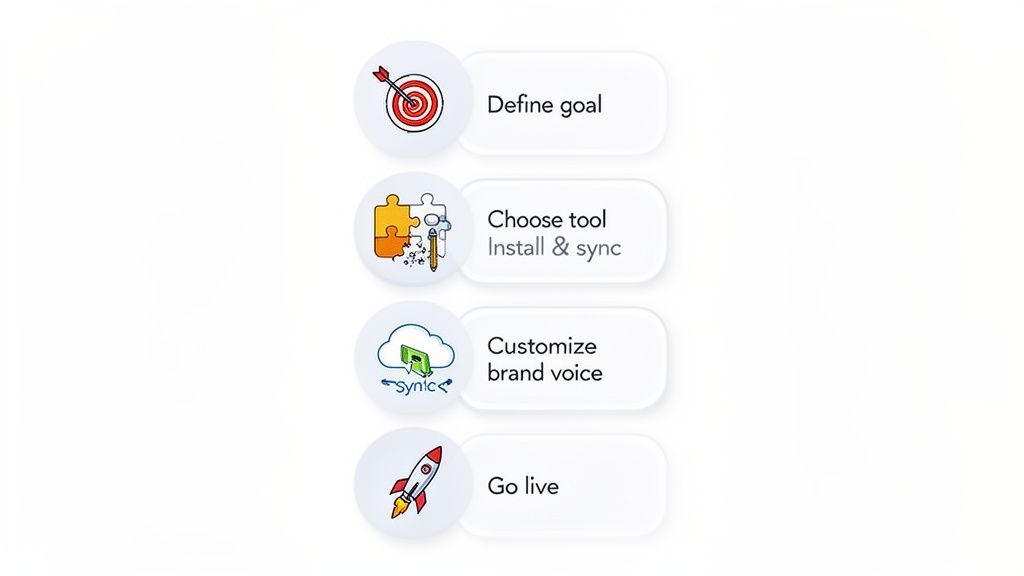
Getting started with customer care automation shouldn’t feel like a huge, technical project that takes months to get off the ground. Forget about all that. With the right game plan and tools, you can have a powerful system up and running in minutes.
This five-step guide is built for Shopify merchants who want to see an immediate impact—without the usual tech headaches. The entire process is designed for speed and simplicity, letting you reap the rewards from day one.
Step 1: Define Your Primary Goal
Before you even think about installing an app, you need to know what winning looks like. What’s the single biggest problem you want automation to solve for you? Be specific and set a clear, measurable target.
Your main goal could be to:
- Reduce Ticket Volume: Aim to deflect 50% of all incoming support queries within the first 30 days.
- Boost Conversion Rate: Increase conversions from chat interactions by 15%.
- Improve Response Time: Slash your average first-response time from hours to under a minute.
Having a single, clear objective will shape every other decision you make. It also gives you a solid benchmark for measuring your return on investment later on.
Step 2: Choose the Right Tool
The tool you pick will either make or break your automation strategy. For anyone on Shopify, the perfect solution is one that fits into your existing setup without a fuss, needs zero coding, and starts delivering value straight away. When weighing your options, knowing your platform's strengths against alternatives like Shopify vs WooCommerce can give you a real advantage.
Look for a tool built specifically for the world of e-commerce. A free, one-click solution like Marvyn AI is designed to eliminate all friction. It installs right from the Shopify App Store and is built to handle the unique challenges of online retail, from pre-sale questions to post-purchase support.
The best tools don't just add another dashboard for you to manage; they get to work for you the moment you install them. The focus should always be on instant value, not a long and complicated setup.
Step 3: Instant Installation and Syncing
Honestly, this step should be the fastest of them all. With a modern AI tool, implementation is as simple as clicking “Add app” in the Shopify App Store. No developers, no messy scripts, and absolutely no manual data entry.
Once installed, a tool like Marvyn automatically gets to work. It syncs with your store's entire database, instantly learning:
- Your full product catalogue, including all variants.
- Your collections and how you’ve organised your products.
- Your shipping, returns, and other critical policy pages.
This “instant sync” process means your AI is ready to answer customer questions accurately within minutes, not weeks. For a deeper look at how to organise this information, have a read of our article on building a great Shopify help centre.
Step 4: Customise Your Brand Voice
Automation should never mean your brand sounds like a robot. Your AI agent is an extension of your brand, and it absolutely must sound like it. Customising its tone and personality is a critical step.
Whether your brand is witty and informal, straight-up professional, or warm and friendly, you can tweak the AI’s responses to match. You can also upload your logo and adjust the colours to make sure the chat widget blends perfectly with your website's design. It’s all about creating a seamless brand experience at every touchpoint.
Step 5: Go Live and Monitor Results
With your goals set and your AI's personality dialled in, you’re ready to flick the switch and go live. Now, your focus shifts to tracking performance against the goal you set back in step one.
Keep a close eye on key metrics like ticket deflection rate, chat conversion rates, and customer satisfaction scores. Taking time to review conversation transcripts is also invaluable. It helps you see exactly what your customers are asking, allowing you to fine-tune your AI’s knowledge and make it even better over time.
Measuring the Success of Your Automation Strategy
So, you’ve set up your automation. How do you know if it’s actually working? Just installing another app isn't the goal—you're looking for real, measurable results for your business. To prove the value of your strategy and keep making it better, you need to track the right Key Performance Indicators (KPIs).
Think about it: you wouldn't run a marketing campaign without tracking clicks and conversions. Your automation strategy is no different. It needs its own set of vital signs to show you how healthy and effective it really is. Let’s break down the essential KPIs for any Shopify store.
Gauging Efficiency and Cost Savings
The first, and most immediate, impact you’ll see from automation is on your team’s workload. The best way to measure this is to focus on one simple question: how many customer queries are being solved without a human ever touching them?
- Ticket Deflection Rate: This is your star metric for efficiency. It’s the percentage of customer questions your AI successfully handles all on its own. A high deflection rate means your team is freed up from repetitive tasks to focus on work that actually grows the business. For example, a tool like Marvyn AI can show you it has handled 70% of incoming queries, which is a massive win for productivity.
- First Contact Resolution (FCR): This KPI tracks the percentage of issues solved in the very first interaction, whether that’s with your AI or a human. High FCR is a sign of an efficient system and, more importantly, leads to happier customers who get their answers fast, with no need for follow-ups.
Tracking these metrics proves a direct return on investment by showing exactly how many hours your team gets back. This isn’t just about cutting costs; it’s about reallocating your most valuable resource—your team’s time—towards activities that actually drive growth.
Measuring Direct Impact on Revenue
Beyond saving time, your customer care automation should be actively driving sales. By connecting your support efforts directly to your bottom line, you can prove its value beyond any doubt.
Here are the key revenue-focused metrics to watch:
- Conversion Rate from Automated Chats: How many shoppers who talk to your AI end up making a purchase? This is a seriously powerful metric. A high conversion rate proves your AI is doing its job—removing friction, answering last-minute questions, and giving customers the confidence to click "buy".
- Impact on Average Order Value (AOV): A smart AI isn't just a support bot; it's a consultative sales assistant. By tracking the AOV for customers who interact with it, you can see if its smart upselling and cross-selling recommendations are actually working. A clear lift in AOV for this group shows your automation is successfully boosting the value of each transaction.
Understanding Customer Happiness
Finally, none of the efficiency or revenue gains mean a thing if your customers are having a terrible experience. Measuring satisfaction is non-negotiable to ensure your automation is a helping hand, not a frustrating roadblock.
The most important metric here is Customer Satisfaction (CSAT). After an interaction with your AI, pop up a simple survey asking customers to rate their experience. Consistently high CSAT scores from automated chats confirm that customers appreciate the speed and accuracy they’re getting. And any negative feedback? That’s gold. It gives you invaluable insights for optimising your AI's responses and knowledge base.
Frequently Asked Questions About Customer Care Automation
Whenever we talk about automating customer care, the same few questions always come up. It's natural. Shopify owners are rightly protective of their brand and wary of anything that sounds too complex or expensive.
Let's cut through the noise and tackle those common worries head-on. This way, you’ll have the clarity you need to decide if automation is the right move for your brand.
Will Automation Make My Brand Feel Robotic?
This is probably the number one question we get, and it’s a good one. But the idea that AI has to sound robotic is a myth rooted in old technology. Modern tools are designed to do the exact opposite.
The secret is in the customisation. A good AI, like Marvyn AI, doesn’t have a fixed personality. You train it to adopt your brand’s voice—whether that’s witty, formal, or super casual and friendly. It becomes an extension of your brand, not some generic call centre script.
Even more importantly, the goal isn't to fire your support team. It's to make them superhuman.
The smartest automation strategy is a hybrid one. Let the AI instantly handle the 70% of routine, repetitive questions. This frees up your human experts for the tricky, high-value conversations where their empathy and problem-solving skills really shine.
The result is a win-win. Your customers get instant answers for simple things, and thoughtful, human-powered support for everything else.
Is This Difficult And Expensive To Set Up?
In the past, yes. Enterprise automation software used to mean massive budgets and long, painful implementation projects. Thankfully, that’s no longer the world we live in.
Today’s tools, especially those built for Shopify merchants, have completely changed the game. An app like Marvyn AI is a one-click install from the Shopify App Store. It’s free to get started and requires zero coding or technical skill.
The moment you install it, the system gets to work, automatically syncing with your product catalogue, collections, and policy pages. You can be live and automating customer conversations within minutes—not months. This puts powerful automation in the hands of everyone, from solo founders to bootstrapped brands.
How Do I Know If It Is Actually Working?
You don't have to guess. Any automation platform worth its salt will give you the data to prove its value. The return on investment shouldn't be a mystery; it should be right there in your dashboard.
You’ll want to keep an eye on a few key metrics:
- Ticket Deflection Rate: What percentage of questions is the AI handling on its own, without needing a human?
- Conversion Rate from Chat: How many of those automated conversations are turning into actual sales?
- Impact on Average Order Value (AOV): Is the AI’s upselling and cross-selling actually increasing basket sizes?
By tracking these numbers, you can draw a straight line from your automated customer care to your bottom line. It’s that simple.
Ready to see how effortless automation can be? With Marvyn AI, you can reduce support tickets by over 70% and turn your customer service into a revenue-driving machine. Install our free, one-click Shopify app and go live in minutes. Get started today at https://www.marvyn.co.