Mastering Customer Support for Ecommerce in 2026
Let's get one thing straight: customer support is no longer just a cost centre. It’s your new sales team, your retention engine, and your most powerful brand asset, all rolled into one. For any DTC brand, it's the critical connection that turns one-time buyers into lifelong fans.
Why Great Ecommerce Customer Support Is Your Strongest Differentiator

In a world where anyone can copy your products, match your pricing, or imitate your marketing, the one thing nobody can replicate is the experience you deliver. That’s where exceptional customer support becomes your secret weapon. It stops being a reactive chore and turns into your most valuable asset.
Think of it this way: your support team is the digital version of that amazing, knowledgeable shopkeeper who remembers your name. They don’t just solve problems; they build relationships, offer guidance, and create the kind of trust that keeps people coming back. It’s that human touch that sets breakout DTC brands apart from the crowd.
The New Standard of Customer Expectations
Today’s shoppers aren’t just buying a product; they’re buying into an entire experience. A slow, unhelpful, or hard-to-reach support channel is a huge red flag, and it's a direct path to lost sales. In fact, after just one bad interaction, a shocking number of customers will jump ship to a competitor without a second thought.
This puts massive pressure on founders, especially when dealing with the classic ecommerce headaches:
- Cart Abandonment: How many times has a shopper bailed at the last second? Often, it’s because of a simple, unanswered question about sizing, shipping, or a product feature. A quick, confident answer is the difference between a sale and another abandoned cart.
- Negative Reviews: Nothing kills a brand's reputation faster than a string of one-star reviews. A frustrating post-purchase experience is the quickest way to get one. But proactive and empathetic support can turn an angry customer into a happy one, protecting your hard-earned reputation.
- Repeat Business: It costs way more to acquire a new customer than to keep an existing one. Excellent support is the bedrock of customer retention, directly fuelling your customer lifetime value (LTV).
Turning Support into a Revenue Engine
If you’re still thinking of customer service as just an expense, you’re looking at it all wrong. It’s time to reframe it as a powerful revenue-generating engine. Every single customer interaction is a chance to build loyalty, gather priceless feedback, and even increase your average order value with smart, helpful suggestions.
A recent report on UK consumer habits found a massive gap in the market. Nearly half of all UK consumers (47%) have dealt with poor customer service in the last year, and one in six (15%) feel that standards are actually getting worse.
This gap between what customers expect and what they actually get is your golden opportunity. By delivering fast, personal, and genuinely helpful support, you don't just meet their expectations—you blow them away. This creates a memorable experience that people will talk about, turning your support team into your best word-of-mouth marketing channel.
If you want to go deeper, check out our guide on how to improve the overall ecommerce customer experience. When you get it right, outstanding customer support for ecommerce becomes your most defensible competitive advantage.
Building Your Modern Ecommerce Support Toolkit
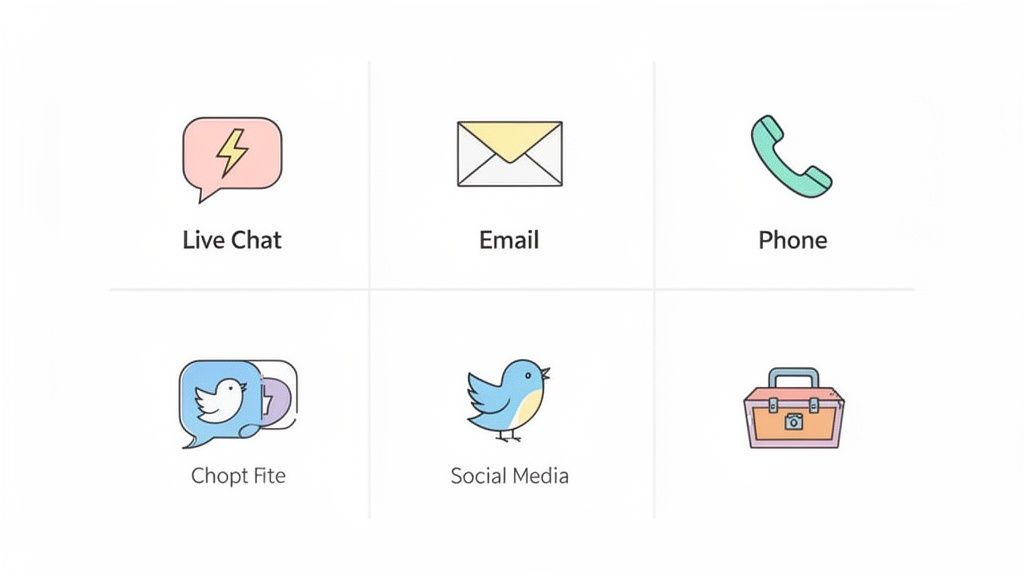
Choosing your support channels is a lot like packing a toolbox. You wouldn't bring a hammer to fix a leaky pipe, and you don’t need every tool for every job. The goal isn’t to be everywhere at once. It's about strategically picking the right channels to meet your customers where they are, without stretching your team too thin.
A smart mix of channels turns your support from a scattered mess into a coordinated system. Let's break down the main options and where they fit best.
Live Chat: The Conversion Driver
Think of live chat as your digital shop assistant, perfectly placed to help customers right at the moment of decision. This is your go-to for pre-sales questions about product specifics, sizing, and stock availability.
Because it’s immediate and conversational, live chat is incredibly powerful for overcoming that last-minute hesitation that leads to abandoned carts. When a shopper has a quick question, a fast answer often leads directly to a sale. For a deeper look, check out our guide on using live chat on a website.
Email: The Problem-Solver
Email is your workhorse. It’s built for complex, non-urgent issues that need a bit of back-and-forth investigation, like complicated returns, order modifications, or quality concerns where a customer needs to attach a photo.
It gives both your customer and your team the space to provide detailed information without the pressure of a real-time conversation. This creates a documented thread that’s easy to reference, ensuring nothing gets lost in translation.
For any of this to work, you need a single source of truth for customer data. Understanding the Role of CRM in Ecommerce is non-negotiable for creating a seamless experience across channels. A CRM ensures your team sees the full customer journey, no matter how they get in touch.
Phone Support: The High-Touch Solution
While many digital-first brands are moving away from it, phone support remains unmatched for handling sensitive or high-stakes problems. This is the channel for de-escalating frustration and building trust when a customer is genuinely upset about a big order issue or a billing dispute.
That direct human connection can reassure an anxious customer in a way that text simply can’t. It’s best reserved for those high-value situations where empathy and direct conversation are critical.
Social Media: The Public Front Line
Your social media profiles are your brand’s public square. Any support interaction here is highly visible, making it a powerful—and sometimes risky—platform for brand management.
The trick is to use social for quick, friendly acknowledgements to general questions, then immediately guide users to a private channel (like email or a support ticket) to discuss order specifics. A swift, helpful public reply followed by a private resolution shows everyone watching that you’re on top of things.
Comparing Ecommerce Support Channels
To make sense of it all, here's a quick comparison of the most common channels. Think about where your customers are and what kind of questions they're likely to have.
Ultimately, you don't need to launch with every channel. A startup might thrive with just email and an autonomous AI chatbot. A larger brand might add phone support for VIPs. The right mix aligns with your audience and your resources, creating a support experience that feels effortless for your customers and manageable for you.
How AI Automation Drives Efficiency and Sales
Scaling your business shouldn't mean you have to scale your support team at the same rate. This is where AI automation comes in, but it’s time to move past the idea of clunky, old-school FAQ bots. Let's talk about what modern AI can really do for an e-commerce brand.
Forget simple script-readers. Think of today's AI as an autonomous sales assistant that works for you 24/7. This isn't just a defensive tool for answering questions anymore; it’s a proactive engine for driving sales and creating a genuinely seamless customer journey.
From Cost Centre to Conversion Engine
The first job of a great AI in customer support for e-commerce is to absorb the flood of repetitive, predictable questions. "Where is my order?", "What is your return policy?", and "Do you ship to Germany?" are all important, but they don’t need the strategic mind of a human agent.
By automating these answers, you solve two massive problems at once:
- Instant Gratification for Customers: Shoppers get accurate answers in seconds, not hours or days. In a market where patience is razor-thin, that speed is everything.
- Freedom for Your Team: Your human agents are freed from the soul-crushing monotony of copy-pasting tracking links. They can now pour their expertise into the complex, high-value interactions that actually build loyalty, like handling a complaint from a VIP customer or giving a detailed product consultation.
The diagram below shows how this hierarchy works. The AI handles the bulk of the simple stuff, empowering your human agents to focus where they're needed most.
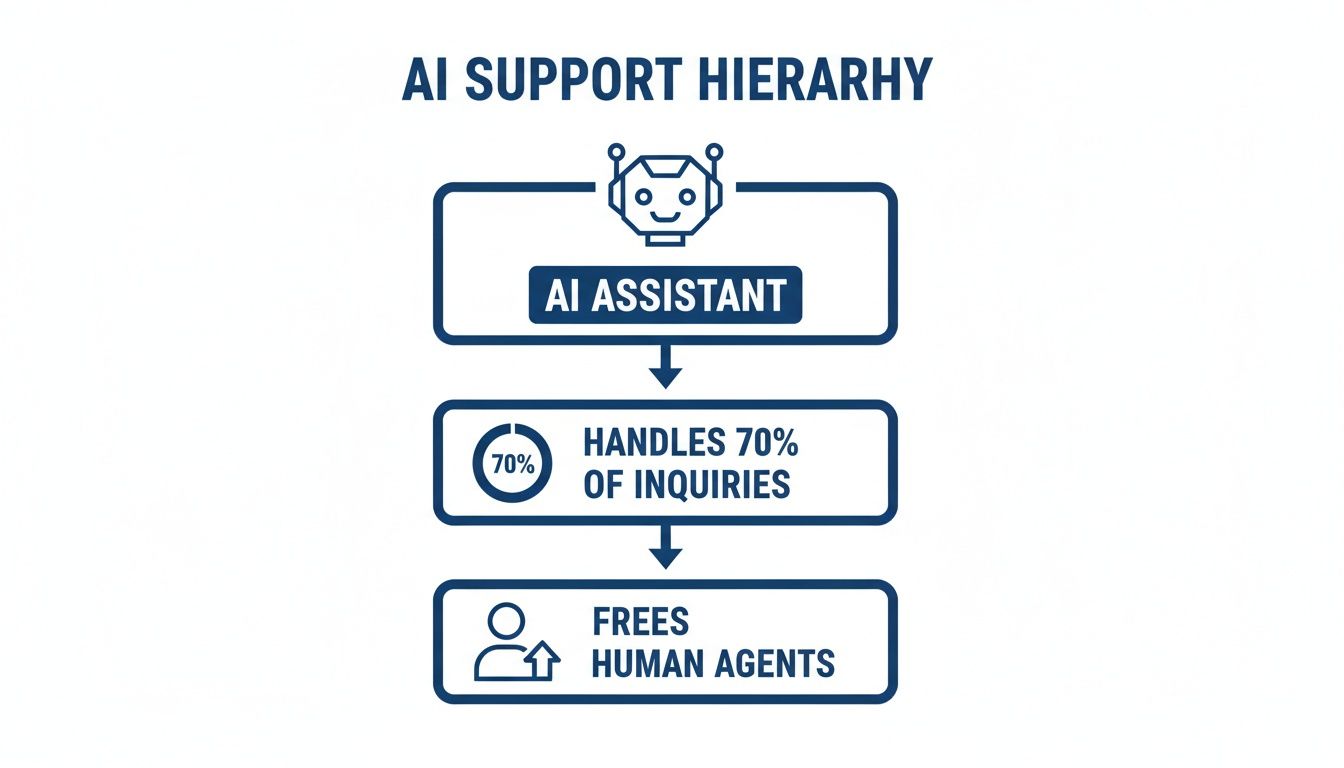
This model shows how an AI assistant can autonomously manage a huge chunk of your support volume, letting your team focus on building relationships and solving the tricky problems.
More Than Answers: Proactive Sales
Here’s where it gets interesting. Modern AI tools plug directly into your Shopify store’s backend. This means they have real-time access to your entire product catalogue, inventory levels, and company policies. This deep integration unlocks capabilities that go far beyond basic Q&A.
Imagine a shopper browsing your site, hesitant about which product is right for them. The AI can engage them proactively, asking about their needs and preferences. It then acts like a personal shopper, recommending the perfect items and even creating a direct link to a pre-filled checkout.
This shift from reactive support to proactive assistance is a game-changer for conversion rates. By engaging customers at their moment of doubt, the AI actively guides them down the sales funnel, preventing cart abandonment before it even happens.
Speed is another huge factor. Response time is make-or-break, with 64% of UK shoppers expecting a reply within an hour. Automation delivers, with AI-powered triage proven to slash average response times from 8 hours down to just 3.5 hours. That’s crucial when 58% of support queries come from mobile devices.
Tangible Benefits for DTC Founders
For a growing DTC brand, the impact of this technology is immediate and measurable. The right AI solution becomes a core part of your growth strategy, not just another tool in your support stack.
Here’s what that actually looks like:
- Dramatically Reduced Ticket Volume: By handling over 70% of routine queries on its own, a good AI cuts down the noise and lets your team focus on what matters.
- 24/7 Global Support: An AI assistant never sleeps. It provides instant, multilingual support across all time zones—essential for capturing international sales. After all, research shows 75% of consumers are more likely to buy again from a brand offering support in their native language.
- Increased Conversion Rates: By answering pre-sales questions instantly and recommending products, the AI turns your support channel into a direct revenue driver.
- Higher Average Order Value (AOV): Through smart cross-selling and upselling ("Customers who bought this also loved..."), the AI can intelligently increase the value of each and every transaction.
For a deeper look at the mechanics, you can learn more about how to automate your customer service effectively. The goal isn't to replace your team; it's to supercharge them. By implementing a powerful AI chatbot, you create a system where technology and people work together, each focused on what they do best.
Structuring Your High-Performance Support Team
Having the right tools is a great start, but it’s only half the story. To deliver consistently great customer support for ecommerce, you need a smart structure for your entire operation.
Whether you’re a solo founder juggling everything or a growing brand building out your first team, having a clear blueprint is what separates order from chaos. It ensures every customer gets the help they need, fast. This isn’t just an HR box-ticking exercise; it’s about designing a system that’s both efficient today and ready to grow with you tomorrow.
Choosing Your Team Model
For most ecommerce brands, it really boils down to three paths: keeping support in-house, outsourcing it completely, or blending the two with a hybrid model. Each one has its own set of trade-offs, and the right choice depends entirely on your brand’s current stage and what you prioritise.
- In-House Team: This model gives you the ultimate control over your brand’s voice and the quality of support. Your agents live and breathe your products, which turns them into incredible brand ambassadors. The downside? It’s a serious investment in hiring, training, and management, especially if you want to offer 24/7 coverage.
- Outsourced Team: Outsourcing can be a brilliant, cost-effective way to provide round-the-clock or multilingual support without the overheads. The risk, however, is a potential disconnect from your brand's culture. You can sometimes lose that deep product knowledge, leading to more generic and less inspiring customer chats.
- Hybrid Model: This is an increasingly popular approach that aims for the best of both worlds. You might have a core in-house team to handle complex, high-value issues during office hours, while an outsourced team or an AI chatbot takes care of routine questions and after-hours support. It’s all about balancing cost, control, and coverage.
Building a Tiered Support Workflow
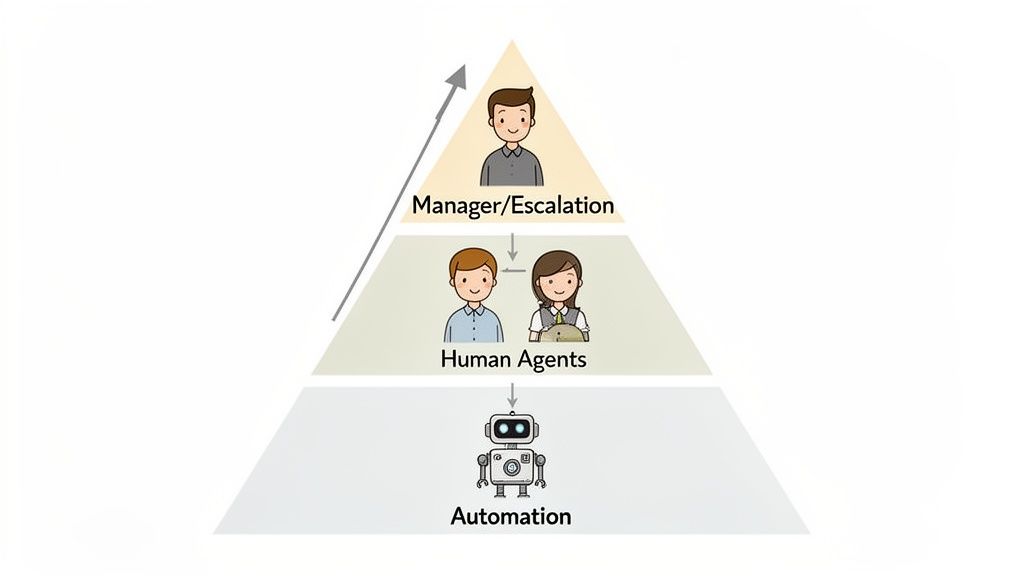
Here’s a secret the best support teams know: not all questions are created equal. A tiered workflow is an absolute game-changer. It makes sure simple issues get resolved instantly while the tricky problems get the expert attention they need. This is how you balance speed with genuine quality.
Think of it as a support funnel:
- Tier 0 (Automation & Self-Service): This is your first line of defence. A smart AI chatbot and a well-written FAQ page should handle the majority of common questions — think “Where is my order?” or “What’s your returns policy?”. This layer gives customers instant, 24/7 answers and filters out all the repetitive queries before they ever hit a human agent.
- Tier 1 (Frontline Human Support): When a question is too specific or nuanced for AI, it gets passed to your frontline agents. This team handles common but specific issues, like manually processing a tricky return or applying a discount code that isn't working. They follow clear Standard Operating Procedures (SOPs) to deliver consistent and efficient service.
- Tier 2 (Expert & Escalation Support): This tier is for your seasoned pros or managers. They take on the highly complex, sensitive, or technical problems that Tier 1 couldn’t solve. This could be anything from a badly damaged high-value order to a complaint from a frustrated, long-term customer.
This tiered structure ensures your most valuable resource—your team's time—is spent on the problems that actually move the needle. By letting automation handle the volume, you empower your people to focus on building relationships and solving real problems.
Equipping Your Team for Success
Hiring the right people is, of course, critical. You’re looking for agents with a strong sense of empathy, excellent problem-solving skills, and a genuine passion for what you sell. They aren't just there to close tickets; they are the voice of your company.
Once you’ve found them, you need to arm them with crystal-clear SOPs for common situations. Documenting the exact steps for handling returns, shipping enquiries, or faulty products removes all the guesswork. This creates a predictable, uniform customer experience, which is a core part of the customer service best practices that top-tier brands rely on.
By combining the right team model with a smart, tiered workflow, you build a support operation that isn’t just efficient — it’s a strategic asset for your brand.
Measuring The KPIs That Actually Matter
That old saying, "If you can’t measure it, you can’t improve it," gets thrown around a lot. For customer support for ecommerce, it's gospel. The right data can flip your support from a cost centre into a predictable revenue driver.
But it’s easy to get lost in a sea of vanity metrics—numbers that look impressive on a slide but tell you nothing about what’s actually working.
To get a real sense of your support operations, you need to zero in on a handful of Key Performance Indicators (KPIs). These are the numbers that connect directly to customer happiness and your bottom line. Think of them as the dashboard for your customer experience, showing you what’s working, what’s broken, and where your biggest opportunities lie.
Key Support Performance Metrics
Before we connect support to sales, let's look at the core metrics that measure the quality and efficiency of your team. These KPIs give you a real-time pulse on your customer experience.
- First Response Time (FRT): This is the average time a customer has to wait for their first reply. In ecommerce, speed is everything. A low FRT shows you respect your customer's time and is a massive driver of initial satisfaction. An AI chatbot can make this nearly instantaneous, especially for common questions.
- Customer Satisfaction (CSAT): This is your classic "How satisfied were you?" survey, usually rated on a 1-5 scale. CSAT gives you direct feedback on how a specific support interaction went. A consistently high score—industry benchmarks aim for 90% or higher—tells you the team is solving problems effectively and with the right tone.
- Net Promoter Score (NPS): This one asks, "How likely are you to recommend our brand to a friend?" and measures overall brand loyalty, not just a single conversation. A high NPS is a powerful sign that your entire customer journey, from product to post-purchase support, is creating advocates for your brand. If you want to dive deeper, you can learn how to calculate your NPS score in our detailed guide.
Connecting Support KPIs to Business Goals
This is where things get interesting. Great support doesn't exist in a bubble; it directly influences the financial metrics every DTC founder obsesses over. The trick is to draw a straight line from your support performance to your business results.
Don’t just track your support team’s response time. Track how that response time impacts your conversion rate. When you can prove that cutting FRT from 4 hours to 4 minutes with an AI assistant boosted pre-sales conversions by 15%, you’ve just proven the ROI of that investment.
This is how you frame support as a growth engine. Let's look at the crucial connections:
- Conversion Rate: When a pre-sales question about sizing or shipping gets an instant answer from a bot or a quick agent, the chances of that shopper completing their purchase skyrocket. Track how many support interactions on product pages lead directly to a sale.
- Average Order Value (AOV): A well-trained AI or human agent can do more than just answer questions. By proactively suggesting complementary products ("Since you like that jacket, have you seen the matching trousers?"), support becomes a consultative sales channel that directly bumps up AOV.
- Customer Lifetime Value (CLV): This is the ultimate goal. Every positive support interaction builds trust and makes customers more likely to come back. Exceptional support for a return or a product issue can turn a potential one-star review into a lifelong fan, dramatically boosting their long-term value.
By setting up a simple dashboard to track these interconnected metrics, you move beyond guesswork. You can clearly see how improving your CSAT score this quarter led to a measurable increase in repeat purchases. This data-driven approach lets you make smarter decisions, justify investments in tools like automation, and finally prove that outstanding customer support is one of the best investments you can make.
Your Step-by-Step Implementation Checklist
Turning a support strategy into a reality that actually works needs a clear plan. This checklist breaks the entire process down into manageable steps, guiding you from where you are now to a fully deployed, high-performing system. It’s designed to give you a straightforward path to making immediate, meaningful improvements.
Phase 1: Audit and Goal Setting
Before you build anything, you need to know your starting line. Kick things off by auditing your current support performance. Dive into your helpdesk data and find your average first response time (FRT), resolution time, and the most common reasons customers contact you.
With that data in hand, you can set specific, measurable goals. Don't just aim to "get better at support." Set concrete targets that you can actually track, like:
- Reduce ticket volume by 40% by automating all "Where is my order?" (WISMO) questions.
- Decrease first response time to under 2 minutes for every live chat conversation.
- Increase your CSAT score by 10 points within the next quarter.
These kinds of clear objectives will anchor every decision you make from here on out.
Phase 2: Channel and Tool Selection
Now that you know what you’re trying to achieve, you can pick the tools to get you there. Look back at your audit. If 80% of your questions are simple and repetitive, then an AI chatbot isn't just a nice-to-have; it's a core part of your toolkit.
The goal isn't to be everywhere, but to be effective where it actually counts. A lean startup can do wonders with just a powerful AI chatbot like Marvyn and an email inbox. A larger brand might add phone support, but only for high-value or complex escalations.
Choose a mix of channels that fits your resources and, more importantly, your customers' behaviour. This is the point where you deploy an autonomous chatbot that integrates directly with Shopify. You want one that syncs with your product catalogue and policies right out of the box for instant, accurate answers.
Phase 3: Deployment and Customisation
It’s time to bring your new system to life. The first step is getting your tools configured and ready to go.
- Customise Your Automation: This part is critical for brand consistency. Tweak your AI chatbot’s personality to match your unique tone of voice—whether that’s playful, professional, or a bit quirky. Don't forget to upload your logo and set your brand colours.
- Establish Escalation Workflows: Define a simple, clear path for when a question needs a human. For example, any time a customer mentions "damaged product" or "billing error," the system should automatically create a ticket for your human team to handle.
- Set Up Your KPI Dashboard: Don’t wait until the end of the month to see how you're doing. From day one, get your dashboard set up to track the key metrics you defined back in Phase 1 (FRT, CSAT, ticket volume).
Taking this structured approach ensures you launch with a system that isn't just powerful, but one that’s perfectly tuned to your brand and your business goals from the very beginning.
Frequently Asked Questions
When it comes to customer support, a few questions pop up again and again. Let's tackle the big ones head-on with some straight answers for DTC founders.
How Much Should I Invest in Ecommerce Support?
The classic mistake is to treat support as a fixed percentage cost. Flip that thinking around: support is a revenue driver. A better way to start is by looking at what you're losing. Tally up the potential sales from abandoned carts and the damage from negative reviews.
Even a small investment in automation, like a smart AI chatbot, can deliver an incredible return. It chips away at those losses and boosts conversions, often paying for itself in just a few months.
Will an AI Chatbot Make My Brand Feel Impersonal?
Not if you do it right. A modern AI chatbot isn't a generic, robotic script; it should be trained to perfectly capture your brand’s unique voice. When you set it up to handle all the repetitive questions instantly, something interesting happens.
Your human team is freed up. They can now dedicate their time to the more complex issues that need a genuine human touch. The result? Your overall support actually feels more responsive and personal, not less.
The goal isn’t to replace humans, but to multiply their effectiveness. Automation handles the volume, while your team provides the irreplaceable empathy and strategic problem-solving that builds true brand loyalty.
Can a Small DTC Brand Compete with Larger Retailers?
Absolutely. In fact, your size is your secret weapon. Big, bureaucratic corporations often struggle to deliver a truly personal experience. You can run circles around them.
By combining smart automation for 24/7 availability with the personal touch of a founder or a small, dedicated team, you create a superior and more authentic customer experience. That's something the giants can't easily replicate.
What Is the Most Important Support Metric to Track?
While metrics like CSAT (Customer Satisfaction) are important, they don't always tell the whole story. The single most impactful metric to tie back to your business is the conversion rate of support interactions.
Tracking how many pre-sales questions—answered by either your team or an AI bot—lead directly to a purchase is the ultimate proof. It shows that your customer support isn't a cost centre; it's a profit centre.
Ready to turn your support from a cost centre into a revenue engine? Marvyn AI offers a FREE, fully autonomous chatbot that automates over 70% of support queries and actively drives sales. Get started in minutes at https://www.marvyn.co.