Live Chat on a Website The Ultimate Ecommerce Growth Guide
Picture your online shop as a real, bustling high-street store. A website without any form of real-time interaction is like leaving that shop completely unattended. You're just hoping people find what they need, while potential customers wander out the door with unanswered questions.
Live chat on a website changes all that. It’s like having a dedicated, expert sales assistant ready to help every single visitor, instantly.
What Live Chat Means for Your Website Today
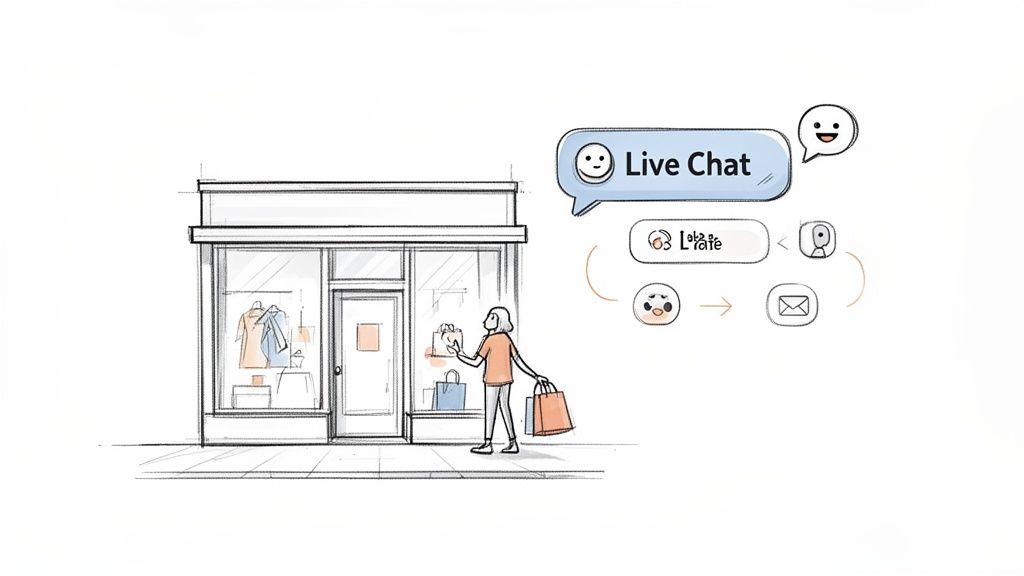
For modern direct-to-consumer (DTC) brands, live chat isn't just a support tool anymore—it's become an essential sales engine. Think of it as a digital sales assistant who never sleeps. This assistant doesn’t just sit back and wait for problems; it proactively engages shoppers, closing the gap between passive browsing and active buying.
Instead of letting visitors click away in confusion, a live chat function provides immediate, helpful conversations. This real-time engagement builds trust, tackles last-minute questions, and guides shoppers toward the perfect product for them.
The Shift From Support to Sales
The role of live chat on a website was originally seen as a way to handle customer complaints after a purchase. But that has fundamentally changed. Today, its primary value is its ability to directly influence revenue and build customer loyalty from the get-go.
In the UK, for example, live chat has become a total game-changer. A massive 63% of consumers are more likely to come back to a website that offers it. On top of that, customer satisfaction rates with live chat are consistently between 82-87%, leaving traditional channels like email and phone in the dust.
This shift is crucial because it redefines the goal. It’s not just about solving problems after the sale, but about creating a seamless pre-purchase experience that actually drives conversions.
Bridging the Conversational Gap
A static website can feel cold and impersonal. A visitor might have a simple question—"Does this coat come in black?" or "What's your return policy?"—but finding the answer takes effort. That small moment of friction is often all it takes to lose a sale.
Live chat bridges this conversational gap. It turns a one-way browsing session into a two-way dialogue, making your online store feel as personal and helpful as a physical boutique.
This ability to provide instant, contextual help has a direct impact on the metrics that matter. By addressing a shopper's uncertainty on the spot, you can:
- Increase Conversion Rates: Answering that one critical question at the right moment can be the final push a customer needs to click "buy."
- Boost Average Order Value (AOV): A great chat interaction can naturally lead to smart upsells or cross-sells, like suggesting a matching accessory or a complementary product.
- Enhance Customer Satisfaction: Shoppers feel seen and valued when their questions are answered quickly, which builds a much better overall brand experience.
Ultimately, integrating live chat on a website is your first step towards building a modern, conversational ecommerce strategy. It's also a key part of the wider trend toward more effective automation in customer service that helps today's brands thrive.
Not all live chat is created equal. The technology has come a long way, evolving from purely manual chats to seriously smart automated systems. Getting your head around this evolution is the key to picking the right approach for your e-commerce store, because each type of live chat on a website comes with its own set of trade-offs.
It all started with the most traditional method: human agents. This approach gives you that genuine, personal touch that can build real customer relationships. A great human agent is like a dedicated personal shopper, able to pick up on subtle emotional cues and offer empathetic, spot-on advice.
But relying only on people has some big drawbacks. It’s expensive—you’re paying for salaries, benefits, and ongoing training. Plus, support is usually stuck in the 9-to-5 box, leaving your late-night shoppers and international customers out in the cold. This means missed sales and a frustrating experience for anyone browsing outside of standard business hours.
The Rise of Rule-Based Chatbots
To patch the holes left by human-only support, many businesses turned to rule-based chatbots. The best way to think of these bots is as interactive FAQ pages or digital flowcharts. You program them with pre-set scripts and decision trees to handle a specific list of common questions.
For example, a rule-based bot can easily field a query like, "What is your return policy?" by firing back a pre-written answer. They're fantastic for automating simple, repetitive jobs and offering basic, around-the-clock support.
The trouble starts the moment a customer asks something that isn’t on the script. These bots have zero ability to understand context, nuance, or even simple typos. A slightly rephrased question can completely stump them, leading to that dreaded "Sorry, I don't understand" reply. For a customer, that’s often more frustrating than having no chat at all.
The New Era of Autonomous AI Assistants
The latest and most powerful stage in this evolution is the autonomous AI assistant. These systems are a giant leap forward, moving way beyond rigid scripts to actually understand and respond to natural human language.
If human chat is a dedicated personal shopper and a rule-based bot is a fixed FAQ kiosk, then an autonomous AI assistant like Marvyn is an expert store manager who works around the clock.
This kind of AI plugs directly into your store's brain—your product catalogue, your inventory levels, and your business policies. It doesn't just follow a script; it learns and reasons. It can figure out what a customer really wants, ask smart clarifying questions, and provide personalised product recommendations that fit their needs and budget.
It knows every single product detail and can guide shoppers all the way from their first question to the final purchase, just like a seasoned sales associate would. This autonomous power gives you the scale of a bot combined with the expertise of a human.
To help you visualise where each solution fits, here’s a quick breakdown of how they stack up against each other.
Comparing Live Chat Solutions for Your Ecommerce Store
This table breaks down the key differences between human agents, rule-based chatbots, and autonomous AI assistants across critical business factors.
As you can see, the right choice really depends on your goals. If you're after basic, after-hours support for common questions, a rule-based bot might do the trick. If you need deep, consultative conversations that drive sales and free up your team, an autonomous AI assistant is in a league of its own.
Driving Revenue with Proactive AI Live Chat
Think of your website’s live chat as more than just a customer service tool. When it's powered by advanced AI, it stops being a passive help button and becomes your best salesperson—working 24/7, never taking a break. Instead of just waiting for a customer to ask a question, an autonomous AI actively engages shoppers, guiding them from casual browsing to confident buying.
It's like having a brilliant sales assistant in a physical shop. You know, the one who doesn't just stand behind the counter but greets customers, intuits what they're looking for, and helps them find the perfect item. The AI does the same by starting conversations to understand a shopper's style, budget, and what they're trying to achieve. It turns a standard visit into a personal shopping experience.
This shift from reactive support to proactive selling is a huge leap in how we should think about live chat. The journey from basic chat to intelligent, autonomous systems is all about increasing capability.
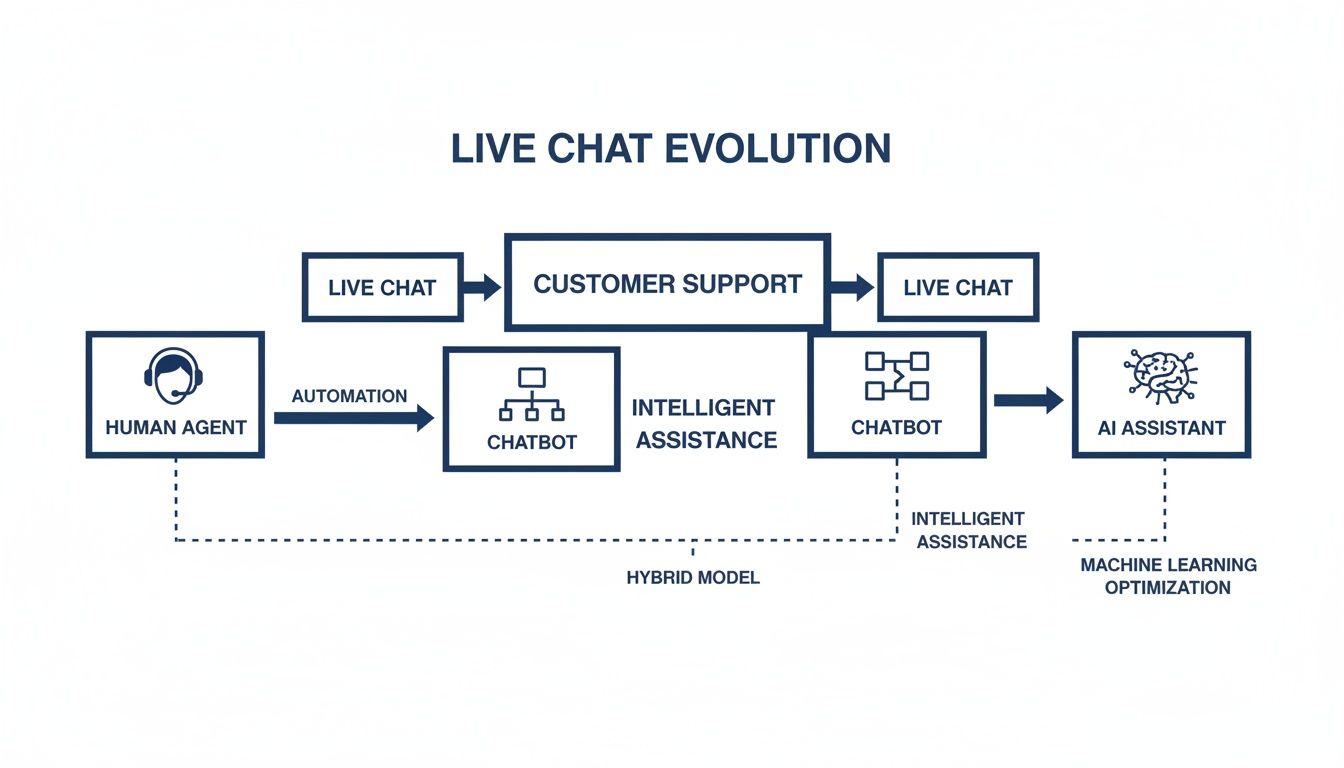
As you can see, we've moved from conversations that depended entirely on a human being available, to smart, independent systems that can run entire sales conversations on their own.
From Browsing to Buying
So how does this actually drive sales? It's all about intelligent recommendations. Once the AI has a good grasp of what a customer is after, it can dive into your product catalogue and pull out tailored suggestions.
For instance, it might ask focused questions like, "Are you looking for a gift for under £50?" or "Which colour are you interested in for that summer dress?" This simple act turns a vague, endless scroll into a focused discovery, getting them to a purchase decision much faster. And it works—shoppers who interact with AI chat show 8% higher engagement on retail sites.
A proactive AI doesn't just answer questions; it anticipates needs. By intervening at the perfect moment, it guides shoppers toward a purchase they'll feel confident about, dramatically reducing cart abandonment.
The evolution from human agents to sophisticated AI Agents is changing the game, allowing for even more powerful and targeted sales tactics right inside the chat window.
Boosting Average Order Value
An autonomous AI is also a master at increasing the value of each sale through smart upselling and cross-selling. It knows your products inside and out, understands which ones pair well together, and can make relevant suggestions that don't feel pushy.
- Strategic Upsells: If a customer is looking at a standard product, the AI can gently highlight a premium version with better features, explaining the extra value in a helpful way.
- Relevant Cross-sells: When a shopper adds an item to their cart, the AI can chime in with a complementary product. Something like, "Great choice! Customers often buy this jacket with these boots to complete the look."
By making these intelligent suggestions at just the right time, the AI naturally lifts your Average Order Value (AOV). If you're keen to learn more about deploying these tactics, it's worth exploring how to build powerful AI sales agents for your online store. This is how you transform your live chat from a simple cost centre into a revenue-generating machine.
How to Get Live Chat Up and Running on Your Shopify Store
So, are you ready to get started? The good news is that adding a powerful live chat on a website built with Shopify doesn't mean you need a team of developers or a PhD in coding anymore. Far from it. These days, installing a modern AI chat app is as simple as a single click in the Shopify App Store.
I'll walk you through just how quickly you can launch a smart chat solution like Marvyn AI. The entire process is designed to be dead simple, getting you from installation to a fully functional AI sales assistant in minutes, not weeks.
One-Click Installation and Instant Syncing
Your journey begins where all good Shopify things do: the Shopify App Store. Once you’ve found an AI chat app that fits what you're looking for, the installation is usually a one-click affair that automatically plugs right into your store.
Here’s a look at just how simple the starting line is for an app like Marvyn AI.
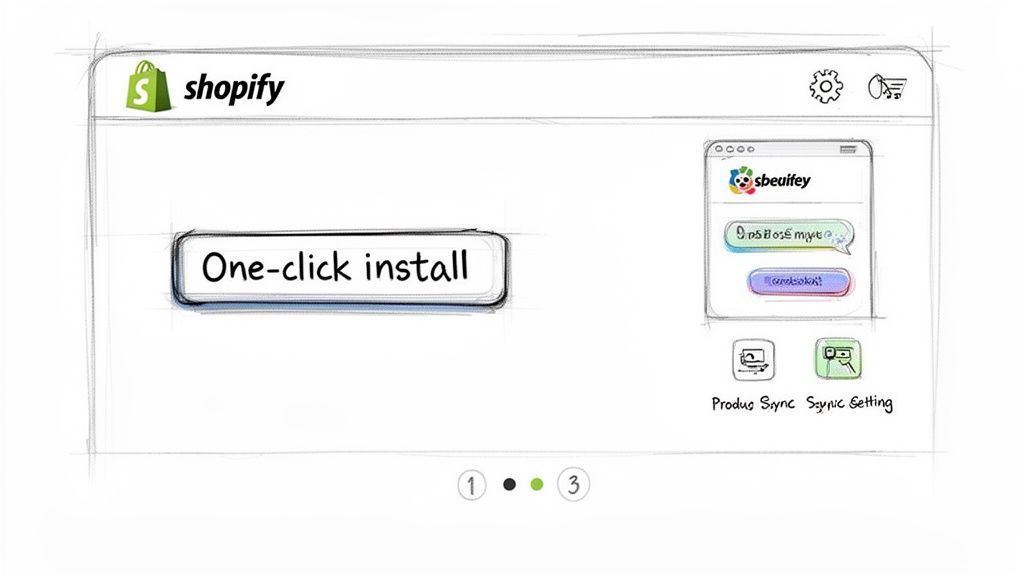
This screenshot captures that first, painless step of adding the AI to your Shopify backend. But once you've installed it, the real magic starts happening behind the scenes. An autonomous AI like Marvyn immediately gets to work, syncing up with all your store’s data.
This means it automatically learns:
- Your Entire Product Catalogue: Every last item, variant, price, and description.
- Store Collections: The way you've organised and grouped your products.
- Key Business Policies: All the important stuff, like your shipping rules, return policies, and FAQs.
Within just a few minutes, the AI becomes a genuine expert on your brand. It’s ready to answer customer questions with complete accuracy—all without you needing to do any manual data entry. You can even take its knowledge further by exploring how advanced chatbots for customer service can be trained on your own unique documentation.
Customising Your Chat Widget and Personality
After that initial sync, the next job is to make the chat widget feel like it truly belongs on your site. A well-designed widget should feel like a natural part of your website, not some clunky add-on you've just bolted on.
You can easily tweak the look and feel to match your brand's aesthetic. This means adjusting colours to fit your palette, uploading your logo, and making sure the widget is placed in the best spot for user experience—usually in the bottom-right corner, right where shoppers expect to find it.
But it’s not just about the visuals. You can also define the AI's personality. Whether you want it to be friendly and casual or a bit more formal and professional, you can set the tone of voice to ensure every interaction feels true to your brand.
Finally, you’ll want to craft some engaging welcome messages. These proactive prompts are your first—and best—chance to engage visitors, turning passive browsers into active shoppers. A simple, "Hi! Need a hand finding the perfect gift?" can be the spark that starts a valuable sales conversation, all powered by your new AI assistant.
Tracking Live Chat Metrics That Matter
There's an old saying: "What gets measured, gets managed." It's a cliché, but it's true. Just switching on live chat for your website isn't enough. The real value comes from digging into the data to see what’s actually working.
To figure out your return on investment, you have to look past the vanity metrics like the total number of chats. What really matters is how those conversations are changing customer behaviour and adding to your bottom line. Tracking the right KPIs gives you the power to make smart decisions—whether that's fine-tuning proactive messages or training your AI to convert better.
Bottom-Line Business Metrics
The most important numbers are the ones tied directly to revenue and customer loyalty. These tell you if your live chat is just a cost centre for answering questions, or if it's actively helping you grow. These are the metrics that should live on your main dashboard.
Here are the essentials to keep an eye on:
- Conversion Rate from Chat: This is the big one. What percentage of shoppers make a purchase after they’ve talked to your chat? This metric is the clearest sign that your conversations are pushing browsers over the finish line.
- Average Order Value (AOV) of Chat Users: Take a look at the AOV of customers who used chat versus those who didn’t. If the chat-user AOV is higher, it’s a great sign that your agents or AI are doing a good job upselling and cross-selling the right products.
- Cart Abandonment Rate Reduction: How often does your chat jump in and save a sale when someone’s about to abandon their cart? This KPI shows you exactly how much revenue you're rescuing with proactive, well-timed engagement.
Forrester research found that website visitors who use chat are 2.8 times more likely to convert than those who don't. That single statistic says it all—real-time conversation has a massive impact on turning browsers into buyers.
Customer Experience and Efficiency Metrics
While revenue is the main goal, you also need to keep track of how your live chat is performing for your customers and your support team. These metrics give you a clear picture of the quality of the experience you're delivering.
For a complete view, you’ll want to track these as well:
- Customer Satisfaction (CSAT) Scores: This is usually measured with a quick, simple question after a chat ends, like "How would you rate your experience?" A high CSAT score means you're delivering helpful, positive interactions that build real brand loyalty.
- First Response Time: How long does a customer have to wait for an answer? With an AI assistant, this should be almost instant, which is a huge driver of customer happiness.
- Resolution Rate: What percentage of problems are completely solved within the chat conversation itself? A high resolution rate means your chat is genuinely effective, and your support team isn't getting bogged down with endless follow-up emails.
Common Mistakes to Avoid with Website Live Chat
Putting live chat on your website can be a genuine game-changer, but a bad experience is often worse than no chat at all. Just switching it on isn't enough. In fact, a few common pitfalls can easily frustrate customers, damage your brand, and actively lose you sales.
Think of this as your pre-flight checklist to make sure your chat soars.
One of the most damaging mistakes is slow response times. When a customer decides to use live chat, they expect an immediate, real-time conversation. Making them wait several minutes for a human agent to show up creates the exact friction you were trying to remove. It defeats the entire purpose.
Another huge issue is relying on robotic, rigid scripts. This is a classic problem with basic, rule-based chatbots. When a customer asks something that wasn’t pre-programmed and the bot spits back a frustrating "Sorry, I don't understand," it shatters trust and makes your brand look clumsy and unhelpful.
Clunky Interfaces and Intrusive Pop-Ups
You also have to think about the chat widget itself. A clunky interface that’s a pain to use, especially on a mobile phone, will only annoy people. If the chat window is slow to load, covers up the "Add to Cart" button, or is hard to navigate, users will just close it—and probably leave your site.
Equally frustrating are overly aggressive pop-ups. While proactive engagement is a great idea, bombarding a visitor with a chat window the second they land on your homepage can feel desperate and pushy.
A great live chat experience should feel like a helpful assistant in a high-end boutique—available and attentive when needed, but never intrusive or in the way.
The trick is to time your proactive messages intelligently. For example, you could trigger a chat message only after someone has been on a product page for 30 seconds, or if they start moving their mouse towards the back button on the cart page.
The Clear Solutions to These Problems
The good news? For every common mistake, there’s a clear, actionable solution that modern tools make easy to implement.
- Slow Responses: Instead of relying only on human agents with limited hours, you can deploy a 24/7 autonomous AI. It provides instant answers around the clock, ensuring no customer is ever left waiting.
- Robotic Scripts: It's time to upgrade from a rigid, rule-based bot to an autonomous AI that understands natural language. This allows for fluid, intelligent conversations that can actually solve complex customer problems, not just deflect them.
- Poor User Experience: Choose a modern chat solution with a clean, mobile-first design. Make sure the widget is customisable to match your brand’s look and feel and, most importantly, doesn't get in the way of the shopping experience.
By sidestepping these common pitfalls and embracing more intelligent solutions, your live chat will stop being a liability and start becoming a powerful engine for growth that genuinely delights your customers.
Frequently Asked Questions About Live Chat
Thinking about adding live chat to your website? You're not alone. But it’s natural to have a few questions before you jump in. We’ve gathered the most common queries we hear from e-commerce managers to clear things up.
Will Live Chat Slow Down My Website?
It really shouldn't. Any modern, well-coded live chat app—especially one built specifically for Shopify—is designed to load asynchronously.
In plain English, that means the chat widget loads separately from the rest of your site content. It won't get in the way of your product images or text, so it has a negligible impact on your page speed scores and, more importantly, your customer's experience.
How Much Does Live Chat Cost?
The cost can vary quite a bit, depending on the approach you take.
Human-powered chat is nearly always the most expensive route, since you're paying agent salaries. Rule-based bots are usually cheaper on paper, but their limited skills mean they can only handle the most basic questions.
Autonomous AI assistants, on the other hand, typically use a tiered subscription model. This makes them a scalable and cost-effective solution that often delivers a surprisingly high return on investment.
Can an AI Chatbot Really Understand My Customers?
Yes, absolutely. Today’s top-tier AI assistants have moved far beyond simple keywords. They use something called Natural Language Processing (NLP) to grasp what your customer actually means, not just what they type.
This allows them to understand intent, context, and even sentiment. They can handle complex questions, figure out typos, and provide genuinely personalised responses that feel natural and helpful. In our own frequently asked questions, we dive deeper into the different support methods offered through live chat.
With an AI-powered solution, you can see results almost immediately. Automating common questions frees up your team instantly, and you can begin tracking chat-influenced conversions within the first few weeks to measure direct financial impact.
Ready to see how an autonomous AI can transform your store? With Marvyn AI, you get a 24/7 sales expert that boosts conversions and delights customers, all for free. Get started in one click at https://www.marvyn.co.
Built with [the Outrank app](https://outrank.so)