Your Guide to the 2026 AI Call Center

An AI call centre isn't just about using artificial intelligence to answer the phone. It's about ditching the old, clunky switchboard model of customer support and plugging in an intelligent, self-driving system that works for you 24/7.
From Hold Music to Helpful Conversations
Imagine your customer support not as a cost centre, but as your most effective sales agent. For most online business owners, that feels like a fantasy, completely disconnected from the frustrating reality of classic customer service.
Think of it like a disorganised, understaffed shop. Customers are wandering around, they can't find what they need, and their questions are met with silence. The single staff member on duty is overwhelmed, creating long queues and short tempers. For years, this has been the standard call centre experience for most customers—long waits, endless repetitive questions, and a painfully slow path to getting a simple answer.
Now, imagine swapping that out for a personal shopper who knows what a customer wants before they even ask. That's the promise of a modern AI call centre. Instead of hold music, customers get instant answers. Instead of confusion, they get expert guidance. This shift directly tackles the headaches Shopify owners know all too well:
- Drowning in support tickets? An AI can handle thousands of queries at the same time. No customer ever has to wait in line again.
- Missing sales after hours? Your store is always open, and now your support can be too, serving customers in every time zone.
- Losing customers at checkout? An AI can step in to answer last-minute questions, calm a hesitant shopper's nerves, and guide them over the finish line.
An AI call centre transforms support from a reactive, problem-solving function into a proactive, revenue-generating engine. It’s an autonomous system that not only resolves issues but actively guides customers to the right products, turning routine queries into sales opportunities.
This isn't some far-off technology reserved for mega-corporations. For merchants, understanding how to improve the customer support for ecommerce is the critical first step. With accessible, one-click tools like Marvyn AI, this level of automation is a practical reality for any brand. It syncs with your product catalogue and policies in seconds, creating a seamless experience right out of the box.
This guide will walk you through exactly how an AI call centre works, the real-world benefits for your bottom line, and how you can implement one to build a smarter, more profitable business. We’ll break down how it turns every customer interaction into a chance to lift conversions and boost your average order value, making your support channel your new top-performing salesperson. It's time to replace frustrating waits with helpful, intelligent conversations that actually grow your brand.
How an AI Call Centre Actually Thinks
So, what’s really going on inside an AI call centre? It’s easy to imagine a single, all-knowing brain, but the reality is much more interesting. It’s not magic; it’s a team of specialised technologies working together in perfect sync.
Think of it like a world-class restaurant kitchen. You don't have one chef doing everything. You have different stations—the greeter, the listener, the brains, and the doer—each mastering their part of the process to deliver a flawless customer experience.
The Digital Greeter: Interactive Voice Response
The moment a customer calls, they meet the first member of the team: the Interactive Voice Response (IVR). Forget the clunky old “Press one for sales, press two for support” systems that everyone hates. Modern IVR is conversational.
It’s the friendly maître d’ asking, “Good evening, how can I help?” instead of just shoving a menu in your face.
This system’s only job is to understand the basic reason for the call. A customer might say, “I need to check my order status,” or “My discount code isn’t working.” The IVR welcomes them, gets a general idea of their needs, and then knows exactly which specialist to pass them to next.
To do this, it needs a perfect set of ears.
The Perfect Listener: Speech Recognition
Once a customer speaks, Speech Recognition technology steps in. Its job sounds simple, but the tech is incredibly complex: it turns spoken words into digital text. Imagine trying to take an order perfectly in a loud, bustling restaurant—that’s the challenge Speech Recognition solves for your business.
It’s trained to filter out background noise, understand a huge range of accents, and transcribe what the customer says with pinpoint accuracy. This is the foundation. If the transcription is wrong, everything that follows will be, too.
But just having the words isn’t enough. The system needs to understand what they mean.
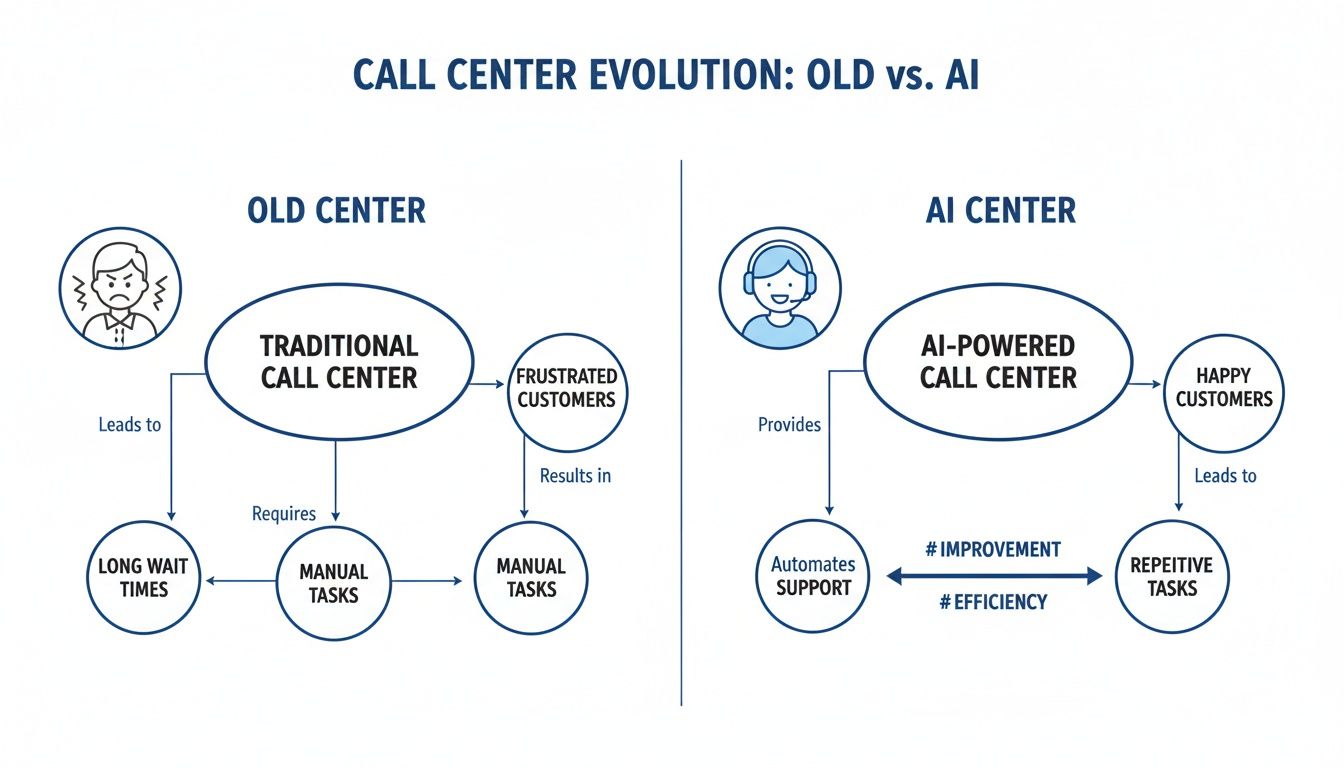
This is the shift away from a slow, frustrating human-led process towards a fast, satisfying AI-driven one. It’s not just about speed; it’s about making the customer’s entire journey with your brand better.
The Brain: Natural Language Understanding
This is where the real intelligence happens. Natural Language Understanding (NLU) is the brain of the operation. It takes the text from the Speech Recognition system and figures out the intent.
For example, the NLU knows that "Where's my stuff?", "Can you track my parcel?", and "What's the delivery date for my order?" are all the same question. It’s the difference between just hearing words and truly understanding what someone wants.
This is what allows the AI to give a genuinely helpful answer instead of a generic script. It's a powerful shift, and adoption is accelerating. In the UK, the use of speech analytics jumped from 28% in 2022 to 37.5% in 2023, driving up first-call resolution by as much as 25%.
With NLU, the AI doesn’t just look for keywords. It gets the context, sentiment, and nuance, letting it handle complex queries about product features or return policies with almost human-like intuition.
Once the AI knows what the customer wants, it needs to decide what to do next.
The Conversationalist and The Doer
The Dialog Manager is the quick-witted conversationalist. Based on the NLU's findings, it decides the next step. Should it ask a clarifying question ("Could you give me your order number?"), provide a direct answer, or pass the conversation to a human? It’s what keeps the chat flowing naturally.
Finally, automation is the efficient doer that gets the job done. Once the Dialog Manager decides on an action—like fetching order details or processing a return—automation connects to your Shopify backend and does it instantly.
For any ecommerce brand, this is how you truly automate customer service effectively. It’s this seamless teamwork between technologies that creates a fast, intelligent system that solves problems on the spot.
Understanding the tech behind an AI call centre is one thing. But what really matters is the direct impact on your store’s bottom line and day-to-day operations.
Let’s move past the theory and get into the real-world results you’ll see. These aren't just small tweaks; they're fundamental shifts in how you talk to customers and grow your business.
Before we dive into the specific benefits, let's establish a baseline. Here’s a quick comparison of how a traditional support setup stacks up against a modern AI call centre.
Traditional Support vs AI Call Centre: A Head-to-Head Comparison
This table shows the operational shift at a glance. An AI call centre isn't just a cheaper version of a human team; it's a completely different model designed for the instant, always-on nature of ecommerce. It frees your human talent from repetitive tasks so they can focus on what they do best: growing the business.
Stop Wasting Money on Repetitive Questions
The most obvious win merchants see is a huge drop in support costs. This goes way deeper than just saving on salaries. Think about the opportunity cost of manual support. Every hour your team spends answering "Where is my order?" is an hour they aren't spending on marketing, product development, or building customer loyalty.
An AI call centre flips that equation on its head. It automates the routine queries that clog up a support agent's day, freeing your team to focus on high-value work that actually drives growth. Instead of just putting out fires, your team can start building a better business.
Sell Around the Clock with 24/7 Availability
Your Shopify store never closes. So why should your customer support? An AI call centre makes your business a truly global, always-on operation. Whether a customer is shopping at 3 AM in London or during a holiday in Sydney, they get the same instant, helpful support.
This constant availability does more than just solve problems; it builds massive trust. When a potential customer has a last-minute question about sizing or shipping, getting an immediate answer is often the deciding factor between a sale and an abandoned cart. For international customers in different time zones, this isn't a perk—it's a must-have.
Build Trust Instantly with Speed and Accuracy
In ecommerce, trust is everything. A customer who trusts your brand is more likely to buy, more likely to return, and more likely to recommend you to their friends. An AI call centre is a powerful engine for building that trust at scale. It does this by consistently delivering two things: speed and accuracy.
When a customer asks, "What’s your return policy for sale items?" they don’t want to wait 24 hours for an email. They want the answer now. An AI, connected directly to your store’s policies, gives them the correct information in seconds.
An AI call centre acts as a single source of truth. It ensures every customer gets the same accurate information, every single time. This consistency kills the risk of human error or conflicting answers, which can destroy a customer’s confidence in your brand.
By providing instant, reliable answers, you show that your business is organised, transparent, and puts customers first. That's the foundation of trust that turns a one-time buyer into a lifelong fan.
Scale Globally with Multilingual Support
Expanding into new international markets comes with a massive headache: language barriers. Hiring a multilingual support team is expensive, slow, and a nightmare to manage.
An AI call centre completely solves this. Modern AI can chat fluently in dozens of languages, letting you offer native-language support in new regions from day one. A customer in France can ask a question in French and get a helpful, natural-sounding response instantly. This removes a huge friction point for international shoppers and makes your brand feel local and accessible. This is a core part of modern customer service, which we explore further in our guide on how AI is being used in sales agent roles.
This isn't just a support feature; it's a powerful growth lever. In the UK, AI adoption is a key driver for success. Recent data shows 87% of contact centres now prioritise customer satisfaction as their top metric, with AI tools reducing response times by up to 54%. For ecommerce brands, AI chatbots now handle 60% of simple queries, reducing support ticket volume by over 70%. You can learn more about how AI is reshaping the industry by reading the full findings from the 2025 contact centre report.
Putting Your AI Call Centre to Work
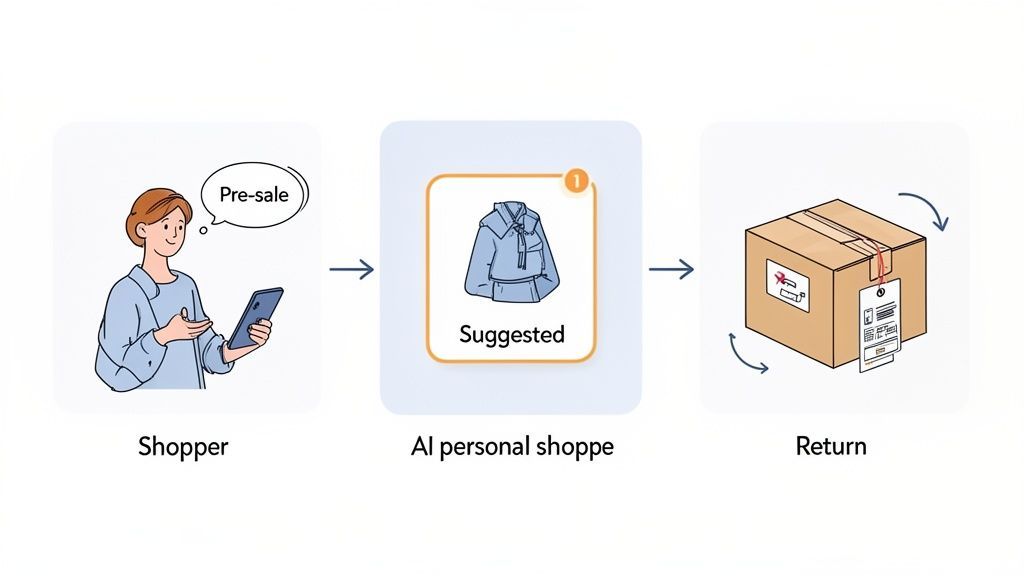
This is where the rubber meets the road. All the theory about AI call centres is interesting, but what really matters is how it translates into measurable results for your business. It's not just about answering questions a bit faster; it's about creating genuinely better customer experiences that boost conversions, build loyalty, and drive up revenue.
Let's walk through what this looks like in practice. We'll follow a customer’s journey with a Shopify store that uses an integrated AI tool like Marvyn AI to see how this technology works at the moments that count.
Turning Pre-Sales Questions into Conversions
Imagine a shopper, Sarah, browsing your store for a new skincare product. She’s got sensitive skin and is hesitant about which moisturiser to choose. Instead of getting overwhelmed by product pages and eventually giving up, she starts a conversation with your AI.
The AI doesn't just sit there waiting. It acts like a sharp, knowledgeable sales assistant.
- Sarah asks: “Which moisturiser is best for sensitive skin and won't cause breakouts?”
- The AI, which is synced to your product catalogue, replies instantly: “Great question! Our Soothing Hydra-Calm Cream is specifically formulated for sensitive skin. It’s fragrance-free and non-comedogenic. Would you like to know more about the key ingredients?”
But it doesn't stop there. The AI can then ask about her budget or other skin concerns to recommend a complete routine—maybe a gentle cleanser and a matching serum. This isn't just answering a question; it's consultative selling. It builds the customer's confidence and guides them smoothly towards a purchase, directly lifting your conversion rate.
Boosting Average Order Value Through Smart Upsells
As Sarah adds the cream to her cart, the AI spots the perfect chance to increase the Average Order Value (AOV).
AI: "I see you're adding the Hydra-Calm Cream to your cart. Many customers who buy this also love our SPF 30 Mineral Sunscreen, as it’s also designed for sensitive skin. Would you like to add it and complete your routine?"
This isn’t some annoying, generic pop-up. It's a helpful, context-aware suggestion that feels like personal shopping advice. By making relevant upsell and cross-sell recommendations, the AI call centre becomes an active salesperson, nudging AOV upwards with every single conversation.
Providing Instant Post-Purchase Peace of Mind
Once Sarah has checked out, the AI’s job shifts from sales assistant to support agent. The next day, she wonders when her order will arrive. Instead of firing off an email to your support team and waiting hours for a reply, she just asks the AI.
- Sarah asks: “Where is my order?”
- The AI, fully integrated with Shopify, gives an immediate answer: “Hi Sarah, your order #12345 has been shipped! It's currently with Royal Mail and is scheduled for delivery tomorrow. Here is your tracking number: [tracking number]. You can follow its journey here.”
That instant gratification is what modern customers expect. It completely eliminates the dreaded "where is my order?" (WISMO) tickets, which frees up your human agents while giving Sarah immediate peace of mind.
This seamless experience is what strengthens brand trust. Poor service costs businesses a staggering £75 billion globally each year, but AI is rapidly changing the game. In the UK, generative AI is expected to hit 80% usage in customer service by the end of 2025, boosting both productivity and revenue. You can dig into more data on how AI is redefining the call centre experience at CMSWire.
Handling Returns and Building Trust
But what about when things go wrong? Let's say another customer, Mark, needs to return a shirt that didn't fit. This is a make-or-break moment where you can either lose a customer for good or create a loyal fan.
A smart AI call centre guides Mark through the process without any friction. It authenticates his order, checks your store's policy to confirm the item is eligible for return, and generates a pre-paid return label for him right there in the chat.
By making a potentially frustrating process simple and transparent, the AI builds trust even during a negative experience. That’s how you make it more likely that Mark will come back and shop with you again.
A Practical Guide to Launching Your AI Call Centre
Getting an AI call centre live sounds like a massive, six-month IT project, right? For most e-commerce brands in 2026, that's no longer the reality. The key isn't technical wizardry; it's having a clear playbook that breaks the process down into simple, manageable steps.
Forget the intimidating enterprise software of the past. Modern solutions, especially those built for platforms like Shopify, are designed for founders and lean teams who need to move fast. Here’s a step-by-step guide to get your AI support running without the overwhelm.
Stage 1: Set Clear, Measurable Goals
The first step has nothing to do with technology. It's about your business. Before you look at a single platform, you need to define what winning actually looks like for your store. Vague goals like "improve customer service" won't cut it.
You need specific, trackable targets. Your goals might be:
- Reduce first-response time from hours down to less than one second.
- Cut support costs by automating 70% or more of repetitive questions.
- Increase after-hours sales by having AI provide 24/7 pre-sales support.
- Slash "Where is my order?" tickets by 90% with instant, automated updates.
Having these Key Performance Indicators (KPIs) from day one gives you a benchmark. It’s how you’ll measure the impact and prove the value of your AI call centre from the moment it goes live.
Stage 2: Select the Right Platform
The market is flooded with AI tools, but they are not all built the same. For a Shopify merchant, the single most important factor is seamless integration. Standalone, complex enterprise software often requires months of custom development and a hefty budget.
A one-click Shopify app like Marvyn AI, on the other hand, is built for a completely different reality. It installs in seconds and instantly syncs with your entire store—your product catalogue, inventory, collections, and policies. This deep connection is what allows the AI to give accurate, store-specific answers straight out of the box.
When you're choosing a platform, prioritise simplicity and deep integration with your e-commerce stack. The goal is to get live in minutes, not months. A native Shopify app is the fastest way to do that.
Stage 3: Configure and Customise Your AI
Once you've picked your platform, it’s time to make the AI a true extension of your brand. This isn’t a long process, but it’s crucial for making the customer experience feel authentic.
This stage usually involves a few quick tweaks:
- Branding the Interface: Customise the chat widget with your brand’s colours and logo. It should look like a natural part of your website, not a tacked-on tool.
- Defining the AI's Voice: Adjust the AI's tone to match your brand. Should it be professional and direct, or more friendly and casual?
- Syncing Your Data: With a tool like Marvyn AI, this part is automatic. The AI instantly learns your products, shipping rules, and return policies on its own.
This ensures that from the very first chat, the AI sounds and acts like it belongs to your brand, creating a consistent and trustworthy experience. For more on this, check out our guide on using chatbots for customer service.
Stage 4: Train Your AI for Success
A great AI call centre is only as smart as the information you give it. While a deep Shopify integration provides a solid foundation, you can make your AI even sharper by feeding it your unique business knowledge.
Don't worry, this is simpler than it sounds. It usually just means uploading documents you already have lying around, such as:
- Frequently Asked Questions (FAQs): Your list of the top questions customers ask.
- Internal Policy Documents: Guides on how you handle special cases or detailed product info.
- Past Conversation Logs: Let the AI learn from how your human team has handled queries in the past.
This step sharpens the AI's accuracy, allowing it to handle more nuanced questions and resolve a much higher percentage of queries without ever needing a human.
Stage 5: Create a Human Handoff Plan
Finally, no AI can solve 100% of problems. A critical part of any AI setup is defining a clear and graceful escalation path to a human agent for the tricky stuff.
Decide what triggers a handoff. This could be when a customer expresses strong frustration, asks a question the AI can't answer twice, or simply types "talk to a human." The platform should then seamlessly route the conversation—along with the full chat history—to your support team via email or a live chat tool.
This creates a safety net, ensuring that complex or sensitive issues are always handled with a human touch, guaranteeing a great customer experience no matter what.
Your Go-Live Checklist for AI-Powered Support
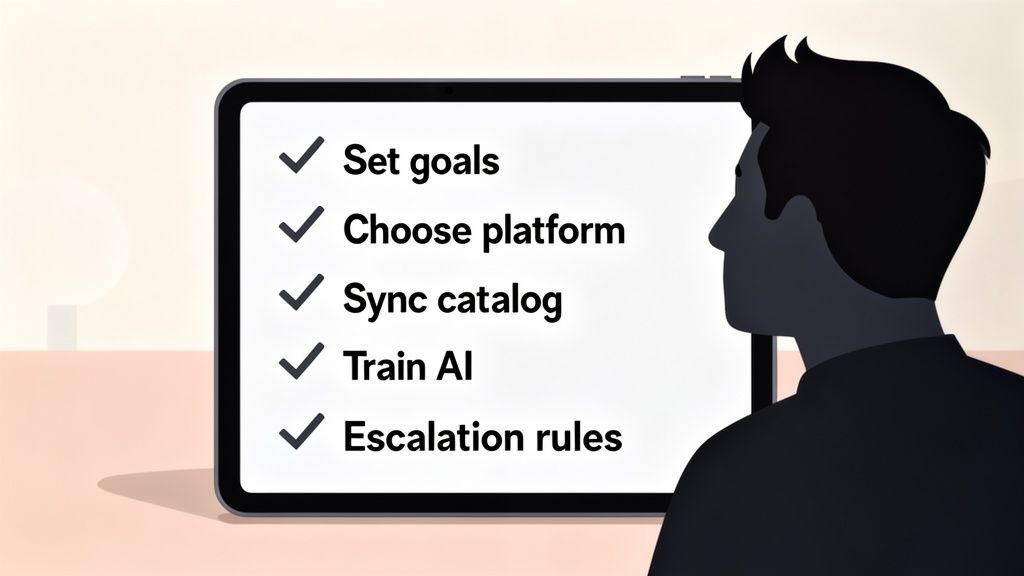
Alright, we’ve talked theory, technology, and benefits. Now it’s time to get practical. This is your quick-start guide for launching your own AI call centre, designed to cut through the noise and give busy founders a simple, actionable plan.
The good news? Getting your AI support live doesn’t need to be a months-long project. If you follow these steps, you can be up and running in a surprisingly short amount of time, seeing results almost immediately.
Your 6-Step Launch Plan
- Know Your Numbers: Audit Your Current Support
Before you make a move, you need a benchmark. Get a real, hard look at your current support load. How many tickets are you actually handling each week? And how much of your team's day is spent answering the same old questions, like "Where is my order?" This isn't just about tracking costs; it’s about knowing what “good” looks like so you can measure your AI's impact.
- Pick a One-Click AI Built for Shopify
For most e-commerce brands, speed is everything. Forget about lengthy development cycles and custom builds. Your best bet is a tool like Marvyn AI that installs directly from the Shopify App Store. This is crucial because it means the AI can instantly sync with your products, inventory, and order data right out of the box.
- Give Your AI a Personality
Your AI isn’t just a tool; it's your newest team member. It’s on the front line talking to your customers. Take five minutes to tweak its colours, add your logo, and adjust the tone of voice so it genuinely reflects your brand. This simple step makes the entire experience feel more consistent, trustworthy, and human.
This isn't just about plugging in a bot. It’s about crafting an extension of your brand that feels helpful, authentic, and genuinely smart. The aim is to build an experience so seamless that your customers feel like they’re getting premium, one-on-one service.
Finalising Your Setup
- Make It Smarter: Upload Your Documents
While a solid Shopify integration handles the basics, you can seriously level-up your AI's intelligence by feeding it more information. Upload your detailed FAQ page, your returns policy, and any specific product guides you have. This extra context sharpens its accuracy and lets it handle far more complex questions on its own.
- Set Your Human Escalation Rules
No AI is an island. You need to decide exactly when a conversation should be handed over to a person. Set clear rules. Maybe it’s after a customer shows signs of frustration, or if they ask a question the AI can’t answer twice. A smooth handoff is the secret to a flawless support system.
- Find Quick Wins by Reviewing Early Chats
Once you're live, spend a little time scanning the first few dozen conversations. This is the fastest way to spot easy wins. You’ll immediately see common questions that your AI might need a little more training on or identify gaps in its knowledge base you can quickly fill.
Following this plan puts you on the fast track to smarter, more efficient customer service. To dig deeper into the principles that make this all work, check out our complete guide to customer service best practices.
Frequently Asked Questions About AI Call Centres
Look, we get it. Even with all the clear benefits, adopting new technology can feel like a big leap of faith. It’s completely normal to have questions and a few concerns when you're thinking about an AI call centre for your store.
Let's get straight to the big ones so you can make a decision that feels right for you.
Will My Customers Hate Talking to a Bot?
This is probably the number one worry we hear from merchants. The short answer? No. Customers don't hate bots—they hate being stuck without an answer.
Let’s be honest, the clunky, repetitive phone menus of the past have left a bad taste in everyone’s mouth. But a modern AI is a different beast entirely. It’s about giving your customers instant, accurate information, 24/7.
Think about it. A recent study found that 69% of consumers actually prefer using chatbots for simple queries because they're so much faster. When someone wants to know “Where is my order?”, they’d much rather get an immediate answer from an AI than wait hours for a person to reply.
The key is quality. A well-designed AI call centre doesn't feel like a robot; it feels like a hyper-efficient personal assistant. It uses natural language to figure out what your customer needs and sorts it out on the spot.
When the AI handles all the simple, repetitive questions instantly, your human team is freed up. They can finally focus on the complex, high-touch issues that genuinely need a human brain. It’s the best of both worlds: instant efficiency and expert help when it truly matters.
The goal isn’t to replace humans, but to elevate them. An AI handles the routine so your team can handle the relationships.
Is This Going to Be Expensive or Complicated to Set Up?
This is a huge misconception, usually coming from how big, corporate-level software works. For a Shopify merchant, the reality is completely different. Modern AI tools for ecommerce are built to be affordable and ridiculously simple to get going.
With a platform like Marvyn AI, there are no six-month implementation projects or pricey developers involved. It's a one-click installation right from the Shopify App Store. The whole setup process is designed to take minutes, not months.
The AI automatically syncs with your product catalogue, policies, and order data, meaning it's ready to start answering real customer questions almost immediately. The cost is a predictable, low monthly fee—just a fraction of what you’d spend hiring a single support agent.
How Much Time Do I Need to Manage the AI?
This is another area where modern AI really shines. A proper autonomous AI call centre is designed to be largely self-sufficient. After the initial few minutes of setup—maybe customising the colours and checking its tone of voice—the AI just gets to work on its own.
Your ongoing time commitment is tiny. Most merchants spend a few minutes a week glancing over the conversation logs. It's a great way to spot opportunities, like adding a new question to your FAQs or making a policy clearer.
Here’s what "managing" the AI actually looks like:
- Initial Setup: Less than 10 minutes to install and customise.
- Training: Uploading your existing FAQ or policy documents takes just a few clicks.
- Ongoing Management: A few minutes a week to review conversations and spot any quick wins.
The system is built to learn and improve over time with very little hands-on effort from you. The entire point is to give you time back, not add another job to your to-do list.
Ready to see how an AI call centre can transform your store? Marvyn AI turns your customer support into your most effective sales agent. Install it for free from the Shopify App Store and get started in minutes.