Automate customer service: AI-driven support to boost revenue
Automating customer service isn't just about installing a chatbot. It’s about using smart AI tools to instantly answer all the common questions about products, shipping, and returns that clog up your inbox.
This frees up your human team to focus on the conversations that actually build loyalty and drive sales, turning your support from a cost centre into a real revenue driver.
Why Smart Automation Is the New Standard
The whole conversation around customer service has changed. It’s no longer about just solving problems—it's about creating an experience that feels instant, personal, and available 24/7. For any modern Shopify merchant, the reality is that shoppers expect immediate answers. Any delay can mean a lost sale.
This is where smart automation stops being a nice-to-have and becomes a core part of your strategy. The idea is simple: let technology handle the repetitive, predictable queries that eat up your team's day. An AI chatbot empowers shoppers to find what they need, on their own terms, at any time. The customer experience is instantly better for it.
Beyond Cost-Cutting to a Better Experience
While you'll definitely save money, the real win with automation is how it improves the entire customer journey. Think about it: instead of waiting hours for an email response about your return policy, a customer gets an answer in seconds. That speed and efficiency build huge trust and confidence in your brand.
Before we dive into the benefits, let's look at how automation changes the game compared to manual support channels like Shopify Inbox.
Manual Support vs AI-Powered Automation
The table makes it clear: while manual support has its place, AI automation delivers on the speed, availability, and scale that modern customers expect.
This hybrid model—where AI handles the first line of defence and routine questions—is clearly working. A recent report from the Institute of Customer Service found that UK customer satisfaction scores hit a new high of 78.2 out of 100. A key driver for this jump was the improved 'right first time' performance, where automation flawlessly handles simple issues, freeing up human agents for problems that need empathy and critical thinking.
The goal isn't to replace your team. It's to supercharge them. Give them the breathing room to focus on the complex, high-value interactions that genuinely build customer loyalty and stop churn.
Turning Support into a Growth Engine
When your team isn't buried under "Where is my order?" tickets, they can finally focus on work that actively grows your business. They suddenly have more time for:
- Proactive outreach to high-value customers or those who had a bad experience.
- Analysing customer feedback to find ways to improve products and policies.
- Handling complex pre-sales questions that lead directly to big conversions.
By putting the right tools in place, you can shift your support function from a reactive cost centre into a proactive growth engine. For a deeper dive on this, our guide on customer service best practices has more strategies for creating these exceptional experiences.
Building Your AI Customer Service Game Plan
Diving into AI without a proper game plan is like setting sail without a map. Before you rush to automate customer service, it's worth taking a moment to figure out what success actually looks like for your brand. This initial strategy is what separates a chatbot that just frustrates customers from one that genuinely improves your business.
It all starts with clear, measurable goals. Are you trying to slash your "Where is my order?" tickets by 30%? Maybe you want to lift conversions on key product pages by engaging shoppers who seem to be on the fence. Without a target, you’re just flying blind.
Audit Your Customer Enquiries
The fastest way to find opportunities for automation is to look at the support tickets you're already handling. Jump into your Shopify Inbox, email, or helpdesk and take a look at the last 100-200 customer questions. You'll start seeing patterns almost immediately.
What are the top three to five questions your team ends up answering over and over again? These are your low-hanging fruit for automation.
- Order Status: "Has my order shipped yet?"
- Return Policy: "How do I start a return?"
- Product Details: "Is this jacket waterproof?"
- Shipping Costs: "How much is delivery to Manchester?"
This simple audit gives you a data-backed starting point. It means your AI will immediately start tackling the repetitive queries that eat up most of your team's time, freeing them up for the stuff that really needs a human touch. For more ideas on this, check out our guide to improving the ecommerce customer experience.
Don't aim for 100% automation overnight. The goal is to build a smart, hybrid model where AI handles the routine, and humans handle the relationships and complex problems. This approach builds trust and efficiency simultaneously.
This hybrid model is key. The AI acts as the first line of defence, instantly answering common questions. Only when something is too complex or requires a personal touch does it get passed to a human agent.
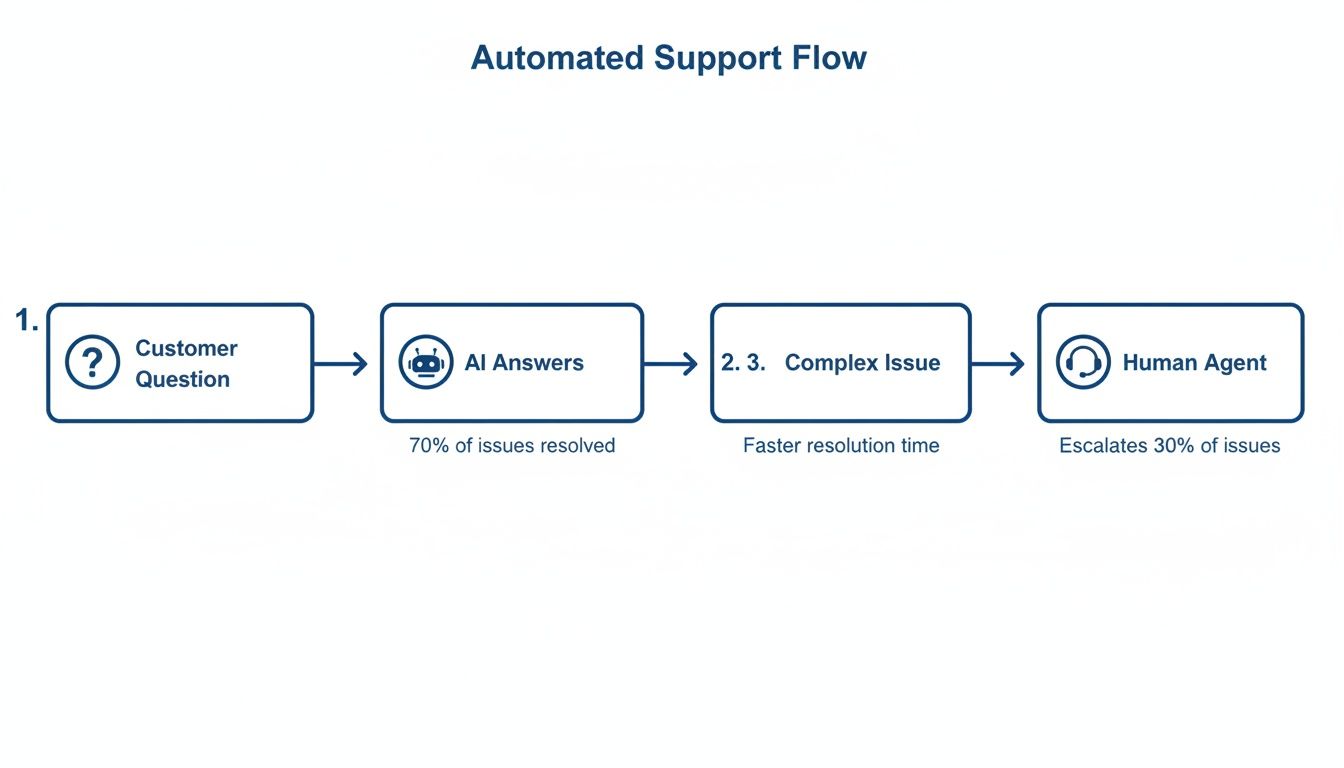
This flow shows exactly how effective automation works: the AI filters and resolves simple queries instantly, making sure your team’s time is spent where it matters most.
Map the Customer Journey
Beyond just reacting to questions, think about where a chatbot could proactively step in. Sketch out your customer’s journey from the moment they land on your site to the post-purchase follow-up. Look for those moments of friction or opportunity. This could be when a shopper is comparing two similar products, or when they hesitate on the checkout page with a high-value cart.
This strategic thinking is quickly becoming the norm. A projected 80% of UK customer care organisations will be using generative AI by the end of 2025. But here’s the reality check: with 75% of UK consumers still wanting a human for complex issues, that hybrid model isn't just nice to have—it's essential.
This shift presents a huge opportunity for DTC brands. It’s not just about cutting costs; it’s about gaining insights that can actually boost your average order value. You can dig deeper into this trend in this report on the UK customer care landscape.
Launching Your AI Chatbot in Minutes
The idea of setting up AI to automate customer service often brings to mind complex projects and developer hours. Thankfully, for Shopify merchants, that's a thing of the past. Modern tools have stripped away the complexity, turning what used to be a major project into a one-click install that delivers value almost instantly.
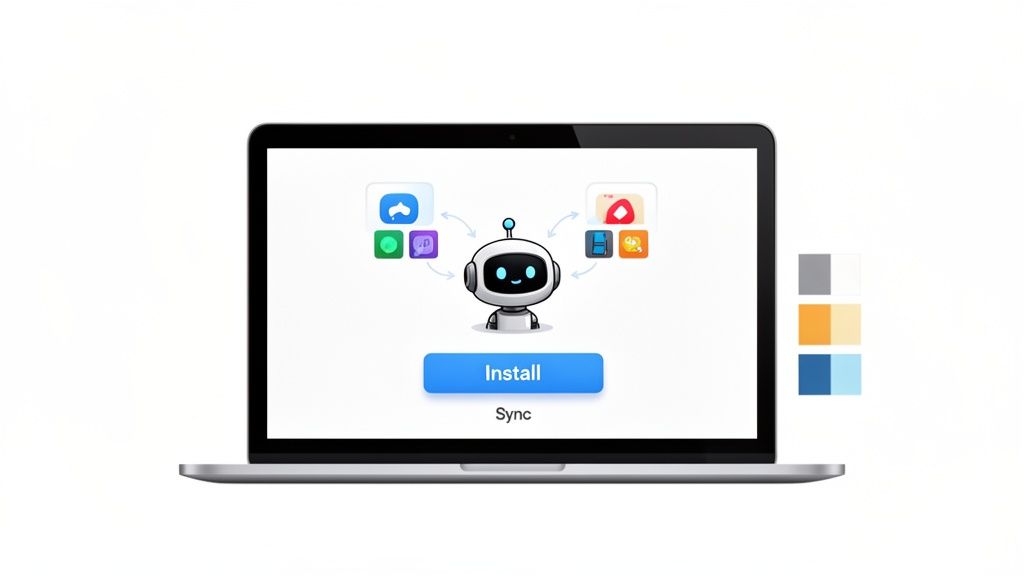
The real breakthrough is the automatic synchronisation. When you install an advanced AI platform like Marvyn, it gets to work right away. It seamlessly integrates with your store, pulling in your entire product catalogue, store policies, page content, and even past customer queries. The moment it’s live, it’s already an expert on your brand.
Your Pre-Launch Checklist
Before you let your new AI loose, a few quick tweaks will ensure it perfectly reflects your brand's voice and aesthetic. This isn't just about getting the answers right; it's about creating an experience that feels authentic to your customers.
Here's a quick checklist to run through:
- Customise the Look and Feel: First impressions matter. Adjust the chatbot widget's colours to match your brand palette and pop your logo in. This tiny step makes the AI feel like a natural part of your site, not some tacked-on tool.
- Define Its Personality: Think about the tone of voice. Do you want a "helpful expert" who's straight to the point, or a "friendly shopping assistant" with a bit more conversational flair? Most platforms let you pick from pre-set personalities in seconds.
- Review the Essentials: Give your core policies a quick once-over. While the AI sync is incredibly accurate, it's always smart to double-check that its understanding of your returns and shipping information is spot-on.
Honestly, you can get through this whole process—from installation to customisation—in less than an hour. That kind of speed means even solo entrepreneurs can get a powerful AI support agent up and running without needing to hire a developer or a whole support team.
Don't get bogged down trying to perfect everything before you launch. The goal is to get a functional, helpful AI live as quickly as possible. You can—and should—refine its personality and responses over time based on real customer interactions.
This accessibility is a game-changer. Powerful automation is no longer just for the big enterprise players; it's right there for merchants of every size.
Instant Knowledge From Day One
Perhaps the biggest advantage here is the immediate knowledge transfer. Your AI isn't some blank slate you have to train from scratch. It learns from all the hard work you've already put into your store's content.
This includes things like:
- Product Descriptions: It can handle detailed questions about materials, sizing, and specific features right out of the box.
- FAQs and Policy Pages: Your rules for shipping, returns, and exchanges are its rules, instantly.
- 'About Us' and Blog Content: It grasps your brand's mission and story, which helps it nail the right tone in conversations.
This instant expertise is what makes modern chatbots for customer service so incredibly effective. They aren't just following a rigid script; they're using your own data to give genuinely helpful, relevant answers from the very first chat.
A smart AI chatbot does more than just answer questions about order tracking. It can—and should—be your most effective, always-on salesperson. When you automate customer service with sales in mind, you shift from simply reacting to problems to proactively generating revenue around the clock.
This isn't about annoying, aggressive pop-ups. It’s about using the AI’s deep product knowledge to guide shoppers, just like a seasoned retail assistant would. A well-configured AI can drive sales in a few powerful ways.
Proactive Engagement and Recommendations
Imagine a visitor is lingering on a high-value product page, like a technical winter jacket. Instead of just sitting there, waiting for them to ask something, the AI can pipe up with a helpful, contextual prompt: "I see you're looking at the Arctic Pro jacket. It's one of our warmest. Are you curious about the waterproofing or sizing?"
That simple opening turns passive browsing into a proper conversation. The AI can then ask clarifying questions about their needs, budget, and where they plan to use the jacket to recommend the perfect item. This kind of guidance doesn't just boost your conversion rate; it builds real shopper confidence.
Strategic Upselling and Cross-selling
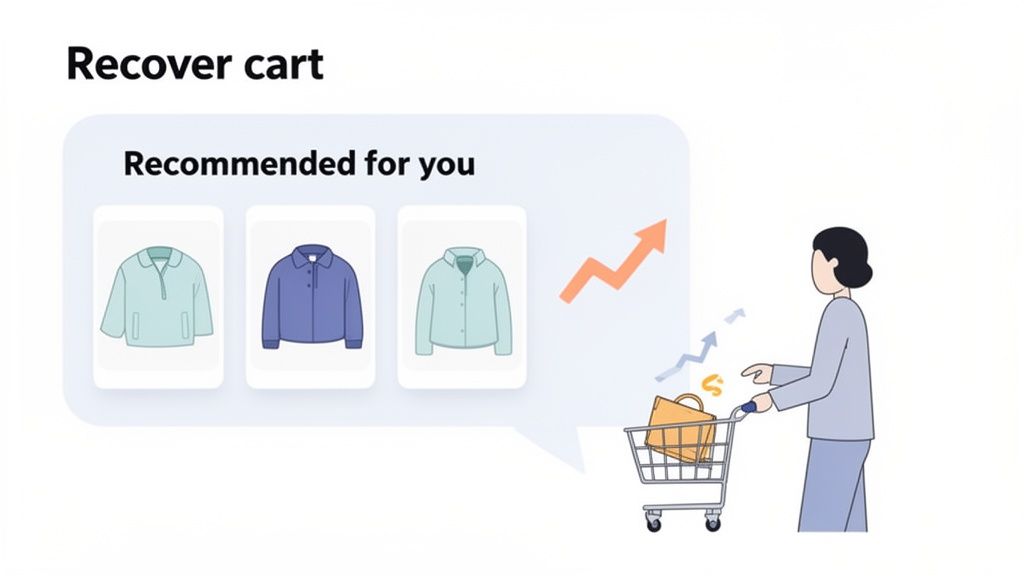
Once a customer adds something to their cart, the sales opportunity is far from over. This is the perfect moment for an intelligent cross-sell. Your chatbot can suggest complementary products that make the original purchase even better, bumping up your average order value (AOV).
- For a dress: "Great choice! A lot of customers pair this with our minimalist gold-plated necklace to complete the look."
- For a tent: "Don't forget a footprint to protect the base of your new tent. It'll extend its life significantly."
- For skincare: "Since you're getting the vitamin C serum, our SPF 50 face cream is the perfect next step for daily protection."
These suggestions feel helpful, not pushy, because they're based on actual product relationships and customer behaviour. This is where an AI that’s synced with your entire catalogue really shines, making connections your team might not have time to make with every single customer. You can learn more about turning your AI into a proactive salesperson in our article on AI sales agents.
An AI sales assistant is at its best when it solves a customer's next problem before they even think to ask. By anticipating their needs—whether for a matching accessory or a crucial add-on—you create a smoother, more valuable shopping journey.
To really turn your chatbot into a sales machine, you should also think about strategies that go beyond your own website. Learning how to be the brand ChatGPT recommends can broaden your digital footprint. When you combine on-site consultative selling with a strong off-site AI presence, you build a powerful flywheel for growth.
Measuring Your Automation Success and ROI
So, you’ve launched your AI chatbot. Great. But the real work starts now. If you can't measure its impact, you can't improve it, and you certainly can't prove its value. To really understand the return on your investment (ROI) when you automate customer service, you need to look past the surface-level numbers and dig into the key performance indicators (KPIs) that actually affect your bottom line.
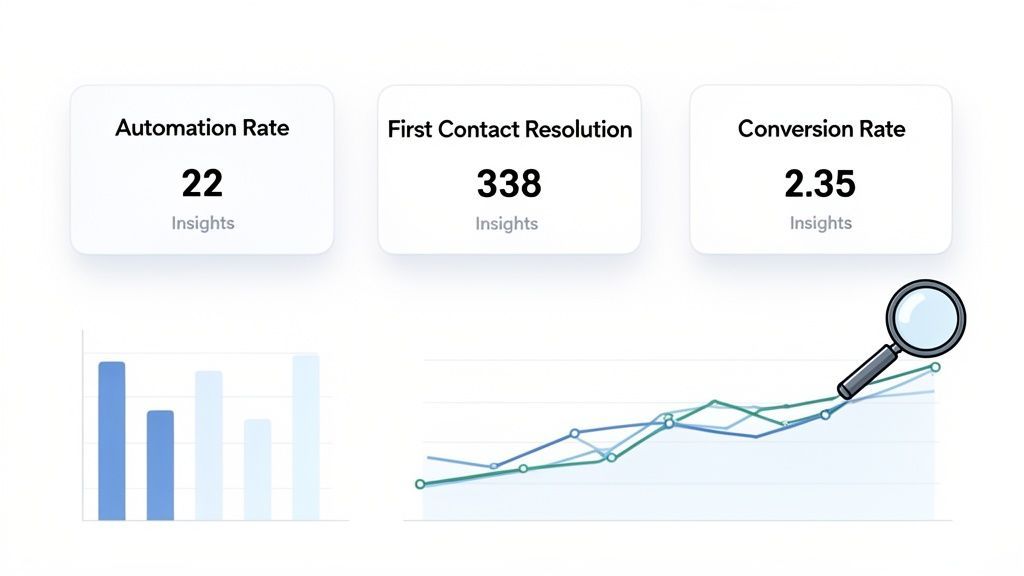
The good news? Any decent AI platform will come with a built-in analytics dashboard. This is your mission control. It’s where you turn raw data into smart business decisions and see if your automation efforts are actually paying off.
Key Metrics for Measuring AI Chatbot Success
You don't need to get lost in a sea of data. For a Shopify store, a handful of high-impact KPIs will give you a clear picture of what’s working and what isn’t.
Here are the essential metrics I always recommend merchants track from day one. They tell you everything you need to know about efficiency, customer satisfaction, and revenue.
These metrics give you a powerful, at-a-glance view of your chatbot's performance and its direct contribution to your store's success.
Your analytics dashboard is more than just a report card; it’s a treasure map. Frequent questions about a specific product's material might not be a chatbot failure, but a sign that your product description needs a quick update. Use these insights to improve your entire store.
Calculating the True ROI of Automation
Beyond the dashboard, the real business impact of automation becomes crystal clear when you look at the financials. Recent data shows that UK contact centres using AI see their cost per contact decrease by 20-40%—a massive saving for any merchant.
These human-AI hybrid teams also handle higher ticket volumes with far greater productivity, which directly translates into higher customer satisfaction. You can read the full research on AI's impact on contact centre trends to see just how significant these shifts are.
Monitoring Your Human Handoffs
Let’s be real: no AI is perfect. A smooth, seamless handoff to a human agent is a non-negotiable part of any good automation strategy. When a conversation gets escalated, your chatbot absolutely must pass the entire chat history to the agent. Making a customer repeat themselves is one of the fastest ways to create a negative experience.
Make it a habit to review these escalated tickets regularly. They are your single best source for identifying where to improve next.
- New FAQ content: If the same complex question keeps getting escalated, that’s your cue. Build a dedicated FAQ page for it and sync it with your AI.
- Training opportunities: Uncover specific topics or product areas where your chatbot is struggling and needs more knowledge.
- Product or policy issues: Escalations often pinpoint recurring pain points related to your products, shipping policies, or return process that need fixing at the source.
By continuously watching these metrics and acting on the insights, you create a powerful feedback loop. Your AI gets smarter, your team becomes more efficient, and your customer experience constantly improves—driving real growth for your business.
Common Questions About AI Customer Service
Dipping your toes into AI customer service can feel like a huge step, bringing a mix of excitement and a good dose of "what if?". It's totally normal to have questions. We hear the same ones from Shopify merchants all the time, so let's tackle them head-on.
Our goal here is to clear up the confusion around what it really takes to automate customer service, from setup to the day-to-day, so you can move forward feeling confident.
Will an AI Sound Robotic and Hurt My Brand?
This is probably the number one fear, and thankfully, it’s based on old-school tech. You can forget the stiff, clunky chatbots from a few years ago. Modern AI is built to be a genuine extension of your brand.
You can customise it to perfectly match your unique tone of voice—whether you're witty and playful, professional and direct, or warm and super-friendly. The AI learns from your website content, product descriptions, and even your blog posts to adopt a personality that feels completely natural to your customers.
The best AI doesn't sound like a robot trying to be human; it sounds like an expert member of your team who just happens to be available 24/7. It maintains your brand's voice with 100% consistency in every single conversation.
That consistency is a massive advantage. It guarantees every customer gets the same high-quality, on-brand experience, no matter when they reach out or what they're asking.
How Much Technical Skill Do I Need for Setup?
Here’s another area where things have gotten so much better. The short answer? Almost none. The days of needing a developer to get powerful AI up and running are long gone.
Most top-tier AI solutions built for Shopify, including Marvyn, are designed for a one-click installation straight from the App Store. The whole process is incredibly straightforward:
- Install the app: Just find it on the Shopify App Store and hit 'Install'.
- Automatic Sync: The AI immediately gets to work, automatically syncing with your entire product catalogue, store policies, collections, and info pages.
- Go Live: Within minutes, your AI is about 90% of the way there, ready to answer questions without you writing a single line of code.
This slick process means even solo founders can have a powerful support system running in less time than it takes to make a coffee. You can get a feel for how different automated messages work in our guide covering examples of auto-replies.
What Happens if the AI Doesn't Know the Answer?
No AI knows everything, and that’s a good thing. This is exactly where a smart, hybrid approach proves its worth. The goal isn’t to hit 100% automation; it's to build a seamless system where tech and humans work together brilliantly.
You can easily set rules for the chatbot to smoothly escalate complex, sensitive, or high-intent conversations to a human agent. For instance, if a customer mentions "legal" or "billing dispute," the AI can instantly transfer the chat to your support team, bringing the full conversation history along with it.
This means customers never have to repeat themselves, and your team gets all the context they need to jump in and solve the problem straight away. The real objective is to empower your team, not get rid of them. By letting the AI handle all the repetitive stuff, you free up your human experts to focus on the high-value interactions where they’re truly needed most.
Ready to see how a smart AI can transform your store's support and drive more sales? Marvyn AI offers a free, fully autonomous chatbot that handles over 70% of customer questions and turns conversations into conversions. Get started in minutes at https://www.marvyn.co.