A Complete Guide to AI for Sales in Ecommerce
When people talk about AI for sales, it's easy to get lost in the hype. Let’s cut through the noise. For an ecommerce brand, it’s not about robot overlords; it’s about equipping your store with a superpowered digital sales assistant. This is a real, practical tool that automates the boring stuff, gives shoppers expert advice 24/7, and actually guides them from just browsing to confidently buying.
The New Sales Floor: Why AI for Sales Is a Game Changer
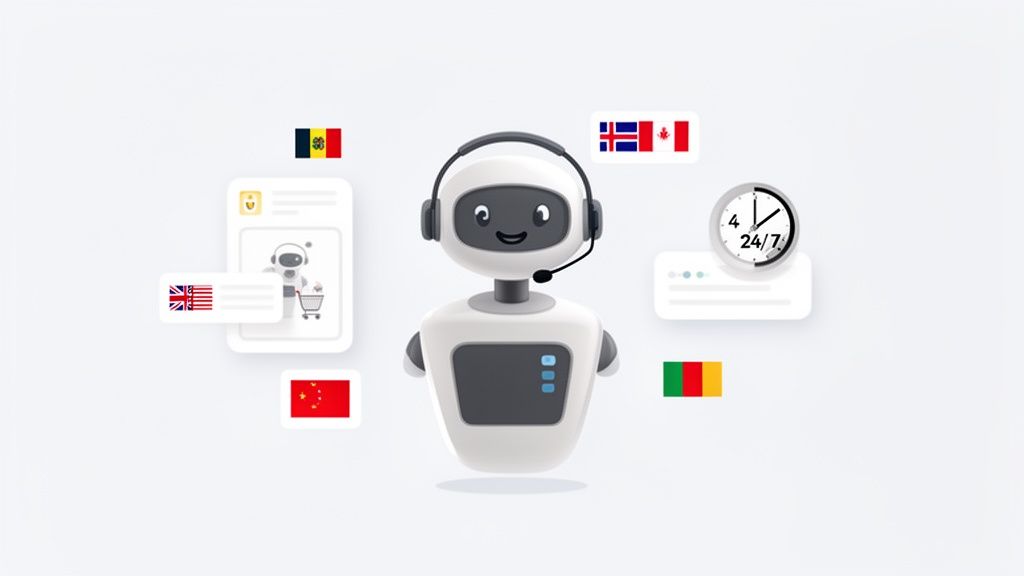
Forget the abstract, futuristic concepts. For modern ecommerce brands, AI for sales is here and it works right now. Think of it as your most dedicated employee—one who never sleeps, speaks every language fluently, and knows your entire product catalogue inside and out.
This isn't just for massive corporations anymore. The technology is levelling the playing field, giving solo founders and growing DTC brands on Shopify the same sophisticated sales tools that were once out of reach. The rise of accessible AI business solutions is completely changing the game for online sales.
What we’re seeing is a fundamental shift. We're moving away from the slow, reactive world of customer support tickets and towards proactive, automated selling that actively drives revenue.
From Manual Support to Automated Selling
Traditionally, customer interactions have been painfully manual. A shopper has a question, sends an email, and then waits... and waits. That friction costs you sales. Every hour they wait is another chance for them to buy from a competitor or change their mind. An AI sales assistant flips this dynamic on its head.
Before we dive deeper, let’s look at how this changes day-to-day operations. Here’s a quick comparison of the old way versus the new.
Manual Support vs AI-Powered Sales
The difference is stark. One is a cost centre focused on damage control; the other is a revenue generator focused on creating sales.
An AI sales assistant is like a digital concierge for your Shopify store. It greets every visitor, answers their questions instantly, and helps them find exactly what they need—turning hesitant browsers into confident buyers.
This immediate, helpful engagement is a massive advantage. It means:
- Answering Questions Instantly: No more lost sales because a customer couldn't find your shipping policy or a product's dimensions.
- Guiding Product Discovery: The AI can ask about a customer’s needs, style, and budget to recommend the perfect items, just like a great in-store assistant.
- Operating 24/7: Your store is always ready to make a sale, no matter the time zone your customer is in.
The Democratisation of Advanced Sales
What makes this moment so different is how accessible these tools have become. Platforms like Marvyn AI are built to be installed with a single click on Shopify. You don’t need a team of developers or a six-figure budget to get started. The AI automatically syncs with your store's data—products, policies, pages—and is ready to start having intelligent conversations in minutes.
The market growth reflects this shift. The UK generative AI market, which fuels these advanced sales chatbots, is projected to explode from USD 909.1 million in 2025 to over USD 13.4 billion by 2033. This isn't just a tech trend; it's a new standard for consultative selling online. With 54% of UK firms expected to be using AI by 2026, merchants who don't adapt risk being left behind.
By handling the endless, repetitive queries that clog up your inbox, AI for sales frees up your human experts. They can finally stop answering "where's my order?" and start focusing on the complex, high-value tasks that truly grow the business. It’s not about replacing people; it’s about letting them do their best work while the AI handles the rest.
Key Use Cases: How AI Transforms the Ecommerce Sales Funnel
Understanding AI for sales in theory is one thing. Seeing it in action inside a real sales funnel is where it clicks. This isn’t about one big, scary tool; it's a set of specialised jobs that AI can do across the entire customer journey. Together, they turn a standard ecommerce store into a smart, consultative selling machine.
Think of your sales funnel as a leaky bucket. You pour potential customers in at the top (awareness), but a lot of them drop out on the way down. They get stuck, have unanswered questions, or just don't feel a connection. AI is what plugs those leaks, stage by stage, guiding shoppers from their first curious click to the final checkout confirmation.
Digital Concierge: Pre-Sales and Lead Qualification
The sales journey almost always starts with a question. A visitor lands on your site, intrigued by a product but unsure if it's the right one. This is the first make-or-break moment. An AI-powered pre-sales chatbot is your digital concierge, ready to help 24/7.
Unlike a static FAQ page that forces customers to search for answers, this AI has a real conversation.
- It qualifies leads: By asking smart questions about what a customer needs ("Are you looking for a waterproof jacket for serious hiking, or something lighter for city wear?"), the AI figures out if they're a good fit for a product.
- It acts as a guide: Instead of making users wrestle with complex menus, the AI points them directly to the best collections or products based on their answers.
This isn't just about providing information. It’s about making that first-time visitor feel seen and expertly guided, just like they would be by a top-tier sales associate in a physical shop.
Hyper-Personalisation: Product and Content Recommendations
Once the AI understands what a customer is looking for, it starts personalising their entire shopping experience. This goes way beyond showing a generic "best-sellers" list. AI-driven personalisation engines change what the user sees in real time, based on their behaviour.
So, if someone shows interest in sustainable, organic cotton clothing, the AI makes sure that product carousels, homepage banners, and even blog post suggestions all line up with that preference. This deep level of customisation makes the shopper feel like the store was built just for them, which keeps them engaged and browsing for longer.
The core function of AI for sales is to transform an anonymous visitor into a known individual with specific tastes and needs, then cater the entire shopping experience to that individual.
Smart Interventions: Dynamic Pricing and Promotions
Cart abandonment is the silent killer of ecommerce sales. A customer finds what they want, adds it to their basket, and then... nothing. They hesitate at the final step. AI is brilliant at spotting this hesitation – maybe they've been lingering on the checkout page for a few minutes, or their cursor is drifting towards the 'close tab' button.
At that exact moment, the AI can trigger a smart intervention. It could be a small, timely pop-up offering a 10% discount to seal the deal, or a quick reminder about your free shipping policy. This isn't about throwing discounts at everyone; it's about using data to offer the right nudge to the right person, right when they need it most. You can learn more about how to strategically increase ecommerce sales with data-driven tactics like this.
Crystal Ball: Sales and Inventory Forecasting
Finally, AI's impact goes far beyond live customer chats. It does some of its most important work behind the scenes, sifting through huge amounts of data: past sales figures, seasonal trends, popular browsing paths, and even external factors like public holidays. This is a core function of the highly capable AI sales agents that are changing ecommerce.
By spotting patterns in this data, AI can generate remarkably accurate sales forecasts. For a Shopify store owner, this is gold. It helps you:
- Optimise inventory: No more running out of stock on your best-sellers during a rush, and no more capital tied up in products that just aren't moving.
- Plan marketing campaigns: If the AI predicts a surge in demand for a certain product, you can launch targeted ad campaigns to get ahead of the curve.
This kind of forecasting turns inventory management from a stressful guessing game into a data-backed strategy, ensuring you always have the right products ready for the right customers.
Your Shopify AI Sales Roadmap: Get Started in Minutes
Getting started with AI for sales on your Shopify store isn't some months-long, developer-heavy project. Forget that. Modern tools are built for speed, letting you launch a new digital sales assistant in less time than it takes to get through your morning coffee.
This isn't about complex coding. It's a simple, four-stage roadmap that any store owner can follow.
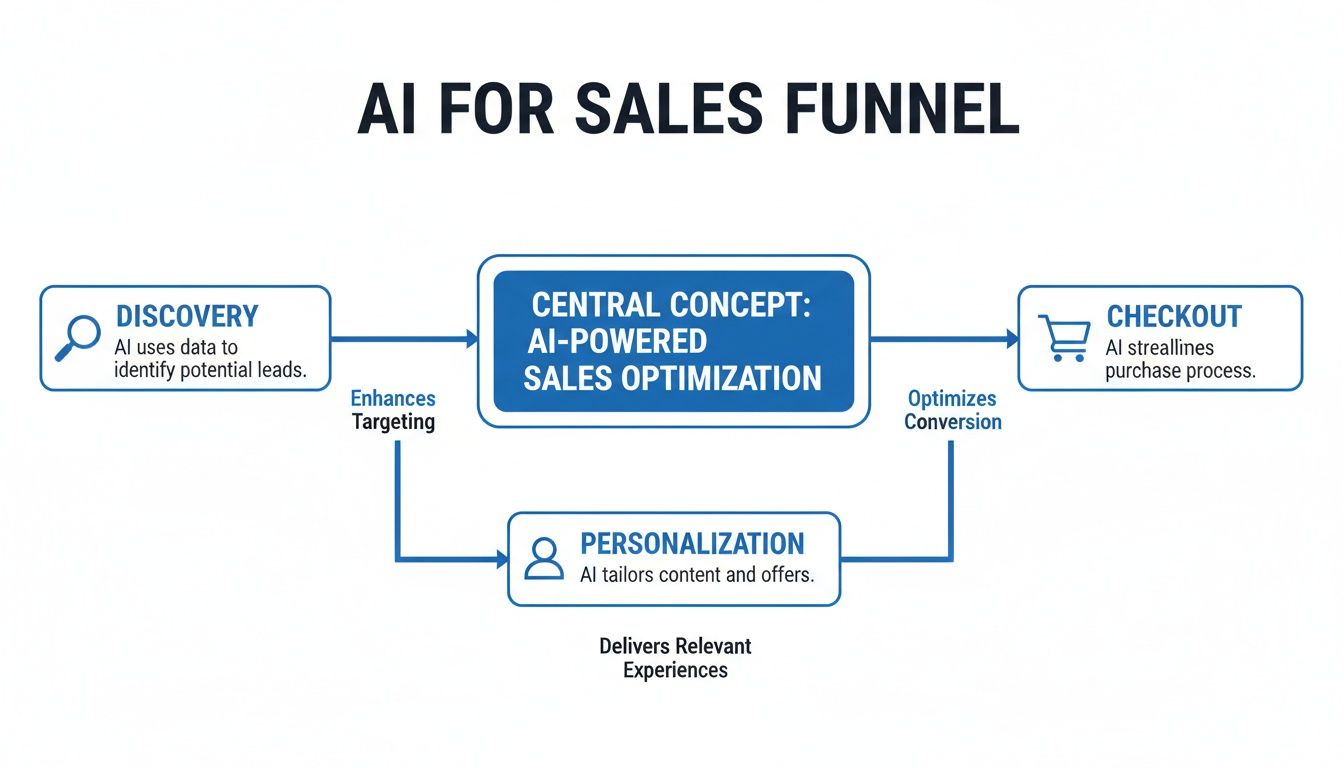
This diagram shows exactly where AI fits into your sales funnel. It’s a guide that works behind the scenes, personalising the journey for each shopper and nudging them smoothly towards the checkout.
Step 1: One-Click Installation
Your journey begins in the Shopify App Store. This is the easy part. Tools like Marvyn AI are available with a one-click installation—no need to call a developer or mess around with code injections.
Once you click “Add app,” the AI gets to work instantly. It’s not just sitting there waiting for instructions; it’s actively syncing with your entire Shopify setup. This includes:
- Product Catalogue: All your products, variants, prices, and images.
- Collections: The product groupings you’ve carefully curated.
- Store Policies: Your rules on shipping, returns, and privacy.
- Pages: Key info like your "About Us" page.
This instant synchronisation is the secret sauce. It means that within minutes, your AI is ready to answer specific questions about your products and policies because it already knows your business inside and out.
Step 2: Initial Training and Customisation
With the tech side sorted, it's time to make the AI truly yours. This is where you inject your brand's personality and stop it from feeling like a generic add-on.
First, you tweak its appearance. Customise the chatbot widget's colours to match your site's design and upload your logo. This small step makes the AI feel like a natural part of your store, not something bolted on.
Next, you define its voice. You can pick a pre-set tone—anything from witty and casual to formal and professional—that mirrors how you speak to your customers. For even deeper customisation, you can upload your existing FAQ documents to give the AI a richer knowledge base to pull from.
Step 3: Setting Up Smart Escalation
An AI sales assistant is incredibly capable, but some conversations will always need a human touch. That’s not a weakness; it’s reality. A critical part of the setup is defining the rules for smart escalation—the process that decides when to hand a conversation over to a human agent.
Smart escalation isn't a sign of AI failure; it's a feature of a well-designed system. It ensures customers get the best of both worlds: instant automated support for common questions and expert human help for complex issues.
You can set up rules that trigger a handover based on certain keywords (like “complaint” or “speak to a person”) or if the AI fails to answer a question after a couple of tries. This creates a safety net that guarantees a smooth customer experience, perfectly blending automation with human expertise. To see how this hybrid model works in practice, check out our guide on using chatbots for customer service.
Step 4: Going Global with Localisation
Finally, if you sell internationally, this is the step that changes everything. Top AI sales tools let you serve a global audience without hiring a massive, multilingual support team.
With just a few clicks, you can enable your AI to understand and respond in over 80 languages. This means a customer from France can ask a question in French, and your AI will reply fluently in French. It instantly removes language barriers, making your store accessible to a much wider audience and unlocking sales potential you might be missing out on.
Measuring Success: The KPIs That Matter for Sales AI
So you've switched on a powerful AI for sales tool. That’s the easy part. The real work is proving it’s actually making a difference. After all, any new tech is only as good as the return it generates.
To justify the spend and show real business impact, you have to look past vanity metrics. Nobody cares how many chats your AI had. What matters is how many of those chats turned into cash. You need a solid business case built on tangible data, whether it's for your leadership team or just for your own analysis.
Revenue-Driving KPIs
Let’s be honest, the most important metrics are the ones that directly affect your bottom line. An effective AI sales assistant should have a clear, positive impact on these core numbers. Think of it as a new salesperson—these are the results that count.
- Conversion Rate Lift: This is the ultimate test. You need to track the conversion rate for shoppers who interact with the AI versus those who don't. A meaningful lift in that first group is hard proof the AI is answering questions that would have otherwise sent customers away.
- Average Order Value (AOV) Increase: A great AI doesn't just answer questions; it actively sells. Measure the AOV for sessions where the AI made a product recommendation or an upsell. If it's successfully suggesting complementary items or premium versions, your AOV will climb.
- Cart Abandonment Rate Reduction: That moment of hesitation right before a customer bails on their basket is critical. A good AI can step in right there. Monitor your cart abandonment rate before and after implementation. A significant drop shows the AI is resolving last-minute doubts or offering timely help that keeps the sale on track.
These metrics paint a clear picture of how AI is adding pounds to your sales figures. The growth here is no small thing. In the UK, the AI in retail market—which powers these exact tools—is projected to grow from USD 554.78 million in 2025 to USD 2,469.74 million by 2034. That boom is driven by AI’s ability to turn browsers into buyers, which directly impacts conversion and AOV. You can find more detail in the full AI in retail market report.
Operational Efficiency KPIs
Beyond direct sales, a good AI assistant should make your entire operation run more smoothly. These efficiency metrics show the tool's value in saving you time and resources—which are just as valuable as revenue.
An AI sales assistant's job is twofold: grow revenue and shrink operational costs. By automating repetitive tasks, it frees up your human team to focus on high-value activities that drive growth.
Here are the key efficiency metrics to watch:
- Reduced Customer Support Ticket Volume: A primary goal here is automation. You want the AI to handle all the common questions. Aim for at least a 70% reduction in routine tickets like "Where is my order?" This proves the AI is successfully deflecting queries from your human support inbox.
- Faster Inquiry Resolution Time: For the questions the AI does handle, it should be instant. Measure the average time it takes for a customer to get an answer. With AI, this should be a matter of seconds, not the hours or days it can take with manual support.
- Customer Satisfaction (CSAT) and Net Promoter Score (NPS): It’s simple: happier customers buy more. Track customer satisfaction scores through post-chat surveys. A high score is a great sign that the AI is delivering a helpful, positive experience. For a deeper look at long-term loyalty, it's also worth learning how to calculate your Net Promoter Score.
Choosing Your AI Partner: A Vendor Selection Checklist
Picking an AI sales tool isn't like buying other software. It's a bit more like hiring a new team member. The wrong choice can lead to frustrated customers and wasted cash, while the right one can become your most valuable sales asset. But not all platforms that claim to offer AI for sales are built the same, especially when it comes to the unique world of a Shopify merchant.
You wouldn't hire a new sales director without a proper interview, right? You need to apply that same level of care here. To help you make a smart call, here’s a checklist of the critical questions you should be asking any potential AI partner before you sign on the dotted line.
Core Integration and Functionality
First things first: how well does the tool actually play with your Shopify store? A genuine ecommerce AI should feel like a native part of your setup, not some clunky, bolted-on gadget. These questions get to the heart of how much work it saves you from day one.
- Does it offer a one-click Shopify integration? Your time is precious. The setup should be a matter of minutes, not days of wrestling with code or technical manuals.
- Does it sync your entire product catalogue automatically? For an AI to give accurate recommendations, it needs instant, real-time access to all your products, variants, and stock levels. Anything less is a non-starter.
- Does it understand your store policies? To be genuinely helpful and build trust, the AI has to know your shipping, return, and privacy policies inside out. This is how it answers customer questions correctly.
Scalability and Pricing Model
Your business is built to grow, and your AI partner needs to keep up. A restrictive pricing model can quickly turn a helpful tool into a huge expense as you scale. You need to dig into the numbers to understand the true long-term cost.
A scalable pricing model is non-negotiable. Your success shouldn't be penalised. Look for vendors that offer unlimited conversations, ensuring your costs don't spiral upwards as your store gets busier.
Ask these specific questions about what it’s going to cost you:
- Is the pricing model scalable? Steer clear of any tool that charges per conversation or per customer interaction. This punishes you for engaging with more shoppers, which is the whole point.
- Is there a free plan or an extensive free trial? You absolutely must be able to test the tool in a live environment to see its real impact on sales and support before you put any money down.
Customisation and Control
Your brand’s voice is one of its most important assets. A generic, robotic chatbot can do more harm than good. You need to be sure the tool gives you full control over the customer experience. For Shopify merchants, seeing how different solutions approach this, like in our analysis of Marvyn versus Zendesk, can be really eye-opening.
- What level of customisation is available? You need to be able to control the colours, logo, and—most importantly—the AI’s tone of voice to make sure it’s a perfect match for your brand.
- How does it handle escalations to human agents? The handover from AI to a person has to be seamless. A good system has clear, smart rules for when and how this happens, so nothing falls through the cracks.
- Does it support multiple languages? If you sell internationally, the ability to chat fluently in your customers' native languages is a massive advantage. It's one of the fastest ways to unlock new markets.
Avoiding Pitfalls and Optimising for Performance
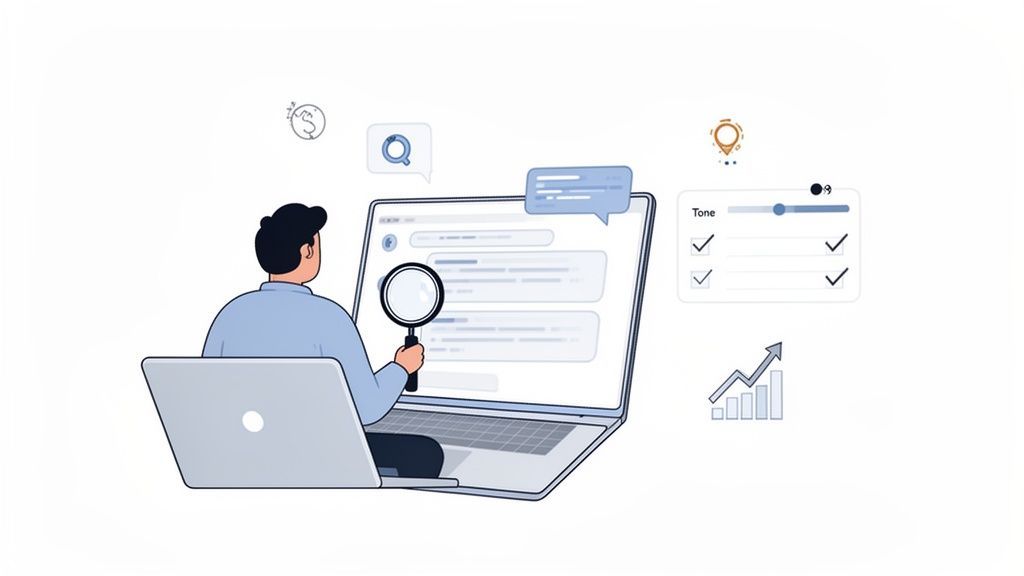
Getting an AI for sales tool live on your store is just step one. The real work—and the real wins—come from continuous improvement.
One of the biggest mistakes we see is the ‘set it and forget it’ mindset. To get the most out of it, you need to treat your AI less like a static bit of code and more like a new member of your sales team who needs regular coaching.
This means getting your hands dirty and actively reviewing conversation logs. Those logs are a goldmine. They show you the exact questions customers are asking, where they're getting confused, and what friction points are killing your sales. Spotting these patterns lets you feed that intel back into the AI or your FAQ page, making it smarter with every interaction.
Fine-Tuning Your AI’s Personality and Process
Two other areas are absolutely critical for optimisation: the AI’s tone and its process for handing off to a human. Get these wrong, and you’ll just frustrate customers.
A common pitfall is getting the tone of voice wrong—either sounding too robotic and cold, or going too far the other way and sounding off-brand. Both can alienate shoppers. The only solution is to test and tweak. Adjust the AI’s personality settings, read the transcripts to see how people react, and keep refining until it sounds like you.
Just as important is having a crystal-clear escalation path. When a shopper actually needs a person, that handover has to be seamless.
An AI without a clear path to a human agent is a dead end. Define precise rules for when and how a conversation is passed to your team to avoid frustrating customers and losing sales.
This structured approach makes sure your automation and your team are working together, not against each other. It leads to a much better customer experience and a real boost to your conversion rate optimisation for ecommerce efforts.
Avoiding Surface-Level AI Implementation
The biggest pitfall of all? Using AI without a clear, sales-focused strategy.
While AI adoption in UK businesses climbed to between 31-35% by early 2026, many smaller companies are still just dabbling. They’re using basic tools like ChatGPT but aren’t properly integrating them into their sales process. This surface-level approach misses the entire point.
By deploying a purpose-built, autonomous chatbot instead of a generic tool, brands can leapfrog competitors who are still figuring things out. And with 64% of UK marketers planning to increase their AI investment, the focus has to be on tools that deliver tangible revenue, not just answer a few questions. For more data on this trend, you can explore the full report on AI adoption in business.
By actively managing your AI, you transform it from a simple Q&A bot into a sophisticated sales engine that gets better over time—driving impressive, lasting results for your Shopify store.
Your Questions About AI for Sales, Answered
As you start to think about bringing an AI sales assistant into your Shopify store, it’s natural to have a few questions. We get it. Here are the straight-up answers to the most common things we hear from merchants just like you.
Is AI for Sales Difficult or Expensive to Set Up?
Not anymore. Forget everything you think you know about complicated tech projects. Modern solutions like Marvyn AI are designed for a one-click install right from the Shopify App Store. Many, including ours, have a completely free plan to get you started.
You don’t need developers or a massive budget. The entire setup process literally takes minutes, not weeks.
A good AI tool automatically syncs with your products, collections, and store pages. This means it’s ready to start answering specific customer questions almost instantly, making AI for sales incredibly accessible, even if you’re a one-person team.
Will an AI Chatbot Replace My Human Team?
Definitely not. An AI sales chatbot is built to make your team better, not replace it. Think of it as the ultimate assistant.
The real goal is to automate the 70% or more of repetitive, simple pre-sales questions that eat up your team’s time. This frees them up to focus on the high-value conversations that actually need a human touch.
A well-designed system also has smart rules for escalation. If a conversation gets too complex or sensitive, the AI knows to seamlessly pass it to a person. This creates a powerful hybrid team where everyone is doing what they do best.
Customer frustration doesn't come from bots; it comes from bad bots that can't answer simple questions. A modern generative AI sales assistant is different. It understands what people are asking and gives genuinely helpful advice, just like a top sales associate would in a physical store.
By solving problems instantly, 24/7, a good AI actually improves customer satisfaction and leads directly to more sales. It's not about replacing people; it's about making them more effective.
How Can I Ensure the AI Sounds Like My Brand?
This is a big one, and the best tools give you full control. You can easily customise the colour scheme and logo of the chatbot widget to match your website’s design, so it feels like a native part of your store.
More importantly, you can shape the AI's personality. Whether you want it to be professional and formal or friendly and a bit witty, you can pick a tone of voice that aligns with your brand.
You can also train it by uploading your own FAQ documents to make sure its answers are perfectly in sync with your brand’s messaging and policies. This level of control ensures your AI for sales is a true extension of you.
Ready to see how an AI sales assistant can transform your Shopify store? Marvyn AI installs in one click and starts driving sales from day one. Get started for free.