Shopify Growth With Chatbots Customer Service
Imagine having your best sales assistant working 24/7, never missing a question, and turning visitors into buyers around the clock. That's what chatbots customer service delivers for modern Shopify stores, flipping support from a simple cost centre into a real engine for growth.
Why Chatbots Are the New Ecommerce Standard
In the UK's direct-to-consumer (DTC) world, old-school customer support just can't keep up. Shoppers want instant answers, no matter the time of day, and any delay usually means an abandoned cart and a lost sale. This is where AI chatbots have gone from a nice-to-have gadget to an absolutely essential tool.
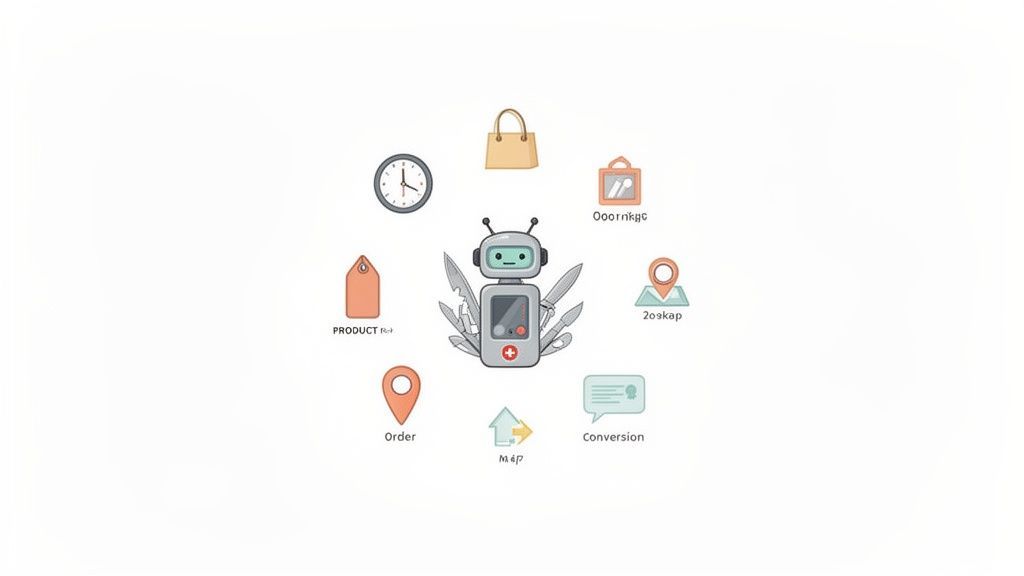
Think of a good chatbot less like a simple pop-up and more like a digital multitool for your online shop. It’s not just there to answer basic questions; it's a fully integrated assistant that handles a ton of different tasks at once, providing immediate fixes for the most common ecommerce headaches.
Tackling Overwhelming Support Volume
For any growing Shopify store, the constant stream of repetitive questions can become a real nightmare. “Where’s my order?”, “What’s your return policy?”, “Do you ship to…?”. These queries flood your inbox and eat up hours that you could be using to actually grow the business. A chatbot answers these instantly.
A well-trained chatbot can automate up to 70% of routine customer service tasks. This doesn't just cut your support costs; it frees up your team to focus on the complex, high-value conversations that actually need a human touch.
This is how you scale support without just hiring more people. Instead of your headcount growing with your ticket count, a chatbot gives you a solution that works tirelessly, 24/7. It guarantees no customer is left waiting on a simple question, which massively improves their experience. You can see some powerful chatbot examples in action to get a feel for their real-world impact.
From Support Agent to Sales Assistant
Here’s the part most people miss: the real power of chatbots customer service is its ability to drive sales. A smart chatbot isn't just a support agent; it's a consultative salesperson that proactively engages visitors and guides them towards a purchase.
This is where that multitool idea really comes into its own. A single bot can:
- Offer Product Recommendations: It can ask customers about what they’re looking for, what their budget is, and what style they prefer, then suggest the perfect products—just like a great in-store assistant would.
- Reduce Cart Abandonment: When someone is hesitating at checkout, the chatbot can pop up to offer help, answer a last-minute question, or even present a small discount to close the deal.
- Upsell and Cross-sell: It can intelligently suggest complementary items or premium versions based on what's already in a customer's cart, directly boosting your average order value (AOV).
By blending seamless support with clever sales tactics, chatbots have cemented their place in the modern e-commerce toolkit. They aren't just there to solve problems; they're actively creating revenue, making them the new standard for any ambitious Shopify store.
How AI Chatbots Actually Work for Shopify
To really get your head around how modern chatbots customer service works for a Shopify store, you need to understand one crucial thing: not all bots are the same. There's a world of difference between a basic, script-following bot and a genuinely intelligent AI assistant. One is like a clunky, interactive FAQ page; the other is like having a personal shopper who understands what your customers actually mean.
Imagine a simple, rule-based chatbot. You feed it a list of pre-set questions and answers, essentially building a decision tree. If a customer asks, "What are your shipping costs?", the bot follows the rule you made and spits out the answer you wrote. It's functional, but incredibly rigid. The moment a customer asks the same thing a slightly different way, like "how much to get it delivered?", the bot gets stuck.
This is where proper AI assistants completely change the game. They don't just follow a script; they understand language.
The Brains Behind the Bot: Natural Language Processing
The technology that powers intelligent chatbots is called Natural Language Processing (NLP). The best way to think of NLP is as the bot's ability to listen and understand human language—typos, slang, and all. It lets the chatbot figure out the intent behind what a customer is asking, rather than just trying to match keywords.
For example, a customer might fire off a message like: "hey, got that green jacket in a medium? need it for next week".
A basic bot would be completely lost. But an NLP-powered chatbot breaks this down in a heartbeat:
- "green jacket": It identifies the specific product.
- "medium": It understands the size variant.
- "got that": It realises this is a stock or inventory question.
- "need it for next week": It detects urgency related to shipping times.
This ability to interpret context is what makes an AI chatbot so powerful. It can hold a natural, helpful conversation instead of forcing customers down a narrow, predefined path. You can learn more about how this transforms support by exploring how to automate customer service effectively.
The Magic of Shopify Integration
Here’s where it gets really powerful for ecommerce brands. A dedicated Shopify chatbot, like Marvyn AI, doesn’t just have a brain (the NLP); it has a direct line to your store's entire nervous system. The moment you install it from the Shopify App Store, it performs a deep integration.
This isn't a manual setup job. The chatbot automatically syncs your entire product catalogue, collections, stock levels, pricing, shipping zones, and return policies. It instantly becomes your most knowledgeable employee, without a single day of training.
This seamless connection is what allows for truly magical customer interactions. When a customer asks, "Is the medium-sized green jacket back in stock yet?", the chatbot doesn't need to go and ask a human. It performs a real-time check of your Shopify inventory data and gives an accurate, immediate answer.
This deep integration means the chatbot can handle highly specific and valuable questions all on its own, such as:
- Stock Status: "When will the blue trainers be available in size 9?"
- Order Tracking: "Where is my order #12345?"
- Policy Questions: "Can I return sale items?"
- Product Details: "Is this shirt made from organic cotton?"
By combining the ability to understand natural language with a live connection to your store’s data, an AI chatbot becomes a fully autonomous sales and support agent. It provides instant, accurate answers 24/7, creating a frictionless experience that keeps customers happy and encourages them to click "buy".
The Tangible ROI of Automating Customer Service
Putting money into new tech always feels like a bit of a gamble. But when it comes to using chatbots for customer service, the return on investment (ROI) isn’t some far-off theory. It’s real, it’s fast, and you can measure it. Forget the setup for a moment and let's talk about what a smart chatbot actually does for your Shopify store's bottom line. The most obvious win? A massive drop in your operational costs.
Take a look at your support inbox. Chances are, it’s swamped with the same old questions: "Where's my order?", "How long is shipping?", "What's your returns policy?". An AI chatbot that’s hooked into your store's data can handle over 70% of these routine tickets on its own. This isn't about firing your support team; it's about making them better. By clearing out all that noise, you free up your people to focus on the tricky, high-value chats that actually build loyalty and bring in money.
Slashing Costs and Boosting Efficiency
The financial knock-on effect of this kind of automation is huge. Research from IBM shows that chatbots can slash customer support costs by as much as 30%, simply by taking the weight of routine queries. For a growing e-commerce brand, this means you can handle more customers without having to hire more support staff at the same rate.
A study by Juniper Research found that for every single query a chatbot handles in banking, it saves about four minutes of an agent’s time. That same logic applies directly to e-commerce. Instant, automated answers don't just keep customers happy—they bring down your cost-per-contact in a big way.
This newfound efficiency is a lifesaver for bootstrapped founders and small teams who are already stretched thin. Instead of burning hours every day typing out the same answers, that time can go back into marketing, developing new products, or figuring out your next big move. The infographic below shows the kind of tech that makes this all possible.
This visual breaks down the different technologies at play, from simple rule-based flows to the more advanced NLP and direct Shopify integration that allows a chatbot to run on autopilot.
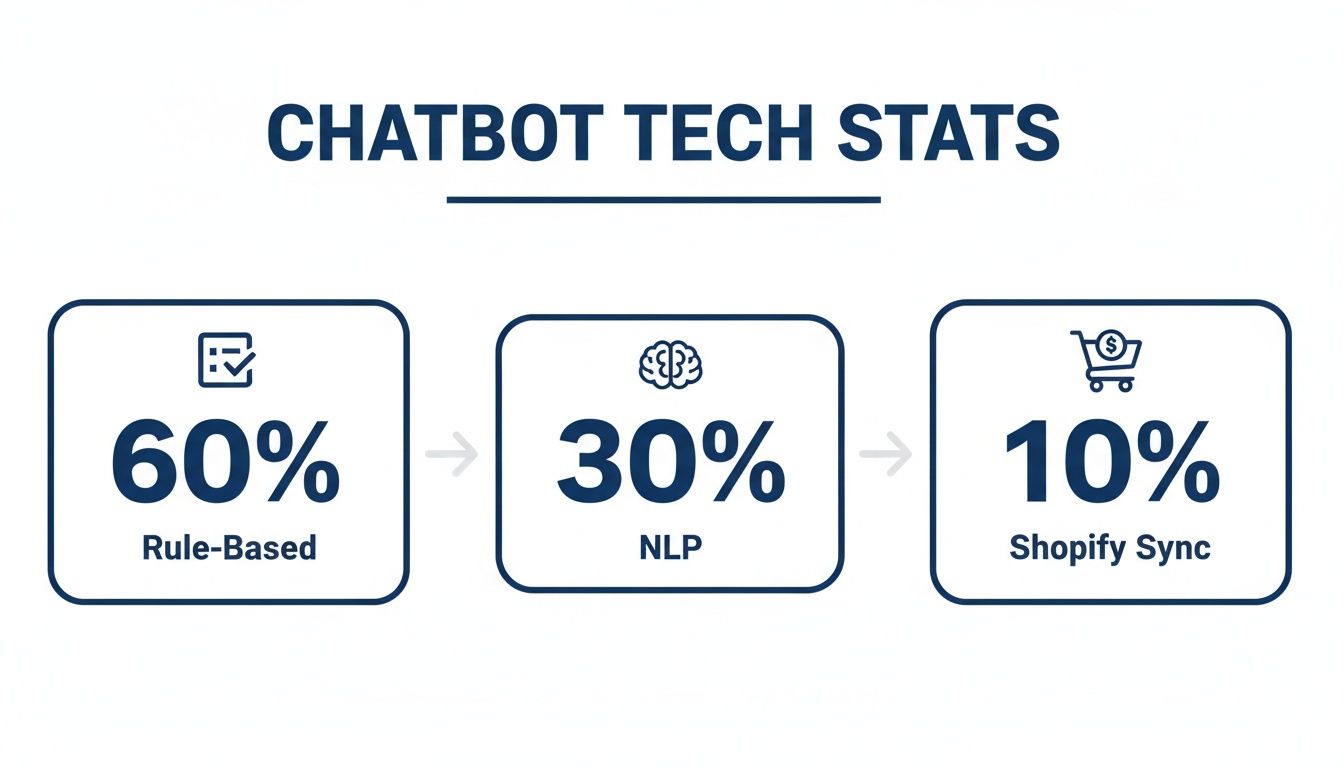
It’s this combination of technologies that allows a chatbot to become more than just a widget—it becomes a genuine part of your store’s operations.
Transforming a Cost Centre into a Revenue Driver
Here’s the part most people miss: a good chatbot isn't just a cost-saving measure. It’s a full-on revenue generator. It acts like a 24/7 sales assistant that never sleeps and is always working to make your store more profitable.
Here’s how a chatbot can directly bump up your sales:
- Consultative Selling: It can ask visitors what they're looking for, what their budget is, and what style they like. It turns a random browsing session into a guided shopping experience that leads to the perfect product.
- Upselling and Cross-selling: Based on what's already in a customer's cart, the bot can suggest complementary items or premium upgrades, pushing up your Average Order Value (AOV).
- Cart Abandonment Reduction: By popping up on the checkout page, the bot can answer last-minute questions about shipping or returns—the kind of small doubts that often cause shoppers to bail on their purchase.
The UK market has seen a huge swing towards this model. In 2026, the chatbot market is expected to hit £1.2 billion in revenue, with over 45,200 businesses using these tools. This isn't just hype; Shopify brands are using tools like Marvyn AI to manage 24/7 support and actively drive sales. We’re seeing chatbots contribute to a 22% increase in revenue through smarter, consultative selling. This smart use of automation in customer service is becoming non-negotiable, a topic we explore more in our detailed guide.
Building a Bulletproof Business Case
The evidence speaks for itself. Getting chatbots for customer service isn't an expense; it's an investment that pays for itself through lower running costs, a more efficient team, and direct sales growth.
With 90% of customer experience leaders already reporting a positive ROI from their AI tools, the question isn't if you should automate anymore. It's how. For Shopify merchants, the answer is to use tools built specifically for e-commerce—ones that can sync with your store in minutes and start working as both a support agent and a sales driver from day one.
Implementing a Chatbot on Shopify Without a Developer
The idea of adding a powerful AI chatbot to your store probably brings up images of complex code and expensive developers. Thankfully, for Shopify merchants, that’s a myth. Launching a fully functional AI assistant is now as simple as downloading an app, completely dismantling the old belief that you need technical skills to automate your chatbots customer service.
Your journey starts in a place you already know well: the Shopify App Store. This is where you’ll find dedicated chatbot solutions designed for a ‘one-click’ installation.
The Shopify App Store is your gateway to powerful, no-code tools that can instantly upgrade your store's capabilities. A quick search for an e-commerce chatbot will show you a range of options built specifically to integrate with your setup, right out of the box.
The One-Click Installation Process
Once you’ve picked a chatbot app, the installation is incredibly straightforward. With a single click, the app asks for permission to connect to your store. After you approve, the real magic starts happening behind the scenes.
The chatbot doesn’t just sit there waiting for you to teach it. It immediately starts syncing with your Shopify data, automatically learning everything it needs to know to become a valuable member of your team. This process includes:
- Product Catalogue Sync: The bot absorbs all your products, including variants, pricing, descriptions, and current stock levels.
- Policy and Page Integration: It scans and understands your store's policies on shipping, returns, and FAQs.
- Order Information Access: The bot can securely access order status information to handle all those "Where is my order?" questions.
This automatic sync means your chatbot is ready to answer specific, real-time customer questions in minutes, not weeks. It knows your business inside and out without you having to manually type in a single piece of product info.
Quick Customisation for Brand Alignment
After the automatic setup, you can quickly make the chatbot your own. This isn’t some complex coding job; it’s more like customising your Shopify theme. Most apps give you an intuitive dashboard where you can perfectly match the chatbot to your brand’s look and feel.
You can launch a fully functional, intelligent customer service agent in minutes, no coding required. The goal is to get you up and running quickly so you can focus on growth, not on technical configurations.
The key customisation steps usually include just a few simple things:
- Setting Brand Colours: Adjust the chat widget’s colours to match your store’s palette for a seamless visual experience.
- Uploading Your Logo: Add your brand logo to the chat interface to build trust and keep your branding consistent.
- Adjusting the Tone: Configure the bot’s personality. Whether your brand is professional, friendly, or a bit quirky, you can set a tone of voice that resonates with your customers.
Whether you're using a developer or doing it yourself, understanding how to add live chat to your website is a fundamental step. The process has become incredibly accessible. For those looking for more advanced features, exploring the best Shopify chatbot for 2026 can offer deeper insights into making the right choice.
This simple, developer-free approach empowers you to improve your customer service and drive sales almost instantly.
Best Practices for Maximising Chatbot Performance
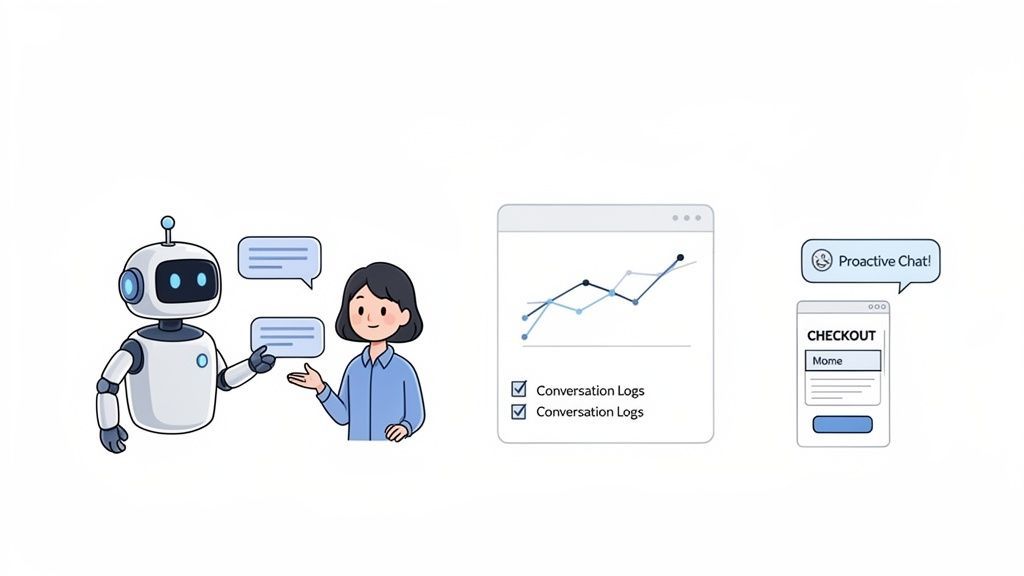
Getting your chatbot live is just the first step. To turn your chatbots customer service from a neat feature into an engine for growth, you need to manage it like a star employee. That means constantly refining its performance, knowing its limits, and using it to guide customers toward a sale.
Think of your chatbot’s launch as its first day on the job. It has all the training you’ve given it, but real-world experience is what turns good into great. This means getting into a rhythm of listening, learning, and improving to make sure it’s always delivering a brilliant customer experience.
Create a Smart Escalation Plan
Here’s a hard truth: even the best AI doesn’t know everything. And there’s nothing more frustrating for a customer than getting stuck in a loop with a bot that can’t help. That's why a smart escalation plan isn't just a nice-to-have; it's absolutely critical.
This isn’t about the chatbot failing. It's about designing a system that’s smart enough to recognise its own limitations and call for backup when needed. You need to set clear rules for when a conversation gets handed over to a human, ensuring complex or high-value queries get the personal touch they deserve.
Excellent triggers for a human handover include:
- Signs of Frustration: The chatbot should be able to spot negative sentiment. If a customer uses words like "useless," "frustrated," or "this isn't working," it’s time for a person to step in.
- Repeated Questions: If someone asks the same thing three times in a row, the bot clearly isn't getting it. That’s an immediate flag for human intervention.
- Complex Scenarios: Queries that involve multiple issues, like a damaged item in a delayed order, require human creativity and problem-solving.
- High-Value Carts: A customer with a shopping cart over £500 is on the verge of a big purchase. Escalating them to a human sales associate for a premium, personal touch can be the difference between a sale and an abandoned cart.
This seamless handover is the safety net that keeps customer satisfaction high. It gives you the efficiency of automation without sacrificing the irreplaceable value of human empathy.
Use Analytics to Continuously Improve
Your chatbot's conversation logs are a goldmine of raw, unfiltered customer feedback. Diving into these analytics is like listening in on every conversation happening on your shop floor. It shows you exactly what your customers are asking, where they're getting stuck, and what information they can't find.
Treat your conversation logs as a direct feedback channel. By analysing frequently asked questions that your chatbot fails to answer, you can identify critical knowledge gaps in its training.
For example, if you see dozens of customers asking, "Are your products vegan-friendly?" and the bot has no answer, that's your cue. You can add this information directly to its knowledge base, instantly making it smarter. This proactive approach turns every failed query into an opportunity to improve. It’s one of the core customer service best practices that applies to both your AI and human teams.
Master Proactive Engagement
A great sales assistant doesn't just stand by the till. They approach customers, offer help, and guide them. Your chatbot should do the same. Instead of just sitting there waiting for a question, you can set it up to proactively start conversations on key pages to drive engagement and boost sales.
Proactive Engagement Strategies:
- On High-Intent Pages: Have your chatbot pop up on product pages where a customer has been browsing for more than 30 seconds. A simple, "Got any questions about this item?" can kickstart a valuable conversation.
- At the Checkout: Cart abandonment is the silent killer of e-commerce profits. A chatbot that appears on the checkout page can resolve last-minute questions about shipping or returns that might otherwise make someone leave. Understanding how users behave is key, and you can learn how to measure customer engagement to fine-tune these triggers.
- For Returning Visitors: Greet customers who’ve been to your store before with a personalised message. Something like, "Welcome back! Can I help you find what you're looking for today?" makes the experience feel less robotic and more personal.
By putting these practices into play, you’ll ensure your chatbot isn't just a cost-saving tool, but an active contributor to your store's growth and profitability.
Choosing the Right Chatbot Solution for Your Store
Not all chatbots are created equal, and picking the right one for your Shopify store is a big decision. Think of it like hiring for your team—you wouldn't hire a part-time receptionist to do a senior salesperson's job. The chatbot market is just as varied, with everything from simple message-takers to fully autonomous AI agents.
Getting this choice right is crucial. The wrong tool leads to frustrated customers and wasted money, but the right one can become a cornerstone of your sales and support, working for you around the clock.
Differentiating Basic Widgets from True AI Agents
First, you need to understand the huge difference between a simple live chat widget and a genuinely autonomous chatbots customer service solution. A basic tool, like the standard Shopify Inbox, is really just a digital walkie-talkie. It lets you talk to customers in real-time, but it’s completely dependent on you or your team being there to type out a reply.
An autonomous AI agent, on the other hand, is a completely different beast. This is a tool that thinks for itself.
A true AI sales and support agent doesn’t just pass messages along; it understands customer intent, integrates with your store's live data, and resolves queries on its own, 24/7. It's the difference between having a phone line and having a self-sufficient employee.
This distinction is everything. A simple live chat might be free, but its value disappears the moment you step away from your keyboard. An AI agent works tirelessly, answering questions and driving sales even while you sleep.
To help you see the difference in practice, here’s a quick comparison of what you get at each level.
Chatbot Solution Comparison for Shopify Merchants
When you're looking at different options, it's easy to get lost in feature lists. This table breaks down what you can realistically expect from the main types of chat solutions available to Shopify merchants. It highlights the gap between basic tools and ecommerce-specific AI that's built to sell.
As you can see, a solution designed specifically for ecommerce isn't just a chatbot—it's an automated member of your team that understands how your business works from day one.
Core Evaluation Criteria for Shopify Merchants
When you're comparing options, don't get distracted by flashy tech that doesn't actually solve a problem for your store. Your evaluation should centre on a few key areas that directly impact your operations and how customers feel about your brand.
Here are the non-negotiables for any Shopify store:
- Ease of Shopify Integration: How deeply and seamlessly does it connect to your store? A top-tier solution should offer a one-click install that instantly syncs your entire product catalogue, inventory, and company policies without any manual data entry.
- Depth of Data Synchronisation: Can the bot access real-time stock levels, order statuses, and product details? This is what allows it to answer valuable, specific questions like, "Is this available in a size 10?" or "Where is my order?" without needing a human to look it up.
- Branding and Customisation: You need a tool that looks and feels like a natural part of your brand. Look for options that let you easily customise colours, upload your logo, and—most importantly—adjust the bot's tone of voice to match your brand's personality.
Understanding Pricing Models
Finally, you need to scrutinise the pricing. Many chatbot providers use unpredictable, per-conversation pricing models that can get very expensive, very quickly as your store grows. This model essentially penalises you for success; the more customers you attract, the higher your bill.
A much more scalable and budget-friendly alternative is a flat-rate subscription. This gives you unlimited conversations for a fixed monthly cost, letting you scale your support without facing surprise charges. For a growing DTC brand, this predictable pricing makes it far easier to manage your finances while still offering world-class, automated chatbots customer service.
Common Questions About Ecommerce Chatbots
As a Shopify merchant, you’ve probably seen chatbots pop up everywhere and wondered if they’re the right move for your store. It’s natural to have questions. Will it cost a fortune? Is it a technical nightmare? And can a bot really represent my brand properly?
Let’s tackle the most common concerns head-on to help you figure out if a chatbot is a good fit for your business.
Will a Chatbot Make My Customer Service Feel Impersonal?
This is a big one, and a totally valid worry. But here’s the thing: modern AI chatbots are designed to feel anything but impersonal. The secret is in the customisation. You can fine-tune the bot's tone of voice to perfectly match your brand, whether you're polished and professional, or a bit more friendly and fun.
What really makes a chatbot personal, though, is its connection to your store’s data. It can pull up a customer's order history in a split second or check real-time stock levels to give genuinely helpful answers. By handling all the routine questions 24/7, your human team is freed up to give amazing, high-touch support for the complex stuff. It actually raises the quality of your service across the board.
One of the biggest myths is that bots are cold and robotic. The truth is, by giving instant, accurate answers around the clock, a chatbot shows customers you value their time — and that’s a powerful way to deliver a personal experience.
How Much Technical Knowledge Do I Need?
If you’re using a tool built specifically for Shopify, you need pretty much zero technical skill. The days of needing a developer to get a chatbot up and running are long gone. The whole process is now built for busy founders, not coders.
Most of these tools are designed for a ‘one-click install’ right from the Shopify App Store. Once you click install, the system automatically syncs with your product catalogue, your policies, and your pages. You manage everything from a simple dashboard where you can:
- Tweak its appearance with your brand colours and logo.
- See what your customers are asking by reviewing conversation histories.
- Upload new FAQs or policies without touching a single line of code.
Can a Chatbot Actually Help Increase My Sales?
Absolutely. A well-designed ecommerce chatbot isn't just a support agent; it’s a sales assistant working for you 24/7. It’s there to actively turn browsing sessions into purchases. We see that around 80% of routine inquiries can be handled by a good chatbot, which frees up your team to focus on high-value sales conversations.
A chatbot drives sales by engaging shoppers with the kind of consultative selling you’d get in a physical shop. It can ask about their preferences, guide them to the right products, and even suggest complementary items to bump up your average order value (AOV). It also plays a huge role in cutting down cart abandonment by answering those last-minute questions that pop up on the checkout page, directly boosting your bottom line.
Ready to see how an AI assistant can transform your Shopify store? Get started with Marvyn AI for free and turn your customer service into a revenue-generating machine. Install it from the Shopify App Store in just one click.