How to Improve Ecommerce Customer Experience A Shopify Playbook
Improving your customer experience is all about making every single interaction feel effortless, personal, and trustworthy. It’s not just one thing. It's about a lightning-fast website, making products a breeze to find, offering instant support when someone’s stuck, and keeping the conversation going long after they’ve clicked “buy”.
Why Your Customer Experience Is Costing You Sales
Let's get straight to it: a clunky, frustrating customer experience is a silent revenue killer for any Shopify brand. We’re living in an age of instant gratification. Even the smallest bit of friction—a slow-loading page, confusing navigation, or a delayed answer to a simple question—is enough to send a potential customer packing. For good.
This isn't just about losing one sale. It's about losing the entire lifetime value of a customer who could have become a loyal fan.
The modern shopper’s patience is razor-thin. They expect a journey that feels natural and helpful, from the very first click to the final delivery notification. When you don't meet that expectation, the consequences are immediate and expensive.
The Real Cost of a Poor Experience
A bad experience doesn't just end in an abandoned cart; it creates a ripple effect that can seriously damage your brand. The data backs this up. In 2025, a massive 47% of UK consumers said they had a poor customer service experience in the last year. It takes, on average, just 2.3 bad interactions before a customer complains publicly.
What do they actually want? The research shows it's timely responses (a priority for 54%) and human-like interactions (51%). This highlights a huge gap in how many stores are currently set up.
The key takeaway here is that doing nothing is incredibly expensive. Every moment of friction you remove from the customer journey translates directly to your bottom line. A seamless experience isn't a "nice-to-have"; it's a core driver of both conversions and long-term loyalty.
To make this actionable, we can break the work down into four core pillars.
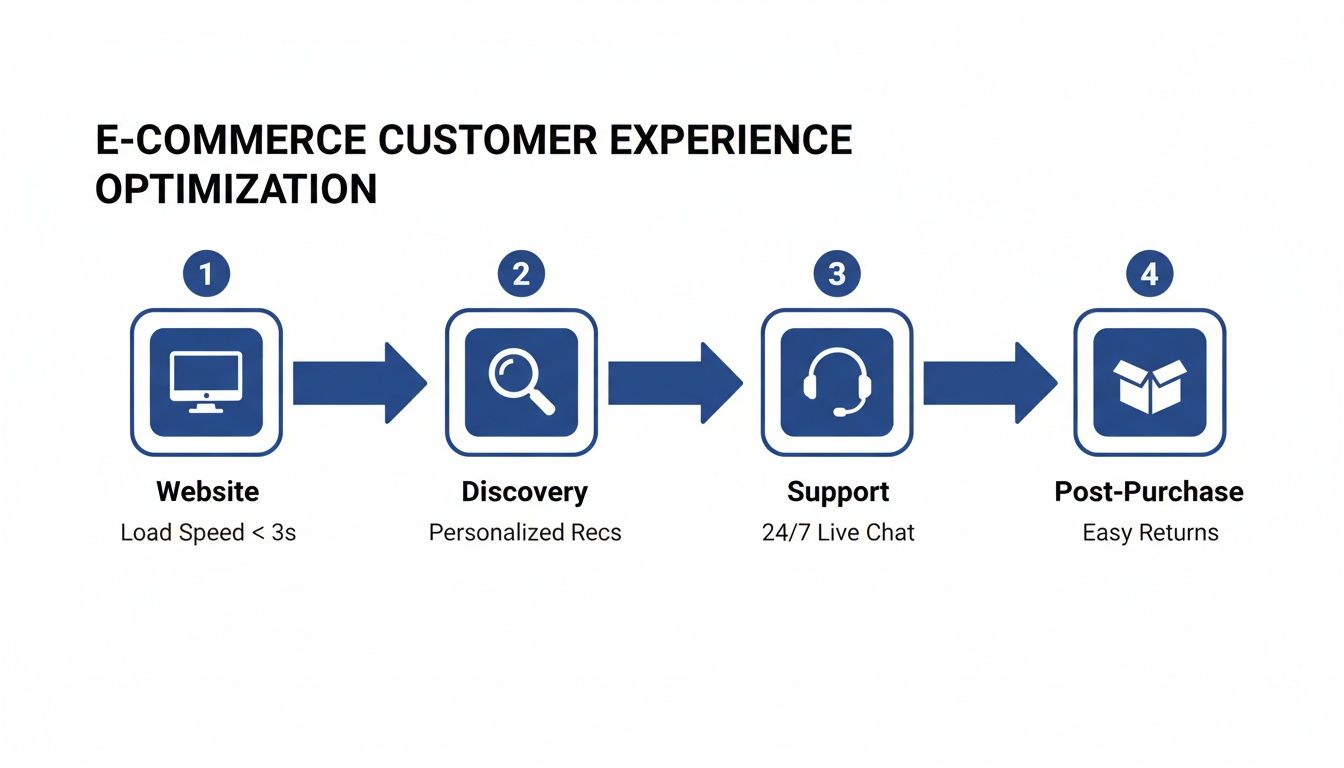
This process shows that you can’t just fix one area and call it a day. A great customer experience is holistic. It starts with your website's foundation and flows through discovery, support, and the crucial post-purchase phase. Each stage builds on the last to create a journey that feels cohesive and genuinely positive for the shopper.
To give you a clearer picture, here’s a breakdown of where to focus your attention.
Core Pillars of a Modern Ecommerce Customer Experience
Focusing on these areas will have a direct and measurable impact on your store's performance.
A Path to Turning Friction Into Loyalty
Fixing your customer experience doesn't have to be some monumental, year-long project. By focusing on these key domains, you can make big improvements that drive immediate results.
- A High-Performance Website: Your site has to be fast, mobile-friendly, and dead simple to navigate. This is the bedrock. Everything else is built on it.
- Intuitive Product Discovery: Shoppers need to find what they want, fast. That means logical collections, smart search, and visuals that sell.
- Instant, Intelligent Support: Providing 24/7 answers to common questions with an autonomous AI chatbot frees up your team and keeps customers happy.
- A Seamless Post-Purchase Journey: The experience doesn’t end at checkout. Proactive communication about orders and returns is how you build lasting trust.
By tackling these pillars, you can directly influence your store's metrics. For a deeper look at how these improvements hit your numbers, check out our guide on https://www.marvyn.co/blog/conversion-rate-optimization-for-ecommerce.
Ultimately, the goal is to improve customer satisfaction and turn one-time buyers into customers for life.
Build a High-Performance Digital Storefront
Your website is the digital front door to your brand. Long before a customer even sees your product, they experience your site's performance. In ecommerce, a slow website isn't just an annoyance—it's the equivalent of a locked door. Every extra second a page takes to load directly increases the chances a potential buyer will simply leave.
Improving your customer experience starts with speed. Shoppers today have zero patience for lagging pages or clunky navigation, especially on mobile, where most people are browsing anyway. A high-performance digital storefront isn't a "nice-to-have"; it's the absolute foundation of a positive customer journey.
But just saying "make your site faster" is useless advice. Let's get into specific, battle-tested tactics for Shopify merchants that actually make a tangible difference.
First, Optimise Your Visuals
High-quality product images are non-negotiable, but massive, unoptimised files are one of the biggest culprits of slow load times. The goal here is simple: shrink the file size without making your photos look grainy or cheap.
Start by compressing all your product and theme images. You can do this for free with online tools like TinyPNG before you even upload them to Shopify. If you've got a huge catalogue, look into Shopify apps that can automate this, compressing new images as you add them.
Next up, make sure you’re using lazy loading. This clever technique only loads images as the user scrolls down the page, instead of all at once. For collection pages with dozens of products, this dramatically improves the initial page load time, making the whole browsing experience feel almost instant. Most modern Shopify themes have this feature built-in.
Pick a Theme Built for Speed
Not all Shopify themes are created equal. Some are bloated with unnecessary code and features that will bog down your site from day one. When you’re picking a new theme or thinking about switching, performance has to be your top priority.
- Look for speed-optimised themes: Developers who focus on performance will shout about it. Read the reviews and, more importantly, check out the live demos on both desktop and mobile to see how they feel in the real world.
- Analyse your current theme: If you're not sure how your current setup stacks up, it's worth taking a closer look at your Shopify theme's specifics to spot any potential performance bottlenecks.
- Cull your apps: Every single app you install adds more code to your store, which can drag down your speed. Do a regular audit of your installed apps and be ruthless—if you're not actively using it, delete it.
A fast, lightweight theme is the chassis of your ecommerce vehicle. You can have the most beautiful design and compelling products, but if the underlying framework is slow, you'll never get up to speed.
When you combine image compression, lazy loading, and a performance-first theme, you create a snappy, enjoyable browsing environment. This encourages people to explore instead of getting frustrated and leaving. You’re removing the very first point of friction in their journey.
Make Product Discovery Effortless
Once your site is fast, the next challenge is helping shoppers find what they’re looking for. A confusing site structure is just as frustrating as a slow one. Your goal is to create a dead-simple path from the homepage to a product page.
This starts with logical collections. Group your products in ways that make sense to your customers, not just your inventory system. Think about how a real person would shop for your items. For a clothing brand, this means creating collections for "New Arrivals," "Dresses," and "Summer Essentials," not just using your internal stock categories.
Then, deploy smart search and filtering. A powerful search bar is a must-have, but filters are what really let shoppers drill down into massive collections to find that one perfect item. Make sure your filters include all the key attributes people care about:
- Size
- Colour
- Price range
- Material
- Customer rating
Finally, use visuals that actually tell a story. This means high-resolution images from multiple angles, lifestyle shots showing the product in use, and even short product videos. These elements help customers visualise the product in their own lives, answering questions before they're even asked and building the confidence they need to actually click "Add to Cart."
A fast, functional website is just the starting point. A truly great customer experience makes every shopper feel seen and understood. We've moved way beyond purely transactional e-commerce; modern customers want to build genuine relationships with the brands they buy from.
This means using the data you already have—from their first click to their latest purchase—to craft shopping journeys that feel less like a generic website and more like a conversation with a helpful expert.
The appetite for this is clear. In the UK, personalisation is a huge deal. 23% of consumers are happy to share personal data if it means getting a more tailored shopping experience. And since a whopping 75% of UK shoppers meticulously compare prices and reviews before buying, making your store feel relevant often matters more than having rock-bottom prices.
For Shopify merchants, this isn't about guesswork. It’s about using the information at your fingertips to create dynamic, relevant interactions that guide customers and build trust.
Make Your Homepage Dynamic
Your homepage should never be a static billboard. It's your most valuable digital real estate, and it needs to adapt to who is visiting. A first-time visitor has completely different needs than a loyal, returning customer.
Think about it like this:
- For a new visitor: Your homepage could feature a prominent "Best Sellers" collection, an introductory offer for signing up to your newsletter, and testimonials that build immediate trust.
- For a returning customer: The homepage could dynamically show "New Arrivals" in categories they’ve previously bought from, highlight their loyalty points balance, or display "Recently Viewed" items to make it easy to pick up where they left off.
This level of customisation makes the shopper feel recognised. It shows you're paying attention to their individual journey, which is a powerful way to make your brand stick.
Offer Smart Product Recommendations
Let's be honest, generic "You might also like" sections are table stakes. To truly impress, your product recommendations need to feel like they’re coming from a personal shopper who actually gets the customer's style and needs.
This is where you combine browsing history, purchase data, and even items left in the cart to provide truly smart suggestions. If a customer just bought a waterproof jacket, recommend matching trousers or a cleaning spray, not another jacket. If they’ve been browsing a specific brand of running shoes, showcase other gear from that same brand.
The goal is to be helpful, not just to upsell. Good recommendations solve a problem for the customer—finding complementary items, discovering products they would have otherwise missed, or completing a set. This builds trust and naturally leads to a higher cart value.
Use Customer Data to Power Support
Personalisation shouldn't stop at your product pages; it needs to be woven directly into your customer support. This is where an advanced AI assistant can be a total game-changer, transforming a simple support query into a guided selling opportunity.
When an AI assistant has access to both your product details and a customer's profile, it can move from simply answering questions to providing consultative advice.
For example, if a customer asks, "Do you have any vegan-friendly skincare for sensitive skin?" the AI can check their past purchases and recommend specific products that fit their criteria and complement what they already use. This turns a routine support interaction into a revenue-driving moment and can significantly increase your average order value.
Create Segmented Email and SMS Flows
Your communication strategy is a core part of the personalised journey. Sending the same generic marketing blast to your entire list is a one-way ticket to high unsubscribe rates. Instead, you need to segment your audience based on their behaviour and history to send messages that feel uniquely relevant.
- Welcome Series: Create a flow for new subscribers that introduces your brand story and highlights best-selling products.
- VIP Customers: Reward your most loyal shoppers with exclusive early access to sales or special discount codes.
- Abandoned Cart: Remind shoppers what they left behind, maybe even including customer reviews for those specific products to build confidence.
To really pull this off and create seamless interactions across all these touchpoints, it’s worth implementing a robust omnichannel customer service strategy. This ensures that whether a customer is on your site, reading an email, or chatting with support, the experience feels consistent and personal every single time.
Deploy Instant Support with an Autonomous AI Assistant
Let's be honest: your customers shop on their schedule, not yours. That means a potential buyer from another time zone might have a make-or-break question at 3 AM your time. If they’re forced to wait for your support team to clock in, that sale is gone. Forever.
This is the reality for growing brands. How do you give every shopper an instant, genuinely helpful answer without hiring a massive, round-the-clock global team?
The answer is a truly autonomous AI assistant. Forget the clunky, rule-based chatbots of a few years ago that could barely handle "What's your return policy?". We're talking about a smart system that understands context, knows your products inside and out, and can solve customer problems instantly, 24/7.
An autonomous AI like Marvyn AI makes this kind of instant, multilingual support a practical reality for any Shopify store. It provides immediate, accurate answers right when your customers need them, turning moments of friction into confident sales.
Go Live in Minutes, Not Months
Not long ago, setting up advanced support was a huge, expensive headache. The beauty of modern AI is how ridiculously simple and fast it is to get started. With a platform like Marvyn AI, the process is dead simple for any Shopify merchant.
- One-Click Install: You just install the app from the Shopify App Store. No code, no developers, no fuss.
- Automatic Data Sync: The second it’s installed, the AI automatically pulls in your entire product catalogue, collections, website pages, and policies (like shipping and returns).
- Immediate Knowledge: Because of this instant sync, the AI is ready to go from day one. It doesn't need weeks of you manually "training" it. It already knows your business.
This hands-off setup means you can have a fully functioning, 24/7 support agent live on your site in a matter of minutes. It’s a massive upgrade to your customer service without touching your schedule or your budget.
From Answering Questions to Driving Sales
Here's where it gets interesting. The real power of a modern AI assistant is its ability to do more than just answer "Where is my order?". It acts as a skilled digital sales associate, guiding customers through their buying journey. Because it has access to your entire product catalogue, it can give consultative recommendations.
Imagine a shopper asks, "I need a gift for my partner who loves hiking."
Instead of spitting out a link to your "Outdoor" collection, a smart AI will ask clarifying questions, just like a great salesperson would:
- "That's a great idea! What's your budget?"
- "Are they an experienced hiker or just starting out?"
- "Are they more in need of apparel, like a waterproof jacket, or gear, like a durable backpack?"
Based on the replies, the AI can then suggest specific products directly from your catalogue, complete with links to their pages. This transforms a basic support query into a guided selling experience that helps the customer and actively drives revenue. This is a critical function that traditional support teams just can't scale. Want to go deeper? We have a complete guide on how AI sales agents are changing ecommerce.
A truly autonomous AI doesn't just cut down your support tickets; it becomes a core part of your sales engine. It engages shoppers, understands what they're looking for, and recommends the right products, helping to slash cart abandonment and boost average order value.
Scale Globally Without Scaling Your Team
One of the biggest growing pains for any brand is supporting customers across different languages and time zones. Hiring a multilingual team that offers 24/7 coverage is phenomenally expensive and a logistical nightmare.
This is where autonomous AI provides an unbeatable advantage. A tool like Marvyn AI can handle an unlimited number of chats at the same time and communicate fluently in over 80 languages.
Whether a customer from Germany asks about shipping times in German or a shopper in Japan has a question about product materials in Japanese, they get an instant, accurate answer in their native language.
This ability to deliver a consistently brilliant experience to every single customer, no matter their location or language, isn't a luxury for giant corporations anymore. By automating the overwhelming majority of front-line questions—often resolving over 70% of all incoming chats—the AI frees up your human team to focus on what matters: strategy, marketing, and the truly complex issues that need a human touch.
Perfect Your Checkout and Post-Purchase Flow
A brilliant shopping journey can completely fall apart at the final hurdle. You can spend all your time and money on site speed, personalisation, and instant support, but it's all wasted if the checkout is clunky or the post-purchase experience feels like an afterthought. This is where you secure the sale and, just as importantly, solidify trust.
Improving your ecommerce customer experience really hinges on making these final steps feel seamless, secure, and reassuring. The checkout isn't just a transaction; it's the start of what you hope will be a long-term relationship.

Design a Frictionless Checkout
The main goal of your checkout page is simple: get out of the customer's way. Every extra field, unnecessary click, or moment of confusion dramatically increases the chance they'll just give up and leave. Your mission is to make paying feel effortless.
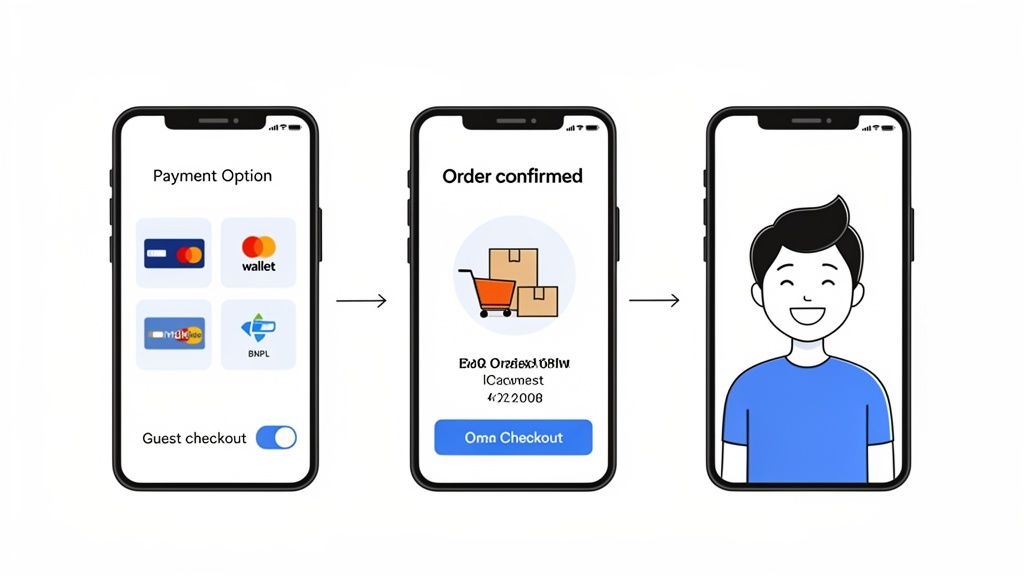
- Offer Guest Checkout: Forcing people to create an account is a notorious conversion killer. Always provide a prominent guest checkout option to capture sales from first-time or time-pressed shoppers.
- Embrace Payment Flexibility: You have to cater to modern buying habits. That means offering a variety of payment gateways, including standard credit cards, digital wallets like Apple Pay and Google Pay, and especially Buy Now, Pay Later (BNPL) options like Klarna or Afterpay, which are crucial for higher-priced items.
- Optimise for Mobile: Your checkout must be flawless on a small screen. Think large form fields, easy-to-tap buttons, and a design that doesn’t require any awkward pinching or zooming.
By focusing on these three areas, you eliminate the most common points of friction. If you want to dive deeper into this, you can learn more about how to reduce cart abandonment on your Shopify store with some really actionable strategies.
Build Trust with Proactive Communication
The moment a customer clicks "Confirm Purchase," a new kind of anxiety kicks in. Did it work? Is this a scam? When will my order arrive? Silence from a brand at this stage is deafening and immediately starts to erode trust.
Proactive communication is the cure. It’s all about keeping the customer in the loop every step of the way, turning that uncertainty into genuine excitement.
- Crystal-Clear Order Confirmation: Immediately send a detailed confirmation email and, if you can, an SMS. It should include the order summary, total cost, and an expected delivery window.
- Timely Shipping Updates: Don't wait for the customer to ask, "Where is my order?" Send automated alerts when the order is packed, when it ships, and when it's out for delivery.
- Easy-to-Access Tracking: Make that tracking link impossible to miss in all your communications. A simple "Track My Order" button builds immense confidence.
The post-purchase experience is your single best opportunity to turn a one-time buyer into a repeat customer. Every reassuring email or SMS update reinforces their decision to trust you and sets the stage for their next purchase.
Turn Returns into a Brand-Defining Positive
Let's be honest, no one likes dealing with returns. But a difficult returns process can permanently damage your brand's reputation. On the flip side, making returns easy and stress-free can be a powerful driver of loyalty. A customer who has a positive return experience is far more likely to shop with you again.
The first step is a clear, simple policy written in plain English, not legal jargon. Make sure it's easy to find on your site and clearly answers key questions like the return window, any costs, and the process itself.
The second, and more powerful, step is automating the process with an AI assistant. An AI chatbot like Marvyn AI can handle return requests 24/7. A customer can simply open the chat, state they want to start a return, and the AI will guide them through the process instantly, providing a shipping label without any human getting involved. This transforms a potential negative into an incredibly efficient and positive interaction, solidifying their trust and making future sales much more likely.
Got Questions About Improving Your CX? We've Got Answers.
Thinking about a full-on customer experience overhaul can feel overwhelming. It’s a big project. But like any big project, breaking it down into manageable pieces is the key.
Here are the answers to the most common questions we hear from Shopify merchants getting started on this path.
I’m on a Tight Budget. Where Do I Even Start?
If you're a small brand or a solo founder where every penny counts, your first move is to focus on the highest-impact, lowest-cost wins. Before you spend a single pound, make sure your digital storefront is clean, fast, and dead simple to navigate. No one sticks around on a slow, confusing site.
Your next best step? Get an autonomous AI assistant on your site. Modern tools, including our own Marvyn AI, have free plans that can immediately automate over 70% of your most common support questions. That one move gives you 24/7 support, frees up your time, and stops you from losing sales to simple, unanswered queries—all without touching your budget.
For a small team, time is your most valuable currency. Automating repetitive support tasks is the fastest way to reclaim hours every single week, letting you focus on the marketing, product development, and growth activities that actually move the needle.
Once that foundation is set, you can turn to other low-cost wins like optimising your product images for speed and making your return policy crystal clear. These basics are crucial for improving the ecommerce customer experience without a big financial investment.
How Do I Use AI Without Sounding Like a Robot?
This is a really common concern, but it’s usually based on an outdated view of how modern AI actually works. The goal isn't to replace your team; it's to make them superhuman. Think of your AI as the first line of defence, instantly handling all the predictable, high-volume questions.
You know the ones:
- "Where is my order?"
- "What's your return policy?"
- "Do you ship to Australia?"
By automating these answers, the AI gives customers the help they need right away, day or night. This completely frees up your human support agents to focus on the conversations that genuinely need a human touch—like calming a particularly upset customer, discussing a large B2B order, or giving detailed styling advice. Those are the interactions that build real relationships.
A well-designed AI also knows its limits. When a conversation gets too complex or a customer flat-out asks for a person, the system should seamlessly hand over the entire chat transcript to a live agent. It’s the perfect partnership: AI provides the speed and scale, while your team provides the empathy and expertise.
What Metrics Should I Track to Prove This is Working?
Improving customer experience isn't just about warm, fuzzy feelings; it's about driving tangible business results. To know if your efforts are actually paying off, you need to track the right numbers.
Here are the key performance indicators (KPIs) you should be watching:
- Conversion Rate: This is the ultimate test. A smoother journey with fewer friction points should directly lead to more visitors clicking "buy".
- Average Order Value (AOV): With great personalisation and consultative AI support, you should see customers adding more to their carts.
- Customer Lifetime Value (CLV): A fantastic experience builds loyalty. You should see customers coming back for their second and third purchases over time.
- Support Ticket Volume & Resolution Time: As your AI deflects more routine questions, the number of tickets hitting your human team should drop dramatically. Your first-response times for the remaining tickets will get much faster, too.
By tracking these KPIs before and after you make changes, you can clearly show the financial return on your investment in customer experience. You’ll see exactly how a better journey translates to a healthier bottom line.
Ready to deliver instant, 24/7 support and turn more browsers into buyers? Marvyn AI is a fully autonomous AI chatbot that installs in one click and starts resolving over 70% of customer questions in minutes, for free.
Get Started for Free on the Shopify App Store
Related Articles

8 Powerful Example of Auto Reply Templates for 2026
Discover every example of auto reply you need. Get 8 templates for Shopify, chatbots, and more to automate support and drive sales. Updated for 2026.
Conversion Rate Optimization Checklist for Shopify in 2026
Master the conversion rate optimization checklist for Shopify in 2026. Boost sales, reduce cart abandonment, and raise AOV with 10 practical steps.

Live Chat on a Website The Ultimate Ecommerce Growth Guide
Learn how to use live chat on a website to boost sales, delight customers, and grow your ecommerce brand. Your ultimate guide to Shopify growth and CX.

Website Welcome Message: 20+ Examples & Templates (2026)
See 20+ real welcome message examples for websites, online stores, fashion boutiques, and more. Plus how to automate them with an AI chatbot.
How to Improve Ecommerce Customer Experience A Shopify Playbook
Discover how to improve ecommerce customer experience on Shopify. Our playbook covers site speed, AI support, and post-purchase strategies that drive loyalty.

7 Top Chat Bot Examples for E-commerce Success in 2026
Discover the best chat bot examples for Shopify stores. See how Marvyn AI and others automate support and drive sales with real-world use cases.