Ecommerce Marketing Services for Shopify & DTC
Your Shopify dashboard finally looks healthy. Traffic is up, add-to-carts are coming in, and your campaigns are starting to work.
Then the operational mess hits.
Customers ask whether a product fits their use case. Someone wants shipping clarity before buying. Another shopper needs help comparing two variants. Your abandoned carts pile up beside DMs, email replies, live chat pings, and return-policy questions. The same growth work that should feel exciting starts eating your day.
That is where most founders misread ecommerce marketing services. They think they are buying traffic. In practice, they are buying a system that has to attract the right people, handle their objections, convert them, and keep them coming back without breaking the business in the process.
Why Scaling Your DTC Brand Feels Impossible
A lot of Shopify founders hit the same wall.
At first, the work is straightforward. You launch the site, fix the product pages, post on social, maybe run a few ads, and chase early sales however you can. Then something clicks. A campaign lands. A creator mentions you. Email starts working. Traffic rises.
And your day gets worse.
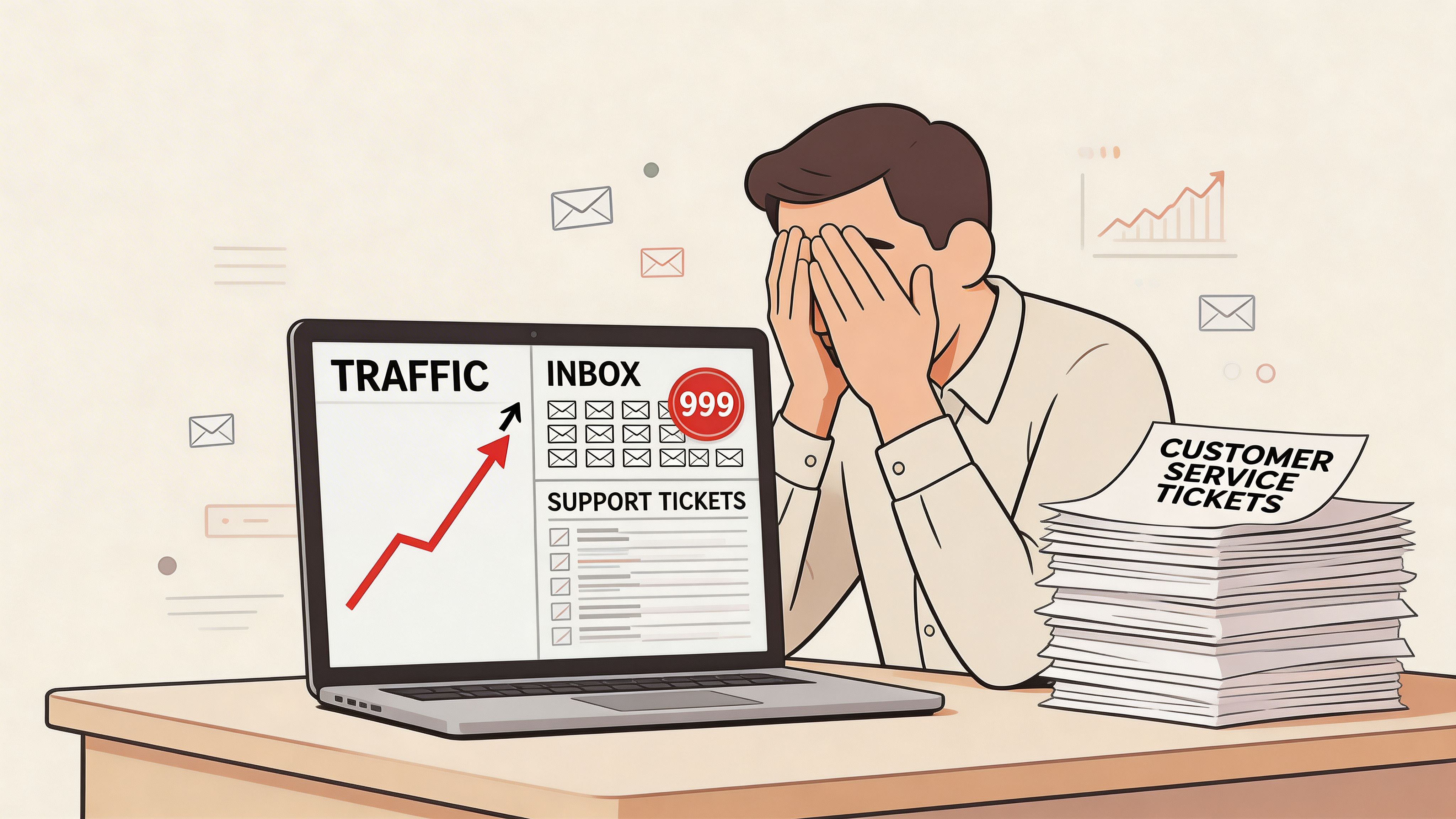
Growth creates operational drag
The problem is not only getting attention. The primary problem is handling what follows.
As noted by Zest Logic, as marketing spend increases and traffic grows, support ticket volume scales proportionally, which creates a support cost paradox for small merchants who do not have a proper service team in place (Zest Logic). In plain English, better marketing can make your business less manageable if your backend cannot absorb the demand.
That shows up in familiar ways:
- Pre-sale questions stack up: Shoppers want help choosing size, model, bundle, or subscription option.
- Response delays kill intent: A buyer ready at 9 pm is gone by morning.
- Founders become the help desk: Instead of working on growth, you spend hours answering repeat questions.
- Marketing performance gets distorted: Ads look weaker than they are because shoppers hit friction after the click.
This is why many stores do not need “more marketing” in the generic sense. They need the right mix of ecommerce marketing services, tied to the actual buying journey.
Traffic without handling capacity is expensive
A founder might think the answer is to push harder on Meta, Google, influencers, or email. Sometimes that works for a month. Then support load, fulfilment pressure, and conversion friction catch up.
Tip: If your best campaign days are also your most chaotic operational days, your bottleneck is not awareness. It is conversion handling.
In practice, profitable growth comes from connecting acquisition with store experience, customer support, and retention. That is why strong operators treat marketing less like a set of disconnected channels and more like a coordinated revenue engine.
If you want a practical example of where many stores leak revenue before adding more spend, this guide on increasing Shopify sales is worth reviewing alongside your current funnel.
The Four Pillars of an Ecommerce Marketing Engine
The simplest way to understand ecommerce marketing services is to think like a builder.
You would not put a roof on a house before the foundation is stable. You would not hire electricians before an architect has drawn the plan. Ecommerce works the same way. Random tactics create noise. Connected systems create revenue.
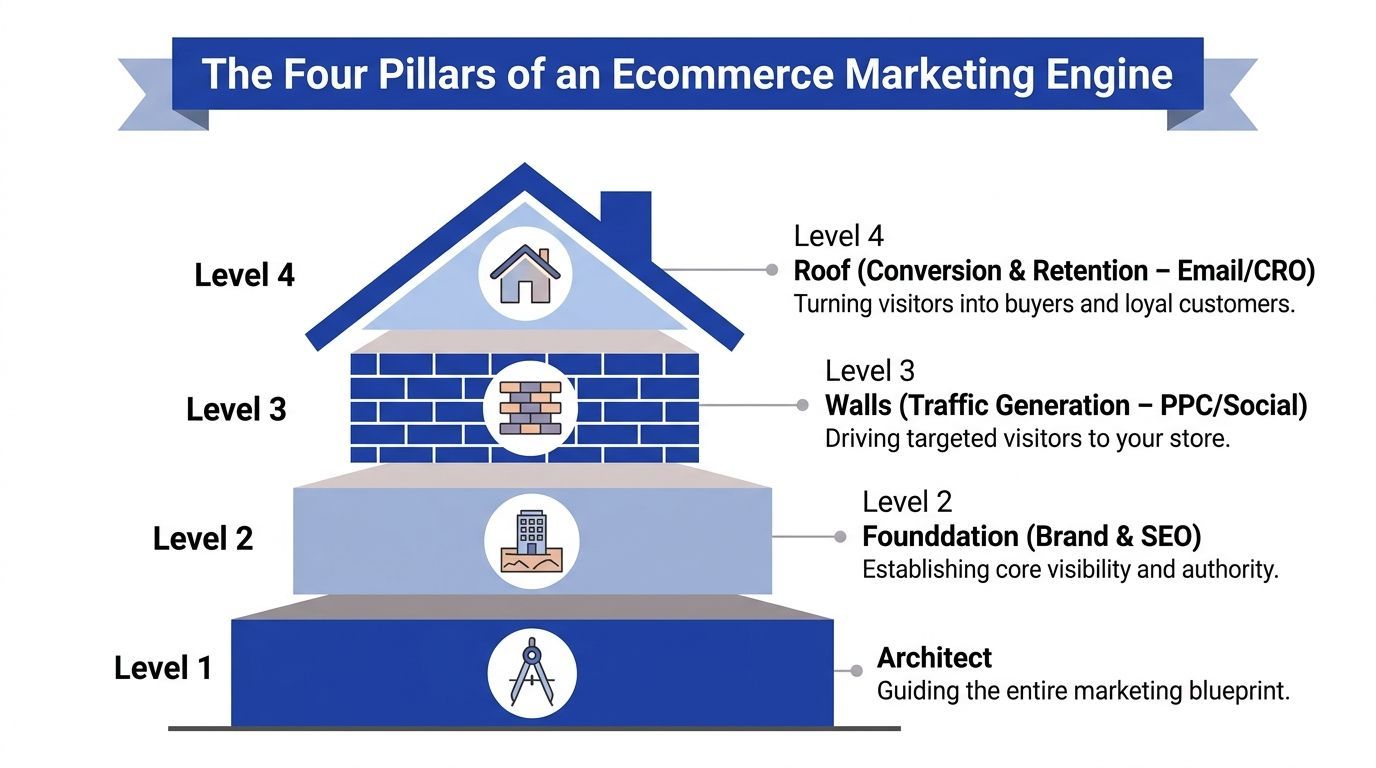
Pillar one attracts the right visitors
This is your visibility layer.
It includes SEO, Google Shopping, paid search, paid social prospecting, influencer seeding, content distribution, and product feed management. The job here is not to get “more traffic” in the abstract. The job is to bring in people who have a plausible reason to buy.
A lot of weak agencies fail at this stage because they optimise for clicks, not fit. Cheap traffic looks busy in a report and useless in Shopify.
Pillar two engages shoppers before they bounce
Once someone lands, your store has seconds to orient them.
This layer includes onsite messaging, landing page structure, product page clarity, navigation, FAQs, merchandising, social proof, and chat. Good engagement reduces confusion. Bad engagement forces the customer to do interpretive work you should have done for them.
Think of this as the shop assistant layer. In a physical store, someone helps the buyer find the right aisle, compares options, and answers objections. Online, your site has to do that job.
Pillar three converts interest into orders
Sales are won or lost here.
Conversion services usually include CRO, checkout optimisation, cart recovery, remarketing, offer testing, bundle strategy, upsell paths, and funnel diagnostics. Here, the store is no longer asking, “Can we get attention?” It is asking, “Why are interested shoppers still not buying?”
A useful way to frame it is this:
If your conversion rate feels stubborn, this is the pillar to inspect first. This practical guide to conversion rate optimisation for ecommerce is a good companion when reviewing your store.
Pillar four retains and compounds revenue
Retention is where margins often improve.
This includes email, SMS, loyalty, subscriptions, post-purchase flows, win-back campaigns, review generation, and customer segmentation. Many founders underinvest here because retention feels less exciting than acquisition. That is a mistake. The store that can monetise existing customers has more room to spend on growth.
Key takeaway: The strongest ecommerce marketing services do not operate as standalone add-ons. They connect attraction, engagement, conversion, and retention into one operating model.
A Practical Guide to Core Marketing Services
When founders compare ecommerce marketing services, they often bundle everything together and call it “marketing”. That leads to poor hiring decisions because each service solves a different commercial problem.
A Shopify store usually needs a few of these at once, but not in equal measure.
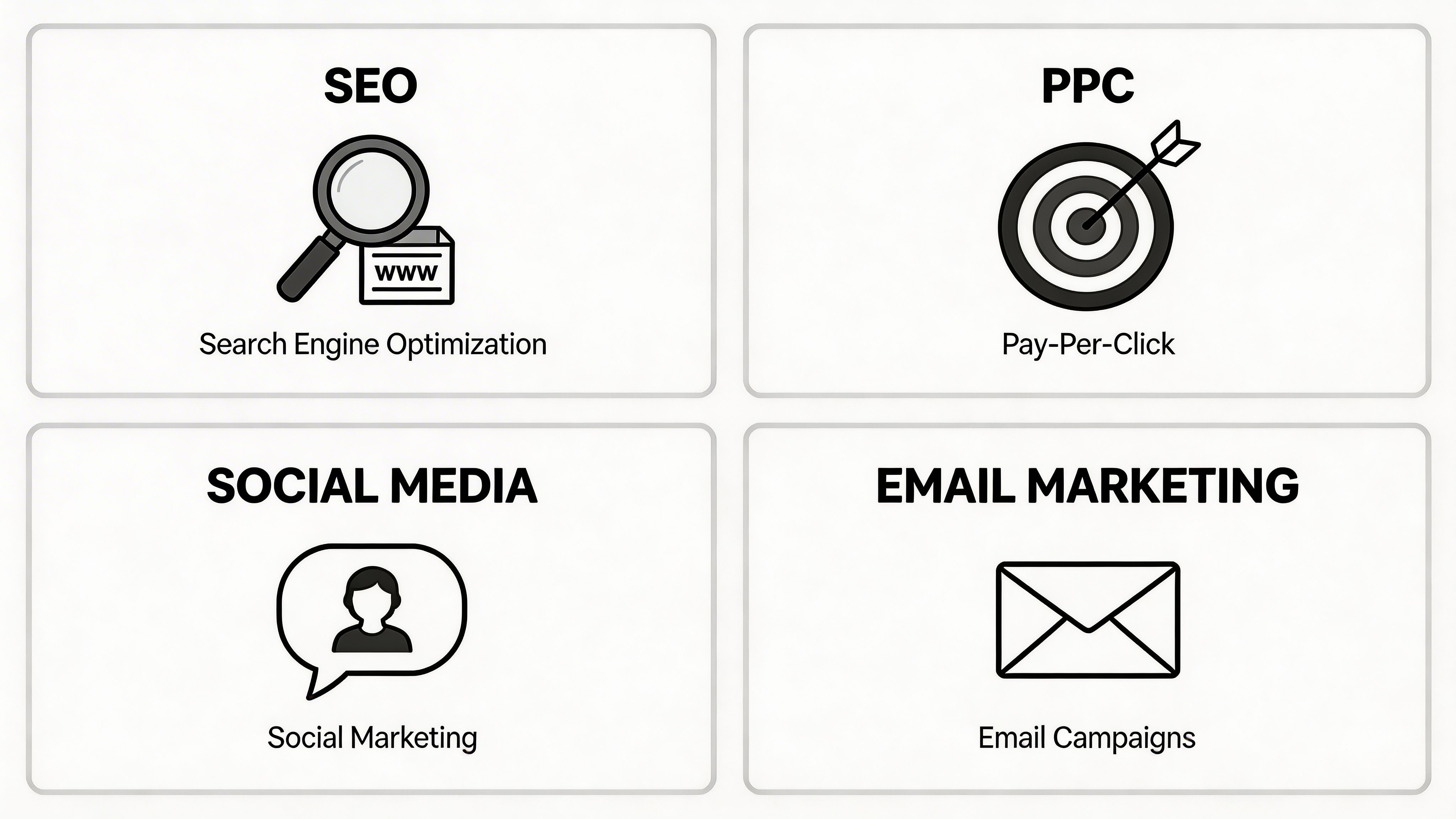
SEO for durable demand capture
SEO helps your store appear when shoppers search for products, categories, comparisons, and buying questions.
For ecommerce, this usually means category page optimisation, product page copy, internal linking, technical cleanup, collection structure, schema implementation, and content that supports commercial intent. Good SEO compounds slowly. Bad SEO creates lots of blog posts that never sell anything.
The practical trade-off is speed versus staying power. Paid media can switch on tomorrow. SEO usually takes longer, but it can lower your dependence on paid acquisition over time.
What to track
- Qualified organic traffic: Not all organic traffic matters. Category and product page visits matter more than vanity blog sessions.
- Revenue by landing page: You want to know which pages attract buyers, not just readers.
- Search visibility for commercial terms: Especially around category and product intent.
How it is commonly priced
- Monthly retainer: Best when technical, content, and ongoing optimisation are all included.
- Project fee: Common for migrations, audits, or site architecture work.
- Hybrid model: Audit first, then monthly support.
PPC for controlled, immediate demand
PPC includes Google Ads, Shopping campaigns, Performance Max, Meta Ads, and remarketing. This is the fastest lever if you need traffic now.
The trade-off is simple. PPC gives speed and control, but it punishes weak product pages and poor economics. If your margin is thin, your average order value is low, and your site does not answer objections well, paid traffic will expose that immediately.
What to track
- ROAS: Useful, but never enough on its own.
- CAC by campaign type: Prospecting and remarketing should not be blended into one story.
- Profit contribution: Some campaigns “win” on platform metrics while hurting the business.
- Search term quality and feed health: Especially for catalogue-led stores.
Pricing models you will see
- Percentage of ad spend: Common, but it can misalign incentives if the agency gets paid more by spending more.
- Flat retainer: Cleaner for stores with stable budgets.
- Retainer plus setup fee: Typical when feeds, tracking, and account rebuilds are involved.
Email and SMS for profit recovery
This is one of the most impactful service categories for ecommerce brands because it works on owned audience rather than rented reach.
In UK ecommerce, email marketing delivers an average ROI of £42 for every £1 spent, and advanced segmentation and personalisation can boost open rates by 20 to 30 percent and click-through rates to 3 to 5 percent according to Saras Analytics (Saras Analytics on ecommerce data management). That is why experienced operators treat email as a commercial channel, not just a newsletter.
The stores that do this well segment by behaviour. They separate first-time buyers from repeat buyers, non-buyers from high-intent browsers, and one-time discount shoppers from customers likely to buy full price.
What to track
- Revenue per recipient
- Flow performance by stage: Welcome, browse abandonment, cart abandonment, post-purchase, win-back
- List quality: Growth means little if intent is weak
- Repeat purchase behaviour: Email should support retention, not just one-off blasts
If you are trying to connect customer data, list quality, and buying behaviour, your CRM setup matters more than many agencies admit. This primer on CRM in ecommerce is useful before you outsource lifecycle marketing.
Social media management for trust and discovery
Social media management is often misunderstood. Posting regularly is not a growth strategy by itself.
For a DTC brand, social usually serves four roles. It communicates taste, shows product context, handles objections in public, and gives paid media fresh creative material. Organic social can support conversion, but only when it reinforces the product story buyers already care about.
Watch for these realities
- Content without a point burns time: A pretty grid is not commercial strategy.
- Community management matters: Replies, comments, and DMs often influence buying confidence.
- Creative testing is the hidden value: Social content often performs best when it doubles as paid creative input.
Content marketing for buyer education
Content works best when customers need education before purchase.
This matters for products with technical features, premium positioning, personal fit concerns, or category confusion. A mattress brand, supplement brand, skincare line, or specialist homeware store often needs more explanation than a low-consideration impulse product.
Useful formats include buying guides, comparison pages, ingredient or material explainers, and post-purchase education. Weak content chases keywords. Strong content removes buying resistance.
CRO for turning existing traffic into revenue
CRO is where many stores find their cheapest growth.
A capable CRO partner reviews product pages, collection pages, cart behaviour, checkout friction, trust signals, mobile UX, offer hierarchy, and message clarity. They do not just “make things cleaner”. They identify where shoppers hesitate and fix it.
Tip: If your traffic is rising but sales quality is flat, invest in diagnosis before buying more clicks.
Typical CRO work includes
- Product page rewrites: Clearer positioning, stronger benefit hierarchy, better proof
- Offer framing: Bundles, thresholds, subscriptions, or merchandising logic
- Experiment design: Structured testing, not random tweaks
- Session review and journey analysis: Finding where intent drops off
Common pricing structures
The right mix depends on your bottleneck. If your store has traffic but poor follow-through, lifecycle and CRO usually matter more than adding another top-of-funnel channel.
How to Choose Your Ecommerce Marketing Partner
Hiring the wrong agency is expensive in a way that does not show up immediately.
You lose money, but you also lose months. The account gets cluttered, reporting gets vague, creative lessons are not captured, and by the time you realise the relationship is not working, you are rebuilding from a weaker position.
Ask questions that reveal operating quality
Most agencies can sell. Fewer can explain how they work when results are mixed.
Ask these in the first conversation:
- Walk me through a typical monthly report: You want to hear how they connect channel data to commercial outcomes, not just screenshots from ad platforms.
- What do you need from us in the first 30 days: Strong partners ask for margin data, catalogue structure, customer insights, and operational constraints.
- How do you respond when a campaign underperforms: Listen for diagnosis, testing discipline, and speed of adjustment.
- Who touches the account: Senior sales calls and junior delivery teams are a common mismatch.
- What access will we retain: You should own the ad accounts, data, and core assets.
A founder who wants a broader framework for how to choose a digital marketing agency can use that checklist alongside ecommerce-specific questions.
Look for channel judgement, not channel enthusiasm
A reliable partner does not try to sell every service.
They should be able to say, “Do not scale paid traffic yet,” if your product pages are weak. They should also know when a store is underusing remarketing. In UK ecommerce, personalised remarketing increases repeat purchase likelihood by 44 percent and can reduce customer acquisition cost by 20 to 35 percent compared with cold traffic when it uses behaviours such as abandoned cart activity to drive dynamic ads (Improvado on ecommerce analytics).
That does not mean every store should pour money into remarketing immediately. It means your partner should know how and when to use it.
Red flags that usually get worse
Bad agency relationships are often predictable from the sales process.
- Guaranteed rankings or guaranteed platform wins: Serious operators do not guarantee outcomes they cannot fully control.
- Vague reporting language: If they hide behind jargon, expect weak accountability.
- No questions about margin: Revenue without margin context is theatre.
- Platform obsession: A partner who only talks about Meta or Google may not understand the store as a whole.
- No discussion of operational readiness: If traffic grows, can your business support the resulting questions and orders?
Green flags worth paying for
The best agencies act more like commercial advisors than channel vendors.
They usually do three things well:
- They ask hard questions early. Margin, stock constraints, repeat purchase patterns, fulfilment speed, and support capacity all matter.
- They separate diagnosis from execution. They can explain the actual bottleneck before recommending a service package.
- They care about measurement ownership. Good partners want clean data because it makes decisions faster.
Key takeaway: Hire the team that understands your economics and operating limits, not the one that promises the most activity.
Supercharge Your Services with AI Automation
Most ecommerce marketing services assume a clean handoff. The ad gets the click. The landing page does its job. The customer buys.
Real stores are messier than that.
Shoppers hesitate. They ask whether one variant suits a specific need. They compare bundles. They want shipping clarity, return reassurance, material details, or help choosing between two products that look nearly identical on the page. If nobody answers quickly, your paid traffic, SEO effort, email flows, and creative testing all work harder for less return.
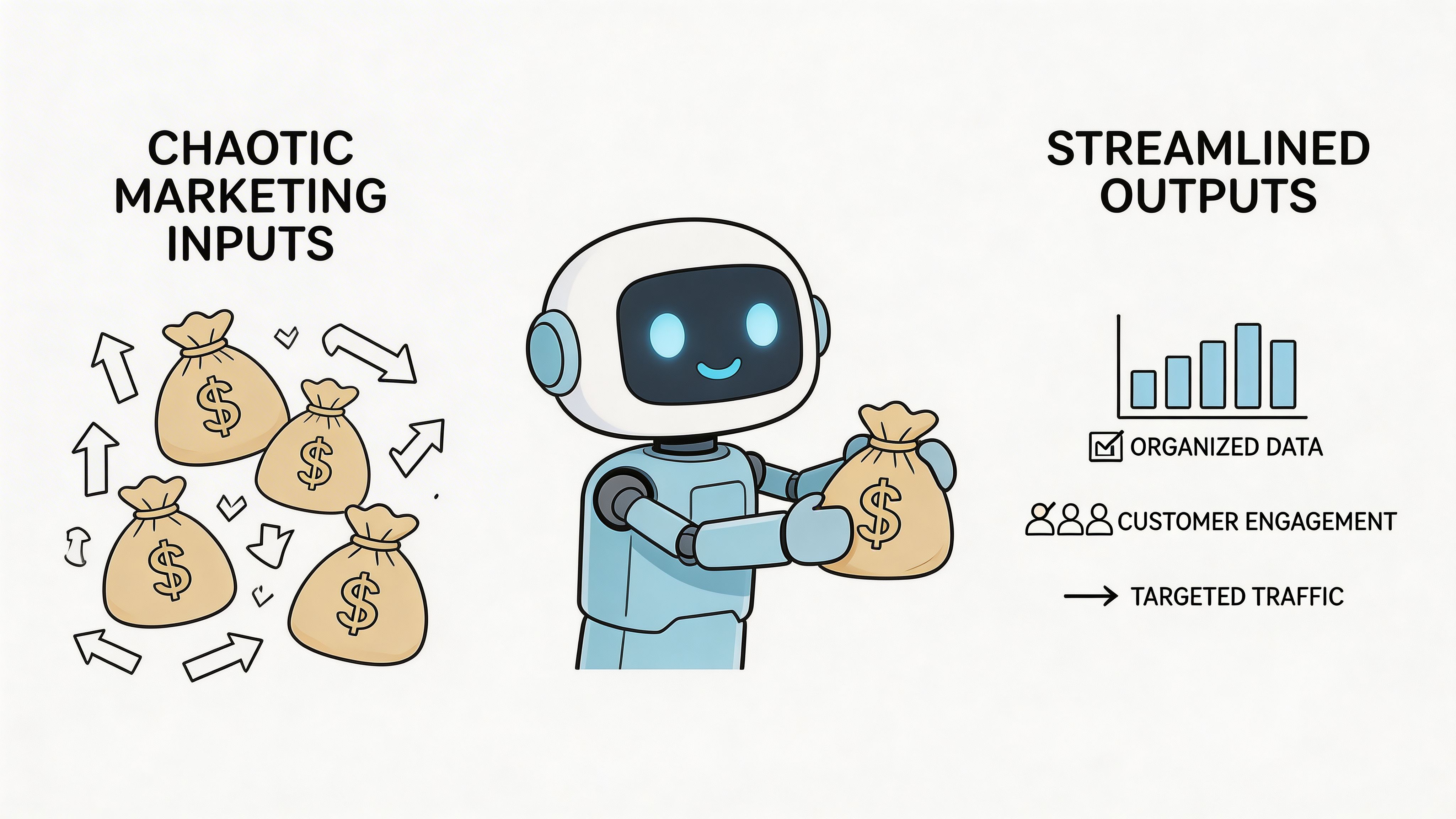
AI changes the shape of the funnel
Founders often think of AI chat as a support tool bolted on after the fact. The better way to see it is as conversion infrastructure.
It sits inside the buying journey and handles the friction that marketing creates when it succeeds. More traffic means more uncertainty expressed at scale. A useful AI layer answers the repeat questions instantly, routes edge cases properly, and helps shoppers move from “interested” to “ready”.
That has practical effects across your service mix:
- SEO traffic converts better when informational visitors can ask clarifying questions without hunting through menus.
- Paid traffic wastes less spend when high-intent visitors get immediate pre-sale help instead of bouncing.
- Email and SMS perform better when returning shoppers land on a store that can continue the conversation.
- CRO work becomes sharper because chat transcripts reveal real objections in customer language.
The overlooked issue is brand fit
There is another layer most agencies still miss.
For Shopify merchants serving niche or underrepresented communities, AI can either help the brand feel more welcoming or damage that trust. HubSpot’s discussion of inclusive ecommerce highlights an important underserved issue here. AI chatbots can either reinforce or undermine inclusive brand positioning, and the opportunity is to train them to maintain brand voice, cultural sensitivity, and identity-affirming language so the experience communicates belonging rather than friction (HubSpot on inclusive ecommerce examples).
That matters more than many founders realise.
If your brand serves a specific cultural community, body type, lifestyle, or identity group, “accurate answers” are not enough. Tone matters. Recommendations matter. The phrasing around fit, use case, and reassurance matters.
Tip: Before adding any AI layer, test whether it sounds like your brand on a normal sales day and on a sensitive customer service day. Those are not the same conversation.
A useful AI setup should feel less like a robotic FAQ and more like a trained sales associate who knows the catalogue, understands customer intent, and stays on-brand.
For a practical look at where AI fits into revenue generation rather than just support, this guide on AI for sales is a helpful reference.
Automation is most valuable when traffic rises
The operational upside becomes obvious here.
The strongest marketing systems do not just create demand. They absorb demand without forcing the founder to become the bottleneck. An automated service layer helps a store stay responsive at night, during campaign launches, on weekends, and during spikes when the whole team is stretched.
A short demo helps make that concrete:
If your current ecommerce marketing services are pushing more people into the funnel, but nobody is systematically handling pre-sale uncertainty, you do not have a full growth system yet. You have a traffic system with a response gap.
A Phased Growth Plan for Your Store
Most founders do not need every service at once. They need the next layer at the right time.
A sensible growth plan looks less like a grand launch and more like staged reinforcement.
Phase one builds the base
In the first stretch, the store is still lean.
The founder focuses on product page clarity, collection structure, technical SEO basics, and a clean measurement setup. They also add a strong conversational layer on the site so existing visitors can get product answers without waiting for manual replies.
This phase is about extracting more value from traffic already reaching the store. There is no point paying for aggressive acquisition if the shop cannot answer buyer questions properly or guide people toward the right products.
Phase two adds controlled acquisition
Once the store has better handling capacity, the founder starts paid acquisition more deliberately.
Meta prospecting and catalogue ads become easier to justify because the onsite experience is no longer passive. More visitors can ask pre-sale questions in real time, compare options, and resolve objections before they leave. Email capture also becomes more valuable because the traffic has a better first interaction with the store.
At this stage, many brands also tighten upsell logic and merchandising. If you want to think more clearly about what that can look like in practice, this piece on how to increase average order value is useful alongside your offer planning.
Phase three connects insight across channels
By the later stage, the store has enough data to work differently.
Customer conversations reveal repeated objections, category confusion, common comparison questions, and language buyers use before they convert. That information feeds ad creative, landing page copy, FAQs, email segmentation, and remarketing logic.
The store may now bring in a specialist agency or a broader ecommerce marketing partner, but from a stronger position. Instead of guessing what customers need to hear, the team has direct evidence from real buying conversations.
Here is how that progression usually looks:
Key takeaway: Add complexity only when the previous layer is stable. Growth becomes expensive when services are stacked on top of unresolved friction.
The mistake is trying to look like a large DTC brand before the store can operate like one. The better path is crawl, then walk, then scale.
Common Questions About Ecommerce Marketing Services
As a solo founder, which single service should I invest in first
Start with the service that addresses your biggest bottleneck.
If traffic is low and your product has clear demand, search or paid acquisition may be the right first move. If traffic already exists but shoppers hesitate, product page optimisation, lifecycle email, or conversion-focused support will often produce a better return than buying more clicks.
What is a realistic starting budget for a small store looking to hire an agency
There is no safe universal figure, and I would avoid anyone who gives one without understanding your margin, average order value, repeat purchase pattern, and operational setup. If not, start narrower. Hire for a focused problem such as email setup, a CRO audit, or paid account restructuring rather than a broad retainer.
When should I bring marketing in-house
Bring work in-house when one of two things becomes true.
First, you have enough consistent volume that daily execution and fast feedback matter more than outside perspective. Second, you have a clear playbook already, and now you need tighter control over creative, merchandising, and testing cadence.
Until then, external specialists are often the better option because you are buying pattern recognition, not just labour.
How do I know whether my current agency is helping
Ask whether the store is becoming easier to scale. Good ecommerce marketing services improve more than channel metrics. They should make your funnel clearer, your reporting cleaner, your customer questions better understood, and your decision-making faster. If activity is high but clarity is low, something is off.
If your store is getting more traffic but still losing shoppers to unanswered questions, slow responses, or pre-sale friction, Marvyn AI is worth a look. It gives Shopify brands an autonomous sales and support layer that helps convert browsers, reduce repetitive customer service work, and keep the store responsive around the clock without adding support headcount.