Freshdesk vs Zendesk A Shopify Store's Guide for 2026

For Shopify and DTC brands, picking between Freshdesk and Zendesk isn't just about software—it's a decision that defines your entire customer support operation. Freshdesk generally gets the nod for its clean interface and better value, making it a go-to for startups and mid-sized brands who need to get up and running fast without breaking the bank. On the flip side, Zendesk is the powerhouse for its deep customisation, massive integration library, and enterprise-level scale, perfect for larger businesses with complex support workflows.
Choosing Your E-Commerce Helpdesk
When you’re weighing up Freshdesk vs Zendesk, you’re really choosing a philosophy for your customer support team. Get it right, and you’ll see agent efficiency soar, customer satisfaction climb, and your bottom line protected. For any Shopify brand, this choice shapes every single customer interaction.
Freshdesk's biggest draw is its simplicity. It’s built for speed, letting teams get started in hours, not weeks, with almost no technical help needed. This makes it a fantastic choice for growing brands that need a solid, all-in-one solution but can't afford a steep learning curve or a hefty upfront cost. Its transparent pricing, which includes a genuinely useful free plan, is a huge plus for businesses keeping a close eye on their budget.
Zendesk, on the other hand, is more like an ecosystem. It’s a highly modular platform you can bend and shape to fit even the most complicated support setups. This power and flexibility make it the default for larger companies, or brands juggling multiple stores, languages, and intricate business rules. While it takes more effort to set up, that initial investment pays off for organisations that need granular control and sophisticated analytics.
Key Takeaway: Your decision should come down to your current business stage and complexity. Freshdesk is for brands that need to move fast and love simplicity. Zendesk is for brands that require deep, enterprise-level control over every part of their support process.
Quick Decision Matrix Freshdesk vs Zendesk for Shopify
To help you identify the best fit for your e-commerce business at a glance, this table breaks down the core differences. As you look at different types of customer service software, think about how each platform’s strengths line up with your immediate needs and where you see your brand in a few years.
Ultimately, both are incredibly capable platforms. The "better" choice is the one that removes friction for your team and your customers, not the one with the longest feature list.
Comparing Core Features And Agent Experience
A feature list only tells you half the story. The real decider between Freshdesk and Zendesk is how your agents actually use the tool every day. How a platform feels during the daily grind directly impacts your first-response times, ticket resolution, and ultimately, your customer satisfaction.
This is where you see the core philosophy of each platform come to life.
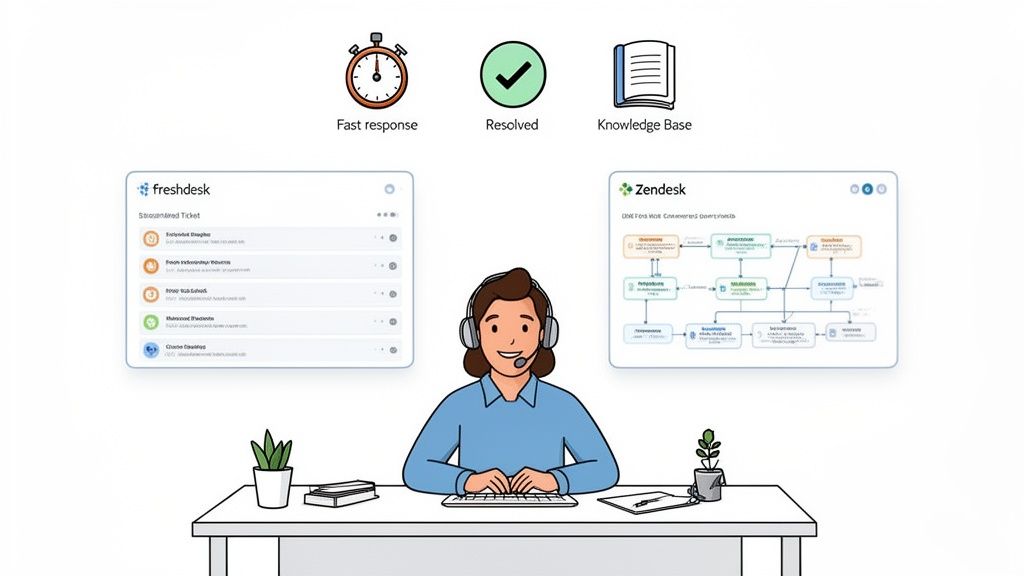
Think of Freshdesk as the tool that gets out of your way. It’s built around a clean, intuitive interface that prioritises speed. For a growing Shopify brand, this is a huge win—it means new agents can get up to speed in a matter of hours, not weeks. Customer queries from email, chat, and social media all land in a unified inbox that just makes sense.
Zendesk, on the other hand, offers a more powerful, but undeniably more complex, agent workspace. It’s designed for deep customisation, letting larger teams build incredibly specific workflows, views, and integrations. While this gives you immense control for enterprise-level operations, it can create a steep learning curve for smaller teams who just need to answer customer questions and get on with their day.
Ticketing Systems and Daily Workflows
The ticketing system is the heart of any helpdesk. It’s where your team lives.
Freshdesk's approach is all about simplifying this core process. It has smart, practical features like collision detection, which stops two agents from accidentally replying to the same customer. It also offers scenario automations, letting agents fire off multiple actions—like sending a templated reply and closing a ticket—with a single click. It's all about small efficiencies that add up.
Zendesk’s ticketing is built for granular control. Its system of Triggers and Automations allows you to micromanage the entire ticket lifecycle. For an e-commerce store, you could build a complex rule that automatically tags any ticket mentioning "return," assigns it to a specific agent, and sends an alert if it isn't updated within two hours. This power is incredible, but it comes at a cost: it requires dedicated administrative effort to set up and maintain.
For a DTC brand just starting out, Freshdesk's simpler workflow allows agents to focus on the customer, not the tool. A more established brand with complex, multi-layered support needs may find Zendesk's customisable rule engine indispensable for maintaining order at scale.
Knowledge Base and Self-Service Portals
Both platforms have robust tools for building a knowledge base, which is non-negotiable for deflecting common questions like "Where is my order?".
Freshdesk makes this incredibly easy. The editor for creating and organising articles is user-friendly, and the categorisation is straightforward. You can get a functional help centre up and running fast.
Zendesk’s knowledge base, known as Zendesk Guide, is a more heavyweight solution. It has stronger support for multiple languages, integrated community forums, and AI-powered content suggestions to help agents (and customers) find the right article faster. For a brand operating in multiple countries, these advanced features are a serious advantage for providing localised self-service. Building an effective help centre is a cornerstone of any solid strategy for customer support for e-commerce.
Reporting and Analytics Dashboards
How do you know if your support is actually getting better?
Freshdesk gives you clear, pre-built dashboards that provide a quick snapshot of the metrics that matter most:
- Ticket volume trends: To spot your busiest support times.
- First response time: To check how quickly your team is engaging.
- Resolution time: To measure your overall efficiency.
The reports are easy to grasp and share, making them perfect for teams that need actionable insights without getting bogged down in data analysis.
Zendesk’s reporting tool, Zendesk Explore, is a different beast entirely. It’s less of a dashboard and more of a full-blown business intelligence tool. It lets you build completely custom reports from the ground up, cross-referencing ticket data with customer information to uncover deep insights. You could, for instance, figure out if customers who buy Product X tend to submit more support tickets.
While that's incredibly powerful, it requires someone on your team who is comfortable with data to unlock its potential. This contrast in reporting philosophy is a key part of the Freshdesk vs Zendesk debate for any data-driven brand.
Analysing True Cost and Long-Term Value
Looking at the sticker price for Freshdesk vs Zendesk is a classic mistake. For a growing DTC brand, what you’ll actually end up paying goes way beyond the monthly per-agent fee. The real cost shows up when you factor in essential add-ons, team growth, and the inevitable surge in ticket volume.
Freshdesk often looks like the more straightforward, budget-friendly option at first glance. Its pricing tiers are clear, and the free plan is genuinely useful, letting a startup get a proper support function off the ground with zero software spend. As you scale, the per-agent cost stays competitive, which makes your financial forecasting a whole lot simpler.
Zendesk plays a different game. It’s a more modular, suite-based system. While the entry-level plans might seem comparable, the total bill can climb fast once you start bolting on the pieces you need for a complete e-commerce support setup. Critical features like advanced AI, proper analytics, and specific channel integrations are often locked away in higher-tier suites or sold as separate add-ons.
Uncovering Hidden E-Commerce Costs
For any Shopify store, certain features aren't just nice-to-haves; they're essential. This is where the pricing philosophies of Freshdesk and Zendesk really start to show their differences.
With Freshdesk, many of the core e-commerce functions are baked into the tiered plans. But if you want to unlock its most powerful AI, branded as Freddy AI, you'll typically need an additional subscription on top of your main plan. This can add a surprisingly significant line item to your monthly bill just to automate common customer questions.
Zendesk bundles many of these advanced tools, but only in its pricier Suite Professional or Enterprise plans. It’s a common story: a brand starts on a lower tier, only to realise they have to make a huge financial jump just to get the automation and reporting needed to handle their own success.
Key Insight: Your total cost isn't the per-agent fee. It's the per-agent fee plus the cost of any modules for AI, advanced reporting, or specific channels your brand needs to operate efficiently.
Cost Projections For Different Growth Stages
Let's walk through how costs might look for a DTC brand at different stages. This really highlights the financial impact of your choice.
- The Startup (2 Agents, 500 tickets/month): At this stage, Freshdesk is almost always the more economical choice. Its free plan, or the very affordable Growth plan, gives you everything you need without a big financial commitment. Zendesk’s starting price is higher, making it a tough pill to swallow for a new, budget-conscious business.
- The Scaling Brand (10 Agents, 5,000 tickets/month): Things get more complicated here. Freshdesk is still cost-effective, but if you're hitting a point where you desperately need sophisticated, multi-layered automation and deep analytics, you’ll probably have to add that Freddy AI subscription, pushing your total cost up. This is where Zendesk’s Suite Professional plan starts to look compelling. It offers a powerful, integrated toolset, but you'll be paying a higher overall price for it.
- The Large Retailer (50+ Agents, 25,000+ tickets/month): For large-scale operations, Zendesk's enterprise muscle often justifies the premium price. Its ability to handle multi-brand complexity, advanced security, and deep customisation provides value that can outweigh the higher cost. The client lists tell the story: Zendesk powers massive enterprises like Tesco and Uber. Meanwhile, Freshdesk has a strong foothold with clients like Hugo Boss and Honda, proving its own power in the mid-market to enterprise space. Discover more insights about their distinct market positions to see how this aligns with your scale.
Evaluating Shopify Integration And Workflow Impact
For any Shopify brand, a helpdesk’s integration isn't just a nice-to-have; it's the core nervous system connecting your support team to your storefront. The gap between a surface-level app and a deep, native integration has a huge impact on your agents’ efficiency and your customers’ experience.
This is where the rubber meets the road in the Freshdesk vs Zendesk debate, and where the realities of your daily workflow come into sharp focus.
A proper Shopify integration should do more than just flash a customer's name on the screen. It needs to give your agents a complete view of order histories, shipping statuses, and customer lifetime value—all without forcing them to leave the helpdesk. The goal here is simple: kill the tab-switching and give agents the context to solve problems in one touch.
Both Freshdesk and Zendesk offer Shopify apps, but the depth and out-of-the-box functionality are quite different, which sets up two very distinct workflow paths for your team.
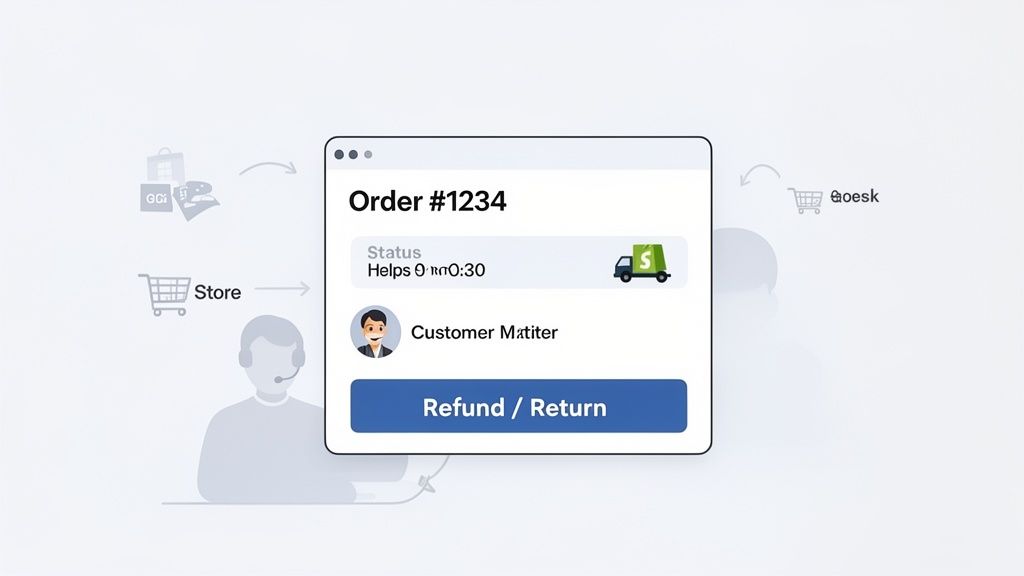
Analysing The Agent Experience In Shopify
Freshdesk’s Shopify integration is all about simplicity and speed. Once you install it, it neatly displays crucial customer and order data right inside the ticket view. Agents can instantly see a customer’s recent orders, shipping address, and other key details.
This setup is incredibly effective for handling the most common e-commerce support queries. An agent can pull up an order in seconds to confirm its status or check an address, which covers a massive chunk of daily support volume. The beauty of Freshdesk is that this functionality just works, right out of the box, with almost no fiddling required.
Zendesk, on the other hand, offers a more powerful and customisable integration. It also shows essential order information, but its real advantage is empowering agents to take direct action. Depending on your plan, the Zendesk app allows agents to process refunds or cancel orders directly from their workspace.
Key Workflow Differentiator: Zendesk’s goal is to turn agents into operators who can execute back-end tasks (like refunds). Freshdesk focuses on arming agents with information to resolve queries quickly. Zendesk’s approach can slash resolution times for complex issues, but it demands a more involved setup and often a higher-tier plan.
Comparing Actionable Workflows
The real test of any Shopify integration is what it lets your agents do. Let's walk through a common but tricky scenario: a customer wants to return an item from a recent order.
The Freshdesk Workflow:
- The agent opens the ticket and sees the customer's order history in the Shopify app panel.
- The agent confirms the item is eligible for return based on your store's policies.
- Here's the switch: the agent has to open the Shopify admin in a new browser tab to actually process the return.
- Finally, they jump back to Freshdesk to let the customer know it’s done.
This works, but it involves context-switching. That adds time and introduces a risk of errors, especially when things get busy.
The Zendesk Workflow:
- The agent opens the ticket and views the order details.
- The agent confirms eligibility.
- Right inside the Zendesk app, the agent clicks a button to initiate the refund or return, which syncs directly back to Shopify.
- The agent confirms the action with the customer, all without ever leaving the Zendesk interface.
This single-screen workflow is a massive advantage for stores with high return volumes, shaving precious minutes off every single one of these tickets. Of course, this kind of power is usually locked behind Zendesk's more expensive plans.
It's also worth noting that building an effective and searchable Shopify help centre can deflect many of these queries in the first place, no matter which helpdesk you choose.
Ultimately, the right choice comes down to your operational needs. If your main goal is to give agents fast access to information, Freshdesk is excellent. If you need to empower them to perform e-commerce actions directly within the helpdesk, Zendesk’s deeper integration is the superior choice.
How AI And Automation Let You Scale Without Breaking
As your DTC brand takes off, you’ll quickly realise that manually answering every single support ticket just isn’t going to work. This is where the AI and automation features in the Freshdesk vs Zendesk debate become absolutely critical. The right tools can get you from 100 to 10,000 tickets a month without having to hire an army of support agents, all while keeping your service quality high.
Both platforms offer rule-based automation to kill off repetitive tasks, like tagging tickets or routing them to the right person. But their approaches to more advanced AI are miles apart, and that difference will have a huge impact on how well you can actually manage that growth.
Rule-Based vs AI-Powered Automation
Freshdesk’s automation is all about clarity and simplicity. Its visual workflow builder lets you create straightforward "if this, then that" rules with a drag-and-drop interface. For an e-commerce brand, this is gold for tasks like automatically tagging any ticket with the word "shipping" and sending it straight to your logistics specialist.
Zendesk, on the other hand, gives you a much more powerful—and admittedly more complex—system of "Triggers" and "Automations." Triggers are event-based rules that fire the second a ticket is created or updated. Automations are time-based. This setup allows for incredibly granular control, like automatically sending a follow-up email if a high-priority ticket sits unanswered for 60 minutes.
For brands in a growth spurt, Freshdesk’s simplicity is a massive plus for getting basic workflows up and running fast. Zendesk’s depth is a better fit for larger operations that need to manage complex service-level agreements (SLAs) and intricate, multi-step processes.
Native Chatbot Solutions For WISMO
"Where Is My Order?" (WISMO) queries can easily make up a huge chunk of your support volume. It’s the number one question for most online stores. Both platforms offer their own AI-powered chatbots to deflect these repetitive questions before they ever hit an agent’s inbox.
- Freshdesk’s Freddy AI: Freddy can be trained to answer common questions and hooks right into your Shopify store to give customers real-time order status updates. The setup is pretty painless, meaning you can get a functional bot live in no time. The catch? Unlocking its full power often means a separate, usage-based subscription.
- Zendesk’s Answer Bot: In a similar vein, Zendesk's bot can pull answers from your knowledge base and use integrations to handle WISMO requests. It's woven deeply into the Zendesk suite, but like many of its advanced features, it's typically bundled into the more expensive plans.
Modern helpdesks are leaning hard into AI to turn support from a cost centre into an efficient, self-service machine. To get a better feel for how this works, our guide to using an AI call centre explores how this technology can completely reshape your support strategy.
Scalability From 100 To 10,000 Tickets
The real test of a platform's automation is how it holds up when things get crazy. As your ticket volume explodes from a trickle to a firehose, which system actually helps you stay afloat?
Freshdesk is fantastic for brands scaling from small to medium. Its friendly automation and clean interface mean you can tweak your workflows on the fly without needing a dedicated administrator. The platform is built to handle volume, but its very simplicity can become a bottleneck when your operational complexity starts to grow alongside your ticket count. You might find yourself needing more intricate, multi-layered rules than Freshdesk can easily handle.
Zendesk was built for enterprise-level scale from day one. Its powerful automation engine is designed to juggle hundreds of complex workflows at once—across multiple brands, regions, and languages. If you’re scaling to 10,000+ tickets with intricate routing needs, like sending different product queries to different teams, Zendesk is built to handle that without breaking a sweat.
Of course, that power comes with a much steeper learning curve and a higher total cost. The choice in the Freshdesk vs Zendesk matchup really comes down to this: do you prioritise ease of use for rapid growth, or do you need raw, customisable power for a complex, large-scale operation?
Making The Right Choice For Your Business Stage
When it comes to the Freshdesk vs Zendesk debate, the decision really boils down to one thing: where is your e-commerce business right now, and where are you trying to go? This isn't about picking the platform with the longest feature list. It’s about matching the tool to your operational reality and growth plans.
For most early-stage and growing Shopify brands, Freshdesk is the smarter, more practical choice. Its clean interface and predictable pricing (including a genuinely useful free plan) let you get a professional support system up and running without a huge financial commitment. Small teams can focus on helping customers, not fighting with complex software.
In contrast, Zendesk becomes the logical next step for established, high-volume, or multi-brand operations. Its real power is in deep customisation, enterprise-grade security, and an architecture built for serious complexity. If your support involves multiple languages, intricate business rules, and the need for granular reporting across thousands of tickets, Zendesk’s robust framework is worth the higher cost and steeper learning curve.
When To Choose Freshdesk
You should lean towards Freshdesk if your top priorities are:
- Speed and Simplicity: You need a functional, multichannel helpdesk live this week, not next quarter.
- Budget Predictability: You need clear, straightforward per-agent pricing without getting blindsided by expensive add-ons for core features.
- Ease of Use: Your team needs an intuitive tool that requires almost no training so they can be productive from day one.
When To Choose Zendesk
Zendesk is the right call when your business demands:
- Deep Customisation: You have to build highly specific workflows, automation rules, and agent roles that mirror a complex org structure.
- Enterprise-Level Scalability: You're handling massive ticket volumes, maybe across different brands or regions, and need a platform that won’t buckle under the pressure.
- Actionable Shopify Workflows: You want agents doing more than just looking up order details—you need them to process refunds and returns directly inside the helpdesk.
This decision tree helps visualise how your specific needs for AI and scale might point you towards one platform or the other.
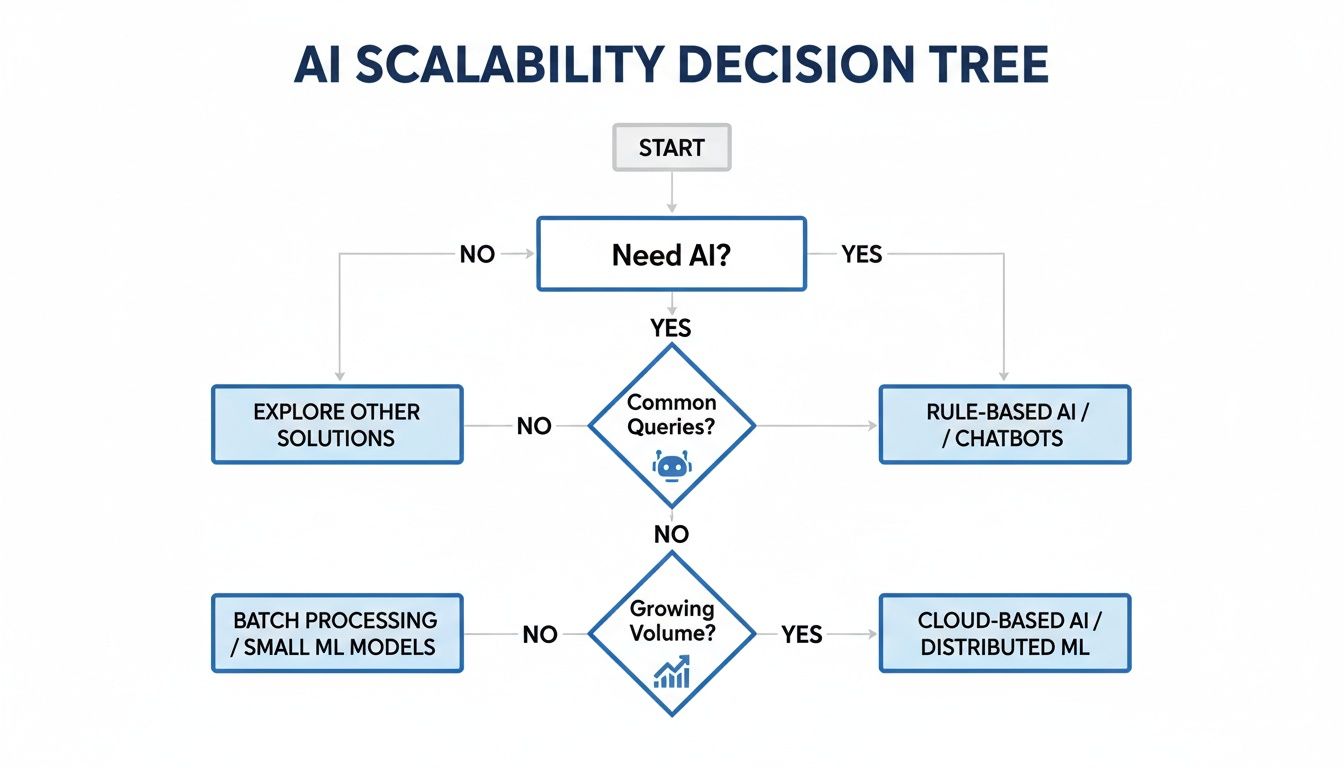
As your query volume and the need for AI-driven automation grow, the more powerful, customisable systems start to make a lot more sense.
Thinking About a Switch? Starting with Freshdesk is often a wise move, but migrating to a more powerful platform like Zendesk is a common growth path for scaling brands. The data shows this move can unlock some serious operational gains.
For example, brands that make the switch from Freshdesk to Zendesk have reported a 42% decrease in first-response time and a 27% reduction in average handle time. These aren't just vanity metrics; for Shopify merchants, faster service directly impacts customer satisfaction and your conversion rate. The same analysis found a 5% increase in CSAT scores, which shows just how valuable a more robust support infrastructure becomes as a brand matures.
Ultimately, whether you start with Freshdesk, scale with Zendesk, or look at other tools, the goal is the same. You need a system that removes friction for your customers and your support team, helping you build lasting loyalty. If you're comparing how a dedicated AI chatbot stacks up against a full helpdesk suite, you might be interested in our deep dive on Marvyn vs Zendesk.
Frequently Asked Questions
When you’re weighing up Freshdesk vs Zendesk, the decision often boils down to a few specific, practical questions. Here are some straight answers to the most common concerns we see from Shopify merchants.
Which Is Better For A Small Shopify Store?
For most new or small Shopify stores, Freshdesk is the better starting point. It's just more intuitive out of the box.
You can get a solid helpdesk up and running fast, without the steep learning curve that often comes with Zendesk. This means a small team can spend their time actually helping customers, not getting bogged down in software configuration. It gives you all the core features you need, without being overwhelming.
Does Zendesk Have A Better Shopify Integration?
Both platforms have strong Shopify integrations, but they’re built for different jobs. Zendesk’s integration is generally seen as more powerful for complex, hands-on tasks. It lets your agents do things like process refunds or cancel orders directly inside the helpdesk.
Freshdesk's integration is simpler but incredibly effective at its main job: giving agents instant access to a customer's order history and shipping details. It’s all about delivering information, whereas Zendesk is about taking action.
Key Takeaway: If your agents need to handle back-end store tasks like refunds, Zendesk’s integration is the clear winner. If they just need to look up order information to answer questions, Freshdesk is more than enough.
Is It Difficult To Migrate From Freshdesk To Zendesk?
Moving from one helpdesk to another is a well-trodden path for scaling businesses, but it definitely requires careful planning. The technical part—moving your tickets, contacts, and knowledge base articles—is the easy bit. Both platforms and third-party services have tools for that.
The real heavy lifting is in rebuilding your custom workflows and retraining your team. All those automations, ticket routing rules, and custom reports you’ve built have to be meticulously recreated in Zendesk. Honestly, the most time-consuming part is often just getting your support agents comfortable with a completely new interface and set of processes.
Ready to bypass traditional helpdesks and delight customers with instant, AI-driven support? Marvyn AI automates over 70% of support queries and boosts sales on your Shopify store. Get started for free at Marvyn AI.