Boost Your Sales: improve ecommerce conversion rate with proven tactics
To get more people to actually buy from your store, you need to do two things: figure out what a "good" conversion rate looks like for you, and then relentlessly hunt down every little bit of friction that stops shoppers in their tracks. It’s about turning a vague goal into a solid business plan.
Even a tiny 0.5% increase can pump serious revenue into your business, especially in a crowded market like the UK. The real secret is getting ahead of customer questions and doubts before they even think about abandoning their cart.
What Is a Good Ecommerce Conversion Rate in 2026?
Before we get into tactics, let's set a realistic target. It’s far too easy to chase global averages that have nothing to do with your specific market. For UK ecommerce brands, the environment is both fiercely competitive and highly mature, which directly shapes what you should be aiming for.
Recent data gives us a pretty clear benchmark. In the UK, the average ecommerce conversion rate is an impressive 3.4%. That’s noticeably higher than the global average, which hovers around 2.1-2.3%. Why? Strong digital infrastructure and high consumer trust in online payments mean UK shoppers are simply more comfortable completing a purchase.
To get a feel for how you compare, it helps to look at industry-specific numbers. A brand selling fast-moving consumer goods will have a very different baseline from one selling luxury furniture.
Here's a snapshot of what "good" looks like across different sectors in the UK.
UK Ecommerce Conversion Rate Benchmarks by Industry (2026)
This table provides a snapshot of average conversion rates across different ecommerce sectors in the UK, helping you compare your store's performance against industry standards.
These benchmarks aren’t rules, but they’re a fantastic starting point. If you’re in the Health & Beauty space and converting at 2%, you know there's a huge opportunity for growth.
Why Small Improvements Matter
Averages are a useful guide, but the real magic happens when you see the financial impact of small, consistent gains. The goal isn’t to hit a 10% conversion rate overnight; it’s about nudging that number up, bit by bit.
Let's run the numbers for a typical direct-to-consumer brand with 10,000 monthly visitors.
- At the UK average of 3.4%, you're making 340 sales.
- By improving that to just 4%, the same traffic now gets you 400 sales.
That's 60 extra orders every single month—without spending another penny on ads. This is the whole point of conversion rate optimisation and why it delivers such a high return for any Shopify store. For a deeper look, our conversion rate optimisation checklist breaks down more of these actionable steps.
The Biggest Obstacle to Higher Conversions
So, what's standing between you and a better conversion rate? The number one culprit is pre-purchase friction.
Today’s shoppers are impatient. They expect clarity and they expect it now. When they have a question—whether it’s about your shipping costs, return policy, or product materials—they want an immediate answer.
Any hesitation or uncertainty creates friction. And friction is the direct cause of abandoned carts. In fact, studies show that 17% of carts in the UK are abandoned purely because of trust issues, which almost always stem from unanswered questions.
The modern shopper’s journey is filled with micro-moments of doubt. Does it come in my size? When will it arrive? Can I return it if I don’t like it? The brands that win are those that answer these questions instantly, removing friction before it even has a chance to build up.
This is where automated solutions are so powerful. An AI chatbot, for instance, can serve as a 24/7 sales assistant, instantly resolving all those common queries that clog up your inbox and kill sales.
A tool like Marvyn AI can automate over 70% of customer questions, guiding hesitant shoppers toward the checkout by giving them the exact information they need, right when they need it. By tackling the root cause of pre-purchase friction, you’re not just offering better service—you’re building a direct path to a higher conversion rate.
How to Find and Fix the Conversion Leaks in Your Sales Funnel
Before you start tweaking button colours or rewriting headlines, you need to play detective. Somewhere between a visitor landing on your site and clicking “Confirm Purchase,” you’re losing people. Finding these leaks isn’t guesswork; it’s a systematic audit using tools you probably already have.
The goal is to pinpoint exactly where shoppers are dropping off and, more importantly, why. A high-level view might show a problem, but the real answers are buried in the user experience at each step. Your best starting points for this investigation are tools like Google Analytics and your native Shopify reports.
Kicking Off Your Funnel Audit with Analytics
Think of your sales funnel as a series of connected pages: landing page, category pages, product pages, the cart, and finally, the checkout. Your first job is to map this journey inside your analytics platform. In Google Analytics, a custom funnel visualisation report is perfect for this.
Set up a report that tracks the flow of users from one key page to the next. This will immediately show you the biggest holes in your bucket. For example, you might see that 90% of visitors who add an item to their cart move on to the checkout page. Great. But then you see only 40% of those who reach checkout actually finish the purchase. That’s a massive leak and a clear signal of where to focus your attention.
A funnel audit isn't just about finding where people leave; it's about understanding the friction that pushed them away. A high drop-off rate is just a symptom. Your job is to diagnose the cause.
Once you’ve found the pages with the highest exit rates, you can start forming a few educated guesses. Is it a technical glitch? A confusing layout? Or is it something a bit more subtle, like a lack of trust?
This simple flow shows how tackling points of friction—like an unanswered question or a clunky design—directly leads to a healthier conversion rate.
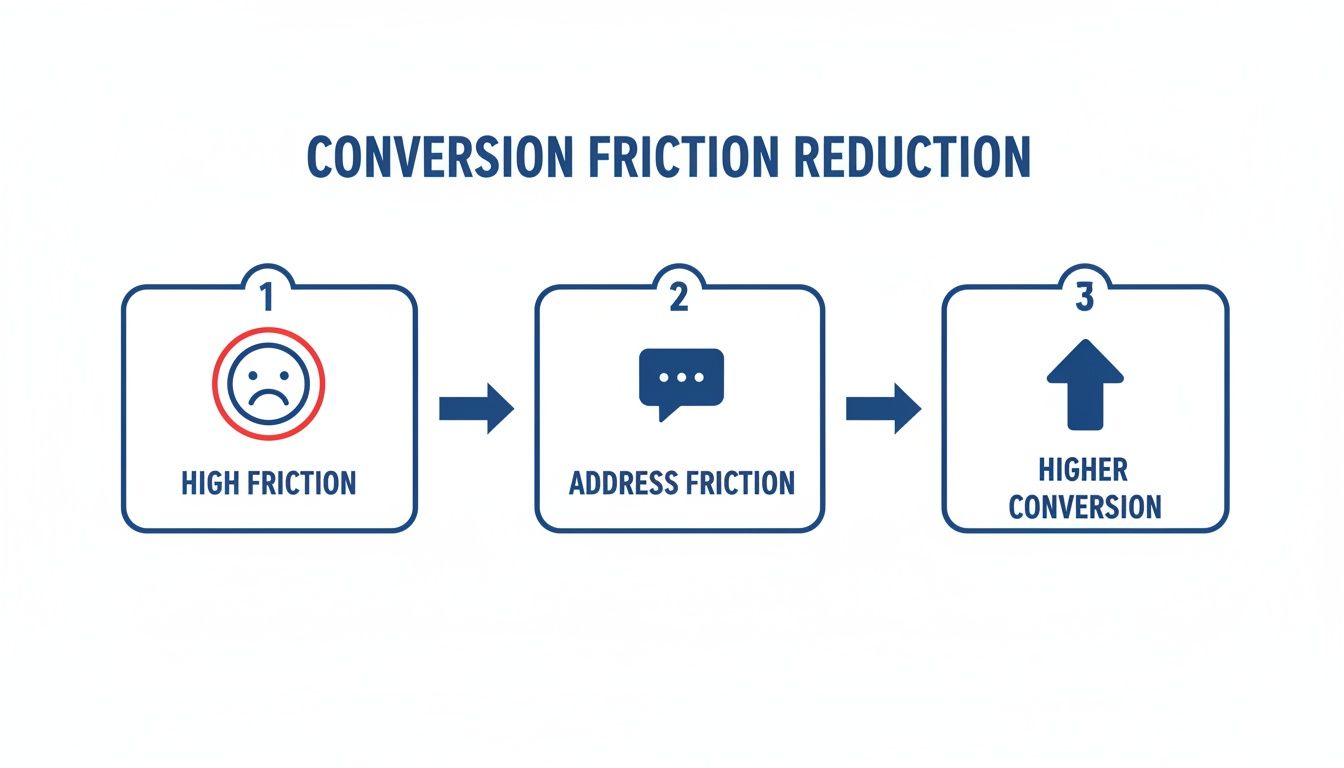
By identifying and smoothing over these friction points with clear information or a helpful nudge, you create a much smoother path to purchase for your customers.
Diagnosing the Most Common Conversion Leaks
With your high-level drop-off points identified, it's time to dig into the "why." Each stage of the funnel has its own classic conversion killers.
High Bounce Rate on Product Pages
If people are landing on your product pages and immediately hitting the back button, it's a huge red flag. Ask yourself these questions:
- Are your product descriptions flat? You shouldn't be selling features; you should be selling benefits. Your copy needs to paint a picture of what the product does for the customer.
- Is your imagery letting you down? Your customers can't touch or feel the product, so high-resolution photos and videos are non-negotiable. Show it from every angle, in use, and in a real-world context.
- Is the Call-to-Action (CTA) obvious? Your "Add to Cart" button needs to be impossible to miss. It should be prominent, well-placed, and maybe even a little compelling.
Sky-High Cart Abandonment Rates
This is the most notorious leak in all of ecommerce. If shoppers are filling their carts but never making it through checkout, the problem almost always boils down to last-minute surprises or nagging doubts. We have a whole guide on this, but here are the usual suspects.
For a deep dive, check out our article on how to reduce cart abandonment with a ton of actionable strategies.
The most common causes I see are:
- Surprise shipping costs: This is the #1 reason for abandoned carts. Be upfront and transparent about shipping fees as early as possible.
- Forcing account creation: Don't put a wall between a customer and their purchase. A guest checkout option is an absolute must-have.
- A lack of trust signals: Are your security badges, return policies, and customer support details clearly visible at the point of purchase? If not, you're creating doubt.
How to Prioritise Your Fixes for Maximum Impact
After your audit, you’ll likely have a long list of potential fixes. Trying to tackle everything at once is a surefire way to get overwhelmed and achieve nothing. Instead, you need to prioritise based on two simple factors: Impact and Effort.
Create a simple matrix and score each potential fix. A high-impact, low-effort task—like making your shipping costs crystal clear on the cart page—should go straight to the top of your to-do list. On the other hand, a low-impact, high-effort project, like a complete site redesign, should be a much lower priority.
This framework forces you to spend your time and resources where they’ll deliver the biggest and fastest return, making your CRO efforts as efficient as they can possibly be.
Boosting Site Speed and Improving the User Experience
A slow, clunky website is the quickest way to kill a sale. Once you've audited your funnel and found the leaks, it's time to tackle two of the biggest conversion killers out there: sluggish performance and a poor user experience (UX).
Getting these technical and design details right is what separates an amateur storefront from a professional DTC brand that consistently beats industry benchmarks.
The absolute non-negotiable starting point? Site speed. In today’s market, shoppers expect things to be instant. Any delay feels like a frustrating wall between them and their purchase.
The True Cost of a Slow Website
It’s easy to write off a few seconds of load time, but the data tells a brutal story. Page speed is a conversion kingmaker in the UK ecommerce market, where even a one-second delay in loading can slash conversions by as much as 20%.
Think about it: top-performing UK stores are pushing past a 5% conversion rate, while the national average sits around 3.4%. A slow site can single-handedly drag you well below that average. You can see how these rates vary by industry and why speed is so critical in the latest 2025 UK ecommerce data.
First thing's first: get a baseline. Tools like Google's PageSpeed Insights give you a detailed report on your site's performance, especially on mobile, and spit out specific recommendations for improvement.
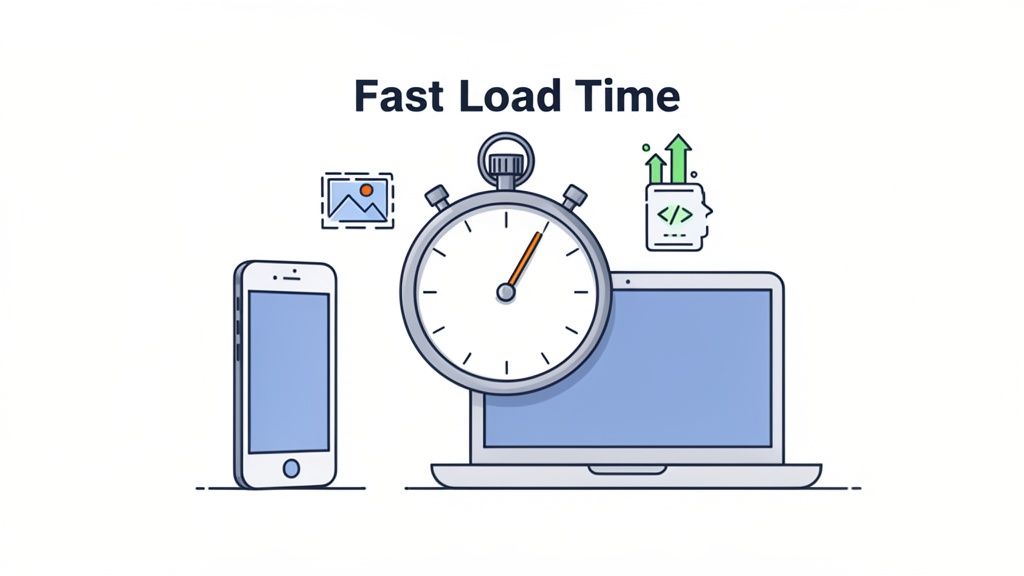
This report gives you an objective score and points directly to the culprits, like massive images or slow server response times that are hammering your load speed and, by extension, your sales.
To start fixing this, focus on a few high-impact areas:
- Compress Your Images: Large, unoptimised images are the number one cause of slow sites. Use tools like TinyPNG or a Shopify app to automatically shrink image files without making them look pixelated.
- Evaluate Your Shopify Apps: Every app you install adds code to your store, and some are heavier than others. Do a regular audit and be ruthless. If an app isn't providing clear value, get rid of it.
- Minify Your Code: Use a tool to minify your CSS and JavaScript files. This process strips out unnecessary characters from the code, making the files smaller and faster to load.
Creating a Seamless User Journey
Once your site is quick, you need to make sure it’s dead simple to use. A great user experience guides shoppers effortlessly from the moment they land on your site to the final click at checkout. It removes friction, answers questions before they’re even asked, and builds confidence every step of the way.
This is where you can truly refine the ecommerce customer experience and see your conversion rate climb.
Focus on these core UX principles:
- Intuitive Navigation: Keep your main menu simple and predictable. Use clear labels for categories that people actually search for. And make sure your search bar is front and centre, especially on mobile. A good rule of thumb is that a shopper should be able to find any product in three clicks or less.
- Compelling Calls-to-Action (CTAs): Your "Add to Cart" and "Buy Now" buttons must stand out. Use a contrasting colour that pops off the page and stick to action-focused text. Don't make people hunt for the next step.
- Mobile-First Design: The majority of your traffic is coming from mobile. Your site has to be flawless on a small screen. Test the entire journey on your phone. Can you easily browse, add to your cart, and check out with just your thumb?
A great UX feels invisible. The shopper never has to stop and think, "Where do I click next?" or "How do I find the shipping information?" The path to purchase is so smooth and logical that it feels completely natural.
A powerful way to nail this experience is by giving people instant answers. Shoppers will always have questions about sizing, materials, or your returns policy. Instead of making them leave the product page to hunt for an FAQ—a massive point of friction—you can use technology to bring the answers directly to them.
This is where a lightweight, autonomous AI chatbot like Marvyn AI becomes so valuable. It installs in a single click and doesn't bloat your site or slow it down. It syncs with your product catalogue and policies to answer over 70% of customer questions instantly, right there on the product page.
This doesn't just stop shoppers from leaving to find information. It actively guides them towards a purchase, helping to significantly improve your ecommerce conversion rate.
Building Trust with Social Proof and Urgency
Once your site is fast and easy to get around, you’ve got to tackle the real reason people don’t buy: hesitation. Even on a perfect website, shoppers pause. They ask themselves, "Is this brand for real?" or "Should I get this now, or wait?" Answering those subconscious questions is the key to pushing your conversion rate up.
This is exactly where social proof and urgency come in. They are two of the most effective behavioural triggers you can use. When you get them right, they build the trust and create the momentum needed to turn a hesitant browser into a paying customer.
Show, Don’t Just Tell, with Social Proof
Social proof is a simple concept: people are more likely to do something if they see other people are already doing it. For your store, that means showing potential customers that real people are buying from and trusting your brand. It’s all about building credibility and making the purchase feel less like a risk.
Star ratings are a decent start, but real social proof goes much deeper.
- Customer Reviews and Photos: Don't just show a star average. Feature detailed reviews with photos or videos from actual customers. This user-generated content (UGC) is gold—it’s authentic and shows your products in the real world, making them instantly more relatable.
- "As Seen In" Logos: If you've been featured in the media or on popular blogs, get those logos on your site. This is a shortcut to credibility, borrowing trust from names your customers already recognise.
- Real-Time Activity: Subtle pop-ups like "Someone in London just bought this" can create a buzz, making your store feel busy and popular. Just use them sparingly so they don't feel cheap or gimmicky.
This isn't just a nice-to-have. In the UK, a staggering 88% of consumers now trust online reviews as much as a personal recommendation from a friend. That’s a massive signal you can’t afford to ignore.
Create Urgency That Feels Helpful, Not Pushy
Urgency is what gets people to act. It answers the question, "Why buy this now?" When a customer feels a gentle nudge to act, they’re far less likely to put it off and eventually abandon their cart. But there's a fine line here. You want to create genuine urgency, not use manipulative tricks that kill trust.
The best urgency tactics aren’t made up; they’re based on real-world factors like stock levels or a sale ending. Your job is to inform the customer, not to pressure them.
Here are a few ethical ways to create that sense of urgency:
- Low-Stock Alerts: Showing "Only 3 left in stock!" works because it's true. It triggers a natural fear of missing out (FOMO) and encourages anyone on the fence to make a decision.
- Limited-Time Offers: If you're running a promotion, make the end date and time impossible to miss. A countdown timer on a product page or in your site's header is a powerful visual cue that the clock is ticking.
- Next-Day Delivery Cut-Offs: A simple message like "Order in the next 2 hours for delivery tomorrow" is incredibly effective. It connects the urgency directly to a real benefit for the shopper.
Using Automation to Amplify Trust and Urgency
This is where modern tools can completely change the game. An AI chatbot, for example, can become a dynamic engine for delivering both social proof and urgency at the perfect moment.
Imagine a shopper is hesitating on a product page. A well-designed chatbot can proactively engage them with a friendly, automated greeting. You can find out more about how to nail that opening line in our guide on crafting an effective welcome message for your website visitors.
From there, the possibilities open up. If a customer asks, “Is this any good?” the AI can instantly pull up a five-star review for that exact item. Or if a shopper is looking at a product that's nearly sold out, the chatbot can gently mention it in the conversation: “That’s a popular one! Just so you know, we’re down to our last few.”
This automated, one-to-one interaction feels personal and genuinely helpful. It surfaces the most powerful trust signals and urgency cues exactly when they’re needed most, creating a persuasive journey that guides the shopper toward a confident purchase.
Right, so you’ve tightened up the foundational elements of your store. The next move is to shift from passively optimising your site to actively selling on it. This is where intelligent automation comes in, turning your store from a static catalogue into a dynamic sales channel that engages shoppers and guides them toward a purchase.
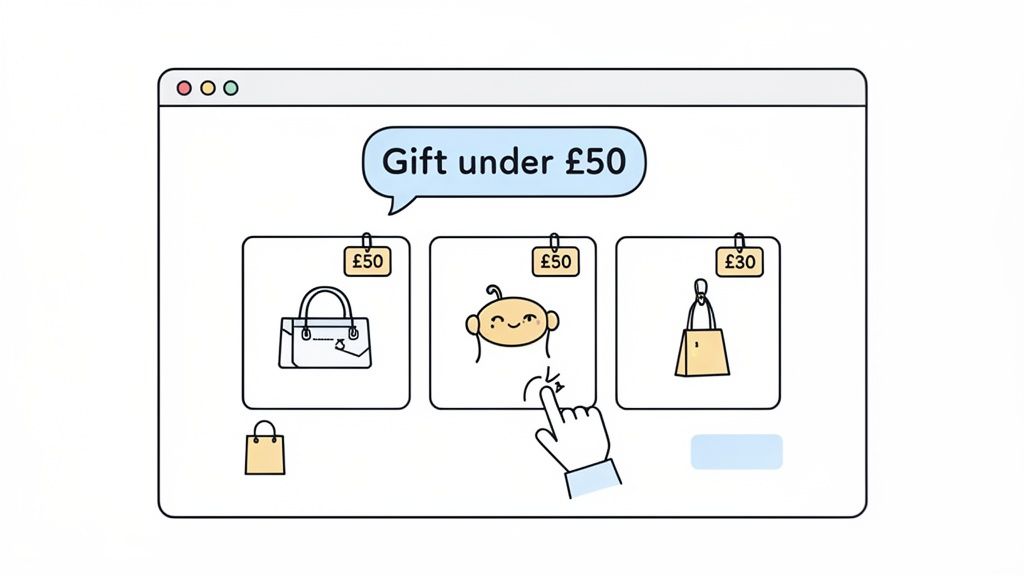
Imagine having a top-tier sales assistant working for you 24/7, ready to help every single visitor who lands on your site. This isn't some futuristic concept reserved for huge corporations anymore. It’s an accessible—and often free—tool that any Shopify store can plug in and use immediately.
From Answering Questions to Driving Sales
The real magic of modern AI in e-commerce is its ability to act as a consultative partner for your customers. An autonomous chatbot, when done right, is so much more than a glorified FAQ page. By syncing directly with your entire product catalogue, it understands your inventory, policies, and brand inside and out.
This is what allows for genuinely helpful, sales-driven conversations. A shopper doesn't just get a link to your returns policy. They can ask, "I need a durable, waterproof jacket under £100 for hiking," and the AI instantly understands the intent—budget, use case, and product features—to pull specific, relevant products from your collection.
That kind of proactive guidance is exactly what cuts through the hesitation that kills conversions. It resolves questions about budget, sizing, or features in real-time, removing friction at the precise moment a customer is considering a purchase.
A Mini Case Study in AI-Driven Sales
Think about a small DTC brand selling handmade jewellery. A customer lands on their site, looking for a birthday gift for their sister, but is completely overwhelmed by the choice and is about to bounce.
Suddenly, a chat window pops up: "Hi there! Looking for the perfect gift? I can help you find something special. What’s your budget?"
Intrigued, the customer types back: "Something under £50."
The AI replies instantly, "Great choice! We have some beautiful silver necklaces in that price range. Our 'Luna' pendant is a bestseller. Would you like to see it?" It then serves up a direct link to the product page. That simple interaction just turned a likely bounce into an engaged shopper, massively increasing the chance of a sale.
An AI sales assistant acts as a personal shopper for every visitor. It narrows down choices, answers specific questions, and builds the confidence needed to click 'Add to Cart,' making the path to purchase feel effortless and personalised.
This level of service, once only possible with a full-time sales team, is now completely achievable for a solo founder or small business. It's one of the most powerful ways to improve your ecommerce conversion rate because it ensures no visitor is left to navigate your store alone.
Beyond a Single Sale: Upselling and Cross-Selling
A smart AI doesn't just stop at the first recommendation. It can also boost your Average Order Value (AOV) with natural upselling and cross-selling, just like a seasoned retail employee would.
For instance, after the customer adds that 'Luna' pendant to their cart, the AI can follow up with a genuinely helpful suggestion:
- Cross-Sell: "Excellent choice! Many customers who bought the Luna pendant also loved the matching 'Stella' earrings. They complete the set beautifully."
- Upsell: "If you’re looking for something extra special, our premium gift-wrapping service is only £5 and makes for a stunning presentation."
This conversational approach feels helpful, not pushy. It introduces relevant add-ons at the perfect moment, often increasing the total order value without you lifting a finger. As our understanding of AI sales agents deepens, we're seeing just how well they can replicate the nuances of human sales expertise at scale.
This frees up an incredible amount of time for founders and support teams. With an AI handling the bulk of pre-sales questions and actively guiding purchases, you can focus on the other critical parts of your business, like marketing and product development. For fashion brands, this evolution is particularly visual. Incorporating platforms that provide AI generated models for fashion can elevate product presentation and engagement, which in turn contributes directly to higher conversion rates.
Building a System for Continuous Improvement and Testing
Right, let's talk about the endgame. Getting your store optimised isn't a one-and-done project. The brands that really pull ahead treat conversion rate optimisation as a constant loop: test, learn, refine, repeat. This is where you move from putting out fires to building a sustainable engine for growth.
The whole system is built on one thing: experimentation. And for most Shopify stores, that means A/B testing. This is how you stop guessing and start letting real customer behaviour drive your decisions. It’s all about creating a clear, testable idea and letting the data prove you right or wrong.
Forming a Clear Hypothesis
Every good test starts with a strong hypothesis. This isn't a wild guess; it's an educated assumption based on the data you've gathered and the funnel leaks you've already found.
A proper hypothesis has a simple structure: "If I change [X], then [Y] will happen, because of [Z]."
Here’s what that looks like in the real world:
- Hypothesis: "If we change the product page CTA from 'Add to Cart' to 'Add to Basket & Get Free UK Shipping', then our add-to-cart rate will increase, because we're calling out a key benefit right at the point of decision."
- Hypothesis: "If we add customer photos below the main product images, then the product page conversion rate will climb, because it adds social proof and helps people visualise themselves using the item."
These statements are specific, measurable, and tied to a logical reason. This is the difference between methodical testing and just changing things on a whim.
A/B testing isn't about finding some mythical "perfect" version of your site. It's about banking small, incremental wins that compound. A string of 1% improvements will always beat a single, high-risk redesign over the long run.
Start with the small stuff that has a big potential impact. Button colours, headlines, product descriptions, or where you place your trust badges are all fantastic places to begin. They're low-effort to implement but can produce some surprisingly significant shifts in behaviour.
Measuring What Matters Beyond Conversions
While boosting your ecommerce conversion rate is the headline goal, it's not the only number that counts. A laser focus on that one metric can sometimes lead you down the wrong path. Sure, a massive site-wide discount might double your conversion rate, but it could also torpedo your profit margins.
To get a true read on your store's health, you need to watch a few other key performance indicators (KPIs) in parallel.
- Average Order Value (AOV): How much is the average customer spending in one go? A good optimisation strategy should be pushing this number up with smart up-sells and cross-sells.
- Customer Lifetime Value (CLV): This is the big one. It's the total profit you can expect from a single customer over their entire relationship with your brand. It’s the ultimate metric for sustainable growth.
- Cart Abandonment Rate: Keep a close eye on this. If you run a successful test on a product page, you should see a corresponding drop in how many people abandon their carts later.
Tracking these KPIs together ensures your optimisation efforts are actually growing the business, not just moving numbers around.
Finding Your Next Winning Test
So, where do the ideas for your next test come from? Your customers are leaving you clues all the time. One of the most overlooked goldmines for customer insight is hiding in plain sight: your support chat logs, especially from an AI chatbot.
These transcripts are raw, unfiltered customer feedback. They show you the exact questions, hesitations, and points of friction that real shoppers are hitting on your site.
Are people constantly asking about your return policy? That’s your cue to make it impossible to miss on your product pages. Are shoppers asking for comparisons between two similar products? That's a clear signal to build a comparison table or write a blog post about it.
By digging into these conversations, you can spot recurring themes that your analytics dashboard might never show you. Every single one of those friction points is a potential hypothesis for your next A/B test. This creates a powerful feedback loop where customer service directly fuels your mission to improve your ecommerce conversion rate.
Ready to turn more browsers into buyers with a sales assistant that works 24/7? Marvyn AI is a free, autonomous AI chatbot that syncs with your entire Shopify store to answer customer questions, recommend products, and guide shoppers to checkout. Install Marvyn AI from the Shopify App Store in one click and start converting more visitors today.