Top Product Marketing Strategies for Shopify
You’ve probably lived this already. You launch a product you know is good. The Shopify theme looks polished, the photography is clean, the ads are live, and visitors do show up. Then sales stall, support inboxes fill with the same pre-sales questions, and the products you expected to move fastest sit there with weak conversion.
That gap is usually not a traffic problem. It’s a product marketing problem.
Most Shopify brands don’t need louder promotion first. They need sharper positioning, tighter segmentation, better launch discipline, stronger on-site messaging, and a way to answer buyer questions at scale before those questions turn into abandoned carts. That’s what strong product marketing strategies do. They connect the product, the buyer, the message, and the moment of decision.
What Product Marketing Means for Your Shopify Store
For a Shopify brand, product marketing is the work of making the right shopper understand why a specific product fits their need, why it’s better than the alternatives they’re considering, and why they should buy now instead of later.
That sounds simple. In practice, most stores blur it with brand marketing. Brand marketing shapes how people feel about your company. Product marketing shapes how they decide on a product. On a Shopify store, that difference matters every day. Your customer isn’t buying your mission statement. They’re deciding between your product, a marketplace listing, and a competitor’s site in the next browser tab.
That’s why product marketing shows up in places founders often treat as “just execution”:
- Product pages that explain outcomes, not just features
- Collection pages that guide choice, not just display inventory
- Email flows that match stage and intent
- Ads and organic content that reflect the same promise shoppers see on site
- Pre-sales support that removes hesitation before checkout
A lot of DTC operators still think the answer is more traffic. Traffic helps, but it amplifies whatever is already true. If your positioning is muddy, more paid spend just buys more confused visitors.
The upside is substantial when the basics are right. UK Shopify merchants using advanced product marketing tactics achieved a 28% higher average order value than non-optimised stores, according to a 2024 Shopify UK benchmark study by Statista. That’s the kind of outcome you’re aiming for when your messaging, merchandising, and buyer journey finally line up.
A useful way to think about it is this. Product marketing is the gearbox between attention and revenue. Without it, your store can generate interest but still fail to convert that interest into sales and repeat purchases.
If you want a broader strategic lens before building your store-level playbook, this guide to marketing product strategy is a strong companion read.
The Foundational Frameworks Positioning and Segmentation
Most product marketing strategies fail before a campaign starts. Not because the ad creative is weak, but because the brand never got clear on who the product is for and what job it does better than the alternatives.
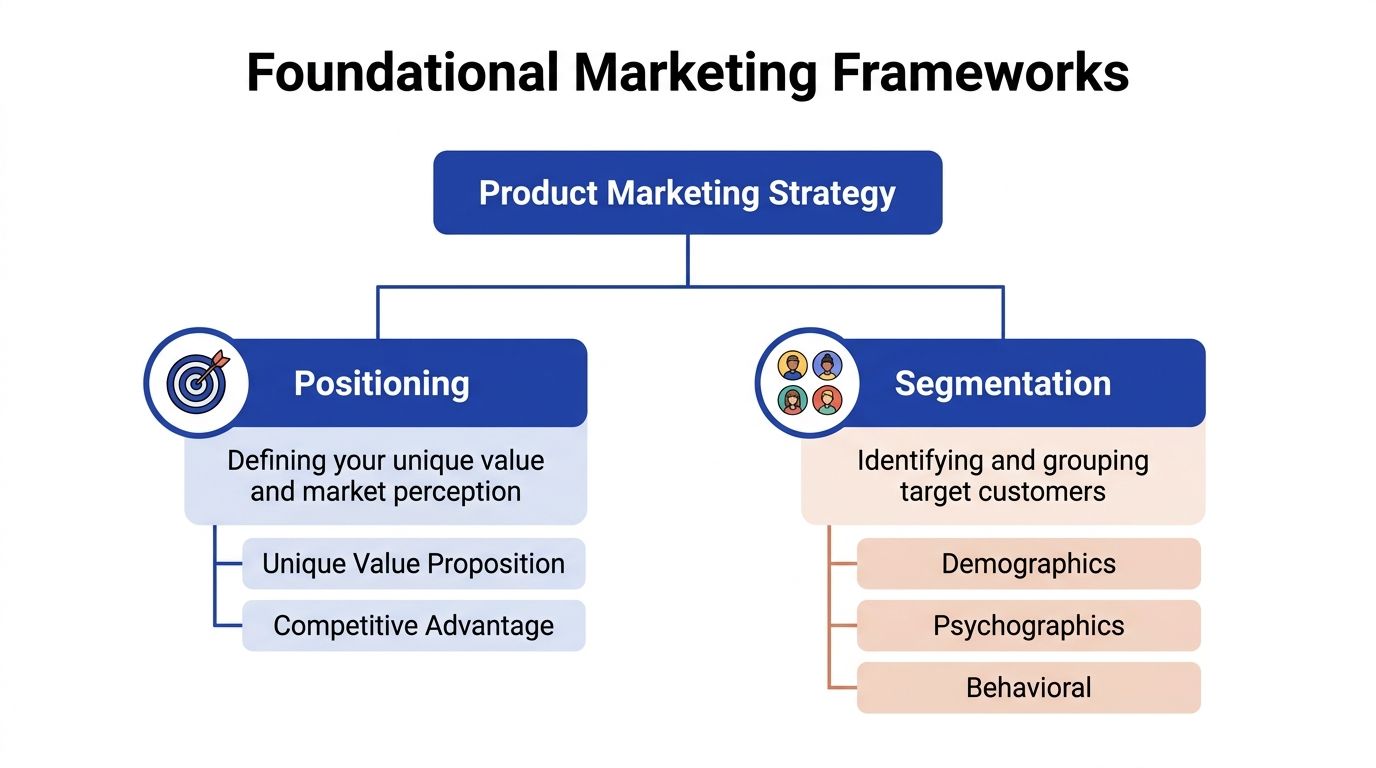
That’s positioning and segmentation. Think of them like building a house. Positioning is the blueprint. Segmentation is choosing the plot of land. If either is wrong, everything built on top becomes expensive to fix.
Start with positioning, not slogans
Positioning isn’t your tagline. It’s the strategic answer to four practical questions:
- Who is this product for
- What problem does it solve
- Why is your approach different
- Why should that difference matter to the buyer
If you skip this work, your store copy turns generic fast. You end up with phrases like “premium quality”, “thoughtfully designed”, and “for modern lifestyles”. Those phrases don’t help a buyer choose.
Use this simple positioning template instead:
For [specific type of buyer], our product helps them [desired outcome] by [unique mechanism or advantage], unlike [main alternative], which [key limitation].
A few examples of how this gets sharper:
The test is simple. Can a buyer read your statement and immediately know whether the product is for them?
Practical rule: If your positioning could describe five competitors with minor edits, it isn’t positioning yet.
Segment by behaviour, not just demographics
A lot of Shopify brands segment too broadly. Age, gender, and location still matter, but they rarely explain buying intent well enough on their own.
Better segmentation for e-commerce usually includes:
- Behavioural signals such as viewed products, time on product page, add-to-cart behaviour, repeat browsing, and abandoned checkout
- Psychographic clues such as budget sensitivity, urgency, gifting intent, quality preference, or preference for simplicity
- Use-case segments such as first-time buyers, replenishment customers, gift shoppers, comparison shoppers, or bundle-seekers
Many product marketing strategies become more profitable when you stop writing one message for “women 25 to 44” and start writing distinct messages for “first-time visitor comparing options”, “repeat customer ready to replenish”, and “gift buyer who needs confidence fast”.
That shift matters because the best-performing message often isn’t more persuasive. It’s more relevant.
If your customer research is thin, start with three inputs you already have:
- Shopify order history
- Customer support transcripts
- On-site search terms
Those three sources usually tell you what shoppers care about far more clearly than a generic persona workshop.
For a useful way to sharpen the underlying demand side of your messaging, this article on what customers need is worth reading.
Document the segments you’ll actually use
A segmentation model is only useful if your team can act on it. Keep it lean. For most Shopify stores, three to five core segments are enough.
Here’s a practical structure:
- Core buyer segment
Your highest-fit customer. Build primary positioning around this group.
- High-intent comparison segment
Visitors deciding between you and competitors. Give them stronger proof, policy clarity, and product selection help.
- Value-conscious segment
Buyers who need reassurance on price, bundles, longevity, or cost-per-use.
- Repeat customer segment
Customers who need replenishment prompts, upgrades, accessories, or product education.
You don’t need dozens of personas. You need a handful of usable groups that change how you write copy, build flows, and merchandise the store.
Actionable Product Launch Playbooks for DTC Brands
A launch isn’t a date on your content calendar. It’s a controlled test of demand, message, and operational readiness. The brands that launch well don’t just announce the product. They remove friction before the first visitor lands on the page.
That’s especially important for high-consideration products, where hesitation kills momentum. For high-ticket UK Shopify brands, pre-sales queries cause 25% of cart abandonment, and early adopters using autonomous chatbots during launch saw 15 to 20% conversion lifts, as noted in this piece on underserved market positioning strategies.
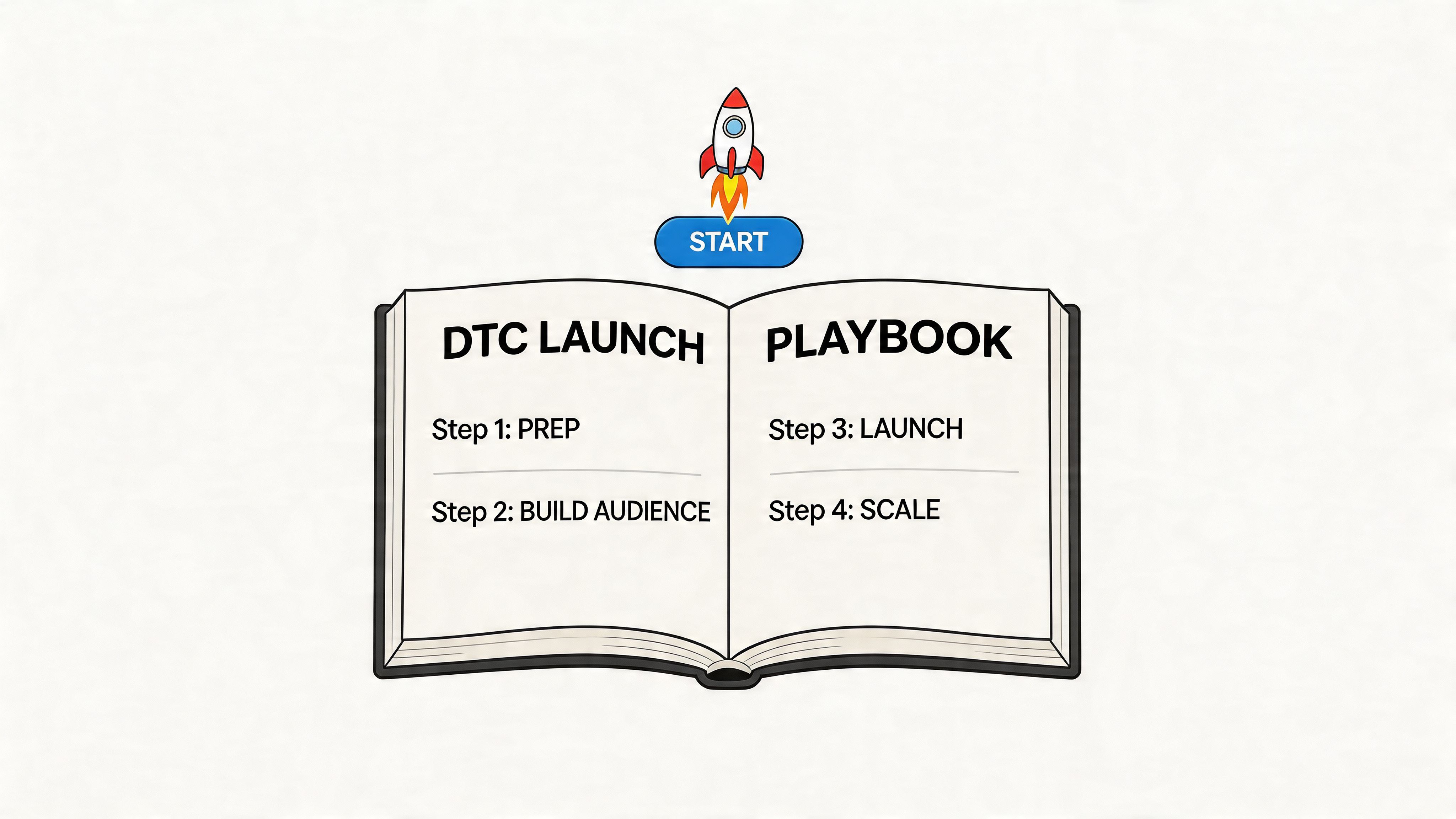
The soft launch playbook
Use a soft launch when you’re testing a new product, collection, variant, or price point and don’t want to bet the month on one rollout.
This works best when your goals are learning speed and message validation.
Pre-launch checklist
- Pick a narrow audience: Start with existing customers, email subscribers, or a warm social audience rather than broad paid traffic.
- Build one clear promise: Don’t test five angles at once. Lead with the strongest use case.
- Prepare support answers: Shipping, returns, fit, compatibility, care, and delivery timing should already be written and easy to surface.
- Set up review capture: Early buyer feedback should come in quickly while the experience is fresh.
Launch window
- Release to a limited group first: This keeps volume manageable and exposes confusion before the bigger push.
- Watch live objections: Product page clicks, support questions, and abandoned carts often tell you more than campaign metrics in the first few days.
- Tighten pages fast: If buyers keep asking the same question, the page is under-explaining something.
Post-launch decisions
- Keep: Messages and offers that moved buyers without heavy explanation
- Fix: Points of friction that generated repeated support questions
- Cut: Angles that sounded clever but didn’t help people decide
A soft launch is not timid. It’s disciplined.
The major launch playbook
Use a major launch when the product has broad appeal, meaningful inventory behind it, and enough confidence in demand to justify coordinated effort across channels.
The mistake here is treating every channel as its own campaign. Strong launches act like one story told in different formats.
Here’s the sequence I’d use.
Two to three weeks before launch
- Create one launch narrative: What changed for the customer because this product exists
- Align all assets: Product page, emails, ad hooks, social scripts, influencer briefs, and customer support macros should say the same core thing
- Seed trusted audiences: Existing customers, creators, affiliates, and community members can help surface objections early
- Prepare segment-specific messaging: If you need help thinking this through, these customer segmentation techniques are a practical framework for tailoring launch messaging by intent
Launch day
- Lead with the product page: Don’t send traffic to a page that reads like a catalogue entry
- Coordinate your channels: Email, paid social, SMS, organic social, and on-site banners should reinforce one value proposition
- Keep support close: New launches create uncertainty. Fast answers preserve intent
- Track first-click confusion: A launch usually wins or loses at the point where a shopper asks, “Will this work for me?”
After launch
- Pull real customer language into copy: Reviews, DMs, and support chats often reveal better wording than your original brainstorm
- Promote proof, not novelty: Once launch-day excitement fades, social proof and objection handling carry the product
- Build the retention path: Follow up with use tips, complementary products, and reorder logic where relevant
Later in the cycle, a short visual explainer can do a lot of heavy lifting:
What usually works and what usually doesn’t
Launches underperform when the team spends more time designing announcement graphics than preparing answers to buyer objections.
A few straight observations from DTC launches:
- Works well
Clear use-case framing, rapid support responses, segmented email, simple landing pages, and fast copy updates based on live feedback
- Usually fails
Vague “now available” messaging, broad discounts with no product story, influencer seeding without a clear angle, and paid traffic sent to an underdeveloped PDP
If your launch process is loose, tighten the store before you widen the audience. This guide on how to increase Shopify sales is a useful next read when you’re pressure-testing launch readiness.
Driving Ongoing Demand Across Key Channels
After launch, demand generation turns into a consistency game. Many brands often drift at this point. Paid social says one thing, email says another, Instagram is mostly aesthetic, and the product page carries the burden of making sense of all of it.
Strong product marketing strategies prevent that drift by using one core positioning statement and adapting it for each channel instead of reinventing the message every week.
Email works best when it follows intent
Email is often treated as a promotion channel. It’s more useful as a decision-support channel.
If someone browsed but didn’t buy, they probably don’t need a louder offer yet. They need the missing piece that helps them decide. That might be fit guidance, comparison logic, care instructions, use cases, or reassurance around shipping and returns.
A practical email structure looks like this:
Personalisation matters. According to a 2024 UK Digital Commerce Index by McKinsey, content personalisation generated a 77% buyer preference for stage-specific materials and led to a 32% conversion lift for UK brands. Stage-specific content works because it respects where the shopper is in the decision, not where the brand wants them to be.
Social should translate your product, not just decorate it
Many Shopify brands post attractive content that doesn’t help anyone buy.
Organic social performs better when it gives the customer a usable frame for the product. Show who it’s for, what problem it solves, when to choose it, and how it compares. Reels, carousels, stories, and creator clips all work better when they reduce uncertainty.
Use social for things like:
- Use-case education: Show the product in the situations buyers recognise
- Decision shortcuts: Compare versions, bundles, or use cases
- Objection handling: Address common hesitations in plain English
- Customer proof: Let buyers explain why they chose the product
If Instagram is a meaningful channel for you, this guide on how to sell on Instagram is a practical extension of the same approach.
Buyers rarely need more brand energy. They need more buying clarity.
Paid acquisition should carry the same promise as the PDP
A lot of ad accounts suffer from a simple disconnect. The creative promises transformation, speed, or simplicity. The landing page then talks in broad feature language. That mismatch causes bounce, weak session quality, and poor conversion.
The ad’s job is to open a loop the landing page can close.
That means your paid channel setup should follow three rules:
- Match the angle: If the ad leads with a specific use case, the landing page should continue that exact frame.
- Send to the right destination: Don’t drop all cold traffic on a generic collection page because it’s easier to manage.
- Keep proof close to the click: Reviews, FAQs, comparison content, and trust signals should appear before doubt takes over.
Content and partnerships keep demand efficient
When a product has a longer consideration window, educational content compounds. Not because blog traffic is magically better, but because useful content answers questions that expensive channels keep paying to answer over and over.
Content that tends to work:
- Comparison guides
- Use-case articles
- Gift guides
- Setup and care content
- Problem-solution posts tied to product categories
Partnerships work similarly when the fit is tight. The best creator or collaborator isn’t always the one with the biggest audience. It’s the one whose audience already understands the need your product solves.
The channel mix matters less than message discipline. If the same product promise can survive in email, paid, organic social, influencer content, and on-site copy, you usually have a scalable engine. If it only sounds good in ads, you have a creative trick, not a product marketing system.
Optimising On-Site Conversion with Messaging and Automation
The most important marketing for an e-commerce brand often happens after the click.
A shopper can arrive highly qualified and still leave if the product page forces them to do too much work. They shouldn’t have to decode your claims, hunt for reassurance, compare variants manually, or wait for a support reply before they feel safe enough to buy.
That’s why on-site conversion deserves its own discipline inside product marketing strategies.
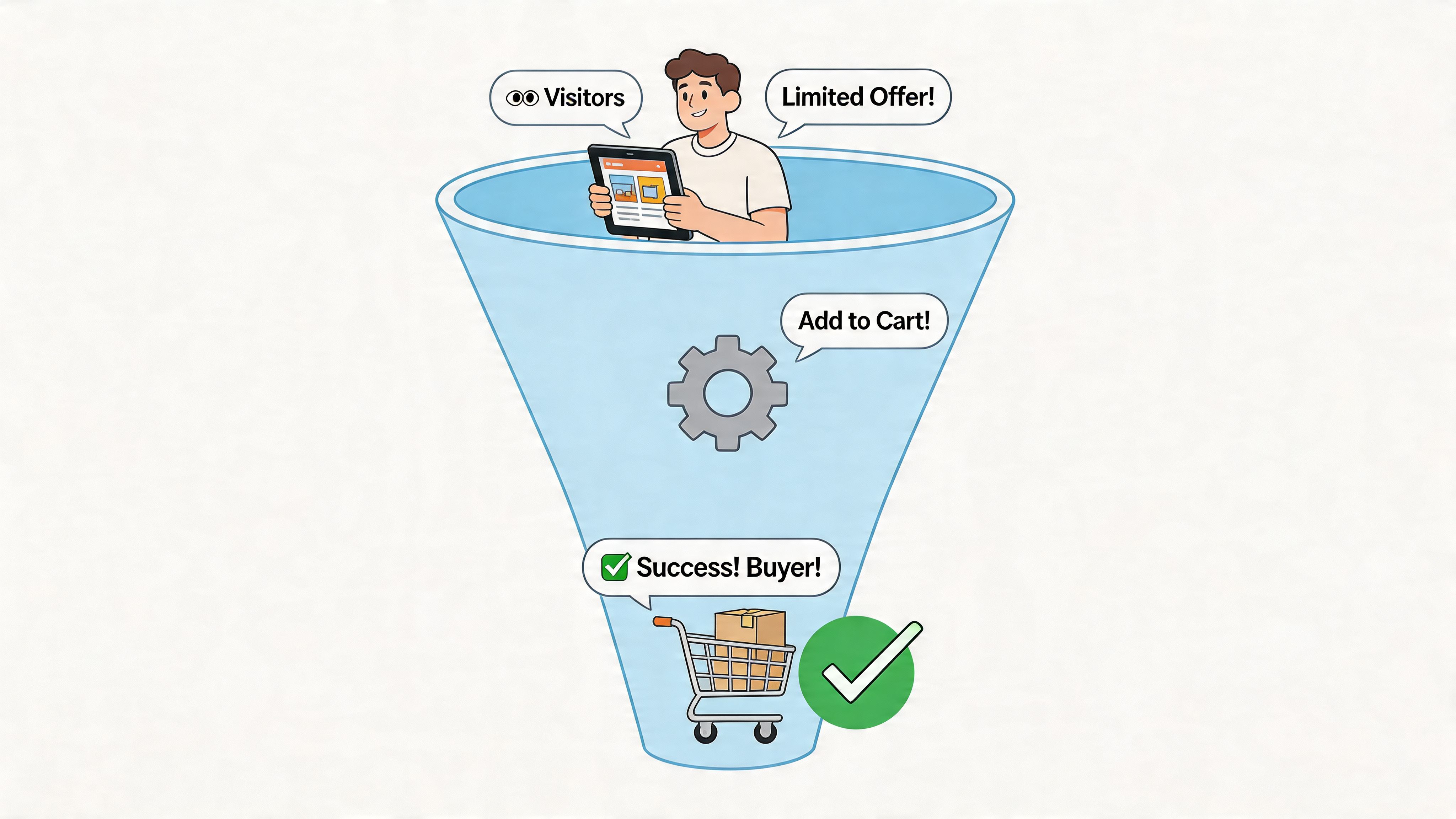
The product page should answer buying questions in order
Most PDPs are written like brochures. Buyers need them written like assisted selling.
A strong page usually answers questions in this sequence:
- What is this and who is it for
- Why is it better for this use case
- What might stop me from buying
- What should I do next
That means your page needs more than polished copy. It needs buying logic.
Use a mix of:
- Outcome-led headlines instead of feature dumps
- Short comparison cues for shoppers deciding between variants
- Trust elements such as reviews, policy clarity, and delivery expectations
- Visual proof that shows scale, use, materials, or results in context
If you want a practical companion on page-level improvements, this walkthrough of Shopify conversion rate optimization is a good reference.
Behavioural signals should change the experience
Not every visitor needs the same page in the same way. Some are ready to buy. Others are stuck on one question.
That’s where behaviour tracking and personalisation matter. Shopify merchants in the UK that adopt behavioural tracking and AI-powered personalisation tools achieve up to 15% higher conversion rates, and using autonomous chatbots for pre-sales queries can reduce cart abandonment by 23%.
Those gains make sense in real store terms. If a shopper pauses on shipping information, keeps switching between variants, or returns to the same collection multiple times, they’re signalling hesitation. A static page can’t adapt. A more responsive on-site experience can.
Consultative selling scales better than passive FAQs
Here’s the trade-off founders run into. Human support gives nuanced answers, but it doesn’t scale well. Static FAQs scale, but they don’t sell well. The middle ground is consultative automation.
Done well, on-site automation behaves less like a help widget and more like a shop assistant. It can ask what the shopper is looking for, clarify budget or preferences, recommend products from the catalogue, answer shipping and returns questions, and escalate edge cases when needed.
That matters because many high-intent visits don’t fail from lack of desire. They fail from unresolved uncertainty.
Good on-site automation doesn’t interrupt a shopper. It steps in at the exact point where confusion would otherwise end the session.
A few practical use cases where this works especially well:
The key is implementation quality. If automation is generic, reactive, or disconnected from the actual catalogue, it becomes another layer of friction. If it’s grounded in your products, policies, and buyer questions, it can actively improve conversion and average order value.
If you’re tightening this part of the journey, this guide to conversion rate optimization for ecommerce is a useful operational checklist.
Measuring Success and Continuously Refining Your Strategy
A product marketing strategy only earns its keep if it changes decisions. That requires measurement you can use, not a bloated dashboard full of vanity graphs.
The cleanest way to do this is to track three groups of metrics: launch signals, growth signals, and retention signals.
Launch signals tell you if the message landed
When a new product or campaign goes live, don’t start by obsessing over top-line revenue alone. First check whether the market understood the offer.
Look at signals like:
- Page engagement quality
- Add-to-cart behaviour
- Pre-sales question themes
- Email click patterns
- Product review language from early buyers
You’re looking for one thing above all. Did the customer interpret the product the way you intended?
If not, don’t assume the product failed. Often the positioning failed, or the page buried the right message too low.
Growth signals show whether the buying journey is getting easier
These metrics help you judge whether your product marketing strategies are reducing friction over time.
A simple working dashboard usually includes:
Conversation data reveals its power. Support chats and on-site questions tell you what analytics alone can’t. If visitors repeatedly ask about sizing, materials, compatibility, or returns, that’s not just support load. It’s a product marketing signal.
Retention signals tell you if your promise matched the product experience
Retention is where weak positioning gets exposed. If acquisition works but repeat purchase lags, one of two things is usually happening. Either the customer bought under the wrong expectation, or the post-purchase experience didn’t reinforce value.
UK-specific benchmarks show that product marketing strategies focused on continuous performance measurement and AI-driven market intelligence yield a 3.2x higher customer retention rate for Shopify stores. The takeaway isn’t just “measure more”. It’s that stores keeping a live feedback loop make better decisions faster.
The best retention improvement often starts before the first purchase, when you set the right expectation clearly.
Build a lightweight feedback loop
Keep the process simple enough that your team will run it every week.
Use this cycle:
- Collect signals from Shopify, analytics, email, and conversation logs
- Group issues by stage, such as attraction, decision, checkout, or post-purchase
- Identify repeated friction instead of reacting to one-off comments
- Update one layer at a time such as product page copy, channel message, offer framing, or support content
- Review again after changes go live
This approach keeps strategy grounded in real buyer behaviour. It also prevents the common habit of replacing campaigns too quickly when the actual problem is on-site clarity.
Product Marketing Strategy FAQs
How should a solo founder handle product marketing without a big team
Keep the system narrow. One founder doesn’t need a full corporate framework. You need one clear positioning statement, a few customer segments, one launch checklist, and a weekly review habit.
Focus on the parts closest to revenue first:
- Product pages
- Email flows
- Pre-sales support
- One or two acquisition channels
If you’re doing everything alone, don’t spread effort across six channels badly. Run two channels well and tighten the store experience.
Do product marketing strategies differ for high-ticket and low-ticket products
Yes. High-ticket products need more reassurance, more comparison help, and more pre-sales support. The purchase is slower and the buyer wants confidence.
Low-ticket products usually depend more on speed, clarity, merchandising, and ease of repeat purchase. The message still matters, but the buyer often needs fewer layers of proof.
A useful way to consider:
What’s the most common mistake on Shopify stores
Writing for the brand instead of writing for the buyer.
That shows up as vague headlines, feature-heavy descriptions, missing comparison guidance, and buried policy details. A shopper lands with a practical question. The site responds with lifestyle language. That gap hurts conversion more than most founders realise.
When should a brand invest in automation
Invest when repeated pre-sales questions are slowing the team down or costing sales. If buyers keep asking the same things and those questions affect conversion, automation stops being a nice extra and becomes part of the sales process.
Good automation is especially useful when:
- The catalogue is large
- The products need explanation
- You sell internationally
- You can’t staff live support around the clock
- Your team is drowning in repetitive questions
How often should you revisit positioning and segmentation
Review it lightly every quarter and seriously when one of these happens:
- A new product category launches
- A major channel becomes more important
- Support questions shift noticeably
- A competitor changes the frame of the market
- Your best customers are no longer who you expected
Positioning shouldn’t change every month. But it shouldn’t sit untouched for years either.
Can a chatbot really help product marketing, or is it just a support tool
It can do both, depending on how it’s deployed.
A basic support widget only reacts. A more consultative setup can guide selection, handle objections, answer policy questions, and keep high-intent shoppers moving. That makes it part of product marketing because it shapes how the product is understood at the moment of purchase.
The key distinction is whether the tool deflects tickets or actively helps people buy the right product.
If your Shopify store is getting traffic but losing buyers to unanswered questions, slow replies, or confusing product choices, Marvyn AI is worth a look. It’s a free autonomous Shopify AI chatbot that syncs your catalogue, policies, and pages, answers pre-sales questions around the clock, and helps shoppers find the right product without adding more support work to your team.