Unlock Growth: Marketing Product Strategy 2026
You launched the product. The photography is sharp. The page looks polished. Friends say the brand feels premium. Then you open Shopify and see the truth. Traffic comes in, some visitors browse, a few add to cart, and too many leave without buying.
That pattern is common in DTC because product quality alone does not carry the sale any more. Buyers compare faster, hesitate longer, and expect answers immediately. If your store cannot explain the product, handle objections, and guide the shopper in real time, a better-made product can still lose to a better-run storefront.
A useful marketing product strategy fixes that. Not the vague version with generic personas and a slide about “brand awareness”. The version that tells you who the product is for, what message each segment should hear, which channels earn attention, how the site converts that attention, and what metrics prove the whole system is working.
For Shopify founders, the strategy has to live inside the store, not just in a Notion doc. That means using customer questions, on-site behaviour, merchandising, email, content, and autonomous AI together. If you have not done the work to understand what customers need, your launch plan is mostly guesswork.
Why a Great Product Is No Longer Enough
A strong product gets you consideration. It does not guarantee sales.
Shoppers do not buy based on craftsmanship alone. They buy when the offer is clear, the timing is right, the objection is resolved, and the path to checkout feels low risk. Most DTC teams underestimate how many sales die in the gap between “this looks good” and “I’m ready to buy”.
The UK market is unforgiving on this point. Businesses with a documented marketing strategy are 313% more likely to report success, according to The Yardstick Agency. That matters even more in a market where UK e-commerce reached £221 billion in 2024, as noted in the same source.
The old playbook breaks in Shopify
A lot of founders still run launches like this:
- Build first: Spend months perfecting the product.
- Write copy late: Add messaging after development is done.
- Buy traffic quickly: Turn on ads because launch day is near.
- Handle questions manually: Answer DMs, emails, and live chat one by one.
That approach creates friction everywhere. The ads pull in mixed-quality traffic. The product page tries to speak to everyone. The founder becomes the bottleneck for questions. By the time the team learns what shoppers were confused about, the launch window has already cooled off.
A better model treats strategy as the operating system for the launch.
What good looks like in practice
A serious marketing product strategy does four jobs well:
- It narrows the audience. You stop selling to “everyone who likes wellness/skincare/home décor” and focus on a defined buyer with a clear purchase trigger.
- It sharpens the promise. The customer understands the outcome, not just the feature list.
- It connects channels to intent. Content educates. Email nurtures. Paid social tests hooks. The store closes the sale.
- It builds conversion into the experience. On-site guidance is part of the strategy, not an afterthought.
A product page without a conversion system behind it is just a catalogue page with nice branding.
The practical shift is simple. Stop thinking of your Shopify store as the place where marketing traffic lands. Start treating it as the place where marketing claims are validated, objections are handled, and purchase confidence is created.
Laying the Foundation with Customer Insight
Most weak strategies fail before the first campaign goes live. The team guesses who the buyer is, guesses what matters, and guesses which message will convert. Then they call the result “testing”.
That is backwards. An evidence-based product strategy requires grounding decisions in empirical customer research, and one of the most common pitfalls is a lack of clear, measurable goals, as Roman Pichler notes in his guide to product strategy mistakes. For a Shopify brand, that means setting baseline metrics before changing anything. At minimum, know your current cart abandonment and AOV before you add new messaging, new offers, or automation.
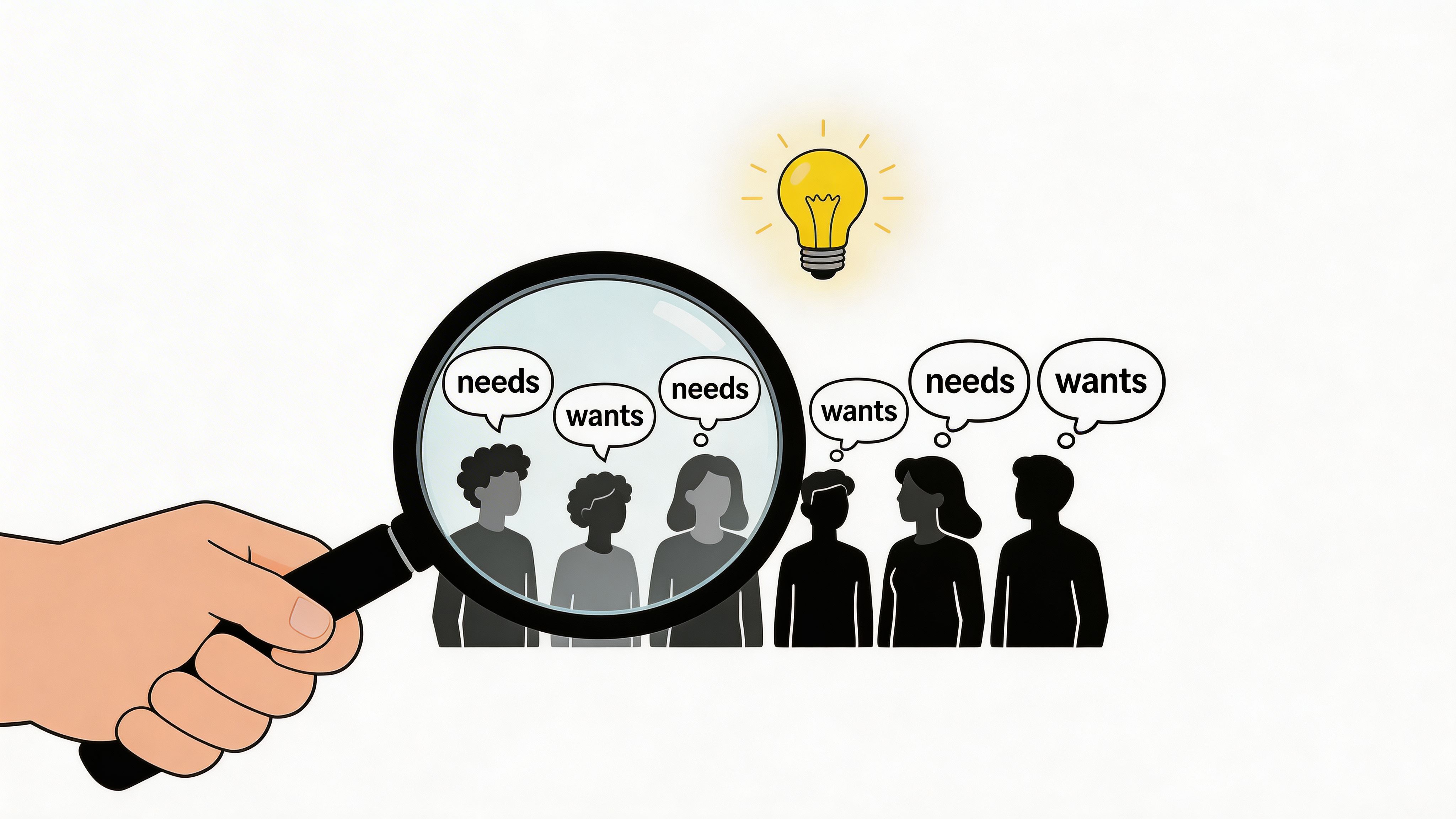
Start with behaviour, not opinions
Founders often begin with internal beliefs.
“We think our audience values sustainability.”
“We think the premium packaging helps conversion.”
“We think shoppers want more product education.”
Some of those beliefs may be right. The problem is that they are still beliefs. Start with evidence from people who almost bought, did buy, returned, or asked pre-sales questions.
Use four input sources together:
- Customer interviews: Best for hearing the language buyers use naturally.
- Post-purchase surveys: Best for finding the trigger that caused action.
- Competitor review mining: Best for surfacing unmet expectations and repeated frustrations.
- On-site conversations: Best for uncovering objections in the exact moment they block conversion.
If you only use one source, you will overfit your strategy to one type of feedback.
A practical customer research workflow
For a Shopify launch, keep the process lean and repeatable.
Interview recent buyers
Talk to people who bought recently enough to remember the decision clearly.
Ask questions such as:
- What was happening when you started looking for this kind of product?
- What nearly stopped you from ordering?
- What alternatives were you comparing us against?
- What convinced you that this was worth the price?
Avoid asking, “Would you buy this?” or “Do you like this concept?” People are polite. Their behaviour is more honest.
Analyse non-buyers and abandoners
Growth opportunities often hide in understanding these groups.
Look for patterns like:
Those are not support issues. They are positioning and conversion issues.
Mine review sections strategically
Do not just read star ratings. Pull out wording around regret, delight, confusion, and comparison.
Focus on:
- What buyers loved unexpectedly
- What they found difficult to understand
- Why they chose one brand over another
- What they felt was missing after purchase
You are building a message bank. The strongest headlines often come straight from customer wording, lightly edited for clarity.
Turn your store into a research lab
Your Shopify storefront already generates some of the best zero-party data you can get. Every question a shopper asks reveals uncertainty, intent, and buying context.
That matters because those questions are unprompted. They are not filtered through a survey form where respondents are trying to be helpful. They show what someone wants to know before they are willing to spend money.
Use your store data to sort conversations into themes:
- Purchase-confidence questions such as shipping, returns, guarantees, and materials.
- Selection questions such as sizing, fit, flavour, compatibility, and bundle choice.
- Comparison questions such as “Which one is best for me?”
- Friction signals such as repeated clarifications, abandonment after an answer, or escalation requests.
If the same question appears every day, the issue is rarely the customer. It is usually your merchandising, copy, or information architecture.
Here, customer experience and strategy meet. If you review conversation logs weekly, you can update PDP copy, FAQ structure, navigation, and offers based on actual buyer confusion. That is far more useful than relying on broad persona decks.
Set the baseline before you optimise
Once you gather insights, translate them into a small set of measurable hypotheses.
For example:
- If shoppers keep asking about delivery windows, then add delivery clarity on PDPs and track checkout progression.
- If buyers ask which variant suits them, then change collection page copy and monitor AOV and conversion.
- If return-policy questions dominate, then surface reassurance earlier and watch abandonment behaviour.
Keep one document with baseline numbers, hypotheses, changes made, and review dates. If you also track customer loyalty, resources like this guide on how to calculate NPS score can help you connect sentiment data to purchase and retention patterns without turning research into fluff.
Good research does not create more documents. It gives your team fewer things to argue about.
Defining Your Product's Place in the Market
Once the customer insight is clear, positioning gets easier. Not easy. Easier.
Most Shopify brands do not have a traffic problem first. They have a sameness problem. The store looks competent, the product seems solid, and the copy sounds interchangeable with ten other brands in the category. When that happens, price becomes the fallback differentiator.
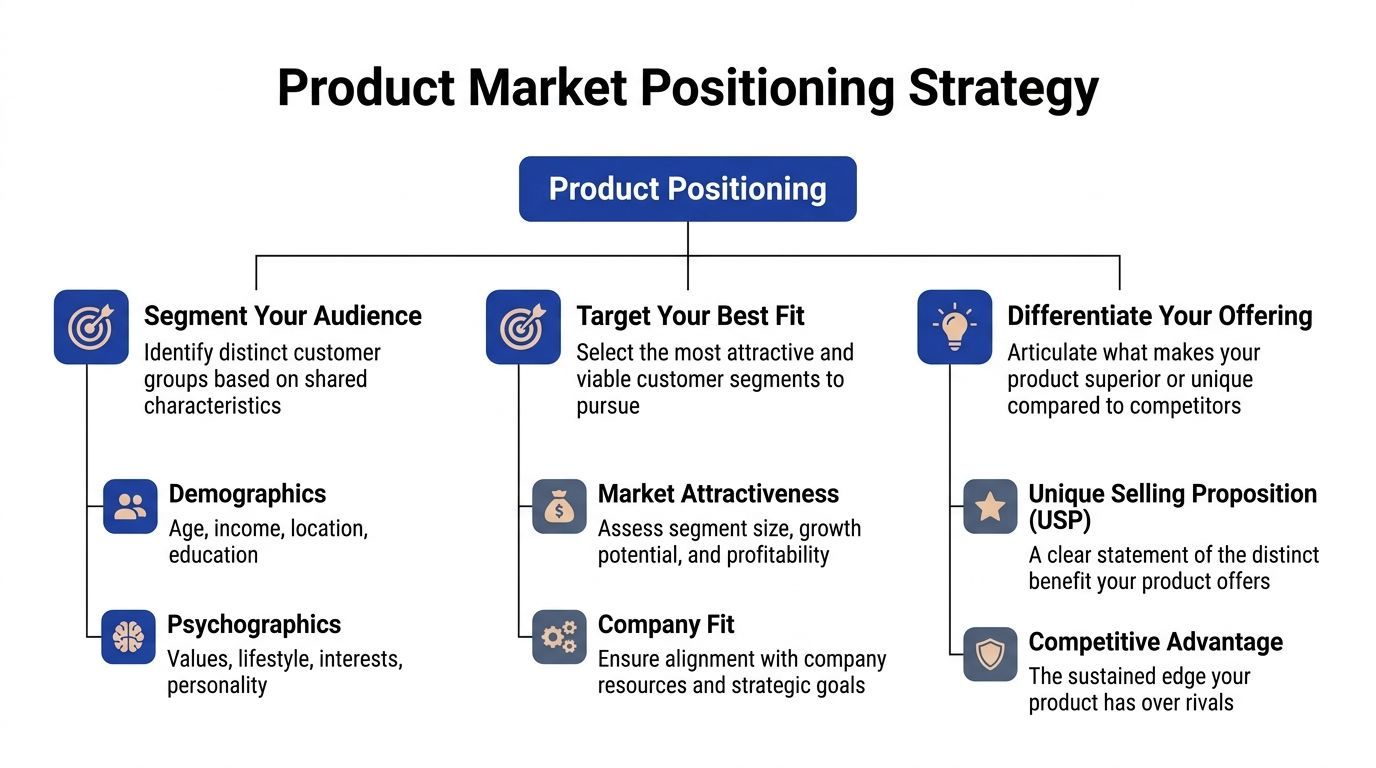
The fix is not louder branding. The fix is sharper positioning.
Build a value proposition from real buyer tension
A useful value proposition answers four questions:
Weak positioning focuses on product traits. Strong positioning ties those traits to a buying decision.
For example, “made from premium materials” is a trait. “Holds its shape after repeated use, so you replace it less often” is a buyer-relevant benefit. One describes the product. The other supports a decision.
Create a simple positioning statement
Use a working statement your whole team can align around:
For [specific customer], our product helps [solve problem or achieve outcome] by [distinct mechanism or differentiator], unlike [common alternative], because [reason to believe].
This is not homepage copy. It is internal strategy.
A good statement helps everyone decide:
- what angles belong in paid creative
- what your PDP lead should emphasise
- which objections need a stronger answer
- what should be left out, even if it sounds attractive
If you cannot fill this in clearly, your messaging will drift by channel.
Segment before you scale
A lot of brands chase volume too early. They try to make one page, one ad angle, and one offer work for multiple segments with different motivations.
That usually weakens the whole funnel.
The underserved opportunity is especially clear for smaller UK DTC brands. The integration of AI chatbots in UK Shopify marketing product strategies remains poorly addressed, even though 68% of UK small online retailers cite customer service automation as a top unmet need in 2025, according to Luth Research. That points to a real gap. Many brands still treat on-site conversations as support overhead when they should treat them as a positioning channel.
Segment by buying context
Useful segments often look like this:
- First-time cautious buyers: Need reassurance, proof, and low-risk framing.
- Comparison shoppers: Need clear differentiation against alternatives.
- High-intent repeat buyers: Need speed, convenience, and relevant cross-sells.
- Gift buyers: Need confidence in selection without deep category knowledge.
Each segment asks different questions. If your strategy does not reflect that, your conversion path gets noisy fast.
Map features to decision-level benefits
Do this exercise line by line.
The last column matters most. Buyers do not pay for your internal product roadmap. They pay for progress in their own life.
Positioning gets stronger when your team writes benefits in the language of reduced risk, better fit, saved time, or clearer outcomes.
Operationalise the position
A positioning statement is useless if it lives only in a founder’s head.
It needs to show up in:
- Homepage hierarchy
- Product page leads and comparison blocks
- Email flows
- Organic social hooks
- Paid ad angles
- On-site conversational prompts
- Return, shipping, and trust messaging
At this point, many strategy guides become abstract. They stop at “define your USP”. Real execution means carrying that USP through every buyer touchpoint with discipline.
If your team needs a broader framework for aligning offer, service, and channel execution, this overview of ecommerce marketing services is a useful reference point for how the moving pieces fit together inside a growth system.
Positioning is not a branding exercise. It is a conversion decision.
Activating Your Strategy Across Channels
Most channel plans fail because they start with tools instead of jobs. The team asks, “Should we be on TikTok?” when the better question is, “What part of the buying journey are we trying to move?”
That distinction matters because each channel should do one primary job well. When channels overlap without purpose, you get duplicated content, mixed signals, and weak attribution.
Build a channel mix around intent
Think in terms of traffic quality, not traffic volume.
Here is the practical breakdown I use.
Content channels educate and pre-frame
Blog content, founder-led video, search-driven pages, and comparison content work best when buyers need context before they trust the product.
Use them to answer:
- what problem the product solves
- who it is best for
- how to choose between options
- what trade-offs buyers should understand
This traffic often converts later, not immediately. That is fine. Its job is to reduce ignorance and shape preference.
Email turns interest into consideration
Email remains one of the cleanest places to sharpen product messaging because you control the narrative. No algorithm decides whether your customer sees the offer.
Use flows with distinct roles:
If every flow sounds the same, your strategy has not been translated.
Paid channels test hooks fast
Paid social and search are useful when you know what hypothesis you are testing.
Good uses of paid:
- validating a problem-aware angle
- comparing benefit-led versus proof-led creative
- testing segment-specific landing pages
- finding which objections lower click-through or page engagement
Bad uses of paid:
- forcing traffic to a weak PDP
- buying reach before the message is stable
- scaling spend while support and site experience lag behind
The ad does not carry the whole sale. It earns the next click. Your site still has to close.
Your site is the conversion engine
A proper marketing product strategy treats the website as the central conversion layer for every channel. Content, social, PR, affiliates, paid media, and email all hand off to the same place. If the store does not guide buyers, all those channels leak revenue in the same spot.
That means your on-site experience needs structure:
- Immediate clarity: The visitor should know what the product is for in seconds.
- Path to fit: The buyer should be able to identify the right option without friction.
- Objection handling: Shipping, returns, ingredients, sizing, and compatibility should be easy to access.
- Momentum to checkout: The next step should feel obvious.
The operational mistake I see most often is treating live chat or conversational tools as isolated support software instead of integrating them into merchandising and CRO thinking.
If your traffic lands with mixed intent, the store needs to sort it. Product pages alone rarely do all the work.
Match channels to the questions they create
Each acquisition channel tends to send visitors with different expectations.
This is why on-site conversation matters so much. It picks up where the ad, email, or content piece stops.
Traffic quality improves when every channel hands off a consistent promise and the site continues the same conversation instead of resetting it.
If you are planning this as a system, not a series of disconnected campaigns, resources on AI sales agents are worth reviewing. The core idea is simple. Buyer guidance on-site should work like sales enablement, not just support triage.
What works and what does not
A few patterns show up repeatedly.
What works
- One clear angle per campaign: Easier to learn what moved the buyer.
- Dedicated landing experiences for key segments: Better fit, less ambiguity.
- Channel-specific creative with shared strategic messaging: Consistency without duplication.
- Weekly review of acquisition quality against on-site questions: Stronger message-market fit over time.
What does not
- Running every channel because competitors do
- Sending all traffic to the homepage
- Using the same copy in ads, email, and PDPs without adjusting for intent
- Judging channel success on clicks alone
The best channel strategy is usually narrower than founders expect. Fewer channels, clearer roles, stronger hand-offs.
Nailing Your Product Launch and Beyond
Launches do not fail only because demand is weak. They fail because the team leaves too much to improvisation.
A Shopify launch needs the same discipline as a campaign sprint. Assets, sequencing, inventory visibility, support readiness, messaging alignment, and post-launch follow-up all need owners. If one piece slips, the whole experience feels less trustworthy.
Pre-launch preparation
The best launches are usually won before launch day.
Use a simple mission plan with these checks:
- Offer clarity: Define the hero message, supporting proof, and most likely objections.
- Page readiness: Finalise PDPs, collection logic, bundles, and mobile UX.
- Audience warming: Seed the narrative through email, social, waitlists, and founder content.
- Support readiness: Prepare answers for shipping, returns, fit, delivery timing, and product comparisons.
- Tracking readiness: Confirm that your analytics reflect the exact actions you care about.
If your team needs a starting framework, this go to market plan template is a useful planning aid because it forces channel, timing, audience, and execution details into one working document.
Pre-launch checklist
A launch should feel prepared, not “busy”.
Launch day execution
On launch day, teams often over-focus on posting and under-focus on monitoring.
The main task involves watching where friction first appears.
Look closely at:
- Which traffic source brings the most engaged sessions
- Which questions appear repeatedly
- Where people stall before checkout
- Which product variants get attention but not conversion
- Whether the main offer is understood immediately
If you see the same question appear across multiple sessions, update the site the same day. Launch windows reward speed.
A good launch setup also protects the team from getting swamped. If every new shopper question routes to a founder inbox, response times slow, buying confidence drops, and the team spends the day firefighting instead of steering.
For stores tightening this part of the funnel, practical guidance on conversion rate optimization for ecommerce helps frame launch day as a conversion system, not just an awareness event.
A useful walkthrough on launch execution is below.
Post-launch is where strategy proves itself
A launch does not end when the first sales come in. Then, the true data collection begins.
In the first stretch after launch, review:
- What buyers asked before purchasing
- Which objections remained unresolved
- Which messages pulled in attention but not orders
- What repeat customers did differently from new visitors
Then adjust the assets that matter most:
- the PDP lead
- comparison blocks
- FAQs
- collection page framing
- abandonment emails
- social proof placement
A launch is not a one-day event. It is a short cycle of release, observation, correction, and reinforcement.
Founders who do this well treat the first version of launch messaging as a testable draft, not a sacred final asset.
Measuring What Matters and Iterating Your Strategy
A strategy that is not tied to outcomes becomes theatre. Teams stay busy, channels stay active, dashboards stay full, and nobody can explain why revenue moved or stalled.
That is why vanity metrics are dangerous. Likes, reach, and page views can tell you something about distribution. They rarely tell you whether your marketing product strategy is improving the business.
Operational risk is frequently larger than teams realise. Product strategy failure often stems from misalignment between strategic vision and tactical execution, and 73% of product implementations fail when teams confuse roadmap execution with strategic direction, according to Lucid’s analysis of common product strategy mistakes. In a Shopify context, that usually looks like this: the team installs tools, launches campaigns, and publishes content, but none of it is explicitly tied to AOV, cart abandonment, conversion, or customer acquisition efficiency.
The KPI view that helps
Use a dashboard built around commercial movement, not channel vanity.
This is the level where iteration becomes useful.
Tie each metric to a decision
Do not review KPIs in isolation. Pair each one with a strategic question.
For example:
- If conversion rate is weak, is the message attracting the wrong traffic or failing to reassure the right traffic?
- If AOV is flat, are your bundles and recommendations relevant?
- If abandonment is high, what unanswered question appears just before drop-off?
- If support themes cluster around one issue, should that answer live higher on the PDP?
That is how you keep tactics attached to strategy.
Review in short cycles
Quarterly reviews are useful for strategic direction. Weekly reviews are better for store reality.
A workable cadence looks like this:
- Weekly: review top objections, traffic quality, and page friction
- Monthly: assess campaign learnings and merchandising performance
- Quarterly: revisit segment focus, positioning, and major experiments
If you wait for a quarterly off-site to fix an obvious conversion blocker, you will waste too much demand in the meantime.
Good iteration is not endless tinkering. It is disciplined adjustment against a clear commercial baseline.
The best teams do not ask, “Did the campaign perform?” They ask, “What did this teach us about the buyer, and what changes now belong in the strategy?”
Your Marketing Product Strategy Questions Answered
How is marketing product strategy different for a new brand versus an established store
The principle stays the same. The difference is your evidence base.
A new brand starts with lighter signals, smaller tests, and tighter positioning. An established store has more first-party data, more customer questions, and clearer behaviour patterns to work from. The mistake in both cases is trying to sound broad too early.
What is the biggest mistake founders make
They confuse activity with strategy.
Publishing content, launching ads, and redesigning PDPs can all be useful. None of them count as strategy unless they connect to a defined customer, a clear value proposition, and a measurable commercial outcome.
Should small DTC brands really prioritise conversational buying support
Yes, especially when the product needs explanation or comparison. In UK e-commerce, sales reached £221 billion in 2024, yet cart abandonment averages 70%. Effective product marketing through chatbots and personalised recommendations can reduce abandonment by 15% to 30%, according to HubSpot’s marketing statistics reference. That makes guided buying support a revenue lever, not just a support convenience.
How often should the strategy change
Your core position should stay stable unless the market, customer, or product has clearly shifted. Your execution should change much more often.
Offers, hooks, page structure, objections, and channel mix should be reviewed continuously. The strategy is the anchor. The tactics are the moving parts.
What should a founder do first after reading this
Pick one product. Pick one segment. Document the buying objections that block that segment most often. Then align your product page, emails, paid angles, and on-site guidance around solving those objections better than anyone else.
If your Shopify store gets traffic but still leaves buyers with unanswered questions, Marvyn AI is the fastest way to add autonomous, always-on sales and support to the funnel. It syncs your catalogue, policies, and pages, guides shoppers to the right products, handles pre-sales questions instantly, and helps turn more browsers into customers without adding headcount.