How to Handle a Disgruntled Customer: Turn Complaints into Loyalty
The moment an angry customer lands in your inbox, the clock starts ticking. Those first five minutes are everything. Get it right, and you can turn a frustrated user into a loyal advocate. Get it wrong, and you’ve likely lost them for good.
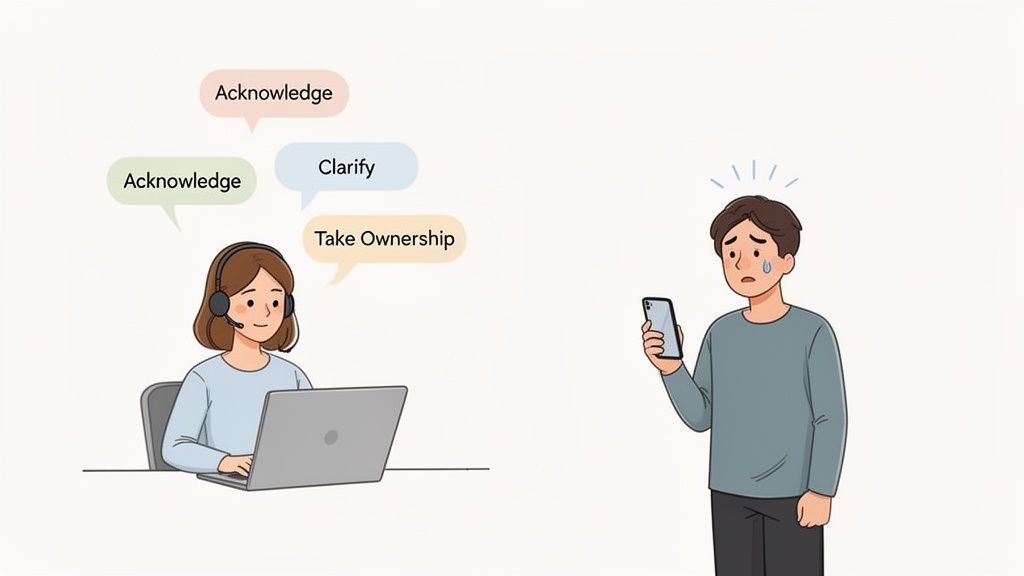
The secret isn’t a magic phrase or a generic, corporate apology. It’s about taking control with a simple, three-part framework: Acknowledge their frustration, Clarify the real problem, and Take Ownership of the fix. I call it the A-C-T method, and it’s your playbook for shifting the conversation from confrontational to collaborative, right from the first sentence.
Your First Five Minutes With an Unhappy Customer
Let's be honest, phrases like "we're sorry for the inconvenience" sound robotic and often make things worse. They lack genuine empathy. Your real goal is to cut through the anger and make the customer feel heard, understood, and confident that you’re the person who is going to solve this for them.
This is where the A-C-T framework comes in. It's a simple but incredibly powerful way to navigate those critical opening moments and de-escalate tension fast.
Acknowledge Their Frustration
Before you jump into problem-solving mode, your first job is to validate their feelings. They’re upset, and they need to know you get it. Acknowledging their emotion shows you’re on their side, not just another corporate wall.
- Avoid this: "I'm sorry you feel that way." It sounds dismissive and implies their feelings are the problem.
- Try this instead: "That sounds incredibly frustrating. I can completely understand why you're upset about the delayed delivery."
This subtle shift in language makes a huge difference. It confirms you’re actually listening and helps build an immediate human connection. You’re telling the customer they aren’t just another ticket number.
Clarify the Core Issue
Once you’ve validated their feelings, you need to quickly and calmly get to the heart of the matter. An angry customer might be all over the place, mixing several issues into one long rant. Your job is to cut through the noise and pinpoint the root cause without making them repeat their story.
Ask direct, but gentle, questions to get the facts straight. For example, if a customer just says, "Your product is a disaster!", you can clarify by asking:
"I'm so sorry to hear this isn't working for you. Could you tell me a bit more about what’s happening? Is it not turning on, or perhaps something was damaged when it arrived?"
Pro Tip: Paraphrasing their problem back to them is one of the most effective techniques in the book. Try something like, "Okay, so just to be sure I've got this right: you received the blue shirt instead of the red one you ordered, is that correct?" This shows you've understood them perfectly and are ready to take action.
This is also where you perform quick triage. We can categorise most complaints to figure out the next steps and manage expectations.
Here’s a quick framework for that initial assessment:
Immediate Customer Triage Framework
This table helps you categorise complaints on the fly to determine priority and the best first move.
Using a simple mental model like this helps ensure you’re spending your energy on the most critical issues first.
Take Ownership of the Solution
The final step in your opening response is to take clear ownership. This doesn’t mean admitting fault before you have all the facts. It simply means reassuring the customer that you are personally going to see this through to a resolution. You’re their champion now.
Use confident, action-oriented phrases like:
- "I'm going to look into this for you right now."
- "Let me take care of this for you."
- "I will personally make sure we get this sorted out."
This commitment is absolutely crucial for rebuilding trust. It changes the dynamic from "customer vs. the company" to "customer and you vs. the problem." A fast, reassuring response is non-negotiable; in fact, recent research shows that 54% of UK consumers say a timely response is the single most important factor in turning a negative experience around.
By mastering the A-C-T framework, you can consistently de-escalate tension and set the stage for a positive outcome. You can dive deeper into building these skills in our guide on customer service best practices.
Crafting Responses That Actually Solve Problems
Okay, you’ve acknowledged their frustration. That’s the easy part. A quick apology is a decent start, but it's not a solution. The real work begins now, moving past generic templates and into genuine, hands-on problem-solving. This is where you flip a negative experience on its head.
For an ecommerce brand, this means getting your hands dirty. Let's say a customer messages you because their discount code failed at checkout. Don't just say sorry. Dive into your Shopify admin. Was the code expired? Was it limited to certain products? Finding the root cause lets you give a specific, helpful answer, not a canned one.
A resolution isn't just about fixing the error; it's about restoring the customer's sense of fairness and control. A customer who feels you've treated them fairly is far more likely to come back, even after a stumble.
From Investigation to Resolution
Once you know what went wrong, you can build a response that doesn't just solve the problem, but shows you’re committed to getting it right. Your goal should always be to nail the first-contact resolution and stop the customer from ever having to chase you. When you're figuring out what to say, it helps to have a playbook of solid strategies and even some negative review response examples to lean on.
Let's walk through a couple of all-too-common scenarios.
- Scenario 1: "My Delivery is Missing"
- Investigation: The first thing you do is check the tracking number in your order management system. Is it marked as delivered? Stuck in transit?
- Bad Response: "Sorry, it says it was delivered." This is a dead end. You've just put all the work back on the customer.
- Good Response: "I'm so sorry your order hasn't arrived. I've just checked the tracking and see it was marked as delivered yesterday. Sometimes couriers mark packages early, but I’ve already started a trace with them for you. If it doesn't turn up in the next 24 hours, we'll get a replacement sent out immediately."
- Scenario 2: "I Received the Wrong Item"
- Investigation: Pull up their order in Shopify. Check the item they ordered against what your fulfilment log says was packed. Looks like a simple picking error.
- Bad Response: "You'll need to return the wrong item first." This just creates more hassle for an already annoyed customer.
- Good Response: "You are absolutely right—it looks like we made a mistake and sent the wrong item. I'm so sorry about that. I've already processed a new order for the correct one, and it will ship out today. I’ve also just emailed you a pre-paid return label; please feel free to send the incorrect item back whenever it's convenient."
For more detailed guidance on what to say in these tight spots, you can check out our comprehensive library of customer service scripts designed specifically for common ecommerce issues.
The Psychology of Choice
Here’s one of the most powerful techniques you can use to resolve a complaint: offer the customer a choice. When someone has a bad experience, they often feel a complete loss of control. Giving them some agency back is a brilliant way to restore that balance.
Instead of just telling them what the solution is, present them with options. For a damaged item, you could ask:
"I am so sorry the item arrived damaged. We want to make this right for you. Would you prefer we send you an immediate replacement, or would you be happy with a 50% partial refund if the damage is only cosmetic?"
This simple move does two incredible things:
- It empowers the customer: They get to decide what actually works best for them.
- It shows you're flexible: It signals that you’re focused on their satisfaction, not just blindly following a rigid policy.
By investigating properly, communicating clearly, and offering thoughtful solutions, you do more than just fix one problem. You show the customer they matter, turning a moment of pure frustration into a reason for them to trust your brand even more. This is how you really handle a disgruntled customer and build the kind of loyalty that lasts.
Knowing When and How to Escalate an Issue
Your frontline team is incredible, but they can't be expected to solve every single problem. A huge part of handling disgruntled customers is knowing when a situation needs a manager or a specialist. Pushing for a resolution when you're out of your depth just makes things worse, but escalating every tricky case grinds your managers' day to a halt.
The solution is a clear framework that empowers your team to know exactly when to pass an issue up the chain. This isn't about giving up; it's about smart, efficient problem-solving.
Defining Escalation Triggers
Think of escalation triggers as the red flags in a customer conversation. When one of these pops up, it’s a non-negotiable signal to involve a specialist or manager immediately. Trying to navigate these situations without the right authority can lead to broken promises and a customer who’s even more furious.
Your triggers need to be crystal clear. Here are a few common ones that should always mean immediate escalation:
- Threats of legal action or chargebacks: This is no longer a customer service issue. These carry financial and legal weight that frontline agents shouldn't have to handle.
- Public complaints on social media or review sites: A public fire needs a coordinated response. This requires a specific PR and management strategy, not a quick chat reply.
- Requests for a fix outside your standard policy: If a customer wants something you’re not authorised to give—like a massive refund, a custom product, or a special exception—it's manager time.
- Security concerns or data privacy issues: Any mention of a potential data breach or compromised account is an all-hands-on-deck emergency. This needs immediate attention from a specialised team.
- Abusive or threatening language: Your team’s safety is non-negotiable. Have a zero-tolerance policy that lets agents immediately escalate and disengage from abusive customers.
Defining these triggers removes the guesswork. Your agents no longer have to second-guess themselves. They have a clear process, which gets the customer to the right person, faster. This decision tree gives a good visual for how that process of investigation and resolution should flow.
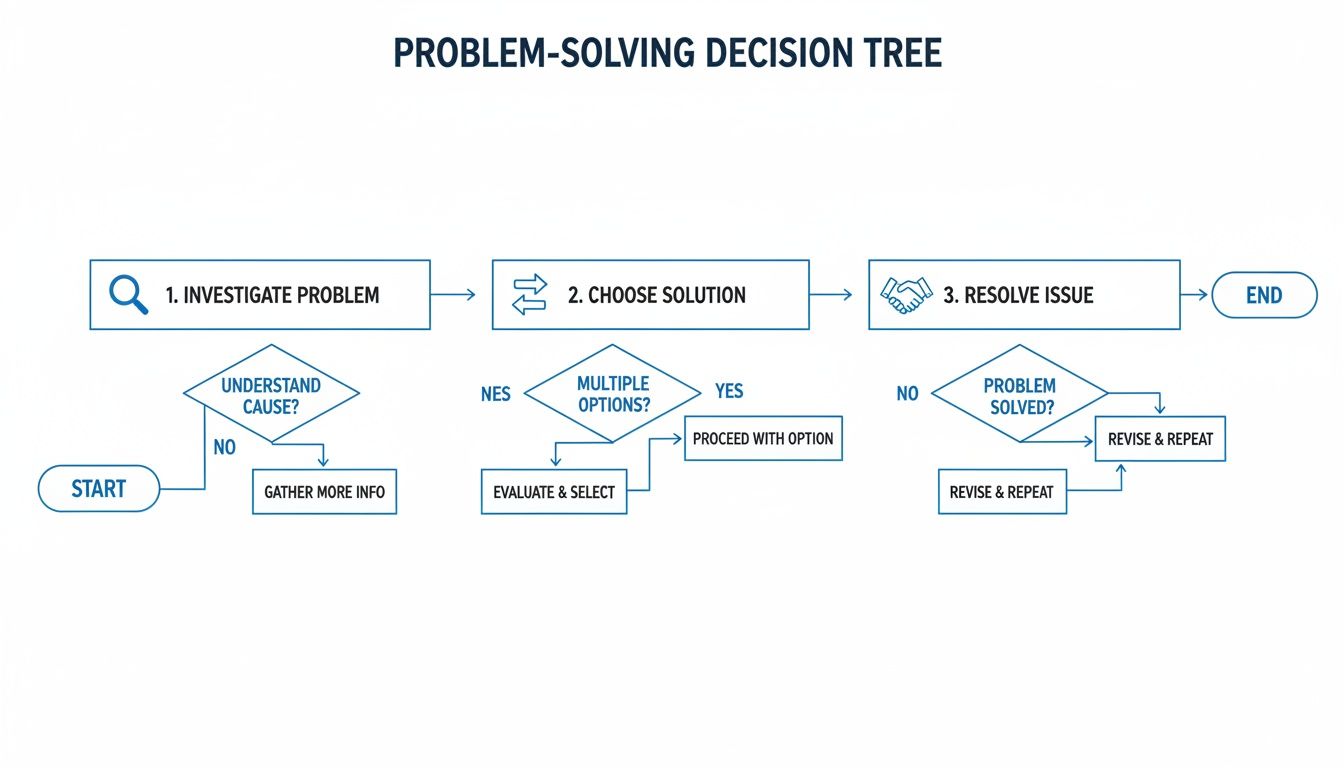
The chart makes it clear: every resolution starts with investigation before a solution is chosen. This is where your escalation rules are absolutely critical.
Executing a Warm Handoff
Just dumping a customer on your manager is a recipe for disaster. A “cold” handoff, where the customer has to repeat their entire story, is one of the most infuriating experiences you can put them through. You need to master the warm handoff.
The goal of a warm handoff is seamless continuity. The customer should feel like they're being passed to a collaborator, not being forced to start all over again.
This means the first agent gives the manager a full summary before the transfer. The manager then joins the conversation fully briefed, ready to say something like, "Hi [Customer Name], this is [Manager Name]. My colleague [Agent Name] has brought me up to speed on the issue with your order. I understand that [brief summary of the problem], and I'm here to get this sorted for you."
This simple step instantly communicates competence and shows you respect the customer's time. For more tips on streamlining your backend, check out our guide on effective order management for ecommerce.
Using AI for Smart Escalation
Let's be honest, manually spotting every escalation trigger is tough, especially when your team is swamped. This is where a tool like Marvyn AI really shines. You can create smart escalation rules to automate the entire process.
You can set up the AI to detect keywords (like “legal,” “chargeback,” or “furious”) or even certain behaviours (like a customer asking the same question three times in a row) and automatically flag the conversation for a human. This creates a perfect balance of automation and the human touch.
While customers are quick to switch brands, research from The Harris Poll highlights that 75% of UK consumers still want to talk to a person for emotional or complex problems. Smart escalation with Marvyn AI handles all the routine stuff automatically but seamlessly brings in a human at the exact moment they’re needed. It's the best of both worlds.
The best way to deal with an unhappy customer is to make sure they never become one. Instead of just putting out fires, you can get ahead of the frustration and build a smoother, more efficient experience from the very start.
Today's AI isn't about deflecting tickets or building a wall between you and your customers. For a busy Shopify store, it's about automating the predictable, repetitive questions that tie up your team and test a customer's patience.
Get Instant Answers for Common Questions
Take a moment and think about the questions your team answers over and over. A huge chunk of them are probably transactional things like "Where is my order?", questions about your returns policy, or checking on product details. These are perfect for automation.
An AI chatbot like Marvyn plugs directly into your Shopify store's backend — your product catalogue, order data, and policy pages. This means it can give accurate, personalised answers in seconds, 24/7. When a customer can get an instant update on their delivery at 11 PM on a Sunday, their frustration never even gets a chance to build.
The whole game is about removing friction. By offering immediate, self-service solutions for routine issues, you free up your human agents to focus on the complex, high-emotion situations that genuinely need their expertise and empathy.
This proactive approach isn't just a nice-to-have anymore. Recent data from the Institute of Customer Service shows a direct link between an organisation's ability to understand customer needs and rising satisfaction scores. For Shopify owners, this is a huge opportunity. The UKCSI 2025 data reveals that 64.1% of customers felt organisations understood their needs—an increase of 4.3 points.
With nearly 36% of consumers now prioritising excellent service over price, a fast, responsive system is a real competitive advantage.
Turn Support into a Sales Opportunity
But a genuinely intelligent AI does more than just answer post-purchase questions. It can also act as a proactive sales consultant, guiding shoppers before they even feel the need to contact support. This is a powerful way to cut down on the confusion that leads to abandoned carts.
Imagine a customer browsing your store, not quite sure which product is right for them. An AI assistant can step in and:
- Ask a few qualifying questions about their needs, budget, and preferences.
- Recommend specific products based on their answers, just like a knowledgeable sales rep would.
- Clarify shipping costs or delivery times right there in the chat, removing any last-minute checkout hesitation.
This consultative approach nips confusion in the bud, preventing it from turning into a support ticket later on. By guiding customers to the right purchase, you not only boost your conversion rates but also reduce the chances of returns and complaints down the line. You can dive deeper into how to get these systems running in our complete guide to automating your customer service.
Manual vs AI-Powered Customer Support
When you put a traditional support setup next to one that's augmented with AI, the difference is night and day. It shifts the whole dynamic from reactive firefighting to proactive problem-solving.
This table really highlights the shift:
By building this kind of resilient and efficient system, you’re doing more than just preparing to handle a disgruntled customer better. You're actively creating a support ecosystem where fewer customers get frustrated in the first place. It's a fundamental change that can turn your customer service from a cost centre into a powerful engine for growth and loyalty.
Turning Negative Feedback into Business Growth
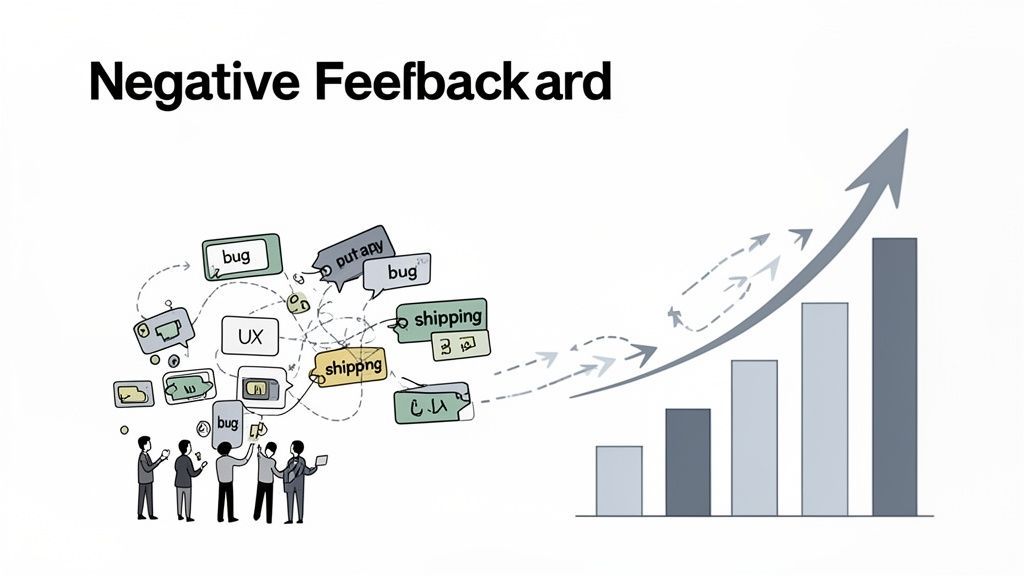
Successfully resolving a single issue feels like a win, but the real magic happens when you realise every complaint is a free consultation. A disgruntled customer isn't just a problem to solve; they’re giving you a raw, unfiltered look at the friction points in your business.
By systematically learning from these interactions, you can shift from constantly fighting fires to proactively improving your entire operation. This final step is about creating a system to turn that negative feedback into your most powerful tool for growth. It’s how you stop fixing the same problems over and over, and start building a stronger, more resilient brand.
Structuring Your Feedback Analysis
First things first: stop seeing support tickets as just a queue to be cleared. Each one is a data point. To make any sense of this data, you need a simple but effective way to tag and categorise every single customer complaint as you resolve it.
This doesn't need to be some complex, over-engineered process. You can start with broad categories and get more specific over time. A good starting point for most e-commerce brands includes:
- Product Issues: This could be broken down into things like Defects, Sizing/Fit Problems, or Misleading Descriptions.
- Shipping & Delivery: Common tags here are Delayed Shipment, Damaged in Transit, or Lost Package.
- Website/UX Problems: This category captures issues like Discount Code Failed, Checkout Error, or Page Not Loading.
- Policy Confusion: Use this for complaints related to your Returns Policy or Warranty Information.
Consistently applying these tags creates a treasure trove of structured data. Before you know it, you'll be able to spot patterns that would have otherwise been completely invisible.
Your unhappiest customers are your greatest source of learning. By systematically tracking their complaints, you're not just solving individual tickets; you're creating a diagnostic tool for your entire business.
From Data to Actionable Insights
Once you have a few weeks or months of tagged data, you can start asking some really powerful questions. Which product is getting the most defect-related complaints? Is one shipping partner responsible for an unusual number of delays? Are a lot of customers getting stuck on a specific page of your website?
This analysis is where you find the gold. Let's imagine you run a report and discover that 25% of all your support tickets last month were about "sizing issues" for a new line of jumpers. That's a huge red flag. It’s no longer just an individual problem; it's a systemic one.
This single insight gives you a clear, data-backed mission. You can now:
- Review the product page: Is the sizing chart unclear or just plain inaccurate?
- Inspect the product: Does the manufacturing run small compared to your other items?
- Update your marketing: Can you add a simple note like, "This item has a slim fit, consider sizing up"?
By taking these steps, you prevent countless future complaints, returns, and lost sales. This is how you handle a disgruntled customer at scale—by fixing the root cause so the problem never happens again for the next person. Understanding customer sentiment through metrics like your Net Promoter Score can also give you a broader view; you can learn more about how to calculate your NPS score to supplement this complaint data.
Building a Company-Wide Feedback Loop
Customer support can't operate in a silo. For this feedback to truly drive growth, the insights your support agents gather have to be shared across the entire organisation. This means creating a formal feedback loop between your support team and other key departments.
Here’s what that looks like in practice:
Set up a simple monthly or quarterly meeting where the support lead presents a summary of the top complaint categories. This makes customer feedback a central part of your company's strategic planning. Instead of guessing what customers want, you're using their own words to guide your decisions and build a stronger business, one complaint at a time.
Frequently Asked Questions
When you're in the thick of a tough customer chat, the same questions pop up again and again. Whether you're running your own Shopify store or you're on the front lines of support, having solid answers ready can make all the difference. Here are a few common ones we see all the time.
What Is the Single Most Important Thing to Do When a Customer Is Angry?
Speed and empathy. Full stop. When a customer is fuming, the first thing they want is to feel heard, not ignored. In fact, over half of UK consumers say a fast response is the most important factor in turning a bad experience around.
You don't need to have the perfect solution figured out in the first 30 seconds. A quick, human reply that acknowledges their frustration can instantly lower the temperature. Ditch the corporate jargon and say something real.
"I'm so sorry to hear about this. That sounds incredibly frustrating, and I'm looking into it for you right now."
A simple message like that does two things: it shows you're taking them seriously and it buys you the time you need to actually solve the problem. That moment of genuine empathy is your single best move.
Should I Offer a Discount to Every Unhappy Customer?
No, not for every complaint. While a discount can feel like a quick fix, handing them out like confetti can cheapen your brand and, worse, teach customers that complaining is the easiest way to get a deal.
The real key is matching the solution to the scale of the problem.
- A minor hiccup? A genuine apology and a fast fix are often enough. If a customer’s discount code didn’t apply, just apologise and generate a new one for them. Job done.
- A major mess-up? This is where you need to step up. If you shipped the wrong high-value item, you need to ship the correct one immediately, cover all the costs, and add something for their trouble, like a decent store credit for a future purchase.
Look into the issue first. The goal isn't just to throw free stuff at problems; it's to make the customer feel like they've been treated fairly. A well-judged response shows you care about getting it right.
How Can I Use AI to Handle Disgruntled Customers?
This is where things get really interesting. You can use an AI chatbot to handle the first contact with an unhappy customer, which frees up your team to focus on the issues that genuinely need a human touch. But you have to set it up correctly, or you risk making an angry customer even angrier.
First, the AI needs to be trained on your entire knowledge base. That means all your FAQs, product details, and especially your policies on things like shipping and returns. This is non-negotiable for it to give accurate, instant answers.
Next, you have to customise its personality. An AI that talks like your brand feels like an extension of your team, not a generic robot reading a script.
But the most critical part is setting up smart escalation rules. This is how you teach the AI when to stop and hand the conversation over to a person. These triggers are your safety net.
- Angry Keywords: The AI should immediately flag conversations containing words like "furious," "unacceptable," or "legal action."
- Repeat Questions: If a customer asks the same thing three times, they're stuck. That's a clear signal to bring in a human.
- Direct Requests: When someone types "speak to a person," the AI's only job is to make that happen smoothly.
This intelligent handoff means the AI resolves all the routine queries instantly, while the truly complex, emotional problems get the human empathy they require.
Ready to stop fires before they start? Marvyn AI automates over 70% of support queries, answers questions 24/7 in 80+ languages, and guides shoppers to the right purchase—all for free. Get started with Marvyn AI in one click and transform your customer service.