Crafting Welcoming Messages on Websites That Convert
That first interaction a visitor has on your site? It sets the tone for everything that follows. Think of a website welcome message not just as a polite ‘hello’, but as your best digital sales associate, greeting visitors the moment they arrive and working around the clock.
A thoughtfully crafted welcome, often delivered through a pop-up or chatbot, can immediately build trust, lower bounce rates, and gently guide visitors towards a purchase.
Why That First 'Hello' Matters More Than You Think
This isn't just some nice-to-have feature; it's a core growth strategy for any direct-to-consumer brand. The psychology is simple: a warm welcome makes visitors feel seen and valued from the very first second. Instead of leaving them to navigate your site alone, you’re proactively offering assistance.
That simple gesture can be the difference between a quick visit and a completed order.
How Welcome Messages Directly Drive Growth
A great welcome message does more than just greet. It’s a workhorse that serves several key business functions, all of which have a direct impact on your bottom line.
- Reduces Bounce Rates: By engaging visitors instantly, you give them a concrete reason to stick around and explore, rather than just clicking away.
- Builds Instant Trust: A helpful, on-brand message shows you actually care about the customer's experience. It establishes credibility from the start.
- Guides the Shopping Journey: You can point new visitors towards best-selling collections, flag a current promotion, or offer personalised help to find a specific product.
- Boosts Conversions: A small incentive, like a 10% discount for a first purchase or free shipping, is often the exact nudge a hesitant visitor needs to buy.
A strong first impression is the foundation of the entire customer journey. When you proactively engage visitors, you turn a simple website visit into a genuine connection and lay the groundwork for a better overall ecommerce customer experience.
The good news is that modern tools, especially AI-powered chatbots like Marvyn AI, have made setting up these personalised moments incredibly simple. These systems can work 24/7, delivering instant value without you needing to be there.
They analyse visitor data in real-time to serve up the most relevant message, turning a passive browsing session into an active, guided shopping experience. For example, a chatbot can greet a visitor arriving from an Instagram ad with a message that references the exact product they just saw. That creates a seamless and compelling path to purchase—and that's the real power of a strategic first impression.
Building Your Welcome Message Strategy
A great welcome message isn't just a friendly 'hello'. It's your strategic first move. Before you even think about writing the copy, you need a solid game plan that turns that initial greeting into a powerful tool for guiding and converting visitors.
It all starts with your brand's personality. Is your shop fun and a bit quirky, or are you aiming for a sleek, high-end luxury feel? Your welcome message has to sound like it’s coming from you. If it feels disconnected from the rest of your site, it’ll fall flat.
Set Clear Objectives
With your brand voice locked in, what do you actually want your message to do? A vague goal like "increase sales" is useless here. You need to get specific and focus on measurable actions.
Think about what a new visitor needs most. Your primary goal could be to:
- Spotlight a new collection: Immediately point first-time visitors towards your latest product drops.
- Capture a lead: Give them a compelling reason to join your newsletter, like a 10% discount or access to exclusive content.
- Offer expert help: Proactively engage shoppers who look lost or might need help with sizing or product details.
- Reduce cart abandonment: Use an exit-intent message with a small incentive to keep shoppers from leaving empty-handed.
The right first impression builds a clear path towards a sale.
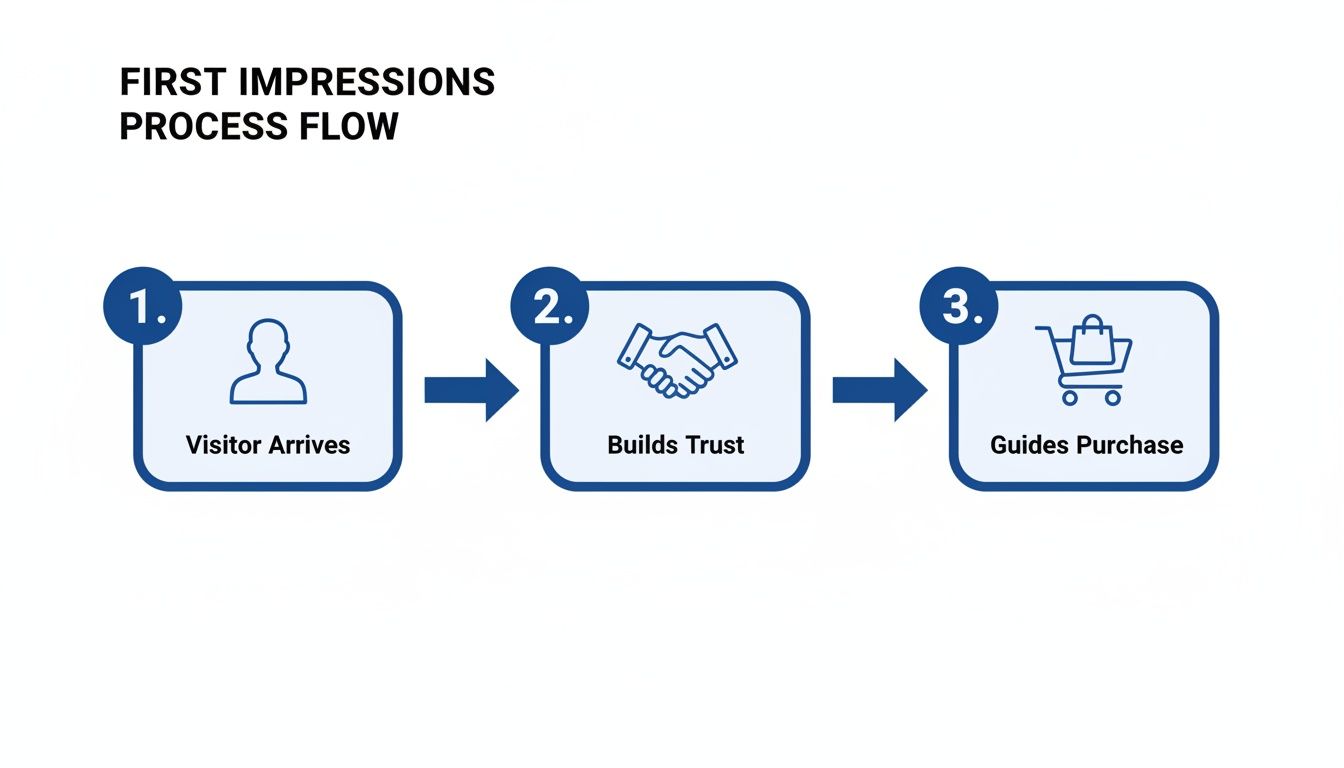
As you can see, the journey from arrival to purchase hinges on building immediate trust and providing clear, helpful guidance from the very start.
This table helps you pair common ecommerce goals with the most effective welcome message formats and provides practical examples to get you started.
Matching Your Goals to the Right Welcome Message
By matching your message format directly to your goal, you ensure every interaction has a purpose and a better chance of success.
Map the Customer Journey
Your strategy also needs to account for where visitors are coming from and who they are. You wouldn't greet a loyal returning customer the same way you'd greet a new visitor who clicked through from a TikTok ad. Mapping these different journeys is key to delivering a relevant message at the perfect moment.
The data shows just how powerful this is. In a study of over 500 UK businesses, 51% saw higher traffic after implementing welcoming messages on websites. Automated greetings, often powered by AI chatbots like Marvyn AI, can hit engagement levels similar to the impressive 80% open rates of welcome emails. Even better, they've been shown to boost placed order rates by 15-20% just by providing instant product answers.
When building your strategy, it's important to consider the core purpose of your message; understanding the difference between content writing and copywriting can help clarify whether your goal is to inform or to persuade.
Ultimately, a strong strategy ensures every welcome message serves a specific purpose tied directly to your business goals. By defining your tone, setting clear objectives, and mapping the journey, you create a framework for messages that not only greet but also effectively convert. For more tips on improving your site's performance, check out our conversion rate optimisation checklist.
Personalising Greetings for Every Visitor
Let's be honest, a generic "Welcome to our store" just doesn't cut it anymore. It's a missed connection right at the front door. Your first greeting is your chance to show a visitor you see them, not just another number in your analytics.
Tailoring your welcoming messages on websites based on who someone is and how they found you is the secret to making a great first impression. It’s the difference between a cold, transactional website and a warm, inviting brand experience. This is the core of ecommerce personalization—moving beyond one-size-fits-all and having real, relevant conversations.
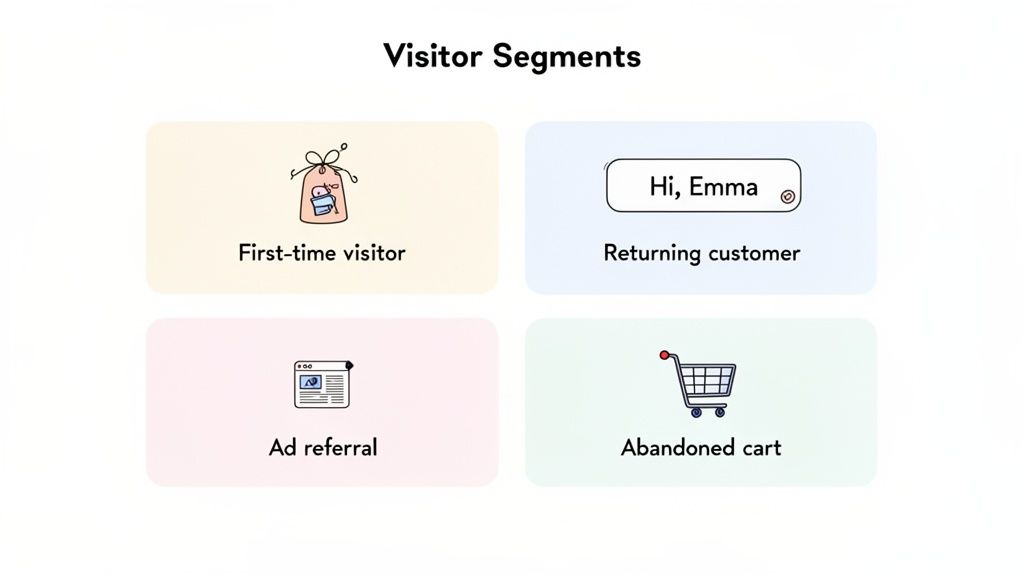
This might sound like a lot of work, but smart tools make it surprisingly simple. AI-powered platforms like Marvyn automatically tap into data like referral source, browsing behaviour, and purchase history to start meaningful conversations in real-time.
Greet First-Time Visitors
When someone new lands on your site, your main job is to build trust and get them exploring. They don't know you yet, so your message needs to be warm, genuinely helpful, and give them a clear reason to stick around.
- Scenario: A user lands on your homepage for the very first time.
- Weak Message: "Welcome!"
- Strong Message: "Welcome to [Your Brand]! So glad you're here. As a little treat, enjoy 15% off your first order with code: NEW15. Need help finding anything?"
See the difference? The second option doesn't just say hello; it offers an immediate incentive and opens the door for a conversation. It turns a passive visit into an active one.
Welcome Back Loyal Customers
Your returning customers are gold. They already like you, so make them feel seen and valued. Acknowledging their loyalty is key, and personalising their return visit makes the experience that much smoother.
- Scenario: A customer who has purchased before comes back to your site.
- Weak Message: "Welcome back!"
- Strong Message: "Welcome back, Sarah! Great to see you again. We've just dropped a new collection we think you'll love based on your last order. Want to take a look?"
This is how you build relationships, not just process transactions. If you want to dig deeper into building these kinds of connections, check out our guide on how to improve customer engagement for more practical strategies.
Engage Shoppers from Ad Campaigns
If you're paying for ads, the journey from click to conversion needs to be absolutely seamless. Your welcome message should feel like a direct continuation of the ad they just saw, creating a cohesive path to purchase.
- Scenario: A visitor lands on your site after clicking a Facebook ad for your "Summer Linen Shirts" collection.
- Weak Message: "Hi! How can I help?"
- Strong Message: "Hey there! Saw you were checking out our Summer Linen Shirts on Facebook. They're perfect for the warm weather. Can I help you find the right size or colour?"
This kind of targeted greeting closes the loop between your ad and your store. It confirms they’re in the right place and immediately guides them towards the product they’re already interested in, which massively boosts the chance of a sale.
Re-engage Abandoning Shoppers
Nearly 70% of online shopping carts are abandoned. Ouch. An exit-intent message is your last, best shot at saving that sale. It pops up the moment a user shows they’re about to leave, giving you one final chance to make an offer they can't refuse.
- Scenario: A user has items in their cart and moves their cursor to close the browser tab.
- Weak Message: "Don't go!"
- Strong Message: "Wait! Before you go, how does free shipping on your order sound? Complete your purchase now, and we'll handle the delivery cost."
This is a strategic move. It directly addresses one of the biggest reasons for cart abandonment—unexpected costs—and can be the exact nudge someone needs to finish checking out. By segmenting your visitors and personalising your greetings, every single interaction becomes an opportunity.
Choosing Your Welcome Message Channel
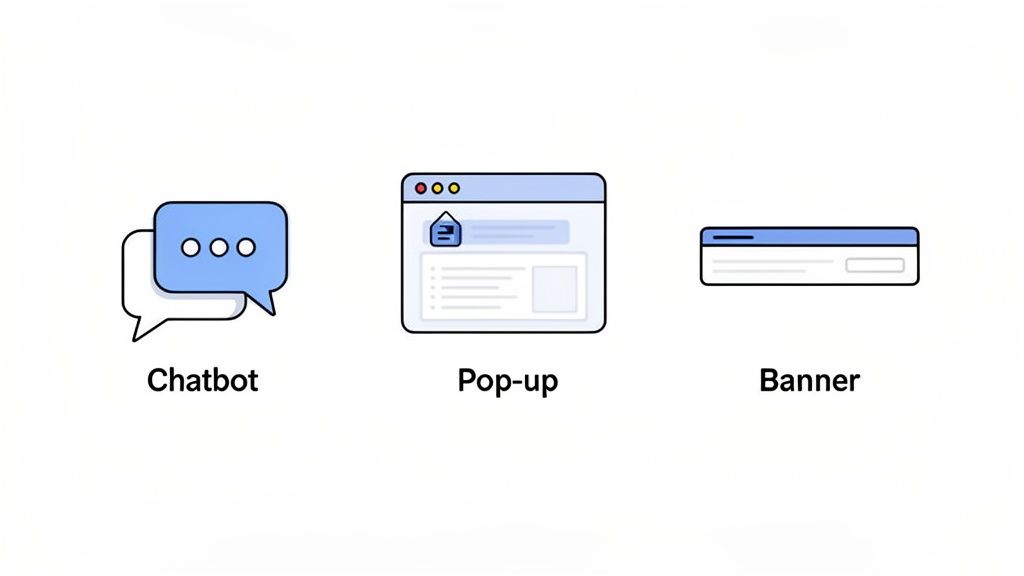
Alright, you know who you’re talking to and what you want to say. Now for the practical part: how are you actually going to deliver these welcoming messages on websites? The channel you pick is just as important as the message itself—it sets the tone for the entire interaction.
You’ve basically got three tools in your belt: the trusty static banner, the high-impact pop-up, and the dynamic AI chatbot. Each has its place, and knowing when to use which one is key to making a great first impression.
Static Banners: The Low-Intrusion Approach
Static banners are your most passive option. They usually sit at the top or bottom of the screen, making quiet announcements like a free shipping offer or a site-wide sale. They're great for general messages because they get the point across without interrupting the shopping experience.
But that’s a double-edged sword. Because they don’t get in the way, they’re also incredibly easy to ignore. We’ve all developed a bit of "banner blindness" over the years. They’re a one-way street—not interactive, not personal, and definitely not the right tool for starting a real conversation.
Pop-ups: High Impact, High Risk
Pop-ups are the complete opposite. They demand attention. When used wisely, they are brilliant for time-sensitive offers or capturing an email with a first-purchase discount. Exit-intent pop-ups are particularly effective, giving you one last shot to convert a visitor who's heading for the door.
The danger, of course, is that they can be incredibly annoying. A pop-up that appears the second someone lands on your site feels aggressive and can make a brand look cheap, sending bounce rates through the roof. My advice? Use them sparingly and only when you have a genuinely good offer on the table.
The key to a successful pop-up is a clear value exchange. A visitor will forgive the interruption if you're offering something truly useful—a real discount, a helpful guide, or a solution to a problem they're facing right at that moment.
AI Chatbots: The Dynamic Conversation Starter
This is where it gets really interesting. AI chatbots like Marvyn AI give you the best of both worlds. They’re proactive enough to get noticed but subtle enough not to feel intrusive, usually sitting neatly in the corner of the screen until they’re needed.
A chatbot takes what would be a one-way announcement and turns it into a genuine two-way conversation. Instead of just stating a fact ("We have free shipping over £50"), it can engage, ask questions, and offer personalised guidance. For a deeper dive into this, our guide on implementing live chat on a website is a great read.
Just think about the possibilities here:
- For a fashion brand: An AI chatbot can act like a personal shopper, asking for a visitor's measurements to recommend the perfect size.
- For a tech store: It can ask about a visitor’s budget and needs before suggesting the right laptop.
- For any store: It can greet a visitor who clicked on a specific ad with a message that directly references the product they were just looking at.
This kind of dynamic, personal interaction is something banners and pop-ups just can’t do. It lets you deliver welcoming messages on websites triggered by actual behaviour, making the greeting feel genuinely helpful, not just automated.
Measuring Performance and Optimising Your Strategy
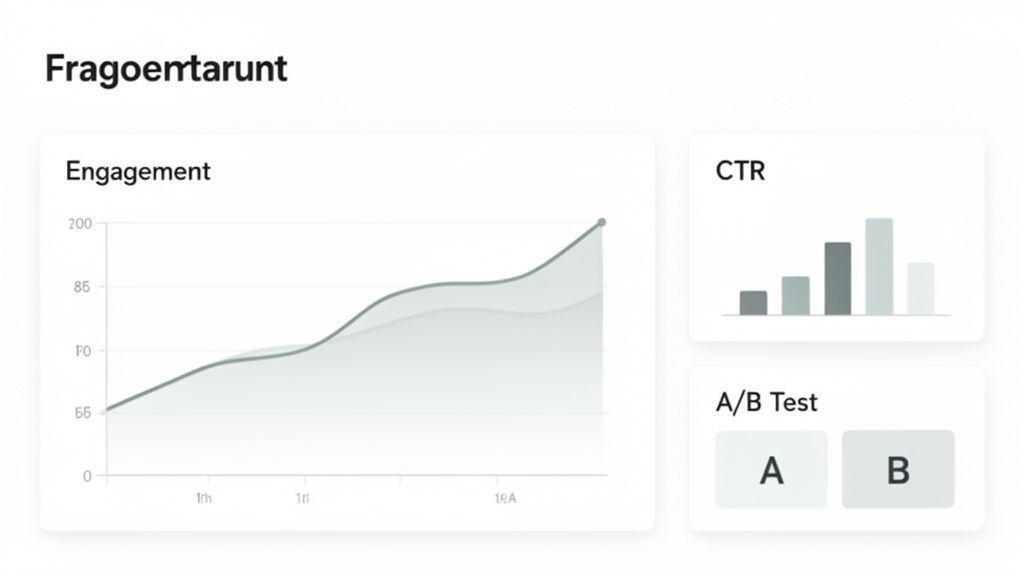
Getting your welcome messages live is a great first step, but the real work—and the real magic—happens when you start optimising. A data-driven approach is what turns a friendly "hello" into a powerful revenue driver. If you're not tracking performance, you’re just guessing what your customers actually want.
The goal is simple: find out exactly what resonates with your visitors and what nudges them toward a purchase. This means getting past the vanity metrics and focusing on numbers that connect directly to your bottom line.
Key Metrics to Track
First things first, you need to know what to measure. Good analytics dashboards, like the one built into Marvyn AI, cut through the noise by showing you the most important indicators for your welcoming messages on websites.
I’d recommend focusing your attention on these three core metrics:
- Engagement Rate: This is the percentage of visitors who actually interact with your chatbot, banner, or pop-up. Think of it as your baseline for whether your message is even getting noticed.
- Click-Through Rate (CTR): For any message with a button or a link, CTR tells you how many people clicked it. A high CTR is a strong signal that your offer is compelling.
- Assisted Conversion Rate: This is the one that really matters. It tracks how many visitors who engaged with a welcome message went on to buy something during that same visit.
An assisted conversion directly links your welcome message strategy to sales. If your engagement is high but assisted conversions are low, that’s a crystal-clear sign your message is visible but the offer isn't strong enough to actually close the deal.
This data becomes your roadmap for improvement, showing you exactly where to put your energy. For more tips on turning visitors into customers, our guide on how to improve the ecommerce conversion rate is a fantastic starting point.
Master A/B Testing for Continuous Improvement
Once you have your baseline numbers, it’s time to start experimenting. A/B testing is just a fancy way of saying you show two different versions of a message to similar audiences to see which one performs better. It’s the best way to stop guessing and start making decisions based on real user behaviour.
The key is to test one thing at a time. Does "15% Off" beat "Free Shipping"? Does a message that triggers after five seconds work better than one that appears when someone tries to leave the site?
Try testing a few of these elements:
- The Offer: Discount percentage vs. free delivery vs. a free gift.
- The Copy: A playful, witty tone vs. a more direct and helpful one.
- The Trigger: On-page load vs. after a time delay vs. on exit-intent.
Even tiny tweaks can have a massive impact. In the UK e-commerce scene, the power of a warm welcome is undeniable. It mirrors the success of welcome emails, which boast an incredible 80% average open rate. We’ve seen brands that take the time to customise their tone and logo in their website messages get 41% higher click-throughs on recommendations, which in turn lifts their average order value by 15-20%. These UK email marketing statistics show just how much potential is there.
By constantly measuring and refining, you ensure your welcome strategy doesn't just greet visitors—it actively grows your business.
Common Questions About Website Welcome Messages
Whenever we talk about adding welcome messages to a site, the same few questions always pop up. It's smart to be sceptical—you don't want to add something that gets in the way of a sale.
Let's tackle those common concerns head-on with some straight answers, based on what actually works for real e-commerce stores.
Are Welcome Message Pop-Ups Annoying to Visitors?
It's the first question everyone asks, and for good reason. We've all been hit with an aggressive, full-screen pop-up demanding an email the second a page loads. Yes, that is annoying. It kills the experience before it even starts.
But the real answer is, it depends entirely on timing, value, and relevance. A pop-up that blocks the entire screen right away is intrusive. One that slides in with a helpful offer when a user is about to leave? That’s just good business.
The key is to be helpful, not disruptive.
For a less aggressive approach, an AI chatbot sitting quietly in the corner is often a much better bet. It puts the visitor in control, offering help without interrupting their browsing. They can engage if and when they need to.
How Can I Create Personalised Messages Without a Developer?
Not long ago, this kind of personalisation required a full-time developer and a massive budget. That's just not the case anymore.
Modern tools like Marvyn AI were built specifically for store owners, not coders. After a one-click installation on Shopify, you get a simple visual interface where you can build seriously powerful rules without touching a line of code.
For example, you can set up a rule that says:
- IF a visitor lands on your site from a Facebook ad for your "Summer Dresses" collection...
- THEN the chatbot greets them with: "Welcome! Looking for the perfect summer dress? I can help you find the right style and fit."
These tools plug directly into your store's data, so you can personalise based on where a visitor came from, what they've looked at, and what they've bought before. All of it is managed through a simple dashboard.
What Is the Most Important Metric to Track?
It’s easy to get distracted by vanity metrics. Things like engagement rates or click-throughs are nice to see, but they don't pay the bills. They tell you if people are noticing your message, not if it's actually working.
The single most important metric is the assisted conversion rate.
This number tells you exactly how many customers who interacted with a welcome message went on to buy something in that session. It’s the metric that directly connects your welcome messages to your revenue.
Analytics dashboards, like the one inside Marvyn AI, are built to track this for you. If you see lots of clicks but no assisted conversions, you know your message is grabbing attention but the offer isn't strong enough to close the deal. That’s the kind of insight you can actually use to make more money.
Ready to turn more browsers into buyers with a smart, automated welcome? Marvyn AI installs in one click and starts engaging shoppers 24/7. Get your free AI chatbot at https://www.marvyn.co.