What is consultative selling: A Practical Guide to Ecommerce Success
Think about the last time you felt truly understood by a salesperson. They weren't just pushing a product; they were a helpful expert guiding you to the perfect solution. That’s the heart of consultative selling.
It's a complete shift away from just processing orders. Instead, it’s a customer-first approach where your goal is to understand a shopper's real needs and recommend the absolute best fit for them—just like a trusted advisor would.
From Transactional to Consultative
Most e-commerce is purely transactional. A customer lands on your site, finds something, and buys it. The whole interaction is often anonymous and over in minutes, centred entirely on the sale itself. But consultative selling flips that model on its head.
Instead of just being a digital catalogue, your store becomes a problem-solving partner. You’re moving beyond simply selling to advising. You don’t just show a customer a list of tents; you ask them where they're camping, how many people are going, and what season it is to help them find the right tent.
This switch from a passive product display to an active, helpful guide is how you build real trust and loyalty. By genuinely focusing on the customer’s success, you create a connection that lasts long after the checkout. For a deeper look into creating these valuable interactions, you can learn more about how to improve the ecommerce customer experience.
A Mindset Shift
The real difference is in the objective. One method is all about volume and speed, while the other is about value and building a relationship. This doesn't mean consultative selling is slow—it just means it's smarter. It leads to happier customers who are more confident in their purchase.
This advisory role helps customers cut through the noise of endless options, validates their needs, and reassures them they're making the right call. When you understand their problem and guide them to a solution, you turn a simple purchase into a memorable, positive experience.
The best way to see the difference is to compare them side-by-side.
Transactional vs Consultative Selling
Ultimately, the consultative approach is about putting the customer’s journey ahead of the immediate sale. It’s a strategy built on empathy, expertise, and a real desire to help. When you adopt this model, your brand becomes more than just a place to buy things—it becomes a go-to resource that customers trust and return to again and again.
The Six Principles of a Consultative Approach
To move from just ‘selling stuff’ to becoming a trusted advisor, you need to master the consultative mindset. This isn't a single action but a sequence of six core principles that work together, step-by-step, to build real trust and guide customers to the perfect solution for them.
When done right, the entire process feels natural and helpful, not pushy. The whole interaction follows a simple, three-stage flow that puts understanding the customer first.
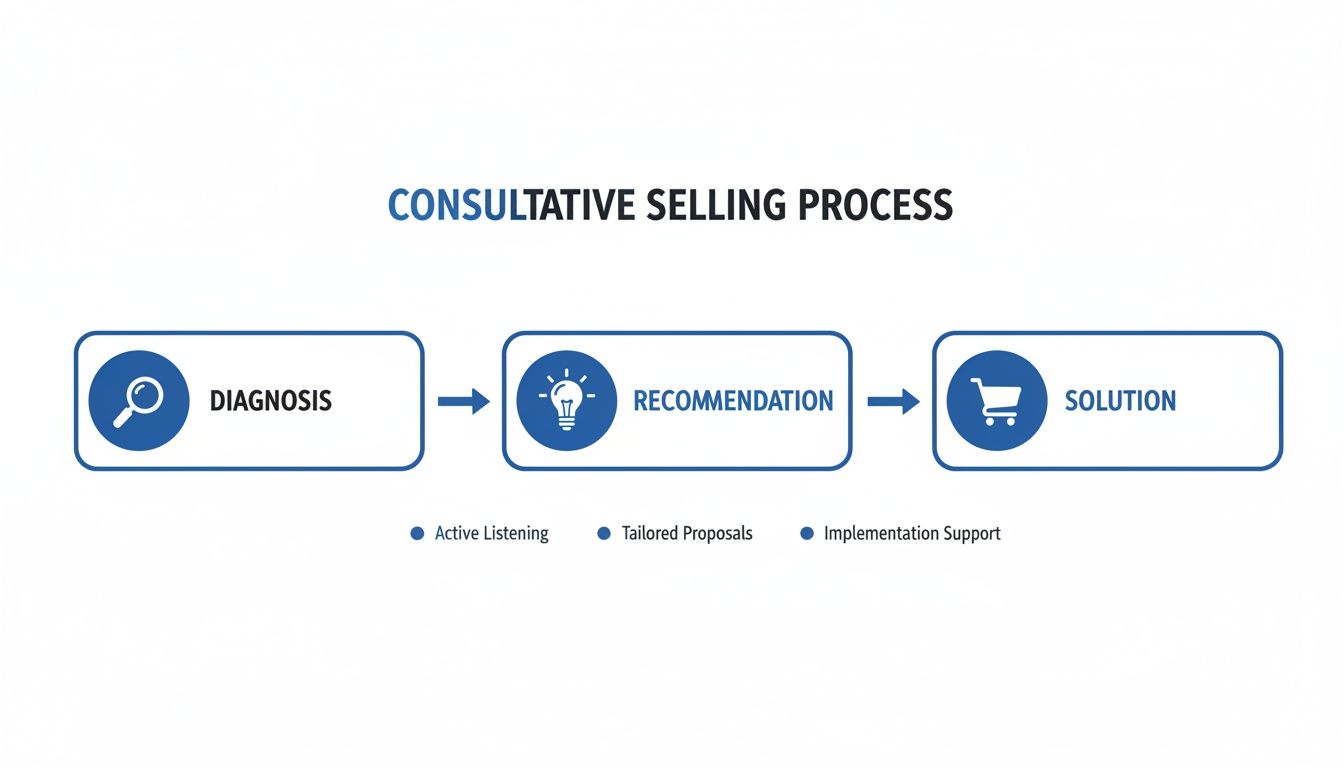
This visual makes it clear: you can’t recommend a solution until you’ve properly diagnosed the problem. Let’s break down the principles that make this work.
1. Research and Prepare
The first rule is simple: do your homework. In an ecommerce setting, this isn’t about cold-calling research. It’s about understanding customer behaviour on your site, spotting the common questions your support team gets hammered with, and knowing the real-world problems your products solve.
A skincare brand, for example, might notice heaps of visitors comparing two specific anti-ageing creams. That single insight is your starting point for a genuinely helpful, consultative conversation.
This proactive approach is essential in the UK’s retail market. Online sales recently accounted for 28.0% of all retail spending. To stand out, brands must bridge that digital gap with tactics that make online shopping feel just as personal as walking into a physical shop. You can read more about the latest UK retail trends from the ONS.
2. Ask and Listen
Once you’ve got your research, it’s time to engage. This is where you move from observing to interacting. A great consultative salesperson—or an AI chatbot built to think like one—asks open-ended questions designed to get to the heart of what the customer actually needs.
Forget asking, "Can I help you?" A much better question is, "What are you hoping to achieve with your new running shoes?" This prompts a detailed answer that reveals their true goal, not just the product they think they want. The 'listening' part is about actually processing their answer to guide what you do next. We dig into this more in our guide on customer service best practices.
3. Teach and Inform
After you’ve listened, your role flips from investigator to teacher. You use the customer’s stated needs to filter the information you provide, ensuring it’s relevant and genuinely valuable. This isn't a sales pitch; it's an educational moment.
The goal is to empower the customer with knowledge so they can make a confident decision. You’re not telling them what to buy—you’re explaining why a particular option is the best solution for their specific problem.
4. Qualify the Fit
As you’re teaching, you’re also qualifying. This means making sure your product is actually the right fit for the customer's needs, expectations, and budget.
If someone looking for a basic laptop for emails keeps asking about high-end gaming features, a consultative approach means you gently guide them back. You can explain the trade-offs in price and performance to ensure their expectations line up with what the product can deliver.
5. Propose a Solution
Only after you’ve researched, listened, taught, and qualified do you formally recommend a solution. This proposal should connect directly back to the specific needs you uncovered earlier.
You frame it as the logical outcome of your conversation, reinforcing exactly how this product solves their specific problem. The trust is already built.
6. Close and Confirm
Finally, you close the sale. In a consultative world, this is a natural, low-pressure step. The customer feels understood and is already confident in the solution you’ve built together.
The close is less about persuasion and more about confirmation. Your job is just to make the path to purchase as smooth and easy as possible.
Why Consultative Selling Drives Real Business Growth
Moving to a consultative model isn't just about tweaking your sales tactics; it's a direct investment in real, long-term growth. The benefits aren't just theoretical fluff—they show up in the key performance indicators (KPIs) that actually matter to your e-commerce business. By putting the customer’s needs first, you build a powerful engine for profitability.
When you guide a customer to the right solution, you're doing more than just closing a sale; you're building their confidence. This confidence often leads them to choose a better, more suitable product—which directly pushes up your Average Order Value (AOV). Instead of just grabbing the cheapest option, they invest in the best one for their needs. To see more on this, check out our complete guide on how to increase average order value.
Boost Your Bottom Line
The real-world impact of this approach is clear across your most important metrics. When you proactively solve problems and answer questions before they become deal-breakers, you can make some serious improvements.
- Higher Customer Lifetime Value (LTV): Trust is the bedrock of loyalty. When customers feel understood and valued, they are far more likely to come back, turning one-time buyers into repeat business.
- Reduced Cart Abandonment: Uncertainty is one of the biggest killers of sales. A consultative approach tackles those doubts on the spot, reassuring shoppers they’re making the right choice and clearing the path to checkout.
- Increased Conversion Rates: Guiding a customer is always more effective than leaving them to wander through your store alone. By helping them find their perfect product quickly, you dramatically raise the odds of a successful sale.
Drive Conversions and Loyalty
Consultative selling moves the needle on these critical metrics because it fundamentally changes the customer interaction from a passive browse to an active conversation. One study found that 84% of business buyers are more likely to buy from sales reps who genuinely understand their goals. That same principle applies directly to e-commerce.
Understanding what your customer actually needs is the first step in building a better sales strategy. For example, once you diagnose their problems, you can figure out how to improve ecommerce conversion rates and boost sales.
The core idea is simple: a helpful experience is a profitable one. Every question answered and every problem solved builds a layer of trust that transactional selling can never achieve.
This creates a positive feedback loop. Happier customers lead to better reviews, stronger word-of-mouth referrals, and a brand reputation built on expertise—not just on having the lowest prices. This is how you build a resilient business that thrives, even in a crowded market.
So, how do you actually bring consultative selling to your website? It’s about transforming your product pages from static catalogues into dynamic, helpful advisors. The goal is to guide shoppers and answer their questions before they even have to ask, building trust with every single click.
This all starts with a foundation of deep knowledge. You have to know your products inside and out—not just their specs, but the real-world problems they solve. That expertise is the fuel for every conversation, whether it's with a human agent or a piece of technology.
From there, you flip the focus to the customer. Who are they? What are their goals, their budgets, their biggest headaches? Creating detailed customer personas is non-negotiable here. A "budget-conscious student" has entirely different needs from a "luxury-seeking professional," and your advice has to reflect that.
Build Your Digital Sales Advisors
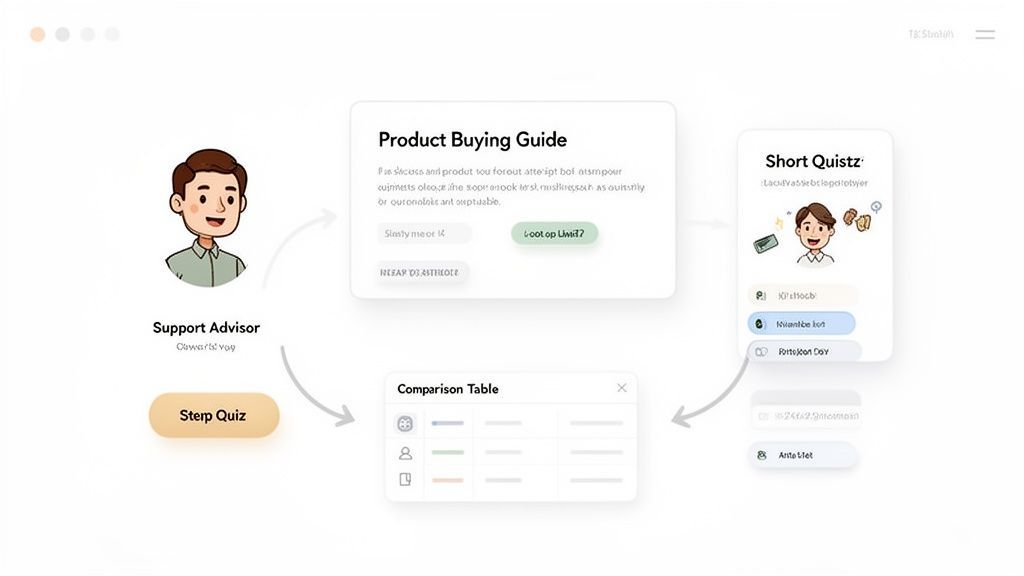
Once you’ve got a handle on your products and customers, you can start creating content that acts like a silent salesperson, working 24/7 to guide shoppers. This is where you put all that expertise on full display.
- Detailed Buying Guides: Go deep. Create comprehensive guides that walk customers through their decision. For a camera shop, this might be a guide on "Choosing Your First Mirrorless Camera," breaking down sensor sizes, lens compatibility, and video features in plain English.
- Interactive Quizzes: Build simple quizzes that ask a few diagnostic questions and then recommend products based on the answers. A skincare brand, for instance, could ask about skin type, concerns, and lifestyle to suggest a fully personalised routine.
- Product Comparison Tools: Let shoppers compare key products side-by-side. Highlighting the differences in specs and ideal use cases helps them make an informed choice, which builds their confidence in the purchase.
Think of these assets as your digital advisors. They provide real value and steer customers toward the right solution for their specific needs.
Train Your Team to Be Consultants
Your customer support team is on the front line, and it’s crucial to train them to think like advisors, not just ticket-solvers. This means empowering them to ask probing questions to get to the customer’s true goal, not just their stated problem.
A customer might ask, "Does this backpack have a laptop sleeve?" A transactional agent says, "Yes." A consultative agent asks, "Great question! What size laptop are you carrying? It helps to make sure you get a perfect fit."
That simple shift transforms a functional query into a genuinely helpful consultation. By focusing on the underlying need, your team builds trust and can even upsell or cross-sell by recommending additions that are actually useful. An effective support tool is vital here, and you can learn more about how to add live chat on a website to make these conversations happen.
Finally, all these manual efforts—creating content, training staff—can be automated and scaled. This is where modern AI tools come in, acting as a force multiplier for your consultative strategy. An AI chatbot like Marvyn AI can absorb all your product knowledge and guides, becoming an instant expert that provides personalised recommendations around the clock. This makes a sophisticated consultative approach accessible to any business, regardless of its size.
Automating Your Consultative Sales with AI
Scaling a personalised, consultative experience used to mean hiring a large sales team. It was expensive and slow. Today, artificial intelligence makes it possible for any e-commerce brand to deliver this high-touch service, turning your website into a 24/7 expert advisor that perfectly executes the consultative framework.
An AI chatbot, such as Marvyn AI, acts as your digital sales consultant. It automates the entire process, starting with what would take a human employee weeks: research. By syncing with your full product catalogue, policies, and web pages, it gains deep product knowledge in seconds.
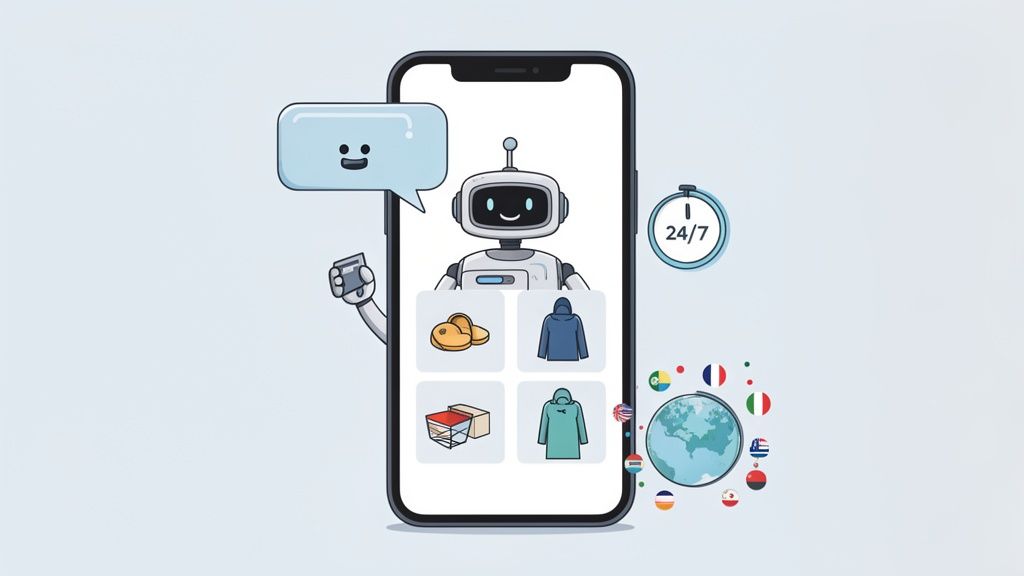
With that knowledge baked in, the AI can immediately begin a real consultative dialogue. It moves beyond generic greetings to ask intelligent, diagnostic questions, all to understand a shopper's specific needs, preferences, and budget.
How AI Executes the Consultative Framework
By understanding a customer's intent, the AI can then teach and inform. It provides instant, accurate answers and genuinely personalised product recommendations, guiding the customer towards the best solution for their problem. It’s the digital version of a top-performing human sales associate.
- It asks and listens: The AI engages shoppers with open-ended questions to uncover what they’re trying to achieve.
- It teaches and qualifies: It provides relevant information, filters out the noise, and makes sure the recommended products are a genuine fit.
- It closes with confidence: By resolving doubts and making the path to checkout frictionless, it helps confirm the sale.
This automated guidance is especially critical in markets like the UK, where B2B transactions alone account for £1.7 trillion, and 71% of buyers say they value helpful interactions. Yet, a staggering 34% of sales reps only reply the next business day, despite 72% of buyers rating immediate responses as very important. AI tools close this gap, automating service while driving sales that build trust and loyalty.
For practical examples of how AI can transform sales, explore what the Lunabloom AI platform offers. These systems show just how well technology can replicate and scale expert human interactions.
Scaling Your Expertise Globally
The true power of AI in consultative selling is its ability to scale. A tool like Marvyn AI can automate over 70% of customer interactions, handling unlimited conversations at the same time in over 80 languages. This means you can deliver a world-class, consistent consultative experience to every single visitor, around the clock.
For small to midsize merchants, this technology levels the playing field. It provides the capabilities of an enterprise-level sales team without the overhead, turning your website into a powerful sales engine that boosts conversion rates and average order value.
This frees up your human team to focus on high-level strategy and handle only the most complex escalations. By implementing this technology, you are not just answering questions; you are creating a scalable system for building relationships and driving revenue. You can learn more about how to deploy these systems by reading our guide on AI sales agents.
Common Questions About Consultative Selling
Even when you’ve got the principles down, a few nagging questions always seem to pop up. It’s totally normal to wonder how a strategy famous for high-value B2B deals could possibly work in the fast-paced world of ecommerce.
Let's tackle those lingering doubts head-on. Here are the most common questions we hear from store owners about putting a consultative framework into practice.
Can Consultative Selling Work for Low-Cost Products?
Absolutely. While its reputation was built on big-ticket items, the core principles are universal. For lower-cost products, the goal isn't a long sales call but a quick, automated, and genuinely helpful interaction.
It’s all about guiding a customer to the right bundle, pointing out a money-saving subscription, or helping them choose between two very similar items. An AI chatbot can run these "micro-consultations" at scale, asking a customer about their hair type to recommend the perfect £20 shampoo. That small, helpful moment builds trust, cuts through purchase anxiety, and boosts customer lifetime value.
Is This Approach Too Slow for Fast-Paced Ecommerce?
It’s a common myth that being consultative means being slow. With the right tools, the opposite is true. A consultative approach is actually faster and more efficient for the customer than leaving them to browse aimlessly.
Think about it. Instead of a shopper clicking through dozens of product pages or waiting hours for an email reply, an AI-powered tool gives them immediate, guided help.
It diagnoses their needs and presents the best solution in seconds. This prevents the frustration that leads to high bounce rates and actually speeds up their journey to a confident purchase.
How Do I Measure the Success of This Strategy?
The impact of consultative selling isn't abstract; it shows up directly in your key ecommerce metrics. To measure its success, you need to watch the specific data points that reflect improved customer confidence and loyalty.
Keep an eye on these key indicators:
- Average Order Value (AOV): When customers get expert guidance, they feel more confident choosing premium products or adding relevant accessories that better fit their needs. This directly lifts the average value of each sale.
- Conversion Rate: Compare the conversion rate of shoppers who interact with your consultative tools (like a quiz or AI chatbot) against those who don't. A higher rate in the engaged group is a clear win.
- Cart Abandonment Rate: When questions are answered before a customer hits the checkout, uncertainty disappears. A lower cart abandonment rate proves your consultative efforts are removing friction from the buying journey.
- Customer Lifetime Value (LTV): This is the ultimate report card. Building trust with helpful advice encourages repeat purchases, turning one-time buyers into valuable, long-term advocates for your brand.
Ready to turn your website into a 24/7 expert advisor? Marvyn AI automates consultative selling to help you build trust and drive sales around the clock. Get started for free at https://www.marvyn.co.